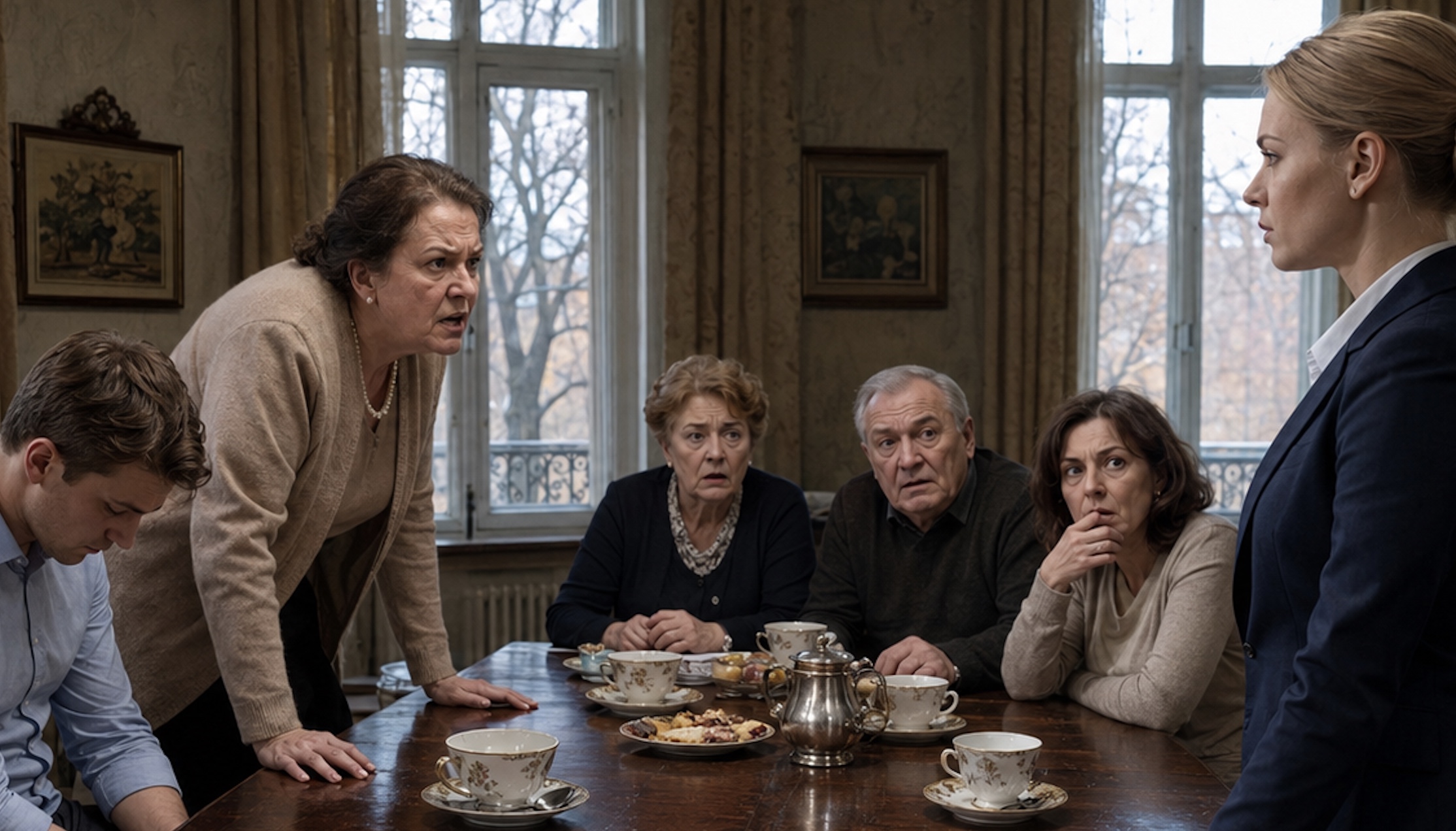
“Kristina, you really should be more generous. You’re the oldest, you’re already firmly on your feet,” Aunt Tamara said briskly, tapping her teaspoon against the edge of a crystal jam dish to bring the noisy family council to order. “You have your own career at the bank, a stable income, and you’re in no hurry to get married. But Lidochka and her husband are in a very difficult situation right now. They’re expecting their second child and living in a cramped one-room apartment on the outskirts of the city. Fate itself is telling you to free up your grandfather’s apartment in the center and give the younger ones a chance. They need it more. You’ll earn yourself another place eventually. You’re a fighter.”
I sat at the head of the large table in that very “grandfather’s” four-room apartment near Chistye Prudy and silently studied my relatives.
The entire family tribunal was assembled: Aunt Tamara, her daughter Lidochka with her useless husband Tolik, my second uncle, and even a distant great-aunt who had clearly been brought along purely for numbers and moral pressure.
All of them were happily drinking my tea, devouring pastries I had bought, and greedily admiring the three-meter ceilings, antique parquet flooring, and huge windows overlooking a quiet historic side street.
“Aunt Toma, did I hear you correctly?” I calmly set my cup aside. “You’re suggesting that I pack my things and move out of the apartment where I’ve lived for the last seven years simply because Lidochka decided to have a second child without being financially prepared for it?”
Lidochka immediately gave a theatrical sob and buried her face in Tolik’s shoulder. He puffed out his chest and glared at me.
“Kristina, what kind of heartless person are you? Are you really begrudging your own nephews a few square meters? Children should grow up in the city center, walk along the boulevards, attend a good school. And here you are, living alone in four rooms like some lonely owl. That’s pure selfishness! Grandpa would never have approved.”
“Exactly!” Aunt Tamara picked up triumphantly, looking around at everyone present. “Land and housing belong to the family. They’re common property. Your grandfather received this apartment from the ministry for the whole family, not for you alone. The fact that you’re registered here and lived with him during his final years doesn’t give you the right to possess the family nest all by yourself. You have to share like family. We’ll draw up a free-use agreement for Lidochka, you’ll move into a rental or take out a mortgage on a studio apartment. You’ll get a good rate — you work at a bank, after all. Let the young family settle in.”
The irony of the situation was so deep and layered that it took enormous effort not to laugh in their faces.
My relatives had a truly remarkable selective memory. They had completely “forgotten” how, seven years earlier, after Grandfather suffered a severe stroke and became bedridden, this huge apartment instantly turned into a burden for them.
Aunt Tamara had announced back then that she had “a weak heart and couldn’t stand the smell of medicine.” Lidochka was too busy with parties and her personal life. The rest of the relatives simply stopped answering their phones.
For all those seven years, caring for Grandfather fell entirely on my shoulders. I hired professional rehabilitation specialists, paid for expensive medication, ordered special meals, and spent every night by his bedside, all while balancing an exhausting job in the investment department. My father, the only person who helped me financially, sadly passed away three years ago.
The rest of the family appeared here exactly twice a year: on Grandfather’s birthday, to bring a cheap cake and take photos for social media, and on New Year’s, to check “how Grandfather’s health was doing,” while also carefully inspecting the condition of the antique furniture.
Grandfather died two months ago. The tears from the memorial meal had barely dried before Aunt Tamara launched into action.
She was absolutely convinced that the apartment was still municipal property, or at least arranged in such a way that it could easily be divided in court among all direct heirs. In her mind, I was nothing more than a temporary caregiver who had overstayed her welcome in a valuable living space.
“Kristina, why are you silent?” Uncle Valera snapped, slapping his palm against the table. “The family is waiting for your decision. Tomorrow Lidochka will bring boxes with her things. You need to clear out the rooms. We’ve already found workers to freshen up the wallpaper. Everything here smells like the old man. We can take your things to Tamara’s dacha for now, put them in the shed.”
I looked at Lidochka, at her husband, at Aunt Tamara.
Their faces showed absolute, rock-solid confidence in their own righteousness. They sincerely believed that slogans about “the younger generation,” “family duty,” and “blood ties” were a universal key that would make me surrender, afraid of being judged by distant aunts and neighbors.
They thought they had caught me off guard with their collective attack.
They had forgotten one simple thing: I work as a senior mergers and acquisitions analyst. My profession is built on cold calculation, legal due diligence, and a complete lack of sentiment when obvious blackmail enters the picture.
“One moment, please,” I said softly, rising from my chair. “Before you start tearing down the wallpaper and packing my belongings into a shed, I need to bring one important document. So that our agreement can be, shall we say, legally supported.”
“Well, why didn’t you say so right away?” Aunt Tamara beamed with a sugary smile. “That’s my sensible girl. Blood is thicker than water, after all. You understand that family must help family. Go on, bring your papers. We’ll wait.”
I went into my study, opened the safe, and took out a large leather folder that had held, for several years now, the documents capable of closing any property dispute in our family once and for all.
When I returned to the kitchen, I placed the folder in the center of the table, right on top of the little jam dish.
An expectant silence filled the room. Tolik even pulled a measuring tape from his pocket, apparently planning to start measuring the hallway immediately.
“So, dear relatives,” I said, opening the folder and removing the first document — a thick sheet with watermarks and an official seal. “Let’s refresh everyone’s memory about the legal history of this apartment, since you’re so fond of invoking Grandfather’s wishes. Aunt Toma, you claimed that this apartment was a ‘family nest’ received from the ministry and should have been privatized for everyone. Is that right?”
“Of course!” Aunt Tamara declared proudly. “My father earned it, and I have the right to my share, just like my children!”
“Well then,” I said, turning the document toward her, “Grandfather privatized this apartment back in 1996. In his name only. Your mother, my grandmother, had already passed away by then, and both you and my father were adults registered at completely different addresses — you in your cooperative apartment, and Dad in an institute dormitory. You had no rights to privatize this housing then, and you have none now.”
Aunt Tamara frowned, but quickly recovered.
“So what? After his death, we’re still first-priority heirs! Me and your late father — which means you in his place. So we divide it in half! Half the apartment is mine, and I’ll gift it to Lidochka!”
“Don’t rush, Aunt Toma,” I said, taking out a second document from the folder, one certified by a notary exactly five years earlier. “This is a lifetime maintenance agreement with dependency. It was concluded between my grandfather, as the recipient of care, and me, as the provider. Under this agreement, ownership of this apartment passed to me five years ago. In return, I undertook full responsibility for his care, treatment, caregivers, and dignified living conditions. All receipts, statements from my bank accounts, medical records, and expense reports for those five years are attached here, in the second section of the folder. The agreement was officially registered with Rosreestr, and the encumbrance was removed two months ago after the recipient’s death.”
I placed a fresh extract from the Unified State Register of Real Estate in front of Aunt Tamara.
In the “Owner” field, my name was printed in black and white. Ownership share: 1/1. Restrictions and encumbrances: none registered.
The kitchen became so silent that I could hear the leaves rustling outside.
Lidochka froze with her mouth slightly open. Tolik slowly slid the measuring tape back into his pocket. Uncle Valera suddenly became deeply interested in the pattern on the wallpaper.
Aunt Tamara’s face changed color rapidly — from triumphant pink to ashen gray, then to furious crimson. Her fingers clutched the extract convulsively as she stared at the lines, as if trying to change the owner’s surname by sheer force of will.
“What… what kind of trick is this?” she finally shrieked, jumping up from her chair so abruptly that the crystal jam dish bounced. “You forced a sick old man to sign this fake paper! You stole our property behind the family’s back! We left you to care for him, we trusted you, and you… you vile thief! We’ll challenge this agreement in court! Grandpa wasn’t in his right mind. He didn’t understand what he was signing!”
“The agreement was signed five years ago, Aunt Tamara,” I replied in an icy, measured tone, without raising my voice. “At that time, according to the official medical conclusion of a forensic psychiatric evaluation — which we conducted right before the notary’s visit, because I always calculate risks in advance — Grandfather was of sound mind, clear memory, and fully aware of his actions. The notary recorded the transaction on video. Grandfather took this step precisely because, when he fell ill, all of you conveniently switched off your phones. He understood perfectly well that if the apartment remained part of the estate, you would sell it the day after his funeral and tear each other apart over every ruble. This way, he secured proper care and a peaceful old age — the kind I gave him.”
Lidochka sprang from her seat, her face twisted with rage and disappointment.
“How can you do this? Do you have any conscience at all? I have a child, and another one on the way! You’re really that greedy, aren’t you? We thought you were family, but you’re a snake! Choke on your square meters! Tolik, let’s go. I can’t breathe in this stolen apartment!”
“Stop,” I said quietly, but with such heavy finality that Lidochka froze at the door.
“Since you gathered this ‘family council’ and decided to talk about justice and helping the younger ones, let’s finish the conversation properly. Tolik, you said something about me ‘never having enough money’ and ‘profiting’ off the family. Well, over five years of caring for Grandfather, I spent around four million rubles of my own earned money. Operations, rehabilitation, caregivers, specialized transport. Aunt Tamara, your contribution over those five years consisted of exactly two jars of jam and one duvet cover, which you brought three years ago and then spent two months reminding me how much it cost. Lidochka, your husband Tolik did not once climb to the second floor to help me carry Grandfather to the bathroom when the lift broke. His back was always ‘hurting.’”
I closed the leather folder and carefully moved it aside.
“The apartment belongs to me one hundred percent. No Lidochkas, Toliks, or their future children will ever live here. Not under a use agreement, and not even as guests. Right now, all of you will stand up, take your bags, and leave my property. Lidochka, don’t even bother unloading the boxes from your car. If any of you are still in this apartment ten minutes from now, I will press the emergency call button for the private security response team with whom I have an official contract. You will be removed firmly, with video recording and a formal report for unlawful presence on private property. Your time starts now.”
The relatives exchanged glances.
My cold, professional tone, my complete lack of emotion, and the folder full of documents had a sobering effect on them. Arguing with a senior analyst from a major bank who had Rosreestr extracts and notarized agreements in hand was pointless — even Aunt Tamara understood that, despite her complete legal ignorance.
They began gathering their things in a hurry.
Aunt Tamara, frantically stuffing her notebook into her bag, kept hissing without looking me in the eye.
“Just you wait, Kristina… Money won’t bring you happiness. God sees everything. You’ll be left alone in these empty walls, and when old age comes, there won’t be anyone to bring you a glass of water! Shame on you, cold-hearted career woman! We don’t want anything more to do with you! Don’t ever call me again!”
“I wasn’t planning to, Aunt Toma,” I replied, opening the front door wide. “All the best. Enjoy staying in your one-room apartment on the outskirts.”
The heavy oak door slammed shut behind them.
A ringing, deep, surprisingly pure silence settled over the hallway. There was no longer any room in this home for fake smiles, hypocritical speeches about “family solidarity,” or shameless attempts to profit from my years of hard work.
The next day, I changed the locks on the front door and installed a modern video surveillance system with motion sensors connected to the holding company’s security desk. The only keys to the apartment now belonged to me and my mother, who fully supported my decision and had once suffered plenty from Tamara’s attacks herself.
Three years passed.
My career at the bank entered a new stage — I became head of the large asset management department. My income grew, and I was finally able to fully restore Grandfather’s apartment. I repaired the antique plasterwork, renewed the parquet flooring, and turned the place into a true interior masterpiece where old-world character blended perfectly with modern comfort.
Recently, my cousin on my mother’s side, who does not communicate with Aunt Tamara’s branch of the family, told me how the “younger ones” were doing.
Lidochka did give birth to her second child. A year later, Tolik left the family, exhausted by the constant lack of money, crying babies, and his mother-in-law’s control. Now Lidochka lives with her two children and Aunt Tamara in that same cramped one-room apartment, drowning in payday loans, endless mutual accusations, and court battles over property division with her former husband.
Aunt Tamara periodically calls distant relatives and complains about her “cruel millionaire niece who seized the family nest and left her own blood to die in poverty.”
When I hear these stories, I only smile calmly and look out the window at the quiet, sunlit Chistye Prudy.