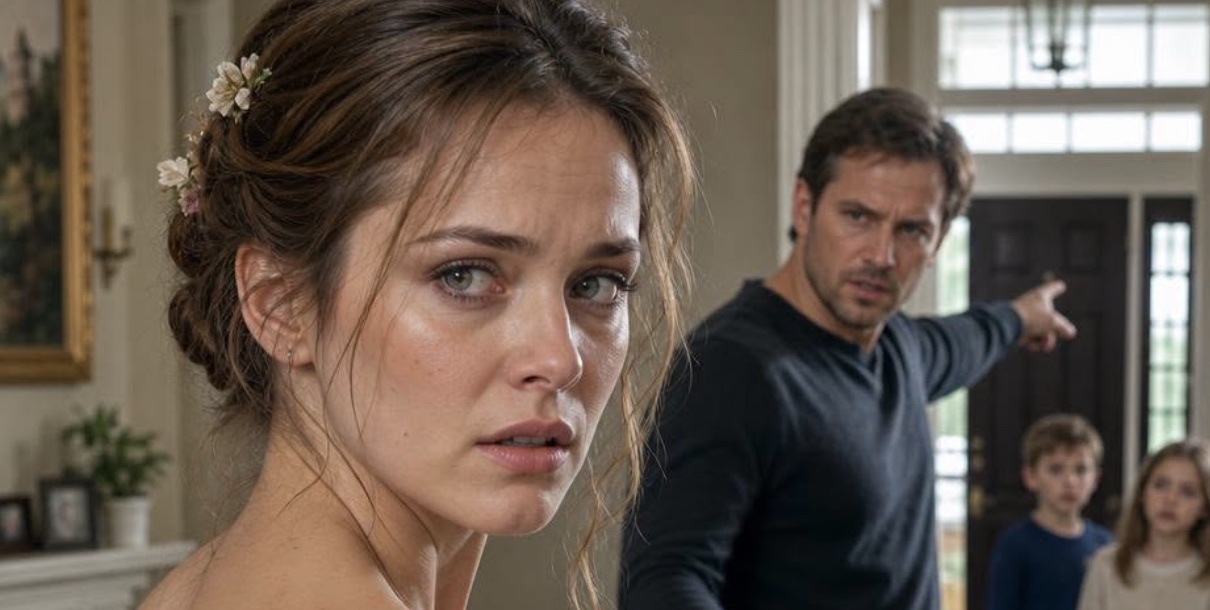
“Stas, could you at least clear your plate after yourself?” Veronika asked gently, almost affectionately, as she served dinner to the children. “Your hands weren’t given to you just for decoration.”
“I’ll do it, I’ll do it,” he brushed her off without looking away from his phone. “Honestly, you sound like a broken record.”
“I’m not a broken record. I’m simply asking you to do something. Politely, by the way.” The corner of her mouth lifted in a faint smile. “They say politeness costs nothing but can buy everything.”
“There you go, trying to sound clever again,” Stas muttered.
Twelve-year-old Timur set down his fork and glanced at his father from beneath lowered brows. Sonya swung her legs under the table and quietly hummed to herself. It was an ordinary evening—warm, peaceful, domestic—and nothing yet suggested that disaster was only moments away.
“Listen, I’ve been thinking,” Veronika continued as she sat down across from him. “We help your mother every month, and that’s the right thing to do. I’m not arguing about that. But my father could use some help with his medication too. His blood pressure has been unstable.”
“Oh, here we go,” Stas said, finally raising his eyes. “Money, money, money.”
“This isn’t about ‘money, money, money.’ This is your father-in-law. The same man who took you fishing every summer, by the way.”
“So what? Did I ask him to?”
“Stas.” She sighed, still trying to remain patient. “I’m not fighting with you. I just want things to be fair. Equal. We’re supposed to be a team.”
“We may be a team, but I’m the captain,” he replied with a smug grin.
Veronika fell silent and slowly smoothed the tablecloth with her palm. She was used to his sharp remarks. Over the years, she had learned to extinguish his angry outbursts the way one smothers a spark before it becomes a fire.
“All right. Let’s look at it another way,” she said calmly. “I earned good money this month. I’m going to use part of it to help my father. It’s my income, so it doesn’t affect you. Fair enough?”
“No, it isn’t,” Stas snapped. “Everything in a family belongs to everyone.”
“Oh, now everything is shared?” She gave a quiet laugh. “It’s amazing how quickly your accounting rules change when it benefits you.”
“What are you implying?” His voice rose.
“I’m not implying anything. I’m telling you directly. When your mother needs something, it’s sacred. When my father needs help, suddenly it’s ‘money, money, money.’ Do you even hear yourself?”
“What I hear is you nagging me to death!” Stas slammed his palm against the table. “I’m sick of your constant calculations.”
Sonya stopped humming and went still.
Under the table, Timur quietly slipped a hand into his pocket and found his phone. He turned on the camera. He didn’t really know why. He simply had a feeling that this moment needed to be remembered.
“Stas, the children are right here,” Veronika said, lowering her voice. “Let’s not do this in front of them.”
“Why not? Let them learn how life works!” He leaned back in his chair and declared with a strange, bitter pride, “The only person I owe anything to is my mother. I owe you nothing!”
The words hung in the air, heavy as stones.
Veronika did not scream. She did not clutch her chest or burst into tears. She simply stared at her husband as the last trace of hope faded from her eyes.
“Nothing,” she repeated evenly. “Twelve years together, and I mean nothing.”
“What did I say that was wrong?” Stas had already realized he had gone too far, but retreating had never been one of his talents. “My mother gave birth to me. She raised me. But you… you’re just my wife. Wives come and go.”
“Dad, what’s wrong with you?” Timur finally spoke, his hand trembling slightly around the phone. “You can’t say things like that.”
“Stay out of it, kid!” his father barked. “The adults are talking.”
“This isn’t a conversation,” Veronika said quietly. “It’s a diagnosis.”
“What kind of diagnosis?”
“Greed, Stas. And fear. Greedy people are always afraid someone will take something away from them, even when they don’t own anything worth taking.”
She stood and began gathering the plates.
“Sonya, finish your dinner, sweetheart. Timur, help your sister.”
Stas snorted and returned to his phone, convinced the argument was over. He did not notice his son quietly stepping into the hallway or Timur’s fingers moving rapidly across the screen.
A minute later, the short video was already on its way to someone who would care very much about what had happened, although no one else knew it yet.
An hour later, the recording was seen by the children’s grandfather—the man who loved his grandchildren more than anything in the world.
Viktor Pavlovich’s country house stood on a hill surrounded by old apple trees. He sat on the veranda with his phone held at arm’s length, watching the video for the third time.
His face remained completely still.
“‘I owe you nothing,’” he repeated aloud, echoing his son-in-law’s words. “Well, well. What a philosopher we have on our hands.”
That evening, he called his daughter himself. His voice was calm, but Veronika immediately heard something new in it—something hard and unyielding.
“Have you seen the video?” he asked.
“What video?” she replied, confused.
“The one Timur recorded. He sent it to me. I’ve been sitting here admiring your wonderful husband.”
“Dad…” Veronika pressed a hand to her forehead. “I didn’t want you to see that.”
“You should have,” Viktor Pavlovich replied. “For years, my son-in-law told me I was like a father to him. Fishing trips, evenings at the bathhouse, presents on holidays. Now it turns out he only owes something to his mother. Well, I suppose I should thank him for his honesty, even if it arrived rather late.”
“Please don’t worry about me.”
“I’m not only worried about you, sweetheart. I’m worried about the children. They’re growing up watching a man humiliate their mother in her own home. They may start thinking that’s normal.”
He paused.
“Have you decided what you’re going to do?”
“I have,” Veronika said firmly. “I’m not going to tolerate it anymore. I just don’t know how to move forward yet.”
“The ‘how’ is my problem now,” her father said. “Come here tomorrow and bring the children. We’ll sit down and discuss it properly.”
“And where exactly are you going?” Stas stood in the doorway with his arms crossed. “Running off to Daddy?”
“To my father’s,” Veronika confirmed calmly while fastening Sonya’s coat. “He misses the children and wants to see them.”
“And I’m not invited?” her husband scoffed. “A family council without the head of the family?”
“The head of the family announced yesterday that he owes me nothing,” she said, adjusting her daughter’s hat. “So he can enjoy a break from his responsibilities. He’s earned it.”
“Are you going to throw those words in my face for the rest of my life?”
“No, Stas. The rest of my life would be far too long. My plans are much shorter than that.”
“What plans?” he asked suspiciously.
“You’ll find out soon enough.” She smiled so lightly that it made him uneasy. “Be patient, my friend. They say patience and hard work can overcome anything. Fortunately, I have plenty of both.”
Stas wanted to answer with something cruel, but no words came.
Veronika took the children by the hands and left without slamming the door or making a scene.
It was the silence that frightened him most.
Viktor Pavlovich’s house smelled of apples and polished wood. The children ran into the garden while father and daughter sat at the large kitchen table.
“Let’s start with the basics,” he said as he poured tea. “The apartment where you and Stas live—who owns it?”
“It belonged to Grandma, your mother,” Veronika replied. “She left it to me in her will. Stas has always called it ‘our shared home.’”
“Oh, has he?” Viktor Pavlovich smiled beneath his moustache. “How convenient. What belongs to someone else is shared, while anything shared belongs to him. Where are the ownership documents?”
“I have them. They’re in a folder with the rest of my papers.”
“Good. Now we’re getting somewhere.” He nodded. “You know, sweetheart, there’s no point pulling a cat by the tail once you’ve decided the tail is unnecessary. He said he owes you nothing, so free the man from all obligations. And free yourself from him while you’re at it.”
“I’ve been thinking the same thing,” Veronika admitted. “But I’m a little frightened. The children, the habit, twelve years of marriage…”
“Habit is a dangerous thing,” Viktor Pavlovich said. “Some people live by habit their entire lives and then wonder why everything feels empty. You aren’t one of them. You take after me. Stubborn.”
“Thank you, Dad.”
“Don’t thank me. Listen instead. I’ll help in every way I can, but the decision has to be yours, and you must make it quickly. The longer you wait to pull a rotten tooth, the more painful it becomes.”
Two days later, Veronika called her friend Zhanna.
Zhanna hurried to the little corner café where they had often met during their university years.
“Tell me everything,” she said, dropping into the chair opposite her. “You sounded like a general preparing for battle.”
“I’m leaving Stas,” Veronika said without preamble.
Zhanna slowly set down her cup.
“Finally. I thought you would never say it.”
“So did I,” Veronika replied with a faint smile. “Then he announced in front of the children that he owed me nothing. And do you know what? I’m grateful to him. He opened my eyes more effectively than any great philosopher could have.”
“What happens now?”
“The apartment is mine. I inherited it. That already solves half the problem. I have a job, and my father is ready to help. What exactly am I waiting for?”
“Does Stas know?”
“He’ll find out when the time is right.” Veronika stirred her coffee. “You know, Zhanna, for years I thought love meant enduring someone. It turns out love is when the other person doesn’t have to endure you.”
“You need to write that down,” her friend said with a low whistle. “You’ve become frighteningly wise.”
“I’m not wise. I’ve simply had enough. You know how a hungry person thinks bread is worth more than money? I was starving for respect for twelve years. Then one honest sentence, even a cruel one, finally made me feel full.”
“Don’t you feel sorry about destroying everything?”
“What exactly am I destroying?” Veronika shrugged. “A home where I was treated like domestic staff? That wasn’t a home. It was a badly managed hotel.”
Meanwhile, Stas began to suspect that something was wrong.
That evening, he called his wife, speaking in an unusually sweet voice.
“Vera, why are you staying at your father’s so long? The house feels completely empty without all of you.”
“Do you miss us?” she asked ironically.
“Of course. There’s no one here to wash my socks,” he joked.
He immediately fell silent, realizing he had once again said the wrong thing.
“There you are,” Veronika replied softly. “You explained it perfectly yourself. There’s no one to wash your socks. You didn’t say you missed your wife.”
“You’re twisting my words!”
“I’m not twisting anything. I’m listening very carefully,” she said. “You said many beautiful things about love over the years. But the truth came out in one sentence about obligation. Words can lie, Stas. Tone never does.”
“You and your ridiculous quotations,” he snapped. “When are you coming home?”
“Everything will be settled soon,” she answered calmly. “Good night, Stas.”
She ended the call, leaving him alone with his growing anxiety.
When Veronika finally returned to the apartment to collect a few belongings, Stas was waiting for her.
“Vera, you’re taking this too far,” he said. “So I blurted something out in anger. Are you really going to destroy our whole life over one sentence?”
“You blurted it out,” she agreed as she placed the children’s books into a bag. “In front of our children. And you said it with such pleasure that you looked as if someone were about to give you a medal.”
“Fine. I’m sorry,” he forced out, as though the word physically hurt him. “Are you happy now? I apologized.”
“A little late, my friend.” She zipped the bag shut. “An apology is like an umbrella. It’s useful when you open it before the storm. Once the rain has already soaked you through, it doesn’t help much.”
“Are you mocking me?” Stas exploded. “I’m humiliating myself by apologizing, and you’re making jokes!”
“I’m not joking.” Her voice hardened. “I simply don’t cry anymore. Tears come when you still hope for something. I’ve already understood everything.”
“What exactly have you understood?” He stepped closer.
“That a man who openly calculates who he owes and who he doesn’t isn’t a husband. He’s a calculator with a moustache,” Veronika said coldly. “And honestly, I’d rather have an ordinary calculator. At least it doesn’t lie about love.”
Stas felt the ground disappearing beneath his feet.
Like many weak people when trapped, he resorted to threats.
“You aren’t going anywhere,” he hissed. “You have two children. Who else would want you? You’ll come crawling back.”
“How interesting.” Veronika almost laughed. “One minute you owe me nothing, and the next minute I supposedly have nowhere to go. Make up your mind, Captain. Is the ship sinking, or are we sailing?”
“This apartment belongs to both of us!” he shouted. “I’ve lived here for twelve years!”
“You have,” she agreed. “As a guest. The apartment belongs to me. My grandmother left it to me in her will. Would you like to see the documents? My paperwork is perfectly organized, unlike your conscience.”
“That’s impossible!” Stas went pale. “You’re bluffing.”
“Check for yourself.” She shrugged. “Why would I lie? I’m not you. I don’t get confused about my obligations.”
“This is despicable!” he shouted. “You’re throwing me out onto the street!”
“Not onto the street. You can live with your mother,” Veronika corrected calmly. “You owe her everything, remember? Now you can repay your debt personally, twenty-four hours a day. I’m sure she’ll be delighted.”
“You have no idea what you’re doing!” Stas paced around the room. “The children will be left without a father!”
“The children will remain with someone who respects them,” Veronika replied without raising her voice. “You can see them whenever you like, provided you behave like a decent person. I’m not a monster. I’m simply putting my home in order. Anything unnecessary goes out the door.”
“Unnecessary? I’m unnecessary?” He looked as though he could barely breathe.
“What else should I call a man who spent twelve years pretending to captain a ship he never owned?” she asked with a faint smile. “A stowaway, Stas. You were a stowaway, and you travelled in comfort.”
“I supported you!” he shouted.
“Supported me?” Veronika raised an eyebrow. “Let’s be honest. You supported your mother. I supported the household and raised the children. Add everything up, divide it properly, and you’ll get a very interesting result. I think you’ll especially enjoy the final number.”
He opened his mouth to argue but could not find the words.
All his old confidence crumbled like a sandcastle beneath someone’s foot.
The final chapter unfolded in the bright apartment on the third floor—the home Veronika had inherited from her grandmother.
“Mom, where is Dad going to live now?” Sonya asked, hugging her toy tightly.
“With Grandma,” Veronika answered gently. “That was his choice, sweetheart.”
“Will we visit him?” Timur asked.
“Of course.” She nodded. “As long as he invites you kindly. And by the way, you did well when you recorded that video, although I should still scold you a little. Secretly filming people isn’t a good habit.”
“I didn’t know why I was doing it,” the boy admitted. “I just felt I had to. So no one could later say nothing happened.”
“You’re a clever boy.” She ruffled his hair. “Just like your grandfather.”
Viktor Pavlovich arrived that same evening carrying groceries, tools and his usual amused smile beneath his moustache.
“Well, let’s welcome the new residents,” he said, setting a basket of apples on the table. “I’ll put up that shelf, assemble the wardrobe, and send my warmest regards to my son-in-law if I happen to see him.”
“He isn’t your son-in-law anymore, Dad,” Veronika said with a smile.
“Then my regards can be even warmer,” the old man laughed. “Do you know what I think, sweetheart? You did the right thing by acting quickly. The problem isn’t that a person makes a mistake. The problem begins when everyone builds an entire life around that mistake. You refused to do that. You made a decision and moved on.”
“I was frightened,” she admitted.
“Courage doesn’t mean feeling no fear,” Viktor Pavlovich said as he took out a screwdriver. “Courage is being frightened and still doing what must be done. That’s exactly what you did.”
“What if I had forgiven him?”
“You can forgive someone,” he replied with a nod. “Forgiveness is a matter of the heart. But returning to someone who treats you as worthless isn’t about the heart. It’s about having a very short memory. Fortunately, your memory comes from your father. It’s strong.”
Stas called late that evening, after the children had gone to sleep. His voice trembled, either with anger or confusion.
“Vera, stop putting on this ridiculous performance. I… I’m willing to think about my behavior.”
“It’s too late for thinking, my friend,” she replied wearily. “The train has left, and you’re still standing on the platform with a ticket dated yesterday.”
“Why do you keep talking about trains?” he shouted. “There isn’t even anyone here to cook soup for me! My mother nags me from morning until night!”
“There you are again,” Veronika said softly. “Talking about food and service. Not one word about the children. Not one word about me. Even now, Stas, you still can’t hear yourself.”
“What am I supposed to say?” he asked helplessly.
“Nothing,” she answered calmly. “You made that decision yourself. Remember? ‘I owe you nothing.’ Keep your word. At least in that way, try to be a man.”
Silence filled the line.
Stas had no answer because no answer existed.
The man who had spent his life calculating everyone else’s debts was finally left alone with his own, and he discovered that they were much harder to count.
“Timur, Sonya, breakfast is ready!” Veronika called the next morning as she arranged the plates in their new kitchen.
“Mom, are you sad?” Sonya asked while climbing onto her chair.
“No, sweetheart.” Veronika stroked her daughter’s cheek. “Sometimes sadness and relief feel very similar at first. What I’m feeling is relief.”
“What does relief mean?” the little girl asked.
“It’s like carrying a heavy backpack for a very long time,” Veronika explained with a smile. “Then one day you take it off and suddenly notice how high the sky is.”
“Was Dad’s backpack heavy?” Timur asked.
“It wasn’t Dad’s backpack. It was someone else’s,” she answered. “I carried it for twelve years because I thought it belonged to me. But he said he owed me nothing. So now I owe him nothing either. It’s more honest that way.”
The children looked at each other and began to laugh. They did not fully understand her words, but they could feel that it had become easier to breathe inside the apartment.
Their light, innocent laughter was the best possible answer to anyone who had ever believed that love could be measured in debts.
Viktor Pavlovich stopped by with groceries and found the three of them gathered peacefully around the breakfast table.
“Well, this looks like an important council meeting,” he said with a smile. “What matters of state are we discussing?”
“We’re talking about how high the sky is, Grandpa,” Timur reported.
“A worthy subject.” The old man nodded and winked at his daughter. “The main thing is never to hang your head. You know, sweetheart, life is like a garden. A rotten branch must be cut away before it destroys the whole tree. If you feel sorry for it and leave it there, you may lose everything.”
“I cut it off, Dad,” Veronika said calmly. “And I think the tree can finally breathe.”
“Exactly.” He stroked his granddaughter’s hair. “And your former husband can learn to cook his own soup. Since he’s such an expert at calculating debts, he can balance his own books now. Without us.”
Veronika laughed freely and sincerely.
There was no anger or bitterness left in that laughter. Only the calm of a woman who had finally stopped paying someone else’s bills and chosen to live according to her own values.