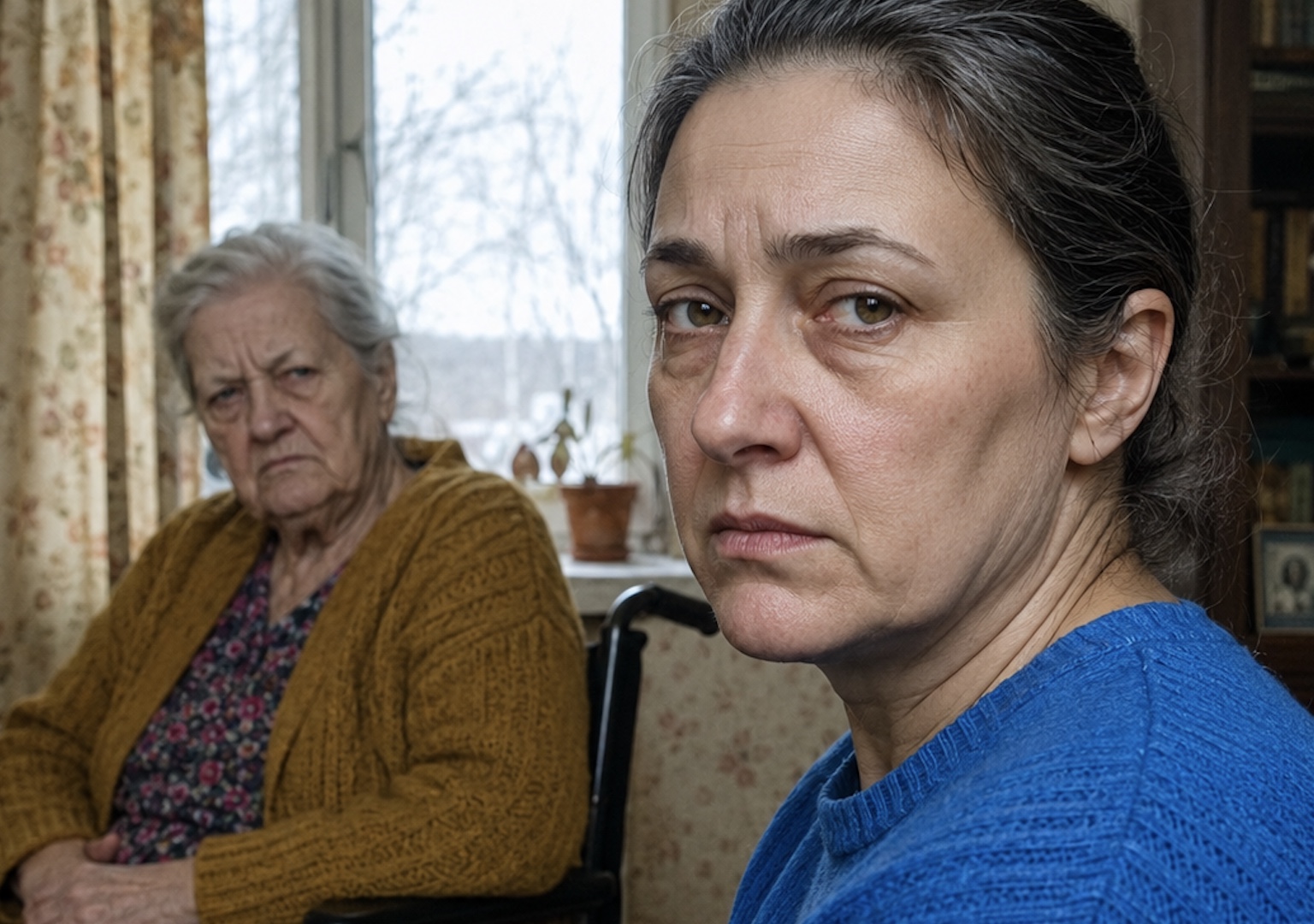
Marina read the discharge papers for the third time.
“Femoral neck fracture, condition after endoprosthetic replacement, requires constant care, independent living is not possible.”
Her mother lay on the hospital bed, staring somewhere past her — at a poster about flu prevention.
“Did you call Svetochka?” she asked instead of saying hello.
Marina folded the paper.
“Hello, Mom. How are you feeling?”
“Fine. So, did you call her or not?”
“I will.”
“You always say that. Then it turns out you didn’t do anything.”
Marina sat down on the visitor’s chair. Her legs were aching. She had come here straight from work, across all of Moscow, after two hours in traffic. Sveta lived forty minutes from this hospital — by car, with a driver.
That evening Marina called her sister. The phone rang for a long time, then Svetlana rejected the call. She called back twenty minutes later.
“What happened? I was getting a massage.”
“Mom is being discharged tomorrow. She can’t live alone anymore. Not at all. She needs care for at least six months.”
Svetlana was silent for a moment.
“Well, you’re closer. And your schedule is flexible.”
“I work five days a week, and it takes me an hour to get to the office.”
“Oh, come on, that’s not the same as my situation. I can’t be distracted from clients. Oleg has business partners over all the time, we’re constantly hosting people. And you… well, you’re an accountant. Numbers can wait.”
Marina tightened her grip around the phone. She had worked at the design institute for twenty-three years. First as an ordinary accountant, now as deputy chief accountant. Svetlana had always called it “shuffling papers.”
“I have a two-room apartment. Forty-three square meters.”
“And we just finished renovating ours. We spent eight million on it. What do you want, for Mom to smear everything there? Besides, you know her personality. Oleg can’t stand her after what happened at his birthday.”
“So you’re not taking her.”
“Marin, don’t start. These conversations give me a migraine. Mom has always loved you. You’re her favorite daughter, so…”
Marina let out a bitter laugh.
“I’m the favorite?”
“Of course. She only ever talks about you. Marina this, Marina that. Marina’s husband doesn’t drink. And all she does is hiss at me for wasting money.”
“Sveta, in forty years she has never once told me I did something well. But she bought you a car for university. Paid for your wedding. Gave you money for the down payment on your apartment.”
“That’s different. You never needed anything. You were always independent. Anyway, Marin, I have to go.”
She hung up.
Sergey came out of the room.
“Sveta won’t take her?”
“No.”
He sat down beside Marina and rubbed the bridge of his nose.
“Marin, understand me correctly. I respect your mother. But if she moves in here, there won’t be a family left in a month. She eats you alive. Every time she comes for two days, it takes you a week to recover.”
Marina knew that. Her mother had a way of looking at her food, her hairstyle, her husband, that made Marina want to disappear into the floor.
“You wear that to work? Well, well.”
“Your Seryozha is a decent man, of course, but he could have become a manager by now.”
“So much dust. When I visited Sveta, she had a maid coming twice a week.”
Marina brought her mother home three days later. There was no choice. The hospital couldn’t keep the social-care bed any longer, and Svetlana had not called back once.
The taxi was expensive — four thousand two hundred rubles from Lyublino to Mitino. Her mother complained about every bump in the road.
At home, Sergey had already unfolded the sofa in the large room. He and Marina moved into the small room, twelve square meters. It had once been their son’s room before he grew up, started his own family, and moved out. After that, they had turned it into a cramped little office.
Her mother looked around the apartment as if she were seeing it for the first time.
“When did you put up this wallpaper? In the Stone Age?”
“Five years ago, Mom.”
“That’s exactly what I mean. And look at your kettle — filthy. Sveta buys a new one every month.”
Marina silently put the water on.
She barely remembered the first week. It was nothing but endless movement: bring this, fetch that, change the channel, listen to another complaint. Her mother demanded attention constantly. At night, she could call out for Marina to hand her a glass of water that was already within arm’s reach. She criticized the food: bland, too salty, overcooked, not like Sveta’s. She complained about Sergey: he walked too loudly, the television was too loud, he could at least say hello properly.
Sergey did say hello. Every day. Her mother simply refused to hear him.
“You are ungrateful,” she told Marina on the eighth day, after Marina refused to switch the channel away from football. “I raised you. I did everything for you and Sveta, and now you won’t even let me watch television.”
“Mom, Seryozha has one day off a week.”
“And I feel like I’m in prison every day. Sveta would have bought me a separate television.”
Work became harder and harder. Marina kept asking to leave early — either to take her mother to a doctor or to run home and check that everything was all right. Hiring a caregiver cost at least sixty thousand rubles a month. After the mortgage and utilities, she and Sergey together had one hundred thirty thousand left.
Marina called her sister.
“A caregiver?” Svetlana repeated. “What for? You’re at home.”
“I’m at work for eight hours. At least pay half, Sveta. Thirty thousand.”
A pause hung between them.
“Marin, we’re going through a difficult period right now. Oleg took out a loan for a car, and I’m doing these treatments — very expensive ones. Maybe in a couple of months.”
After that conversation, Marina sat in the kitchen and cried for the first time in many years. Quietly, so her mother wouldn’t hear and say that she was making a drama out of nothing again.
In the third week, her mother brought up the apartment.
“I’m curious,” she said over dinner. “What’s going to happen to my apartment? It’s just sitting empty. Maybe we should rent it out?”
It was a sensible idea. A one-room apartment on Preobrazhenka, near the metro. They could get forty or fifty thousand a month for it. Enough for a caregiver.
“Let’s put up an ad,” Marina said. “I’ll help.”
Her mother gave her a strange look.
“I was just thinking out loud.”
But a week later, she said:
“Sveta called. She says there are some documents that need to be signed. For the apartment.”
That evening Marina couldn’t hold back and called Svetlana herself.
“What documents?”
“Mom didn’t tell you?” Svetlana said lightly. “We took care of everything three years ago. Mom gifted the apartment to me. A deed of gift. Everything official.”
Something inside Marina gave way.
“What?”
“Yes. Mom decided it would be safer that way. In case she, you know, passes away, and then you and I start dividing things. She always helped me, and I took out the loan for my first apartment in her name. So we settled things. Fairly.”
“Wait. Mom’s apartment has belonged to you for three years? And now she’s living with me because she has nowhere of her own?”
“I didn’t take anything. Mom wanted it herself. Listen, I have to go. Oleg’s calling.”
She hung up.
Marina went into the large room. Her mother was watching a TV series. When she saw Marina, she pressed pause with an irritated sigh.
“Mom, you gave the apartment to Sveta.”
Her mother didn’t look away.
“So what?”
“So now you’re living with me. Because you have nowhere to live.”
“I’m living with you because you’re my daughter.”
“Why didn’t you tell me?”
“Why should I have? It’s none of your business.”
Marina sat down on a chair.
“I took you into my home. I ruined my relationship with my husband. I almost lost my job. And it turns out the apartment has belonged to Sveta all this time.”
Her mother grimaced.
“You always turn everything into a tragedy.”
“Why did you give it to Sveta and not divide it equally?”
“Because Svetochka needed it more. She has needs. You’re used to managing. You’re fine as you are.”
Low-maintenance. Used to managing. Marina had heard it all her life.
Sveta had needs, so she had to be helped. Marina was strong, she would endure. Sveta got the first piece, the new dress, money for university. Marina got whatever was left.
“Why did you always choose Sveta?”
“I never chose anyone. Sveta simply needed help, and you didn’t. Svetochka was tired. You were used to it.”
“I’m tired too, Mom.”
“Oh, stop it. What, are you really sorry to give your mother a corner?”
“I’m not talking about the apartment. You live with me, but you gave the apartment to Sveta. Sveta isn’t helping with a single ruble. Don’t you think something is wrong here?”
Her mother looked away.
And suddenly Marina understood: no, her mother did not think anything was wrong. She had expected Marina to care for her for free, out of filial duty. And Sveta would receive the apartment income because Sveta was used to receiving. That was how it had always been.
“Sveta, we need to talk,” Marina said on Saturday morning.
“Again?”
“Are you planning to rent out Mom’s apartment?”
Svetlana paused.
“Oleg and I were thinking of renting it out for the summer. Why?”
“The money goes toward Mom. A caregiver or a daytime care facility.”
“Are you out of your mind? That’s my money.”
“Then take Mom to your place.”
“I already explained…”
“Sveta, either the rental money goes toward Mom, or Mom moves in with you.”
“Don’t tell me what to do! Oleg and I will decide for ourselves. You’re just jealous. You were always jealous that my life turned out better.”
“My life is normal. It was normal.”
“Then throw her out into the street if you’re so principled!”
“I’ll bring her to you. You own her apartment.”
“Go to hell, Marina!” Svetlana shrieked.
At that moment Sergey, who had been standing nearby and listening to the whole conversation on speakerphone, calmly but firmly took the phone from Marina.
“Listen carefully, Sveta,” he said, his voice even, like metal. “If the rent money is not in the care-home account tomorrow, I will personally bring your mother to the door of your precious renovated apartment. And I will leave her there, right on the threshold. And I don’t care what your Oleg says. I’ll speak to him myself. Do you understand?”
He ended the call without waiting for an answer, then squeezed Marina’s shoulder reassuringly.
An hour later, her mother called — from her own mobile phone, from the next room.
“Svetochka called. She was crying. She says your husband insulted her and threatened her.”
“He told her the truth.”
“What truth? That I’m a burden to you?”
“That Sveta has to take responsibility. She got the apartment. I got nothing.”
“That’s unfair.”
Marina felt something hot and suffocating rise inside her.
“Unfair? What exactly is unfair — that I’m asking my sister to help?”
“Sveta deserved that apartment.”
“How?”
Her mother said nothing.
“You were always strong,” she finally said. “You fell down, got up, and kept going. But Sveta wasn’t like that. She needed support.”
“And I didn’t?”
“Everything came easily to you. You always managed on your own.”
Marina stood there, looking at her mother. She truly believed what she was saying. One daughter deserved things, the other did not. Not because of actions. Just because.
“All right, Mom. If that’s how it is.”
She left the room.
They found a care home a week later. Not in Moscow — in the Moscow region, forty minutes by train. A shared room for two, a nurse around the clock, walks in the garden. Forty-five thousand a month.
Sveta gave in after Oleg’s first conversation with Sergey. As it turned out, Oleg had no desire to go to court, and the prospect of having his mother-in-law move into his precious square meters terrified him. The rent, minus utilities, began going regularly toward the care home.
Though karma caught up with Sveta faster than Marina expected. Literally the day before their mother was supposed to move, Sveta sent a furious message dripping with poison. The tenants she had rushed to accept into their mother’s apartment — greedily and without properly checking them — had turned out to be a disaster. In the very first week, they forgot to turn off a tap and badly flooded the neighbors downstairs. Oleg had made a huge scene because of the massive compensation they now had to pay.
Their mother found out about the care home on Sunday evening.
“So you’re sending me away after all.”
“I’m arranging proper care for you.”
“To an almshouse.”
“To a care home. I’ll visit every week.”
“Oh, what an honor.”
Marina sat down beside the bed.
“Mom. I can’t do this anymore. I have a job, a husband, my own life. You don’t love me — don’t argue, I understood that a long time ago. I don’t know why. And I don’t want to force myself to hear every day that Sveta is better, that my kettle is dirty, that my husband isn’t good enough. I loved you. I probably still do. But I never wanted to live with you again.”
Her mother was silent.
“It’s a good place. A beautiful garden, decent staff. Sveta will pay.”
“So you forced her after all.”
“Yes.”
“She won’t forgive that.”
“I know.”
“And neither will I.”
Marina nodded.
“That’s your right, Mom.”
She stood up and walked to the door.
“The move is on Friday.”
Her mother did not answer. She only turned her face to the wall.
On Friday morning, Marina packed her mother’s things. Two suitcases. She left the photographs behind: most of them were of Svetlana. Sveta at graduation. Sveta at her wedding. Sveta and Oleg at the seaside.
There were three photos of Marina.
Her school graduation, where she stood at the edge. Her own wedding — one blurry picture. And that old photo from the maternity hospital.
Her mother was already sitting in the wheelchair.
“Ready?”
“Do I have a choice?”
The taxi was waiting in the courtyard. At the car, her mother suddenly stopped. With dry, trembling fingers, she took out her phone and dialed a number. The ringing went on endlessly.
Then came the cold, indifferent voice of the answering service:
“The subscriber is busy or out of network coverage.”
Her mother slowly lowered the phone. Her face seemed to collapse inward.
“Sveta hasn’t come once. In three weeks… And now she won’t even answer,” she whispered, barely moving her lips.
Marina said nothing. She helped her mother into the car and fastened her seat belt.
“Let’s go.”
The taxi pulled away, turned the corner, and disappeared.
Marina went back upstairs. Sergey was sitting in the kitchen, leaning on the table.
“She’s gone?”
“She’s gone.”
He stood, came over, and wrapped his arms around her firmly, securely, resting his chin against the top of her head. Marina closed her eyes, absorbing the warmth. She stood like that for a minute, then gently pulled away and went into the room.
The sofa was still unfolded, the bedding crumpled. Marina took hold of the edge of the sheet and pulled it off decisively. She gathered the linen into a bundle, carried it to the bathroom, and threw it into the washing machine, as if washing away the remains of the last heavy weeks.
Then she returned to the room, sat at the table, and opened her laptop.
Her mother had been right about one thing — their old kettle really was no good.
Marina opened an online store and, without hesitation, ordered a new one. The most beautiful, expensive, modern one she could find.
Then she opened a new tab with a hotel-booking website.
There was a vacation ahead. And this time, she and Sergey would spend it alone.
By the sea.
They had earned it.