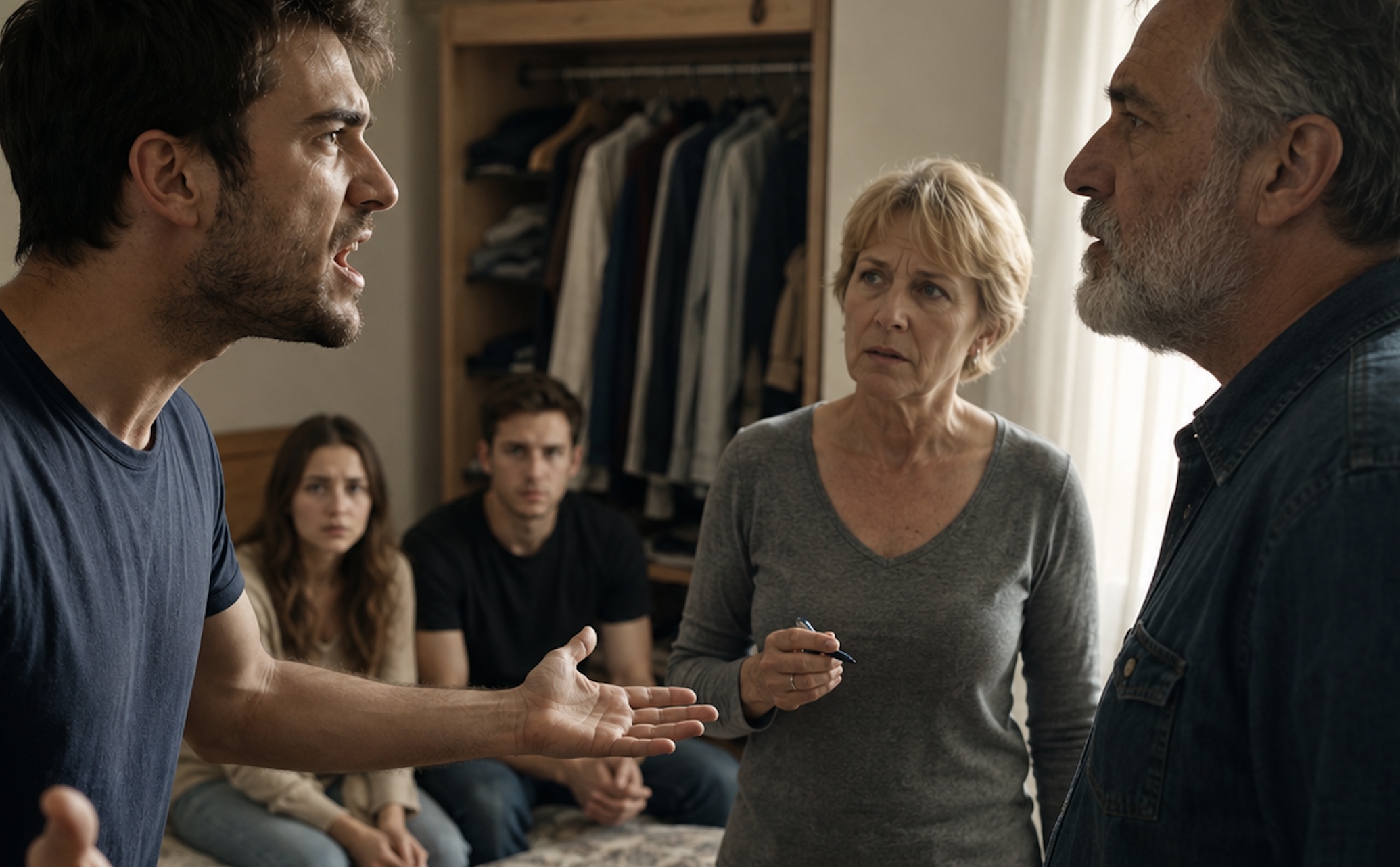
“Will you tell him, Aunt Galya, or should I?” Lera’s voice was sweet, like an overripe peach, and just as sticky. She lazily stirred sugar into a cup of cheap instant coffee, leaving brown rings on the saucer.
“I’ll tell him, sweetheart, I will,” Galina, Kirill’s mother, said, waving her plump hand dismissively. “Don’t worry. Kiryusha is a reasonable boy. He understands that family can fall on hard times. You don’t abandon your own. You and Maksim can stay here until you get back on your feet. There’s enough room for everyone.”
Anatoly, Kirill’s father, sat at the table, methodically crumbling a biscuit into his tea. Without looking up from his newspaper, he gave a low approving grunt. That was the extent of his participation in family matters: a dull sound that meant total agreement with his wife and total unwillingness to think about the details.
The kitchen had a relaxed, almost countryside calm about it. Outside, the November wind howled, but inside it was warm and smelled of yesterday’s borscht. Lera already felt like she had won. She knew her cousin Kirill was incapable of refusing anyone — a workhorse whose neck the whole family had been sitting on comfortably for years. He paid the mortgage on this huge three-room apartment, sent money to his parents, solved their problems. Which meant he would solve hers too. The fact that she had moved into his private room with her boyfriend without warning did not seem rude to her. It felt like a small family formality.
The key turned twice in the front door lock.
“Oh, speak of the devil,” Galina said, spreading into a satisfied smile. “Kiryusha’s back.”
Kirill stepped into the hallway, set down his heavy suitcase and laptop bag. Two weeks of business trips through factories in the Urals had drained him completely. All he wanted was a hot shower and to collapse into his own bed. He pulled off his boots and immediately noticed something that should not have been there. Against the wall stood a pair of worn men’s sneakers, size forty-five, and on the coat rack hung someone else’s puffy jacket with a greasy collar.
Without a word, he walked into the kitchen.
“Kiryusha, hello, darling! Welcome home!” his mother rushed toward him, trying to hug him.
He gently moved her aside. His gaze slid over Lera and stopped on his mother. He did not ask a single question. He simply looked.
“Well, you see… Lera has had some trouble. She was asked to leave her apartment,” Galina began quickly, feeling her cheerful confidence start to crack under his cold, exhausted stare. “So I thought, your room is empty most of the time anyway… She and Maksim can stay there for now.”
Kirill said nothing. He turned and walked down the corridor to his room. The door was slightly open. He pushed it and froze on the threshold.
The air inside was stale and foreign. It smelled of unfamiliar women’s perfume and something sour. On his bed, under his blanket, two bodies were tangled together in sleep. He recognized Lera. Beside her lay a large man with a bald patch beginning to show. His hairy arm lay possessively on Kirill’s pillow. Their clothes were piled on the chair. On Kirill’s desk stood an opened beer bottle and a plate with scraps of food.
Kirill stared at it for several seconds. His face showed neither anger nor surprise. It looked like a mask carved from gray stone. He quietly shut the door and returned to the kitchen just as silently.
His mother, father, and Lera were watching him with tense expectation. They were waiting for a reaction: outrage, shouting, persuasion. Anything but this.
Without a word, Kirill walked to the utility cupboard in the corner. He opened it, took out a roll of large black trash bags — one hundred and twenty liters — tore off two, and headed back to his room with them.
“Kiryusha, what are you doing?” his mother’s voice trembled with sudden dread.
He did not answer. He entered the room and sharply switched on the light. The sleeping couple on the bed stirred with annoyance. Maksim opened one eye.
“Hey, who are you?” he muttered sleepily.
Kirill ignored him. He walked to the chair and swept all the clothes into the first bag with one motion. Jeans, T-shirts, women’s underwear, socks — everything went in. Then he moved to the desk. Laptop, chargers, makeup bag, beer bottle, plate — all of it went into the second bag. He did not sort anything. He did not check. He worked quickly and methodically, like an orderly cleaning a contaminated room.
“What the hell are you doing, you bastard?” Maksim finally woke up and sat up in bed, trying to cover himself with the blanket. Lera stared at her cousin with eyes wide in horror.
Kirill tied the bags shut. He took one in each hand, turned, and left the room, leaving the stunned, half-naked couple behind him. He dragged the bags through the apartment, past his frozen parents in the hallway. He opened the front door, then the door to the shared stairwell, and threw both bags hard toward the elevator. They landed with a heavy thud.
He left the stairwell door open. Then he returned to the kitchen, picked up a pack of cigarettes from the table, and shook one out. Only then did he look at the stone-faced relatives around him. His voice was completely calm, without a single trace of emotion.
“I pay sixty thousand a month for this apartment. I support all of you. And as long as I do, things will be done by my rules here.”
Kirill’s final words landed on the kitchen table like chunks of ice, instantly freezing the cozy atmosphere of the family tea gathering. Galina stared at her son as if he had suddenly started speaking a foreign, threatening language. Her round, usually good-natured face stretched, and confusion hardened in her eyes before turning into offense.
“What do you mean — your rules?” she was the first to recover, her voice becoming shrill and defensive. “We are family! Lerochka is your sister. She needs help! Do you have no heart at all? Throwing your own blood out into the street, at night!”
At that moment Maksim appeared in the kitchen doorway. Wearing only sweatpants, bare-chested, he looked both sleepy and aggressive. He rubbed his face and glared at Kirill.
“Listen, hero. Bring our stuff back. What right did you have to touch it?”
Kirill did not even turn his head toward him. He kept looking at his mother, as if Maksim did not exist in this room, this apartment, or this universe. That complete, absolute disregard affected Maksim more strongly than any threat would have.
“My room is my room,” Kirill repeated, stamping out every word. His calm was more frightening than any shout. “It is not a shelter and not a charity fund. Especially not for people who didn’t even bother to warn me.”
“But where are we supposed to go?” Lera shrieked, jumping up from her chair. The performance of the helpless victim had begun. “We were kicked out! We have no money! Do you want us to sleep at the train station?”
“That is interesting,” Kirill said, slowly turning his heavy gaze toward her. “But how can I put this… I don’t care. You have a boyfriend. Judging by appearances, he is able-bodied. Solve your own problems. Just not in my bedroom.”
His father, who had remained silent until then, decided to intervene. He carefully folded his newspaper, took off his glasses, and looked at his son with the air of a wise patriarch — something he had never been.
“Son, let’s not act rashly. Fine, things got out of hand. The girl needs help. Let them stay for a week or two, and then we’ll think of something…”
“This won’t be one week, Dad,” Kirill cut him off. “And you know that perfectly well. First it will be a week. Then a month. Then they’ll ‘find work’ and ‘get their first paycheck any day now.’ I’ve been through this. Enough.”
He paused briefly and looked around at all three of them. His mother, ready to erupt in righteous anger. His father, already regretting that he had gotten involved. And Lera, whose face had twisted into a grimace of offended innocence.
“Rule number one,” he said coldly and clearly. “My room is my territory. Your guest and her… gentleman,” he spat the word out as if it tasted foul, “have exactly three hours to take their bags and disappear from this apartment. It is now 20:17. At 23:17, they must not be here.”
“Have you lost your mind?” his mother cried. “You wouldn’t dare! I won’t allow it!”
“You will,” Kirill’s gaze became hard as steel. “Because if they are still here at 23:18, I will call the police and file a report for illegal entry. My bank statement will be enough to prove this apartment is mine, and all of you are merely living here.”
He gave them a second to absorb what they had heard. Then he delivered the second, decisive blow — aimed not at Lera, but directly at his parents’ hearts.
“And one more thing. Since we’re talking about rules. Starting tomorrow, you will also begin paying for your stay here. Rent for your rooms. Yours, Mom, is twenty thousand a month. Yours, Dad, is twenty-five — your room is larger. Money to my card by the fifth of every month. No money — you find housing together with Lera. Have I made myself clear? Your three hours start now.”
He turned and left the kitchen, leaving behind a ringing, stunned silence. He was not just throwing out an arrogant relative. He had just blown up the cozy little world his family had built at his expense and handed them the bill for the wreckage.
Kirill went to his room not to hide, but to reclaim it. He threw the window wide open, letting icy November air flood the stale space soaked with someone else’s sweat and cheap perfume. The wind immediately scattered some advertising flyers Lera had left on his desk. Kirill swept them up and tossed them into the trash. Then he stripped the crumpled bedding from the bed, holding it with two fingers in disgust as if it were the hide of a diseased animal, and threw it into the corner. The bare mattress looked lonely and dirty.
His mother was the first to enter the room. She did not burst in screaming. She seeped in like poisonous fog. Her face was crimson, and her hands trembled slightly.
“Do you even understand what you’ve done?” she began in a low, hissing voice that was more frightening than shouting. “You humiliated us. Your family. In front of that… Maksim. You made your own mother a laughingstock.”
Without looking at her, Kirill took clean bedding from the wardrobe.
“I threw the belongings of two strangers into the hallway because they were sleeping in my bed. That is all I did.”
“Strangers? Lerochka is a stranger to you?” Galina raised her voice. “I remember how your father and I scraped together our last money to buy you your first computer. How your aunt, Lera’s mother, lent us money when your father wasn’t being paid at the factory. And this is how you repay us? With this cruelty? Have money blinded you?”
He carefully spread a fresh sheet across the bed, smoothing out every crease. His movements were precise and calm, like those of a surgeon rather than a man in the middle of a scandal.
“Money hasn’t blinded me, Mom. It opened my eyes. I see that I pay for an apartment where I don’t even have my own room. I see that I support grown adults who think it is their privilege. And I see that all of you decided it would always be this way. You were wrong.”
His father appeared in the doorway. He tried to look authoritative, leaning against the doorframe.
“Kirill, stop it. Don’t upset your mother. We all understand — you’re tired from the trip, your nerves are shot. Let’s do this: the kids will spend the night here, and tomorrow we’ll all sit down and calmly discuss everything like adults. And about your money… you said that in anger. It isn’t decent to demand rent from your own parents for a roof over their heads.”
“Is it decent to move another man into the room of the son who pays for that roof?” Kirill put a pillow into a clean pillowcase and fluffed it. “There’s nothing to discuss. You heard my conditions. Time is passing.”
Behind his father appeared Lera and her boyfriend Maksim, now dressed in jeans and a T-shirt. He clearly felt humiliated and was searching for a way to regain control.
“You think you’re the boss here?” Maksim rumbled, taking a step forward. “Think you’re the smartest one in the room? We’re not going anywhere. Let’s see you call the police. They’ll figure out who’s right.”
Kirill finally turned toward them. He looked straight past Maksim and into Lera’s eyes. There was no hatred in his gaze. There was something worse — icy contempt.
“So all of you think it’s normal that I pay the mortgage on this apartment while you move my cousin and her boyfriend into my room without asking me? Excellent. They have three hours to move out. Or I call the police.”
He took his phone from his pocket and checked the screen.
“Two hours and forty-three minutes left. You can start packing. Or you can keep standing here and wasting your time. Your choice.”
He walked past them, pushing through the stunned crowd of relatives like an icebreaker crushing frozen water. He went into the bathroom, locked the door behind him, and turned on the water. The loud rush of the shower became the sound of a timer starting — counting down the last minutes of their familiar, comfortable life. For him, it was the first breath of clean air in his own home.
The three hours expired. To the minute. The cheap plastic wall clock in the kitchen, decorated with painted fruit, showed eleven-seventeen at night. No one had left. Lera and Maksim sat at the table with defiant expressions. They had dragged their bags back from the stairwell into the hallway and were now waiting to see what would happen next. They were certain Kirill was bluffing. That this had only been an emotional outburst from an exhausted man and would pass if they pressed a little harder and waited it out. His parents sat beside them, forming a silent but firm alliance. Their postures radiated reproachful expectation. They were waiting for an apology.
The bathroom door opened. Kirill came out wearing a clean house T-shirt and pants. He did not look at the gathering. He walked into the kitchen, poured himself a glass of filtered water, and drank it in slow, measured sips. The kitchen air was thick, charged with unspoken accusations, like the air before a thunderstorm.
“Well?” his mother asked with a poisonous smile when he set the glass down. “Time’s up. Where are your police, commander? Or have you changed your mind about dragging your own blood to the station?”
Kirill looked at the clock. 23:18. Then he turned his eyes to his mother.
“I haven’t changed my mind.”
He took his phone from his pocket. Everyone tensed. Lera instinctively sank back into her chair. Maksim frowned, preparing himself for an unpleasant conversation with the patrol officers. Anatoly sighed heavily, anticipating humiliation.
Kirill scrolled through his contacts and placed a call. He switched on speakerphone. A cheerful male voice came through.
“Hello, Kir, hey! Something happen?”
“Hi, Seryoga. Am I disturbing you?” Kirill’s voice was completely ordinary, businesslike.
“No, we’re still awake. Did you get home all right?”
“Fine. Listen, I have something for you. Two rooms are becoming available here.”
A confused silence fell over the kitchen. Galina looked at her husband blankly. Two?
“Wow,” the voice on the phone said in surprise. “Which rooms? Are you kicking your parents out or something?” he joked.
“Exactly,” Kirill replied without the slightest smile.
At that moment, his mother’s face turned into a gray mask.
“Yes, in this same apartment,” Kirill continued. “You can start looking for tenants tomorrow. Find decent people. Solvent. A couple is fine, but no children and no pets. Payment upfront for two months. I’ll send you photos of the rooms now. All right, talk soon.”
He ended the call and placed the phone on the table. Then he turned to his petrified relatives. His father looked at him as if he had just been punched in the stomach. Lera and Maksim sat with their mouths open, finally understanding the scale of the disaster they had triggered.
“I see you didn’t understand,” Kirill began calmly, speaking to his parents. “You decided that because I pay the mortgage, this is our shared apartment. No. This is my apartment. My asset and my burden. And if you don’t respect my rules, then you will live by market rules. The mortgage won’t pay itself. So starting tomorrow, your rooms are being rented out.”
He paused, letting them take in the full depth of the abyss they were falling into.
“You have a choice. Of course, you can stay with Lera. She needs help, after all. She’s family. I’m sure she and Maksim will be delighted to take you in. Or,” he paused again, “there is a second option. My room. Once Lera and her boyfriend carry their things out of here, you can move in there. Together. You’ll live in one room, just like when you were young. How romantic.”
He looked at them without anger, without regret. With the cold calm of a man who had made a final decision. He had not simply thrown out his niece. He had crossed his parents out of his life, turning them from masters of the home into pathetic tenants with no rights, entirely dependent on his will. He left them with nothing — no pride, no status, not even the illusion of control.
Without waiting for an answer, he turned and went to his room. He did not slam the door. He simply closed it quietly behind him.
The click of the lock rang through the stunned kitchen like a gunshot, cutting off their former life. At the table remained four people who had just lost everything — and had no one to blame but themselves.