“I’m the main breadwinner in this house, and you’re living large on my money!” Stas slammed a thick stack of supermarket receipts onto the table. “From now on, we’re having a strictly separate budget. We split everything fifty-fifty, and each of us buys our own food.”
Elena looked at her husband calmly and set her work documents aside. For the past few months, he had been criticizing every penny she spent. For some reason, he sincerely believed his salary alone was enough to support the entire family.
In reality, she worked as a senior economist and brought home exactly the same amount of money. But her income disappeared into household necessities, cleaning supplies, and groceries, while Stas proudly saved his own wages in a personal account.
“Are you sure about this decision?” she asked evenly, gathering the receipts into a neat pile. “That means I’m no longer responsible for cooking, cleaning, or serving your guests.”
“Don’t make me laugh,” he snorted, crossing his arms. “You just fry eggs. That’s not real work. I’m the one who fully provides you with food. We’ll see how you sing when you have to pay for everything yourself at the checkout.”
The next day after work, Elena stopped by a large hardware store. She bought several small furniture locks and a couple of spacious plastic containers with strong coded latches.
When she got home, she calmly set aside two large shelves in the kitchen cabinets and one big shelf in the refrigerator for herself. Then she locked away all the food she had bought with her own money.
That evening, Stas swaggered into the kitchen and slammed the refrigerator door.
“Where’s my meat casserole?” he shouted down the hall, irritated. “I’m starving after work. Hurry up and set the table.”
Elena came out of the room slowly, dressed in a comfortable home outfit.
“Your casserole stayed in the old budget,” she replied clearly. “Yesterday you said each person buys and cooks for themselves. My food is in the containers.”
Her husband nearly choked with indignation and jabbed a finger toward the wall cabinet.
“Have you completely lost your mind? You actually put locks on pasta?”
“It’s good pasta made from durum wheat,” Elena said with a slight smile. “And it was bought exclusively with my personal money. Your shelf is the bottom one. Right now, it has a pack of cheap sausages and a packet of dry soup.”
Stas’s eyes flashed with anger. He pressed his lips together tightly, but there was absolutely nothing he could say. His own rules had turned against him.
For the next week, he tried cooking for himself. In three days, Stas ruined two frying pans, burned a saucepan beyond saving, and eventually switched to bread with mayonnaise and the cheapest frozen meals he could buy with his own money.
“This is impossible to eat!” he complained one evening, standing over meat patties that had fallen apart in the pan. “They’re made of cardboard! You always bought normal ones!”
“I bought farm-raised meat and ground it myself,” Elena replied calmly. “But that took two hours of my time. And as you understand, time is very expensive.”
She calculated her expenses for the week and was pleasantly surprised. Without buying expensive sausages for her husband, constant supplies of meat, and sweets, her personal spending had been cut almost in half. Elena peacefully baked red fish for herself, made fresh vegetable salads, and drank her favorite hot drink every morning.
On Thursday evening, Stas approached her with his usual demanding expression, phone in hand.
“My mother called. On Saturday, she, Denis, and Polina are coming at two in the afternoon. Make that French-style meat, a couple of salads, appetizers, and definitely bake something for dessert.”
Elena put down her tablet and looked him straight in the eye.
“Saturday lunch is canceled. At least, the version where I make it. You can order delivery at your own expense.”
“What do you mean, canceled?” Stas raised his voice sharply, looming over her. “It’s our family tradition! Mom waits all week for that lunch!”
“Then cook for your mother yourself,” Elena replied. “We have a separate budget now. I’m not spending my weekend or my personal groceries serving your relatives for free.”
“You’re supposed to set a proper table! You’re my wife, after all!”
“I am a free woman who feeds and supports herself,” she said firmly. “If you want to invite guests, then you can welcome them at the stove.”
On Saturday, exactly at two o’clock, loud voices and footsteps echoed in the hallway. Elena’s mother-in-law swept into the apartment with her usual air of being the true lady of the house. Behind her came Stas’s older brother Denis and his wife, Polina.
“What smells so delicious in here?” the mother-in-law asked loudly, marching confidently into the kitchen. “I brought some empty plastic containers so I can take leftovers home.”
But what awaited her in the kitchen stopped her cold. There was no festive table at all.
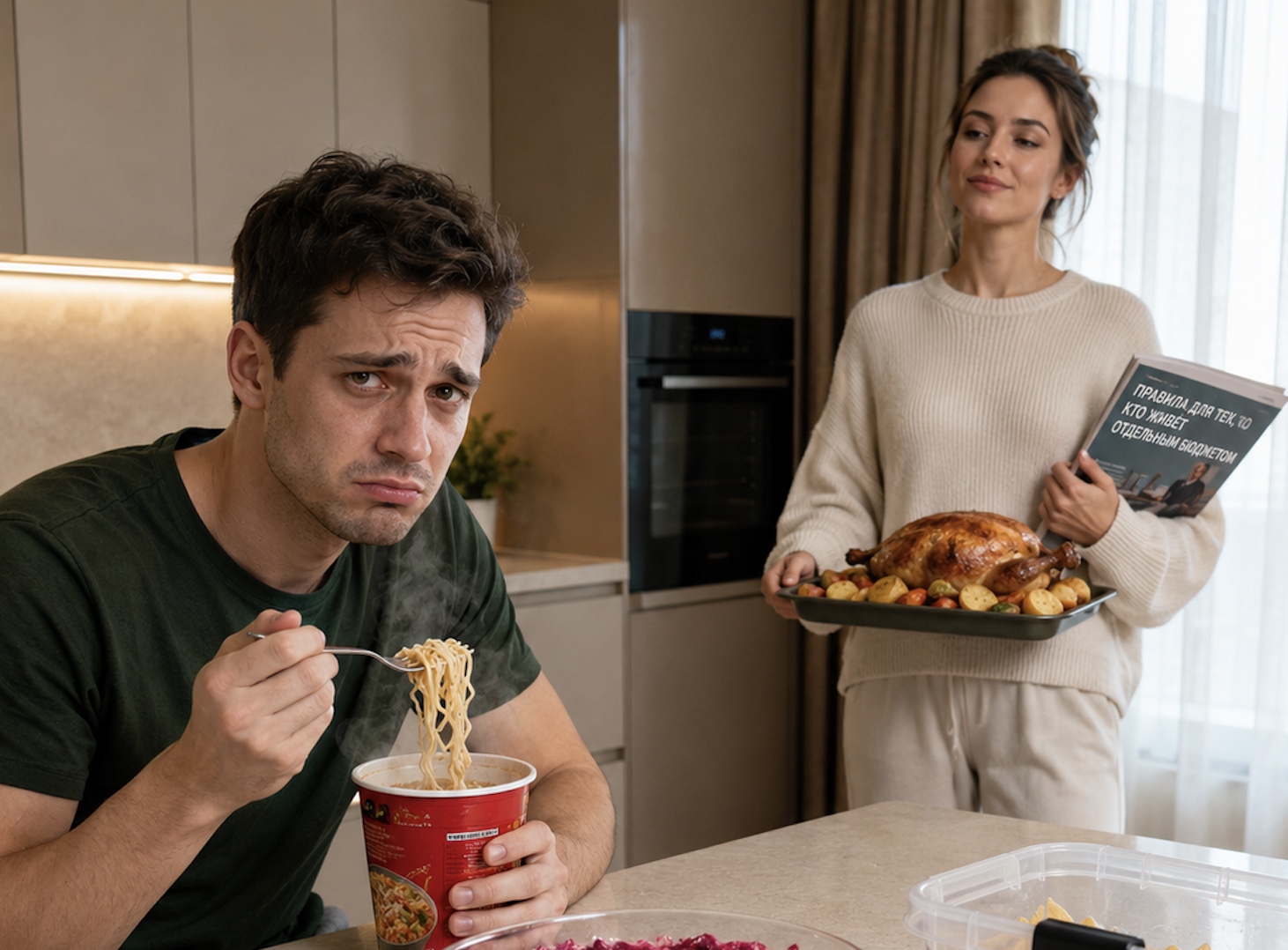
At the empty dining table sat a gloomy Stas, miserably poking at instant noodles in a plastic cup with an aluminum fork. And at the breakfast bar, Elena sat comfortably.
She was slowly enjoying a golden roasted duck with apples, which she had prepared especially for herself, while calmly flipping through a glossy magazine.
“I don’t understand,” the mother-in-law said, confused, looking from her younger son to her unbothered daughter-in-law. “Where is our big lunch? We drove across the whole city in traffic for this!”
“Mom, the thing is…” Stas began mumbling vaguely, trying hard not to meet anyone’s eyes.
Elena carefully set down her fork, wiped her lips with a paper napkin, and looked at the uninvited guests.
“Your son switched us to a separate budget because he was absolutely convinced he fully supported me,” she said clearly and loudly. “But as you can see for yourselves, this is the real result. His personal money was only enough for cheap noodles.”
The mother-in-law’s face stretched with outrage, and she slapped her palm hard against the countertop.
“What disgraceful behavior! How dare you welcome your husband’s family like this? My boy works so hard and tries so much for this family, and you won’t even pour him a bowl of soup?”
“Your boy decided that my daily work in the kitchen had absolutely no value,” Elena answered without raising her voice even for a second. “He counted his finances, and I counted mine.”
She calmly glanced at the empty tabletop in front of her husband.
“It turned out that without my constant contributions and cooking, he can only afford processed food. I fulfilled my part of the agreement honestly.”
Nobody said a word. The mother-in-law opened her mouth, ready to launch into another lecture, but then she looked at her pitiful younger son and his cheap meal — and chose to stay silent.
“Take your empty containers with you,” Elena said, delivering the final blow before returning to her delicious lunch. “There is no one here to fill them anymore. The free cafeteria is closed forever.”
After that strange Saturday, the atmosphere in the house changed completely. Stas never again mentioned his supposedly exceptional role as the main provider. He bought a large cookbook and began spending evenings awkwardly but diligently learning how to make seafood pasta and bake vegetables in the oven.
Elena removed the locks from the cabinets, but she never again allowed one-sided domestic service to become the norm. They began managing the family budget together, but now her husband clearly understood the real cost of every grocery item and every washed plate.
As for his mother, after leaving that day empty-handed, she finally understood the true value of someone else’s daily labor. She stopped demanding lavish weekend feasts. Now, whenever Stas’s mother wanted to gather the whole family, she simply reserved a table at an inexpensive café and paid for her own meal.
And Elena finally gained the peace and respect she had long deserved, enjoying cozy evenings at home without the humiliating burden of kitchen servitude.