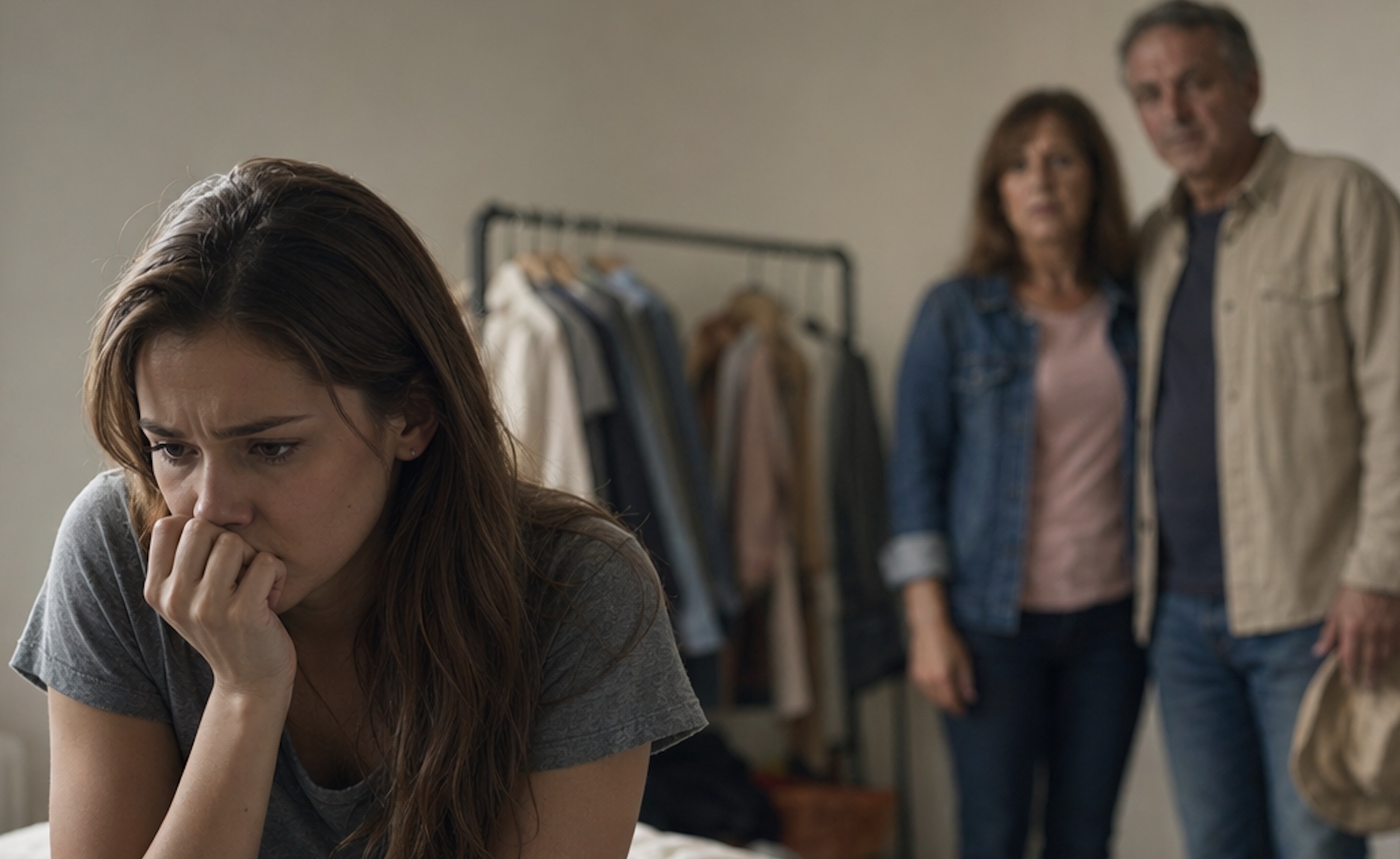
“Anya, your father and I have decided to sell the apartment.”
Her mother’s voice sounded so matter-of-fact, as if she were mentioning something ordinary, like buying a new kettle. Anna slowly sank onto the edge of the sagging sofa, the phone suddenly feeling unbearably heavy in her hand.
The evening light filtered through the thin curtains of her rented studio, catching the dust in the air. On her laptop screen, a real estate website was still glowing—she had just closed another listing after once again realizing that housing prices were rising faster than her salary. The old floor creaked under her feet when she shifted.
“Anya, are you listening?” her mother asked, her tone tightening with concern and bringing Anna back to the moment.
At once, another apartment rose before her eyes: high ceilings, a sunlit living room, an old mahogany bookcase. The apartment where she had grown up. The apartment she had always believed would one day be part of her future.
“I hear you,” Anna managed, though something inside her chest seemed to snap.
She set the phone down and stared out the window. Lights flickered in other people’s apartments beyond the glass—boxes just as cramped as her own. Thirty-two years old, steadily employed at an advertising agency, no debt—and still no place of her own.
“Why take out a mortgage if…” she had repeated that sentence to herself many times, never finishing it.
The phone rang again. This time the screen said: Dad.
“Anya, your mother said she already told you the news. Don’t be upset. It’s the sensible thing to do.”
Sergey Ivanovich had always been practical. An engineer from the old school, he believed in calculations, plans, and reason. He had recently retired and, as he liked to say, had finally “been given time to actually live.”
“Dad, but why so suddenly? You never said anything…”
“What was there to say? It’s too much space for your mother and me now. Three rooms, high utility bills, and cleaning takes half the day. Your mother gets tired.”
Nadezhda Petrovna had, in fact, been saying that a lot lately. A former literature teacher, she had devoted her entire life to school and family. Now that she was retired, she often repeated that she wanted to “live a little for herself.”
Anna remembered running down the long hallway of that apartment as a child, counting the steps from the kitchen to her room. Twenty-three tiny steps when she was little, fifteen when she was older. She remembered New Year’s celebrations too—her father always placed the tree by the large window in the living room, and her mother set the table for twelve, even when fewer guests came.
“When are the buyers coming?” Anna asked, trying to keep her voice level.
“There are already several interested people. It’s in the center, it’s a Stalin-era building, high ceilings—places like that get snapped up.”
After the call, Anna sat in the dark for a long time. When she was fifteen, she used to lock herself in her room—the one overlooking the courtyard where the old linden tree grew—turn up the music, and dream about the future. About how one day that apartment would become hers. About renovating the living room, putting in a modern kitchen, turning her old room into an office. Or maybe a nursery for future children.
She had never said any of this out loud to her parents. Why would she? It had always felt obvious. Natural. She was their only child. Of course she would inherit the apartment one day. Not soon, of course. But eventually.
Sunday dinner at her parents’ home had always been a tradition. Anna arrived, as usual, at five o’clock, carrying a box of éclairs from her mother’s favorite pastry shop.
“Come in, come in,” Nadezhda Petrovna said brightly. She looked strangely energized, even younger somehow. “I made your favorite casserole.”
The apartment felt odd. At first Anna couldn’t tell what had changed, only that something was different. It wasn’t until she sat down at the table that she realized what it was: the photos were gone from the hallway walls. The old kitchen curtains had been replaced with blinds. And the door to the living room was shut—something that almost never happened.
“Have you already started packing?” she asked, trying to sound neutral.
“Yes, little by little,” her father said, pouring tea from the old porcelain teapot. “It’s amazing how much you collect over thirty years.”
“Thirty-three,” her mother corrected him. “We moved in a year before you were born.”
Anna took a sip of the scalding tea.
“And where are you planning to move?”
“We found a lovely two-bedroom place in New Trekhgorka. New building, gated courtyard, park nearby. Forty minutes to the center by metro.”
“Forty minutes? That’s so far…”
“We don’t need to go downtown every day anymore,” Sergey Ivanovich said, pushing aside his empty plate. “And do you know how much money we’ll have left over? Enough to travel. We could go to Italy. Greece. Your mother has always wanted to see the Parthenon.”
“And the Colosseum,” Nadezhda Petrovna added, her eyes shining. “Can you imagine it, Anya? Your father and I will finally see the world. While we still have the health for it.”
Anna looked at them and felt as if she were seeing them clearly for the first time. They were making plans. Dreaming. Building a new life. A life in which the three-room apartment in the city center was simply property. An asset. Something to exchange for travel, comfort, and new experiences.
“What about the things?” she asked quietly. “The books? The furniture?”
“The books will go to the library. As for the furniture… well, it’s old. In the new place we’ll buy something modern and comfortable.”
Something tightened painfully inside her. In one piercing moment, Anna understood: in her parents’ plans, there had never been a place reserved for her. They weren’t thinking about where she would live or how she would build her future. They were simply… living their own lives. As they had every right to do.
“Can you show me the listing?” she asked, surprised by how calm she sounded.
“Of course. I’ll get the tablet,” her father said, rising from the table.
Anna stayed where she was, looking at the familiar wallpaper, at the crack in the ceiling corner that had appeared when she was seven and the upstairs neighbors flooded the apartment. At everything she had once imagined as part of her future home. A home that would never actually be hers.
The words came out before she could stop them.
“I thought this apartment would be mine one day!”
Silence settled heavily over the kitchen table. Her father froze with the tablet in his hand. Her mother slowly lowered her cup.
“What exactly do you mean by that?” Nadezhda Petrovna asked, frowning.
“I… I’ve spent years living in rented apartments. I kept putting off the idea of a mortgage because I thought…” Anna faltered, suddenly hearing how awful it sounded.
“Because you were waiting for us to die?” Sergey Ivanovich’s voice turned icy.
“No! Not like that! I just thought… someday… that it was the natural thing…”
“No one asked you to wait,” her father said, dropping the tablet on the table with a sharp thud. “We never promised you this apartment.”
“But I’m your only child!”
“And?” her mother stood up from the table. “We worked our whole lives, Anya. Our whole lives! I spent forty years grading papers until midnight, and your father practically lived at the factory. Don’t we have the right to live for ourselves now?”
Anna glanced toward the hallway. On the small cabinet lay folders filled with documents—the sale contract, registry papers. A realtor’s card was pinned to the wall with the note: Viewing on Monday. Everything had already been decided. Without her.
“That’s selfish!” she burst out. “You’re only thinking about yourselves!”
“Selfish?” Sergey Ivanovich stood too, his face flushing red. “You’re the one who’s spent thirty-two years expecting our deaths, and you dare talk about selfishness?”
“I wasn’t waiting for you to die!”
“No? Then what exactly were you doing? Planning renovations in an apartment that doesn’t belong to you? Putting off your own life because you expected someone else’s property to become yours?”
Every word landed like a slap. Anna remembered all the apartments she had refused to look at, telling herself there was no point in taking on a thirty-year mortgage. She remembered mentally arranging furniture in her parents’ living room.
“This is our life and our apartment,” Sergey Ivanovich said now in a quiet voice, which was far worse than shouting. “You’re an adult, Anna. You don’t get to treat something as yours before it belongs to you.”
He walked to the door and opened it.
“I think you should leave.”
Anna snatched up her bag and rushed out. The tears did not come until she was inside the elevator.
A week passed. Then another. Anna did not call her parents, and they did not call her.
Life went on, but now every little thing reminded her of what had happened. Sending the rent payment on the first of the month felt heavier than usual. When the faucet in the bathroom started leaking, she had to find a plumber herself, haggle over the price, and wait around for half a day. Her landlady refused to reimburse the repair.
At work, Anna was booking an Italy trip for an elderly couple. They happily argued about what they should see first—the Colosseum or the Vatican. Anna smiled automatically, but inside, something kept twisting tight.
“You’ve been gloomy lately,” said Irina, her colleague and only close friend, setting a cup of coffee on her desk.
At lunch, Anna told her everything. Irina listened without interrupting.
“And do you know what hurts the most?” Anna said, turning a plastic fork between her fingers. “They never even thought about me.”
“Were they supposed to?”
Anna blinked. “What?”
“Were they supposed to center you while planning their own life? Sorry, Anya, but did you really think that apartment was already yours? While your parents are still alive?”
“I just thought… it was natural…”
“No, it isn’t, my friend. What’s natural is building your own life yourself. You built a castle in the air on someone else’s foundation.”
That night Anna could not sleep. She lay in the darkness, remembering. Her father teaching her how to ride a bicycle, running beside her with a hand on the seat. Her mother staying up through the night while she prepared for exams. The way they had let her move out without guilt or pressure, asking nothing in return. The pride they had felt over every one of her achievements.
They had given her everything she needed to begin her life: education, support, love. And she… she had simply wanted more. She had waited for something that had never been hers.
Toward dawn, a painful but liberating realization came to her: she was not merely hurt by her parents. She had spent years living inside an imagined future that belonged to someone else. And now that the illusion had collapsed, she would have to start building her own real life at last. From scratch. But truly her own.
Anna stood outside the familiar entrance for ten minutes before she found the courage to go in. A moving van with a transport company logo was parked by the curb. Two movers were carrying out the old mahogany bookcase.
“Careful with that!” she heard her father call.
Her heart clenched. She climbed the stairs. The apartment door stood wide open.
The place looked unfamiliar now. Bare walls with dark rectangles where pictures had once hung. An empty living room. A rolled-up rug in the corner. Sunlight fell across the parquet floor, revealing every scratch carved into it over the years.
“Anya?” Her mother appeared from the kitchen carrying a box.
“Mom, I… can we talk?”
Nadezhda Petrovna set the box down and silently walked into the kitchen. The table and three chairs were still there—apparently they were being taken last.
“I’m sorry,” Anna said, sitting down across from her parents. “I was wrong. Completely wrong. I had no right to count on that apartment, and no right to be angry.”
“Anyechka…” her mother reached across the table.
“No, let me finish. You worked your whole lives. You earned the right to live however you want. And I… I behaved like a spoiled child who thought everyone owed her something.”
Sergey Ivanovich quietly got up and put the kettle on. The old electric one with the chipped handle—the last thing left in the kitchen.
“We overreacted too,” he said without turning around. “We could have told you earlier. We could have prepared you.”
“We got carried away making plans,” said Nadezhda Petrovna, hugging her daughter. “You know, we bought such a lovely apartment. It has a balcony! Your father is already deciding what he’ll plant there.”
“Tomatoes,” Sergey Ivanovich corrected, pouring boiling water into their old cups. “Cherry tomatoes.”
They sat together in the stripped-down kitchen and, for the first time in years, talked openly about the future. Her parents told her about their trip to Italy, about tickets for May, about a route along the Amalfi Coast. Anna listened and felt a strange surprise—how had she failed to notice that spark in their eyes before?
A year later.
Anna stood by the window in her own apartment—tiny, just one room, but hers. Boxes were stacked around her, and a cardboard cup of tea was cooling on the windowsill.
Her phone beeped. A new message from her mother. A photo: her parents standing in front of the Colosseum, both wearing ridiculous tourist caps, both grinning. Unbearably hot, but so happy! the caption read.
Anna smiled and looked around. The apartment was so small it would have fit entirely inside her parents’ old living room. The mortgage stretched twenty years ahead of her, and she had spent a full year scraping together the down payment, denying herself every extra. But it was hers. Her walls. Her ceiling. Her creaky parquet floor.
The kitchen—if it could even be called that—had room only for a stove and a tiny table. But she already knew exactly where she would hang the spice shelves and where her favorite ficus would stand.
Outside, the avenue rumbled with traffic. Not the city center, not even close. But it was hers.
She took a sip of tea from the cardboard cup and opened her notebook. On the first page she had written: Renovation Plan. Small-scale, modest, stretched out over years.
The phone rang. It was her father.
“Anya, your mother and I were thinking—when we get back, maybe we could help you paint the place? I’m still strong enough to manage.”
“That would be wonderful, Dad.”
“And one more thing… we spotted something for you at IKEA. A small bookcase, light-colored. Just right for a little apartment.”
Anna smiled, warmth spreading through her chest.
“Thank you. Really, thank you.”
Outside, the sun was setting, washing the walls in gold. There was a lot of work ahead tomorrow. But it was her work, her life, her future. Real at last.