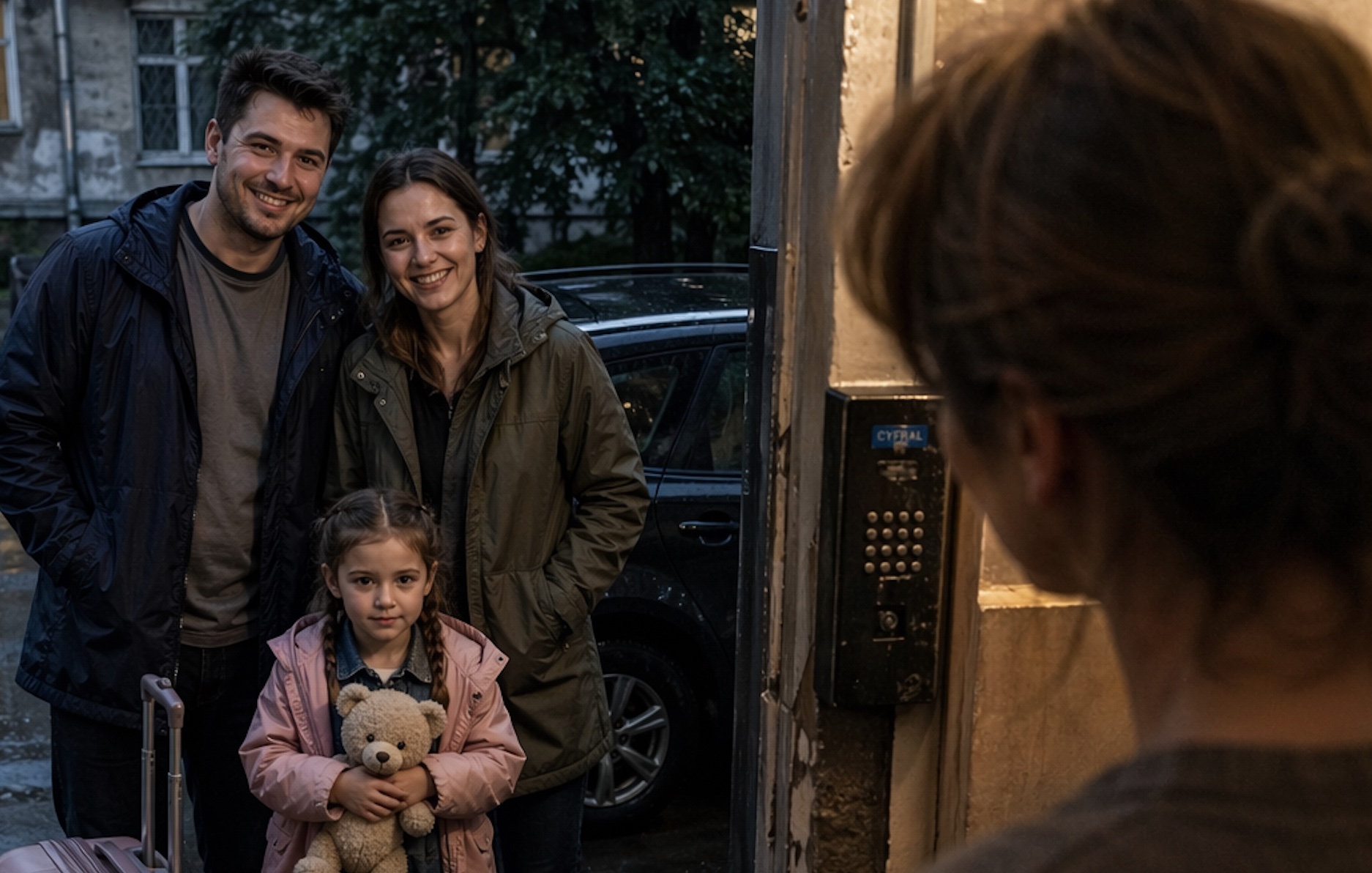
“We’re already downstairs. We’ll leave Vera with you until the evening. Are you coming down, or should we come up?” her brother’s voice announced cheerfully.
Alice stood barefoot on the cold kitchen tiles, clutching her phone. Outside, snow drifted down in soft silence. On the table, a misshapen but somehow comforting omelet was going cold, and in the next room Roman was fiddling with the projector, humming to himself.
She closed her eyes.
They weren’t expecting anyone.
And today was the one day that absolutely could not be ruined.
“Alice, are you there? We’re coming up!” Artyom sounded as though he were delivering good news.
She heard him. She just couldn’t answer. The words were stuck somewhere between her throat and chest—the same place where, for the past six months, a dull, aching heaviness had settled.
Ten minutes earlier, everything had felt different.
Alice had been standing at the stove in one of Roman’s old T-shirts while the egg mixture stubbornly clung to the pan. She tried to flip the omelet with a spatula. It folded in half, then collapsed into three uneven pieces.
“That’s not an omelet,” she said, staring at the result. “That’s some kind of poem.”
Roman leaned out of the other room, glanced at the pan, and shrugged.
“Looks like modern art. Let’s call it Deconstructed Breakfast.”
She laughed.
That laugh hadn’t come easily. Six months earlier, Alice had sat in her manager’s office and realized she couldn’t say a single word. Not metaphorically—literally. Her body had stopped cooperating, her thoughts had tangled into knots, and inside she felt hollow, like a house after all the furniture has been taken out.
The doctor called it emotional burnout. Alice quit her job. She stopped answering calls. For weeks, she barely left the apartment.
Roman never pushed her. One evening, he simply sat beside her and said:
“We need one day. Just one day when nobody wants anything from us. Not work, not relatives, not the world. Just us.”
They had prepared for that Saturday as if it were a small holiday. Notifications off. Groceries ordered in advance. A box of old videotapes brought out from storage—vacation recordings, their wedding, silly little home videos.
They made a pact: no problems. No heavy conversations. Just quiet.
And now Alice stood on the freezing tile, listening to the dead sound of the call.
“Artyom, wait,” she finally managed. “We can’t today. We have plans.”
“What plans? You’re just at home.” His surprise sounded completely genuine. “The elevator’s broken, we’ve got stuff to carry up to the sixth floor, and Lena can’t manage on her own. It’ll only be a couple of hours, tops, until evening.”
“But we really can’t…”
“Alice, she’ll just sit there and watch cartoons. You won’t even notice she’s there.”
The doorbell rang.
Alice froze in the hallway, phone still in her hand. The bell rang again—longer this time, more insistent.
Inside her, two voices crashed together like trains on the same track.
It’s family. It’s your brother. You can’t say no.
This is exactly how it happened before. You keep putting yourself last. That’s what broke you.
Roman came out of the room. One look at her face, and he understood.
“No,” he said quietly, but firmly. “Alice, tell him no.”
“He’s already here.”
“So what? You said we’re busy. That’s enough.”
“He won’t hear it.”
“Because you didn’t say it in a way he’d have to hear!”
Roman’s voice rose. Alice flinched—not out of fear, but surprise. He almost never raised his voice.
“You’re doing it again,” he went on, softer now, but with hurt in his tone. “You’re putting his convenience above your life. Above yourself. Above us.”
“It’s not that simple…”
“It is that simple. You say no, and he leaves.”
The bell rang a third time. Then Artyom’s voice came through the door:
“Alice, we know you’re home!”
She looked at her husband. At the door. At the phone in her hand.
And she opened it.
Artyom pushed in first, shoving a huge bag of вещи into the hallway. Behind him, Lena gently nudged six-year-old Vera forward.
“Thank you, you’re saving us! We’ve got to run, the movers are waiting!” Artyom kissed Alice on the cheek. “We’ll pick her up by evening, no later than seven!”
“But—”
The door shut before she could finish.
Vera stood in the middle of the hallway, glancing around with calm curiosity. Then she pulled a tablet from her pocket, tapped the screen, and the apartment was instantly flooded with blaring music from some cartoon series.
Roman said nothing. He just turned and walked back into the other room.
Alice felt something inside her tighten—slowly, inevitably. Their carefully protected day of quiet was already coming apart, just like the omelet in the frying pan.
The first hour passed in relative peace. Vera sat on the couch with her face buried in the tablet. Alice tried to salvage breakfast. Roman silently worked on the projector—some wire had come loose.
“I’m hungry,” Vera suddenly declared without looking up.
Alice exhaled. Fine. Feeding a child, at least, she could handle.
“We have omelet, porridge, or I could make sandwiches…”
“I only eat nuggets from that delivery place. The one with the green logo.”
“Vera, we don’t have nuggets. How about I make you something nice?”
“No. Mom always orders nuggets.”
The girl turned the tablet slightly and the sound hit harder—shrill cartoon creatures squealing and singing at once.
“Vera, please turn it down,” Alice asked.
No response.
“Vera!”
The little girl stood up and wandered through the apartment without taking her eyes off the screen. She stopped by the shelving unit where the box of videotapes sat.
“What’s this?” she asked, already pulling it toward herself.
“Please don’t touch that…”
Too late.
The tapes spilled onto the floor. Vera stepped on one, and the crack of broken plastic sounded almost like a gunshot.
“That was our wedding,” Alice said quietly, crouching to gather the shattered pieces.
Vera shrugged and moved toward the table where Roman had just finished setting up the projector. It was old, bought secondhand at a flea market, but it worked—and they had specifically searched for one so they could watch the tapes.
“Don’t touch it!” Roman shouted.
But the child had already yanked the cord. The projector tipped, fell, and something inside it snapped.
“What the hell!” Roman jumped to his feet. “Do you have any idea what you’re doing?!”
Vera stepped back. Alice instinctively moved between them.
“Roma, she’s just a child…”
“An undisciplined child! And that’s not her fault, that’s—”
Alice’s phone buzzed.
A message from Artyom:
We’re not done yet. She might have to stay overnight, okay?
Not a question. A declaration.
Alice read the message twice. Something inside her clicked—so sharply she could almost feel it, like the projector hitting the floor.
She called her brother. The ringing seemed endless.
“Alice, what happened? We’re carrying boxes—”
“You’re picking Vera up within the hour.”
Silence.
“What? Alice, we agreed—”
“No, we didn’t. You decided for me. One hour, Artyom. If you’re not here, I’m calling a taxi and sending her to your new address.”
“Are you out of your mind? She’s a child!”
“She’s your child. Not mine.”
“Alice, what is this, cruelty? We’re family! Remember how we helped you after university—”
“One hour, Artyom.”
She hung up.
Her hands were shaking. Her heart pounded somewhere in her throat. Panic rose fast and familiar.
You’re a terrible sister. You’re selfish. You don’t love anyone but yourself.
But underneath the panic was something else.
Lightness.
Almost weightlessness—as if she had finally dropped a backpack she had been carrying for years.
Roman stood in the doorway, watching her. There was something new in his expression. Respect, maybe. Surprise.
“You did it,” he said softly.
“I did.”
Vera was still standing in the middle of the room with the tablet in her hands. The music was still playing, but Alice could barely hear it anymore.
The next ring at the door was short and angry.
Alice opened it.
Artyom stood on the threshold without stepping inside. His face was flushed, his jaw tight. He didn’t say hello. He didn’t even look at his sister. He just stuck out a hand toward Vera.
“Get your things. Now.”
The girl silently picked up her bag. She never turned the tablet off.
Artyom turned to leave. At the door, he threw over his shoulder:
“I’ll remember this.”
Then the door slammed. Footsteps echoed down the stairs. Silence.
Alice leaned back against the wall. A wave rose inside her—heavy, cloudy. Guilt. She had hurt her brother. Damaged the relationship. What would their mother say when she found out? What would everyone say?
Fear of the aftermath squeezed her throat.
But then she took one breath. And another.
The air in the apartment felt different now. Lighter. Wider. The space belonged to her again—not to Artyom, not to Vera, not to anyone else’s expectations.
Roman came up behind her and wrapped his arms around her without a word. No I told you so. No lecture. Just the warmth of his hands and the steady rhythm of his breathing in her hair.
“Let’s start the day over,” he said quietly. “As much as we can.”
Alice nodded without turning around. Tears finally spilled—but these were different tears. Not from pain. From relief.
By the time night fell, the snow was still drifting down outside—slow, indifferent to human drama.
They sat together on the couch under one blanket. On the coffee table were plates with their now-cold brunch. The omelet was still crooked, but Alice ate every last bite.
An old movie played on the laptop—not the one they had planned to watch, but it didn’t matter.
“The projector can be fixed,” Roman said, eyes still on the screen.
“I know.”
“And the wedding tape too. There are restoration shops.”
“I know.”
He was quiet for a moment.
“How are you?”
Alice thought about it. The day had been ruined. That was true. But something important had happened anyway—something that never would have happened in perfect silence.
For the first time, she hadn’t rushed to save everyone. She hadn’t chosen being convenient. She hadn’t surrendered her time without a fight.
“Artyom won’t forgive me for a long time,” she said.
“Maybe not.”
“And Mom will call tomorrow. She’ll say I’ve changed. That I’ve become cold.”
“You’re not cold,” Roman said. “You’re finally whole.”
Alice rested her head on his shoulder. The movie murmured on about love and loss.
Her life was not a place people could “stop by for a while.” It wasn’t a waiting room for other people’s convenience. It wasn’t a buffer zone for someone else’s plans.
For the first time in a very long while, she fell asleep in peace.
And outside the window, the snow kept falling.