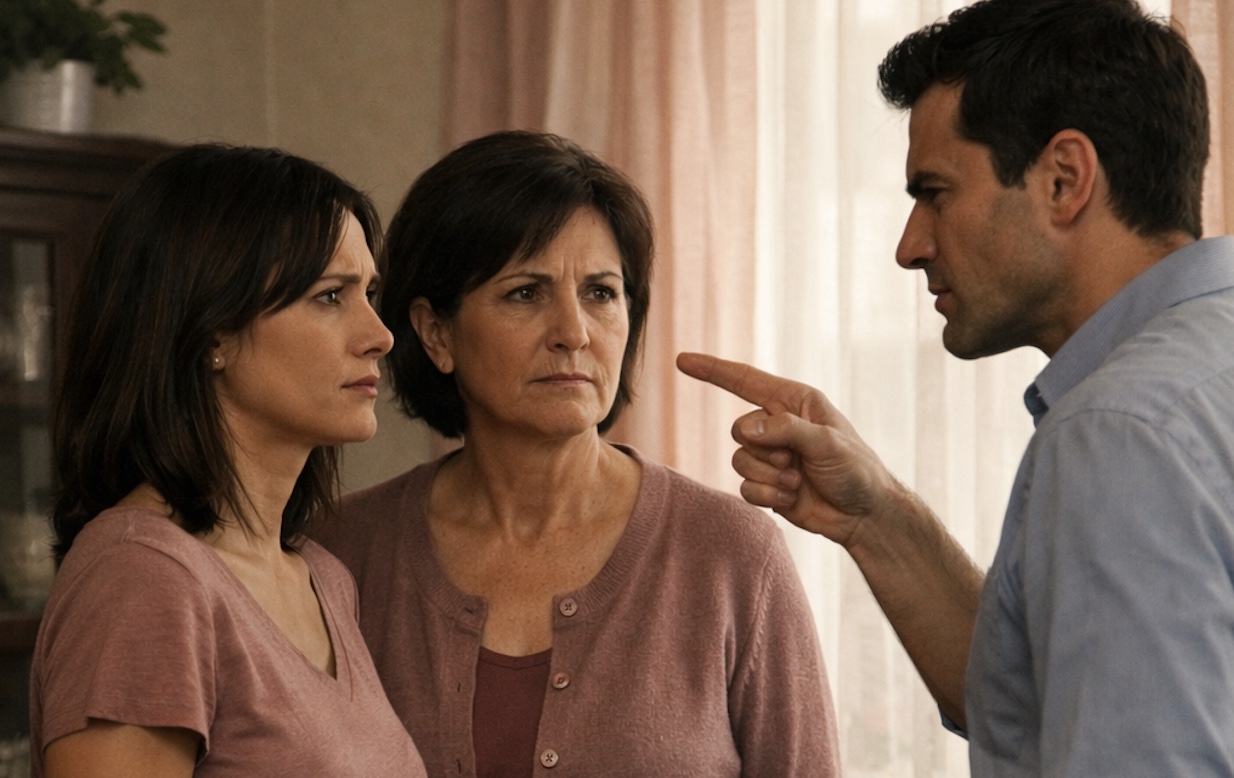
Dmitry tossed out the sentence without even looking at his wife, staring instead at the plate of dinner that had not yet gone cold. The words hung in the kitchen air, thick and heavy, like the smell of burnt stew.
“What?” Anya asked softly. Her fingers loosened on their own, and the spoon dropped onto the table with a dull clatter.
“You heard me.” At last he looked up at her. There was no anger in his eyes, only a tired, stone-hard resolve. “Starting with this paycheck, we split everything. I’m tired of carrying you.”
She said nothing. The ringing in her ears drowned out the ticking of the clock. Carrying you. The same word her father had once used to humiliate her mother for buying an extra packet of butter. A word she had always dreaded.
“I’m not doing nothing, Dima,” she said, her voice trembling. “I work. It’s just…”
“It’s just that your ‘work’ doesn’t bring in even a third of what I make,” he finished for her. “And we spend equally. Or rather, you spend my money. Time to grow up, Anya.”
He stood, carried his plate to the sink without turning back, and disappeared into his office — his private fortress, a room she entered only when she brought in a stack of fresh laundry.
Anya stayed at the table, staring at her untouched half of dinner. The food had gone cold. She felt as if someone had pushed her out of a boat in the middle of a lake and said, Swim on your own. I’m done towing you.
That was how what she later named, in her own mind, the Great Separation began.
The next day Dmitry, brisk and calm, printed out a spreadsheet. Utilities, mortgage, groceries, gas — everything divided neatly in half. His salary was five times higher than her modest income from website design and illustrations? Irrelevant. The market. Fairness.
Anya pushed aside the children’s book project she had been working on late into the nights — it was not bringing in money now, which meant, in this new system, it was a luxury. Instead, she took on two more urgent landing-page jobs, the kind she would once have refused — bland, formulaic, lifeless work. By midnight, her eyes ached.
The first week was a nightmare of calculations. “You ate more yogurt, so you owe extra.” “Going to the movies was your idea, so your ticket is 650 rubles.” Their home turned into a branch office of an accounting department.
But then something strange happened. In all that ruthless economizing, in that creaking machine of you owe me, I owe you, the outline of something she had forgotten began to appear — herself.
Once she stopped waiting for Dima to “bring money into the house,” she started going after it herself. She got back in touch with an old client who had launched an online store and needed a steady designer. Anya proposed new terms, charging twice what she used to. The client respected her confidence and agreed.
For the first time in years, Anya bought herself a pair of boots not because they were on sale, but because they were beautiful and comfortable. She did not ask permission. She did not feel guilty. She simply transferred her own earned money from her own account.
Dmitry noticed. Silently.
He had expected her to crack, to come to him humbled, to start talking about love and shared futures. Instead, Anya withdrew into her financial independence the way a butterfly folds into a cocoon. She cooked dinner only for herself unless it was officially her turn under their “food budget” rules. She washed her clothes separately. Her laugh, once frequent and bright, was now rare, and when it did appear, it was usually on the phone with clients or friends.
One evening he found her in the living room. She was sitting with her laptop open, and on the screen were sketches filled with light and warmth, nothing like her old commercial work.
“What is that?” he asked, trying to keep his voice from wavering.
“Mine,” she answered simply, without looking up. “Not yours. Not ours. Mine.”
There was such distance in that word that something inside him tightened painfully. With sudden, merciless clarity, he understood: he had gotten exactly what he had demanded. He was no longer “supporting” her. She had separated from him. Completely. And in that separation she was beautiful, calm, and utterly beyond needing him.
“Anya…” he began.
She closed the laptop and looked at him. It was the same gaze he had once admired — direct, clear, alive. But now there was no question in it. No expectation. Only a quiet acknowledgment of fact.
“Yes, Dima? Do you need to discuss the electricity share? I think I overpaid last month.”
He wanted to shout, Forget the damned electricity! He wanted to rip apart his stupid spreadsheet and say he had been wrong, that he had been tired and scared and foolish.
But the words he had once released into the world had already done their work. They had built a wall. And now he stood on his side of it, alone, with money in his pocket and ice-cold emptiness all around him. He had won his separate budget. Along with the money, he had divided their lives. It turned out that was the most valuable thing they had, and he himself had put a price tag on it.
Anya picked up her mug and went into the kitchen. A cupboard door creaked. A switch clicked. Ordinary sounds in a home that had not yet become чужой — foreign — but had already stopped being shared.
Dmitry remained standing in the middle of the living room, staring at the soft glow under the kitchen door. She was in there. And he was no longer wanted.
The yellow light beneath the kitchen door was warm and gentle. Dmitry stood frozen. That simple rectangle of light now felt like an impossible border. To cross it, he would need permission. And that permission — his right to walk in without asking, to call out “I’m home,” to kiss the back of her neck while she cooked dinner — had been revoked. By his own hands.
The word mine, spoken by her, burned inside him. He remembered how it had all begun. She had been a design student with shining eyes, showing him her sketches — awkward, bright, full of life. He had been a young, promising analyst already earning good money. “Don’t worry,” he used to tell her. “Do what you love. I’ll take care of us.” Back then, us had sounded whole and strong.
Then came the mortgage, the renovation, the urge to “provide.” His salary grew; her creative work remained unpredictable, good for “pins and pocket change,” as he had come to think of it. Gradually, I’ll take care of us became I’m carrying us, and then turned into I’m tired of supporting you. When had the meaning shifted? He had never noticed.
A spoon clinked against porcelain in the kitchen. The sound was lonely. She used to drink tea on the couch under a blanket, her icy feet resting in his lap. Now she drank it alone at the kitchen table, probably bent over her phone or a book. In her separate life.
He took one step, then another. Reached the door. Laid his hand on the smooth wood. But he could not bring himself to open it.
The next day Dmitry came home earlier than usual. In his hands were two bags from the gourmet store where Anya used to pick out cheeses and strange sauces he always complained about. “Why pay extra for a label?” he would say.
The kitchen smelled of cinnamon. Anya was baking. When she saw him, she only nodded toward the table.
“The utility papers are there. I already calculated everything.”
“I’m not here for that.” His voice cracked. He set the bags on the table. “I… brought dinner. Your favorite goat cheese. And that Italian truffle sauce.”
She pulled a tray of apple strudels from the oven. Homemade. His favorite. She used to bake them on Sundays for tea.
“Thank you,” she said politely, as if speaking to a neighbor. “But I already have plans tonight. I’m having dinner with Masha. And these…” she gestured toward the strudels, “…I was just preheating the oven. They’re for an order. For a client.”
For a client. His strudels had become a product she made for money. For other people.
“Anya, we need to talk. Without the numbers.”
She set down the oven mitt and turned to him. He searched her face for some spark — hurt, anger, pain. But all he saw was a calm exhaustion, the same kind that had once lived in his own eyes.
“About what, Dima?” she asked. “I’ve almost finished next month’s budget already. The mortgage payment—”
“For God’s sake, stop talking about the mortgage!” it burst out of him. “I don’t want to talk about the mortgage. I want to talk about us!”
She studied him for a long moment. Then she exhaled slowly.
“You started talking about ‘us’ in terms of money, Dima. You reduced everything to bills. I just learned how to answer in the same language. Now there is no us. There are two people sharing an apartment and splitting utilities. Exactly the arrangement you wanted.”
“That’s not what I wanted!” he shouted, and for the first time there was panic in his voice. “I wanted… I wanted fairness. I wanted you to make an effort too!”
“I always made an effort,” she said quietly. “You just stopped seeing it. You stopped seeing me. You saw a dependent. Now you see a co-payer. Congratulations. Mission accomplished.”
She picked up her bag and packed the strudels carefully into a container.
“I’ll be back late. Don’t wait up.”
The door closed behind her.
Dmitry stood alone in the spotless kitchen, clean and gleaming, filled with the scent of cinnamon and loneliness. He picked up her spreadsheet. Every line, every figure, was perfect. She was following the rules he had written with flawless precision.
She was playing to win her freedom. From him.
Then his eyes fell on the corner of the page. Next to the dry columns of numbers she had drawn a tiny pattern — a little branch with apples. The same kind of doodle she used to sketch on his bookmarks, on their first cards to each other. A fragment of that old irrational self. A sketch.
He snatched up the paper and left the kitchen.
He spent the whole night in his office, but not over reports. He searched through old boxes and cloud storage. He found scans of their first movie tickets, silly photos where she was clowning around and he was looking at her with pure adoration. He found her early drawings — clumsy, imperfect, but so full of drive that they took his breath away.
He remembered laughing at her dream of creating an author’s picture book. “Who needs that? The market wants something else.” He, the man who understood the market, had forced her talent into the narrow lanes of commercial assignments. And when those lanes began suffocating her, he accused her of being inefficient.
He walked over to the sideboard where her vase stood — that odd, crooked thing she had made during a pottery workshop. He used to say it looked like it was collapsing. Now he looked at its strange lines and saw character in them. Stubbornness. Individuality.
The next morning he did not go to work. He went to a flower shop first, but standing before all the bright arrangements, he realized roses and tulips would only be an insult. They would be another money gesture in the system he had built. Instead, he stopped by an art supply studio and bought a set of expensive Japanese drawing pencils — the exact ones she had once admired two years earlier, then refused to buy because “there’s no point in spending that much, I don’t draw enough.”
When he came back, Anya was home. She sat on the balcony with her laptop.
“Hi,” he said, suddenly feeling ridiculous with the box in his hands.
She looked up.
“You’re not at work?”
“I… took the day off.”
He held out the box.
“This isn’t payment for anything. And not some guilty peace offering either. I just… remembered you wanted these. For your sketches. For… your things.”
She took the box slowly and opened it. Ran her finger over the velvety wood of one pencil.
“Thank you,” she said, and for the first time in a month something in her voice shifted. The wall did not fall, but it trembled. “They’re very expensive. You didn’t have to.”
“I did,” he breathed. “I needed to remember that you love this. That it’s part of who you are. The part I… pushed away. Along with everything else.”
She closed the box and set it on the table.
“Dima, I can’t just forget,” she said. “You have no idea what it does to hear the person you love call you a burden. To hear that your place in his life is ‘supporting you.’ It destroys everything. Trust. Intimacy. The feeling that you are one.”
“I know,” he whispered. “I understand that now. I destroyed it. And now when I see you standing in front of me whole, independent, strong… I realize what an idiot I was. I traded us for some illusion of fairness in Excel. And I’m terrified you don’t want me anymore — not as a budget partner, but simply as me.”
He had not cried since childhood. But now his eyes burned with tears.
Anya looked out at the city. The silence dragged on so long and so loudly that Dmitry thought he might lose his mind.
“I don’t know if I can trust you again,” she said at last, very softly. “Trust that in hard times you won’t start calculating losses. That you won’t measure my love against exchange rates. I’ve learned how to live without that certainty. And now… I’m almost peaceful.”
Almost.
That single word was a thread, impossibly thin, but real. He clung to it like a drowning man.
“Let’s try to begin again,” he said, without hope. “Not with a shared budget. With shared tea on the balcony. With conversations that aren’t about money. I’ll learn to see you again. If you give me one chance. Just one.”
Anya turned to face him. Her eyes held that same clear light that now frightened and mesmerized him at once.
“The separate budget stays,” she said firmly. “That’s my shield now. But… we can try having dinner together sometimes. And talking. About anything except bills.”
It was not a bridge. It was a narrow, shaky plank laid over a chasm he himself had dug. But it was something.
“Yes,” he nodded, fighting the tremor in his voice. “Let’s do that. I… I can cook tonight. Not from what I bought. Just something simple. Pasta, maybe.”
“The way you make it, it always turns to mush.”
“I’ll learn not to ruin it,” he said. “I’ll learn.”
And in that moment he understood that this would be the hardest and most important work of his life. Not for a joint account. Not for financial comfort. But for the chance that one day she might again say, as she once had long ago, of something they created together: ours. And that ours would mean not an apartment or a loan, but something priceless that could never be split in half.
That dinner of overcooked pasta became the first step onto the shaky plank. Awkward. Almost comical. But it was no longer mine and yours. It was an attempt to make something shared, however clumsy.
Dmitry kept his word. He never again brought up returning to a common budget. But slowly, molecule by molecule, their life began filling not with financial transactions, but with human ones.
He brought her tea when she worked too late. Not because it was required, but because he noticed the light under the door of her room — the room that had once been their bedroom, which she now occupied alone — was still on. And she, in return, left him a container of soup in the fridge after hearing him cough in the mornings. No commentary. Just a note: can be reheated. A gift, not a duty. A gesture, not a debt.
One evening Anya came into the living room carrying her laptop.
“Listen,” she said, hesitantly. “It’s a draft. The children’s book. About a mouse who studies the stars.”
He set his book aside and looked not at the screen, but at her face. It had come alive. Her eyes carried the sparks he had not seen in years. He read the text, looked at the sketches — simple, warm, full of star dust and innocent wonder — and realized he was not being shown a product. He was being let into a treasure room.
“This is… brilliant,” he whispered. And it was not flattery. He truly saw the magic in it.
“You think so?” she asked, watching him carefully, looking for falsehood.
“I know so. Follow this. Forget the landing pages for a month. I… I’ll help cover the expenses. Not as support. As an investment. In talent. In a future bestseller.”
She shook her head, but the old harsh defensiveness was gone.
“No. The budget stays separate. But… if you want, you can be my first sponsor when I launch the crowdfunding campaign.”
He nodded, swallowing the lump in his throat. She was accepting his help — but on her terms. As an equal. Not as someone dependent on him.
Months passed.
They still kept separate accounts. They still sometimes moved through the apartment like neighbors rather than spouses. But on the shelf in the living room their photos appeared again — not new ones, but old ones he had taken out of boxes. Anya did not remove them. Beside her crooked vase, there was now a model telescope — his birthday gift to her, with no practical purpose at all, only because “a mouse astronomer needs equipment.”
Then one Saturday morning Dmitry woke to the smell of coffee and muffled, joyful sobs. He walked into the kitchen. Anya, wearing his old T-shirt, sat at the table with her hands over her face, and in front of her lay a printed letter.
“Anya? What happened?”
She looked up at him, her face wet with tears and shining like a thousand suns.
“The publishing house… They’re taking it. My book. They’re taking it!”
He froze, then rushed forward without thinking, scooped her up, and spun her around the kitchen. She was laughing and crying and she did not push him away. For that moment they were a single whirl of joy, with no yours and mine, only a shared we did it, shared happiness.
When he set her down, both of them were breathless. He was still holding her hands.
“I’m so proud of you,” he whispered, every word hard-won and true. “So unbelievably proud.”
“Thank you,” she said, and her fingers tightened around his for a second. “Thank you for believing in me. Back then.”
That evening they made a celebration of it. They bought champagne and expensive pasta, the kind Anya used to call wasteful. They talked not about money, but about plans, about stars, about the funny little mouse conquering the universe.
When the dishes were washed and the bottle was empty, silence came. Not awkward silence. A full, ringing silence.
Anya went to the sideboard and took out the folder containing their ridiculous spreadsheets. Then she walked to the decorative fireplace.
“You know,” she said, looking down at those pages with their columns of numbers and the tiny apple branch in the corner, “I think this experiment can officially be called over. Goal achieved.”
Dmitry’s heart sank. Goal? What goal? To prove they could live apart?
She turned to him, and in her eyes he saw not distance, but a quiet, deep certainty.
“I proved to myself that I can do it. That I am not a burden. That I am worth exactly what I decide I am worth. And you… you proved that you can look at me and see not a bank balance, but a human being. A partner.”
She held the folder out to him.
“I don’t want to divide everything into mine and yours anymore. But I don’t want to go back to the old version of ours either — the one poisoned by your contempt. I want us to create a new ours. One where each of us keeps a private cosmos, our own stars, and where those universes choose to orbit together — not because they must, but because they want to. A double system. With shared gravity. Shared light.”
She tore the folder in half and dropped it into the fireplace. The papers did not burn, but the gesture said enough.
Dmitry came toward her slowly, giving her time to step away. She did not.
“I don’t deserve this chance,” he said hoarsely.
“That isn’t your decision,” she replied. “Whether you deserve it or not is for me to decide. And I choose to try. With you. But with a new map.”
He did not kiss her. He did not make grand promises. He simply wrapped his arms around her, holding on like a drowning man who had finally found solid ground instead of sinking sand made of numbers and resentment. She rested her cheek against his chest, and it felt like a truce. Not surrender. A new agreement.
They never went back to one shared account. Instead, they created three envelopes: Hers, His, and Ours. Into Ours they put money for shared dreams — a trip to a real observatory, a large table for guests, a future together. And that Ours no longer felt like a burden. It became a savings fund for happiness.
A year later, at the presentation of her first book, while Anya signed copies for delighted readers, Dmitry stood to the side, waiting for her eyes to meet his. When they did, she smiled that same old trusting smile and winked.
He walked to the table, took a blank sheet of paper, and wrote:
Investment proposal.
Objective: a shared life until old age.
Expected returns: shared stars, shared laughter, shared memories.
Risk factor: total bankruptcy in solitude.
Open to negotiating terms of partnership.
He handed the page to her. She read it, and her eyes lit up. Then she signed beneath it:
Partner agrees. No unilateral termination. Forever.
And below that, she drew a small apple branch.
In the end, the final calculation turned out to be simple: trust, respect, and love cannot be divided down the middle. Either they are gone, or they belong wholly. And that wholeness is the only budget that truly matters.