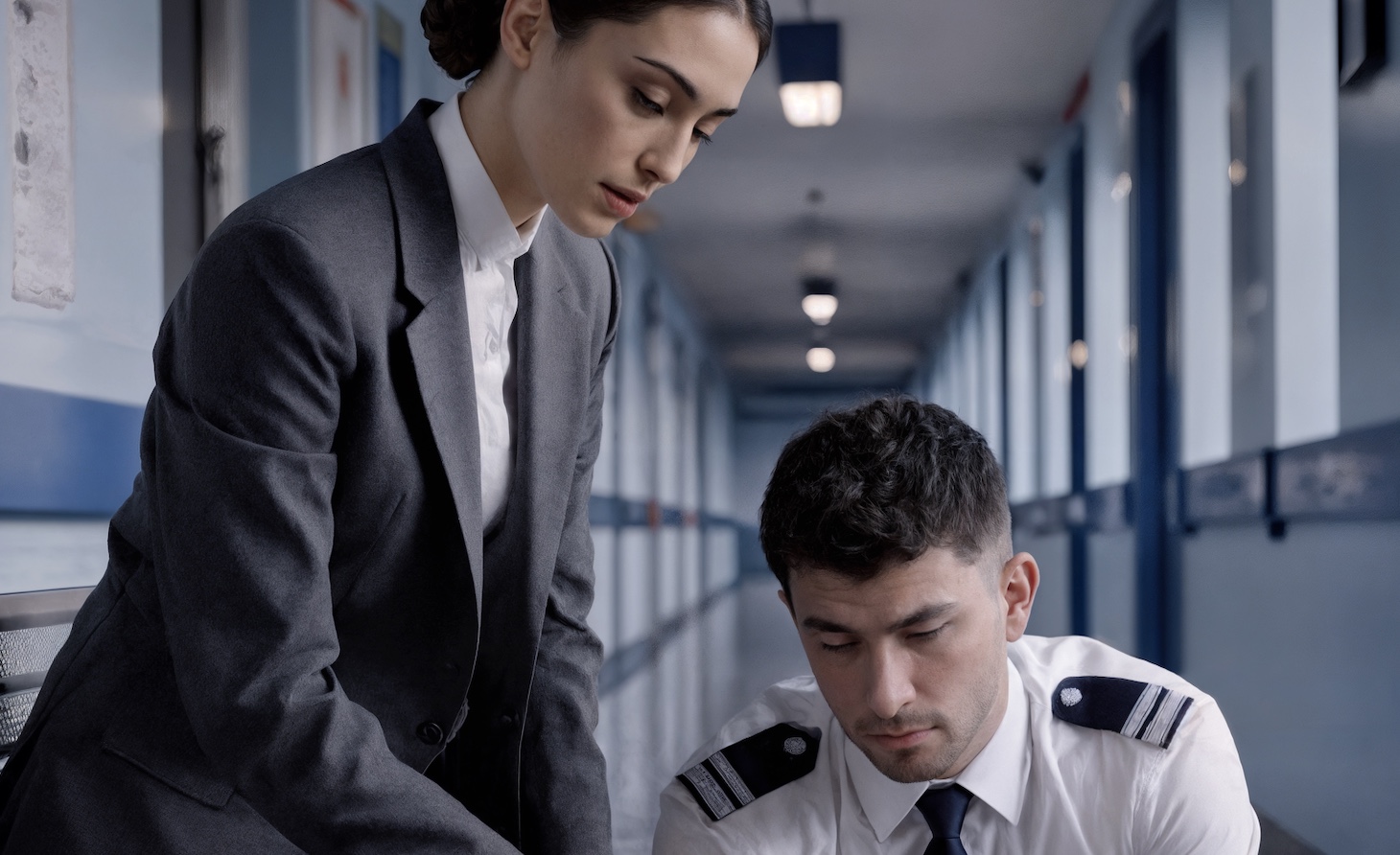
St. Petersburg rain had always felt personal to Kirill, as if the sky adjusted itself specifically to his mood. Today it was the color of old steel—low, heavy, and hopeless, exactly like his life had been for the last six months. He stood under the awning of the entrance to the elite business center Atlant, nervously straightening the collar of the only respectable shirt he still owned. His phone vibrated in his pocket—another call from the bank. Kirill declined it. There was nothing he could say to them.
Just five years earlier, Kirill Volkov didn’t even know the price of a metro ride. He drove a bright red sports car his father had given him for graduating university and believed the whole world lay at his feet like an expensive Persian carpet. He was the “golden boy,” the heir to the Volkov construction empire. Now he was applying to be a personal driver for some powerful executive, because it was the last thread he could grab before falling all the way into the void.
Kirill drew a deep breath and pushed open the heavy glass door. Inside, the air smelled of premium coffee and money—a scent that once felt like the natural background to his life, but now only stirred a sharp, aching nostalgia. A receptionist—polished and cold—looked him up and down as if pricing him.
“I’m here about the ad,” Kirill said. “The personal driver position.” His voice wobbled, betraying him.
“Your last name?”
“Volkov. Kirill Volkov.”
She typed something; her long nails clicked against the keys like heels on marble.
“Twenty-fifth floor. The CEO will consider your candidacy personally.”
Kirill frowned. Normally, this kind of hiring was handled by security chiefs or HR. Apparently, this boss had her own quirks. In the elevator, as the numbers climbed, Kirill closed his eyes. A memory surfaced on its own—unwanted, vivid.
That evening.
The night that split his life into before and after, even though he hadn’t understood it at the time.
Five years earlier
“You’re joking, right?” Kirill laughed, taking a sip of whiskey. He sat in a leather armchair in the living room of his parents’ mansion. Lena stood across from him—small, fragile, still wearing the ridiculous waitress uniform she hadn’t had time to take off after her shift. She’d rushed over straight from work, glowing, clutching a test in her hand.
“I’m not joking, Kirill. We’re going to have a baby.” Her eyes shone with hope—hope that started dimming with every second of his silence.
Kirill’s mother entered the room. Eleonora Pavlovna was the kind of woman who never raised her voice, yet could freeze an ocean with a single look.
“A baby, dear?” she asked in an icy tone, adjusting her pearl necklace. “And how exactly are we supposed to know whose baby it is? You work in a bar—hundreds of men every night.”
“It’s Kirill’s!” Lena blurted, clenching her fists. “We’ve been together for six months!”
“Together?” Kirill stood up, feeling his mother’s heavy gaze pin him in place. He knew the rules. He knew what was expected of him.
“Lena… we were just having fun. You didn’t actually think it was serious, did you? You’re not our equal. Look at you—and look at me.”
The words came out smoothly, like lines he’d rehearsed. He watched Lena’s face drain of color, her lips tremble.
“But you said you loved me…”
“Men say all kinds of things to get a girl into bed,” his father cut in as he walked into the room. He tossed an envelope onto the table. “That’s enough to solve your… problem. And disappear from our lives.”
Lena stared at the envelope, then at Kirill. Tears stood in her eyes, but she didn’t cry.
“I don’t want your money,” she said quietly. “And you, Kirill… you’ll regret it. Not the money. You’ll regret betraying your own child.”
She turned and walked out. Kirill flinched, half-moving after her, but his father’s hand landed on his shoulder.
“You did the right thing, son. Don’t ruin your future because of a youthful mistake. We’ve found you a proper match. A partner’s daughter.”
Present day
The elevator chimed and opened on the twenty-fifth floor. Kirill stepped into a spacious lobby. The memory scorched him with shame, but he shoved it down the way he’d trained himself to. This wasn’t the time for feelings. He needed a job.
The Volkov empire had collapsed a year ago. His father had jumped into a risky scheme, got caught, and competitors tore them apart. The mansion, the cars, the accounts—everything went under the hammer. His father couldn’t take the удар and ended up with a heart attack. His mother became a nervous, hysterical shadow. And their “friends,” along with his fiancée, evaporated the moment the credit cards stopped working.
A secretary nodded toward a massive dark-oak door.
“Go in. They’re waiting.”
Kirill smoothed his jacket, knocked, and stepped inside. The office was huge, with panoramic windows overlooking rainy St. Petersburg. A massive desk stood in the center, and behind it—high-backed chair, turned toward the window—sat a woman. From where Kirill stood, he could see only the back of the chair and an elegant hand resting on the armrest.
“Good afternoon. My name is Kirill Volkov. I’m here about the driver vacancy,” he began, reciting the practiced speech. “I have ten years of experience, a clean record, excellent knowledge of the city—”
The chair began to turn, slowly.
“Knowing the city is admirable,” a familiar, velvety voice said, and cold ran down Kirill’s spine. “But I’m more interested in your ability to handle stress, Kirill Andreevich. And your talent for keeping your mouth shut.”
When the chair turned fully, Kirill froze. It felt as if the air had been knocked from his lungs.
Cold, piercing green eyes stared back at him—the same eyes that once looked at him with adoration, and later with pain.
It was Lena.
But not the Lena in cheap jeans and a waitress uniform. This was Elena Viktorovna—commanding, self-possessed, dressed in an impeccable business suit. Her hair was pulled into a strict style. A ring with a large diamond caught the light on her finger. Her gaze was harder than steel.
“Lena?” Kirill breathed, unable to believe what he was seeing.
“Elena Viktorovna,” she corrected calmly, without blinking. “This is an interview, Mr. Volkov. Maintain professional distance.”
Kirill’s mouth opened and closed like a fish on a shore. His mind spun. How? From where? Impossible. A waitress from some roadside café was now the CEO of one of the city’s biggest logistics companies?
“I can see you’re surprised,” she said, smirking as she picked up his résumé. “Life has a sense of humor, doesn’t it? The ‘golden boy’ applying for a driver job with a ‘simple waitress.’ The irony is delicious.”
“Lena… Elena, I didn’t know it was your company. I’ll leave,” he said, stepping back, ears burning. The mix of shock and shame was unbearable.
“Stop.” Her voice cracked like a whip. “You came to ask for work. And I need a driver. Mine quit yesterday—couldn’t handle the schedule. I need someone who can drive and stay silent. And as I recall, you always drove very well. Especially when you were running away from responsibility.”
Kirill clenched his fists.
“So you want to humiliate me? Enjoy the moment?”
Elena rose from behind the desk and walked toward him at an unhurried pace. She wore high heels; now their eyes were nearly level. She smelled of expensive perfume—cool, complex—nothing like the vanilla-and-bakery scent he remembered.
“I need a professional, Volkov. I don’t care about your past. I care about my future—and my company’s future. You’re bankrupt. Your father is sick. You need money. I’m offering a salary twice the market rate. Full benefits. And a chance to help your family. Unless pride matters more?”
She hit the exact nerve. Pride was a luxury he could no longer afford. His father’s medication cost a fortune, and the debts on the apartment grew every month.
“I accept,” he forced out, staring at the floor.
“Excellent.” Elena returned to the desk and pressed the intercom. “Alina, prepare the contract for Mr. Volkov. One-month probation. One violation and he’s gone—no severance.”
She looked at Kirill again, and for a single heartbeat—only a fraction of a second—something human flickered in her eyes. Pain? Triumph? He couldn’t tell.
“Keys are with Alina. The car is in the underground garage. I’ll be at the entrance in fifteen minutes. Don’t be late, Kirill. You wouldn’t want to disappoint me again.”
Kirill walked out on legs that felt like cotton. One thought pulsed in his skull: he’d just sold his soul to the devil—the devil he himself had created five years ago.
But the worst part wasn’t even that.
The worst part was that he still remembered the taste of her lips. And somewhere deep beneath the shame and despair, a question shifted awake:
What happened to the baby?
Fifteen minutes later he pulled a black executive-class Maybach up to the entrance. Elena stepped outside, sliding on sunglasses even though there was no sun at all. Kirill got out to open the back door—once a gesture people performed for him.
She paused before getting in.
“Kindergarten Skazka, Krestovsky Island,” she said flatly. “And fast. I don’t have time.”
Kirill froze with his hand on the door handle.
“A kindergarten… You have a child?” The words escaped before he could stop them.
Elena looked at him over the rim of her glasses.
“I have a son, Volkov. He’s four and a half. Drive.”
Kirill slid behind the wheel, his heart thundering up into his throat. Four and a half. The dates aligned. The puzzle formed a picture so terrifying his hands shook on the steering wheel.
He was driving the woman he had betrayed… to the child he had rejected without even letting him be born.
“You’re not our equal,” his mother’s voice echoed in his head. Now, watching the flawless, ice-calm businesswoman in the rearview mirror, Kirill understood bitterly:
His mother had been right.
Only now it meant the opposite of what she had intended.
The car glided forward, carrying them toward a past that—he was about to learn—never truly died.
The Maybach’s cabin was cut off from the outside world by double glazing that kept out the rain’s hiss and the evening roar of St. Petersburg. But no glass could shield Kirill from the suffocating silence inside. He drove smoothly, avoiding sudden motions, as if he weren’t transporting a woman and her child but a crate of nitroglycerin.
His hands gripped the wheel until his knuckles went white. He tried to focus on the road—wet asphalt, red brake lights ahead, lane markings—but again and again his eyes betrayed him and returned to the rearview mirror.
Elena sat in back, absorbed in a tablet. The bluish glow made her face look like carved stone: not one unnecessary emotion, not one hint of doubt.
“Igor, move the meeting with the Chinese to tomorrow. I don’t care that they have a flight. If they want this contract, they’ll wait,” she said evenly, steel ringing beneath every word. “And tell logistics: if the trucks are stuck at customs for one more day, I’m firing the entire department. Yes. I’m serious.”
Kirill listened and didn’t recognize her. The Lena he’d known had been afraid to call the building office to complain about cold radiators. She blushed when a cashier snapped at her. This woman ran an empire, giving orders in a voice that allowed no arguments.
“Kiril,” she said suddenly, without lifting her eyes from the screen. “You missed the turn. Is the navigator hanging there just for decoration?”
He jolted. She was right—lost in thought, he’d nearly passed the exit to Krestovsky.
“My apologies, Elena Viktorovna. I was distracted.”
“Drivers aren’t paid to think. They’re paid to watch the road. Concentrate.”
Her words landed like slaps—dry, sharp. Kirill clenched his jaw.
Endure, he told himself. You need the money. And you earned every ounce of this.
They pulled up to an elite residential compound where the private kindergarten Skazka operated. High fences, security, cameras on every corner. Five years ago, Kirill had imagined his children going to places like this. Now he was bringing someone else’s child here.
Or…
The thought had been gnawing at him since she’d named the boy’s age. Four and a half. The arithmetic was ruthless. His mind searched for loopholes.
Maybe she met someone right after me. Maybe she married out of spite, he tried to reassure himself.
“Wait here,” Elena said as she stepped out into the rain. A guard immediately opened a massive umbrella over her.
Kirill stayed behind in the hush of the cabin, watching her stride down the path—confident, beautiful, unreachable. His heart hammered high in his throat.
A couple minutes later the building door opened.
Elena came out holding a little boy’s hand.
Kirill leaned forward, eyes locked on the child. The boy wore a bright yellow raincoat and rubber boots. He chattered animatedly, waving his free hand. And Elena—Elena was smiling. The smile Kirill thought had been erased from the world: warm, real, maternal. She bent to adjust the hood, answered him, and the love in that simple gesture squeezed Kirill’s chest until it hurt.
They reached the car. Kirill snapped out of it and rushed to open the door.
“Mom, why is it a different car today? Where’s Uncle Pasha?” the boy’s clear voice cut through the rain.
“Uncle Pasha is sick, sweetheart. Get in,” Elena said, helping him into a child seat.
Kirill stood by the open door—and then the boy turned his head.
Their eyes met.
The ground vanished under Kirill’s feet. Time stalled.
The child had Kirill’s eyes. Not “similar.” The same: dark gray with a steel fleck, the same shape, the same thick lashes. And that chin—with the tiny dimple Kirill had, his father had, his grandfather had. The Volkov mark.
“And who are you?” the boy asked, studying the frozen man with open curiosity.
Kirill opened his mouth—but no sound came. His throat was sand-dry.
This was his son.
His flesh and blood. The “problem” he’d tried to buy away in an envelope.
Now that “problem” looked at him with living, intelligent eyes and asked questions.
“This is the new driver, Danya,” Elena answered for him, the ice returning to her voice. “His name is Kirill. Get in, Kirill. We’re getting wet.”
“Hi, Kirill!” Danya said brightly as Kirill, as if in a fog, slid behind the wheel. “I drew a rocket today! Want me to show you?”
Kirill stared into the mirror. Danya was rummaging through his backpack.
“Of course… I want to,” Kirill rasped.
“Daniil, don’t distract the driver,” Elena cut in, strict. “He needs to watch the road. And buckle properly.”
“Mo-om…” the boy whined—but obeyed.
The car moved. The rain intensified. The wipers flailed across the windshield as if trying to erase this reality, but nothing disappeared.
Kirill was driving his son. A son he’d never held. A son who had no idea the man at the wheel was his father.
“Are we going to Legoland on Saturday?” Danya kept going. “You promised!”
“If you behave,” Elena answered more gently. “I work hard so we can go to Legoland, you know that.”
“I know. You’re the boss. You tell everyone what to do,” the boy nodded solemnly. “Like a general.”
Kirill listened, and every word cut him open. He remembered his father’s office. We found you a proper match. The “proper match,” Kristina, had fled a week after the bankruptcy news—taking his watch collection with her. And the “improper” Lena, thrown out pregnant, had raised a brilliant child and built a business.
How had she done it? What had she survived?
In the mirror, their eyes met. Elena looked straight at him. He read everything there: she knew he understood. She saw his shock—and she savored it. This was her revenge: quiet, elegant, endlessly cruel.
“Where are we going, Elena Viktorovna?” Kirill asked, forcing his voice into professional calm.
“Home. The address is in the navigator. ‘Golden Harbor’ residential complex.”
Of course. The most expensive development on the waterfront. Once, Kirill had been considering a penthouse there.
All the way, Danya talked—about a friend Misha who ate boogers, about a teacher who smelled like vanilla, about wanting a dog. Kirill drank in every detail, greedy for scraps of the life he’d missed. He learned Danya was allergic to oranges (just like Kirill), afraid of the dark (like Kirill had been), and obsessed with toy cars.
When they arrived, the rain had almost stopped.
“Thank you, Kirill,” Elena said formally as he opened their door. “Tomorrow at eight. You’ll take Danya to kindergarten, then me to the office.”
“I’ll take him… alone?” Kirill’s heart stuttered.
“No. With the nanny. I’m leaving early for a meeting; my partner will pick me up,” Elena said, a cool corner-smile appearing. “Don’t worry. Tamara Petrovna has a black belt in karate—and she doesn’t like chatty men.”
Elena took Danya’s hand.
“Bye, Kirill!” Danya waved. “You’ve got a cool car!”
“Bye… Danya,” Kirill answered softly.
He watched them until they disappeared behind the heavy entrance doors with gilded handles. Only then did he let himself breathe. He leaned against the cold metal of the car and covered his face with his hands.
He was shaking. The adrenaline drained away, leaving a thick, black grief behind.
Five years ago he’d thought he was only losing freedom of choice. A year ago he thought he’d lost money. Today he understood he’d lost the only thing that ever mattered.
His phone buzzed. His mother.
“Kiril! Did you get hired? What company? How much do they pay? We have to pay for your father’s caregiver—they’re threatening to quit!” Her voice was shrill and demanding.
Kirill looked up at the lit windows on the tenth floor. Somewhere up there, Elena was probably taking Danya’s jacket off, asking what he wanted for dinner.
“Yes, Mom. I got the job,” he said dully.
“Oh, thank God. I hope it’s a decent place? I won’t be embarrassed in front of people, will I?”
Kirill let out a bitter, humorless breath.
“Very decent, Mom. The CEO is… an old acquaintance. You’d approve. She’s very wealthy now.”
He ended the call without waiting for her reply.
As he slid back into the car, a strange scent reached him—paper, crayons. On the back seat lay a forgotten sheet.
Danya’s drawing.
A crooked rocket flying toward a yellow moon, and two little figures beside it—one big, one small. Underneath, in block letters:
“DAD ASTRONAUT.”
Kirill stared at it. Dad astronaut. So Lena had told him his father was far away—in space. A heroic lie to spare a child the truth: that his father had abandoned them.
Kirill folded the drawing carefully and tucked it into the inside pocket of his jacket, close to his heart.
“An astronaut, huh,” he whispered to the empty cabin. “All right. Then I guess it’s time to come back to Earth.”
He started the engine.
Tomorrow would be a new day. And tomorrow, he would see his son again.
That single thought—his first bright one in years—gave him enough strength to shift into gear and pull away.
The game was only beginning.
And this time, the stakes were higher than any money.
Elena’s apartment greeted her with silence and the faint scent of lavender. Danya, exhausted after the long day, was already asleep, hugging a plush bear a partner had gifted him last New Year. Elena stood in the doorway of the nursery, watching her son’s small chest rise and fall.
She closed the door and finally let herself exhale. The “iron lady” mask slipped, exposing fatigue and fear. She went to the kitchen, poured herself a glass of wine, and sat by the window, staring at the night city. The headlights below merged into endless rivers of light. Somewhere inside that flow, he was driving. Kirill.
She took a sip, the alcohol burning her throat without bringing relief. Seeing him again had knocked the ground from under her feet. She’d prepared for this moment for years—rehearsed revenge in her head, imagined throwing money in his face, humiliating him, watching him crawl.
But reality was simpler—and far more painful.
When she’d seen his résumé on the HR director’s desk, she hadn’t believed her eyes: Volkov Kirill Andreevich. The same one? Impossible. She checked. Bankruptcy. His father’s illness. Debts. Life had done the dirty work for her. That’s when the idea arrived: hire him as her driver. Make him look at what he’d lost.
It sounded like the perfect plan.
Until she remembered Danya.
Watching them together was unbearable. They were two drops of water—same gestures, same head tilt, the same dimple in the chin. Genetics had played a cruel joke, reminding her of the traitor every day—in the face of the person she loved most.
She remembered that day five years ago: the cold, the wind, the envelope of money she’d thrown into the nearest trash bin as soon as she stepped out of the Volkov estate gates. She’d walked down the street without seeing where she was going, howling from pain. She was twenty-two—pregnant, homeless, jobless, and out of hope.
Anger saved her.
Anger is excellent fuel when love runs out.
She scrubbed floors in a business center at night, and by day took free courses in logistics. She slept three hours. Skipped meals to buy prenatal vitamins. When Danya was born, she went back to work a week later, leaving him with an elderly neighbor. She clawed her way forward, taking any project, learning languages at night while rocking her son to sleep.
And she won.
So why, now that the enemy was defeated and working for her, did victory taste like nothing?
The next morning
Kirill didn’t sleep all night. The rocket drawing lay on the nightstand in his cramped rented studio on the outskirts. His mother called twice more demanding details, but he didn’t answer. He thought about Danya—about the way the boy had looked at him.
At 7:45 he was already outside Golden Harbor. The car shone—washed, polished, aired out. He’d even bought a small Kinder chocolate, though he knew he probably wouldn’t be able to give it to the boy.
Exactly at 8:00 a woman in her fifties came out—strict posture, glasses, military bearing. Clearly Tamara Petrovna, the nanny with the “black belt.” Danya skipped beside her. Kirill jumped out of the car.
“Good morning!”
“Morning,” the nanny grunted, scanning him like an X-ray. “You’re the new driver? Kirill?”
“Yes. That’s me. Let me help.”
He opened the back door and seated Danya. The boy was beaming.
“Hi, Kirill! I forgot my rocket at home today! But I’ll draw you a new one!”
“Hi, Danya. I’ll be waiting,” Kirill said—and his smile, for the first time in years, was genuine.
The nanny sat beside the child.
“To the kindergarten, young man. And no racing. Elena Viktorovna said you like fast driving. That won’t work with me.”
“Don’t worry,” Kirill assured her as he took the wheel. “I’ll drive like I’m carrying a crystal vase.”
On the way, he stole careful glances in the mirror.
“Tamara Petrovna… has Elena Viktorovna been CEO long?” he asked casually.
“Not your business,” the nanny snapped. “Watch the road.”
“I’m just curious. She’s so young, and so successful.”
“Success comes to people who work themselves to the bone, not to people who flap their tongues,” she said. “Elena Viktorovna never spared herself. Built her career with a baby in her arms. Not like certain fathers who can barely manage child support—and even that they try to dodge. And Danya doesn’t even—” She stopped, glancing at the boy, who was absorbed in the window. “Enough. Quit talking.”
Kirill tightened his grip on the wheel. Certain fathers. If she only knew.
After dropping them off at the kindergarten, the emptiness hit him. He wanted to chase after them, take Danya’s hand, be part of that morning. But his role was different now.
Driver.
An hour later he picked Elena up from the office. She got into the car mid-call.
“No, that’s unacceptable. Tell them the price is fixed. Goodbye.”
She tossed the phone into her bag and stared at the back of Kirill’s head.
“Did you take him?”
“Yes, Elena Viktorovna. Everything’s fine.”
“Tamara didn’t complain?”
“Not exactly. She just said I talk too much.”
“She’s perceptive,” Elena huffed. “City-Group. Negotiations.”
The day blurred into errands and meetings. Kirill drove her from one place to the next, waited in the car, bought her coffee (black, no sugar—he remembered she used to like sweet lattes). He watched her: the way she spoke, the way she frowned, the way she rubbed her temples when she was exhausted. She was harder now, sharper—but in small things she was still the same Lena.
Around five, as they sat in traffic on Nevsky, Elena’s phone rang. She answered—and her face went instantly pale.
“What? How did it happen? Did you call an ambulance? I’m coming!”
She dropped the phone.
“Kiril—kindergarten. Now. Something’s wrong with Danya.”
“What happened?” Kirill felt his heart drop through the floor.
“He fell off the slide. They say he hit his head hard—lost consciousness. Faster, Kirill, please!”
There was no steel in her voice now—only a mother’s panic. Kirill didn’t ask questions. He slammed the gas.
He cut around a bus, slid into the opposing lane to bypass the jam, ignoring horns and shouted curses. In that moment, rules didn’t exist. Only one thing did.
Get there.
“Hold on, Lena,” he blurted, forgetting titles, forgetting distance. “We’ll make it.”
He drove on the edge, using every extreme-driving reflex he’d learned in his arrogant youth. For a moment he was the golden boy again—only this time, it wasn’t thrill on the line. It was his son.
They made it in twenty minutes instead of forty. Kirill whipped into the kindergarten lot nearly sideways. Before the car stopped, Elena was out.
Kirill ran after her.
An ambulance stood in the yard. Paramedics were loading a stretcher. Danya lay on it, pale, eyes closed.
“Danya!” Elena screamed, lunging forward.
A medic blocked her. “Mom, calm down! Suspected concussion. We need the hospital for tests. Get in.”
Elena climbed into the ambulance. Kirill stood there, helpless.
“I’ll follow you!” he shouted.
Elena glanced back, tears in her eyes.
“Do it,” she nodded.
Kirill jumped into the Maybach and tucked in behind the ambulance, hazards on. The whole way to the hospital, he prayed—truly prayed for the first time in his life.
God, let him be okay. Take whatever I have left—just not him.
In the ER, time stretched like rubber. Elena was allowed inside. Kirill stayed in the corridor, pacing, unable to sit. One hour. Two.
Finally, the door opened. Elena stepped out, drained, mascara smeared.
Kirill rushed to her.
“How is he? What did they say?”
Elena slid down the wall, covering her face with her hands.
“A mild concussion. A bruise. They’re keeping him overnight for observation. They said he got lucky.”
“Thank God,” Kirill breathed—and sank down beside her on the cold tile.
They sat shoulder to shoulder in the hospital hallway: the CEO and her driver. Former lovers. Parents of one child.
“Thank you for getting us here so fast,” she whispered, hands still over her face. “I would’ve gone insane in traffic.”
“I would’ve carried him on foot if I had to,” Kirill answered, just as quietly.
Silence fell—heavy, but no longer hostile. Fear had melted the boundaries.
“Kiril,” Elena said suddenly, turning to him with a tear-streaked face. “Why did you really come? For this job? To laugh? Or did you think I forgot everything?”
Kirill met her eyes. Now he couldn’t lie.
“I came because I had nothing to eat, Lena. Because my father is dying, and I don’t have money even for painkillers. I came because I’m a failure who destroyed his own life.”
He swallowed hard.
“But I stayed… not for the money. I stayed when I saw Danya. I didn’t know, Lena. I swear I didn’t know you kept him. I thought you had an abortion. I was sure—”
“Sure because you paid for it?” she gave a bitter, broken little laugh.
“Yes. Because I was an idiot. A coward and an idiot.”
He carefully touched her hand resting on her knee. She didn’t pull away.
“I’m sorry. I know there’s no forgiveness for what I did. But… he’s incredible. He has your smile. And my chin.”
Elena looked at his hand, then at him.
“He has a rare blood type. Second negative. Like yours. The doctors just asked if the father has the same, in case he needs a transfusion. And I stood there not knowing what to say. Should I tell them his father is ‘in space’?”
Kirill squeezed her fingers.
“Tell them his father is here. In the hallway. And he’ll give every last drop if needed.”
Elena stared at him for a long time, as if trying to find the reckless boy she once loved inside the tired, broken man sitting beside her.
“You don’t need to give blood, Kirill,” she finally said, withdrawing her hand. “Just take me home. I need to shower and change. I’ll come back in the morning.”
She stood, trying to pull her composure back on, but it sat crooked now, cracked.
“Let’s go,” she said, and walked toward the exit.
Kirill followed. He understood: the ice had fractured.
But beneath it lay such a deep ocean of pain and resentment that crossing it seemed impossible.
Still—
Today, he had made the first stroke.