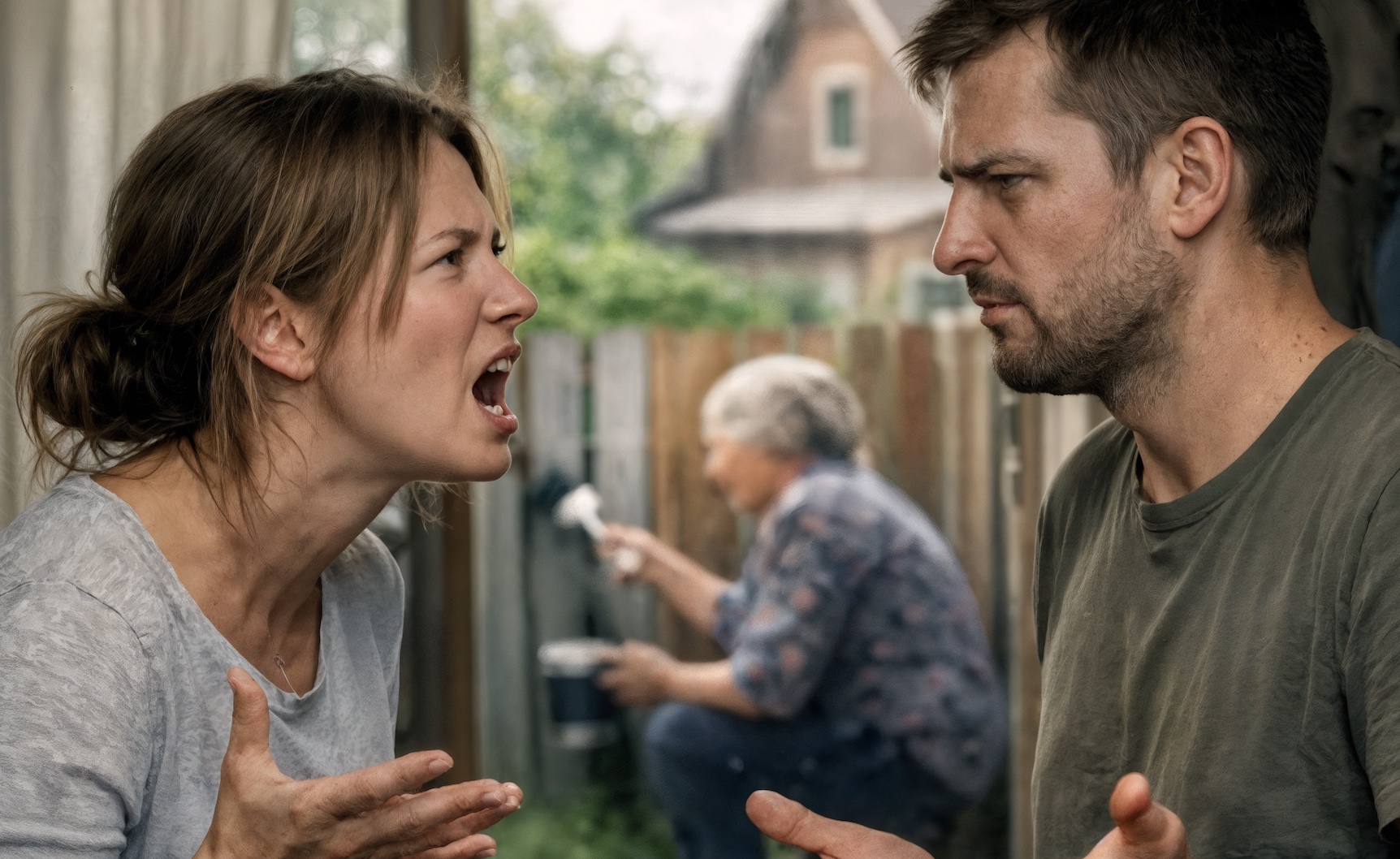
— Anyway, get ready, Sveta. Tomorrow morning we’re going to Mom’s dacha, — Andrey said matter-of-factly, hooking a forkful of mashed potatoes and putting it into his mouth. He spoke as if it were something settled long ago—obvious, unquestionable.
Svetlana went still. Her fork, with a piece of chicken on it, hung halfway to her lips, and for a heartbeat her mind emptied completely. She slowly lowered her hand. Her legs—still buzzing after twelve hours on her feet in the store—answered with a dull, aching throb. Her back, rigid from standing by the register all day, cramped in a sharp, unpleasant spasm.
All week she’d lived for one single thought: Sunday. Her lawful, hard-won day off—the one she planned to spend flat on her back, surrounded by pillows, watching some stupid show.
— We… are? — she asked quietly, almost inaudibly, looking at her husband as though she were seeing him for the first time.
— Well, yeah. I promised I’d help her paint the fence. Two of us will get it done faster, — he replied just as lightly, not even lifting his eyes from his plate. — She already bought the paint, the brushes. The weather’s supposed to be perfect—no rain.
Something inside Svetlana snapped. A spring that had been tightening through six miserable workdays suddenly released with a loud, ringing jolt.
— A dacha?! So after working six days, I’m supposed to spend my only day off painting your mother’s fence? Why don’t you go yourself and help her, if you’re such a caring son?!
Andrey finally looked up at her. His face held honest bewilderment, like she’d just suggested he fly to the moon.
— Sveta, why are you starting again? Mom needs help. I can’t refuse. She won’t manage alone—you know that. It’s not hard, a couple of hours, and then we’ll make шашлыки, hang out outside. You’ll get some rest.
Svetlana gave a bleak little smile. You’ll get some rest sounded like a cruel joke.
— Rest? Andrey, do you even hear what you’re saying? I’m on my feet from eight in the morning until nine at night. By the end of the shift, the numbers on the price tags are swimming in front of my eyes. I want one thing—to lie down and have nobody touch me. No fences, no brushes, and definitely no шашлыки.
— You should be the one helping. You’re her son. And you’re the one who promised, — she said crisply, pushing her plate away. Her appetite had vanished. — I didn’t promise your mother anything. And I had completely different plans for my day off.
— Are we a family or what? — Andrey frowned, setting his fork aside. His easy mood drained away before her eyes. — You help together. What’s the problem? I’m not asking you to haul cement bags. Just paint a few boards.
— A family is when people actually consider each other, — Svetlana cut in. — When you ask whether your wife has the strength—or the desire—after a hell week to play painter. Not when you announce it over dinner like a decree. You already scheduled my day off and didn’t even think to tell me. You just decided for me.
The dinner she’d been looking forward to cooled on the plates, turning into an unappetizing mess. Andrey stared stubbornly, brows drawn down. He didn’t understand—or didn’t want to. In his world everything was simple: Mom asked, son does it. And the wife is just an attachment to the son, a built-in feature that’s supposed to do the same by default.
— You have to rest wisely, not just lie around, — he finally pronounced, and there was open disapproval in it. — One day on the couch isn’t rest, it’s laziness. Out in nature you’ll recharge.
— Did you just call how I feel “laziness”? — Svetlana pushed her chair back, creating space between them. — You—with your comfortable Monday-to-Friday, nine-to-six—are going to lecture me on “proper rest”? Have you ever stood on your feet through a pre–New Year’s rush? Or Black Friday? When people trample everything in their way and you still have to smile and wish them a nice day?
His “laziness” hit harder than any other accusation. It erased her exhaustion, turned it into a whim, a mood. Andrey stood up too, bracing his knuckles on the countertop. His face shifted from puzzled to hard and angry.
— Exactly. Normal wives help their husbands and support them instead of making a scandal out of nothing. I’m just asking for help—for my mother, by the way, who does things for both of us. Always bringing cucumbers and herbs from the dacha—
— So I’m not “normal,” is that it? — Svetlana met his stare. Inside, everything iced over. — Because I don’t want to sacrifice my only day of rest for your “duty as a son”? Did you ever think that maybe I need help? Just to lie down and recover? Or is your “help” only ever about solving your mother’s problems at my expense?
He snorted and turned away dramatically. It was his favorite move: when he ran out of arguments, he stopped listening, as if the discussion were over and he’d won.
— Talking to you is pointless. You only hear yourself. Selfish.
The accusation hung in the air—thick, ugly. Without looking at her, Andrey walked into the room and picked up his phone from the table. Svetlana watched him, already guessing what came next. This wasn’t just a call. It was calculated—cruel—the next scene in this play. He was calling in heavy artillery.
He dialed with deliberate emphasis and put it on speaker.
— Mom, hi, — his voice changed instantly, turning soft, weary, noble. — Yeah, everything’s fine. About tomorrow—there’s a small change of plans.
On the other end she heard Tamara Igorevna’s brisk voice.
— What is it, Andryusha? Something happened?
— No, nothing special. It’s just… Sveta’s not really in the mood to go. Says she’s very tired and wants to stay home, — he said it as if quoting a sulking child, not an adult woman. — So I’ll probably come alone. It’s okay, I’ll manage somehow. It’ll just take longer.
Svetlana stared without blinking. He didn’t say she’d worked six days in a row. He didn’t say she could barely stand. He just made her sound like a lazy egoist who “didn’t feel like it.” He complained to his mother like a boy who’d been wronged in a sandbox—and punished Svetlana at the same time, knowing exactly what would follow.
— Oh, she’s tired… — Tamara Igorevna drawled, steel already edging into her tone. — Well, what can you do. Of course, come alone, son. We’ll deal with it.
Andrey ended the call and set the phone down with the air of injured virtue. He didn’t look at his wife. He waited—waiting for her reaction, her apology, her surrender.
But Svetlana stayed silent. She looked at the cold food, at the husband who had just betrayed her in the smallest, most humiliating way, and understood it had never been about the fence.
She didn’t say a word. Quietly, she gathered the plates and carried them into the kitchen. She turned on the water and began washing the dishes with deliberate, methodical movements, focusing on the sponge, on how warm water rinsed away grease. It was the only thing she could do—simple, mechanical work that kept her from exploding. Andrey stayed in the other room, and his silent presence pressed down harder than any shouting. He waited. He was sure his little tactic had worked, and now she would come back, “realizing how serious her mistake was,” and apologize.
Her phone, left on the kitchen windowsill, vibrated and began to ring. Svetlana knew who it was before she even looked.
Tamara Igorevna.
Her mother-in-law didn’t waste time. Svetlana dried her hands on a towel and picked up. Her fingers trembled slightly, but when she spoke, her voice was even and cold.
— Yes. I’m listening.
— Svetochka, hello, dear, — her mother-in-law’s voice dripped with syrupy honey, and beneath it the poison was unmistakable. — I’m calling and you sound like you’re not glad to hear me. Andryusha said you weren’t feeling well? Tired, our poor thing.
Svetlana closed her eyes. This “caring mother” act made her nauseous.
— I’m not unwell, Tamara Igorevna. I truly am tired. I only had one day off this week, and I want to spend it at home.
— Oh, that job of yours… You really don’t take care of yourself, — her mother-in-law sighed sympathetically, then immediately shifted her tone. — But all the more reason, Svetochka! Come to the dacha, get some fresh air. I’d feed you, you and Andryusha could sit in the sun while the paint dries. That’s what rest is! The dacha is for you too—we’re not doing this only for ourselves. It’s not nice when your husband is out there struggling alone while his wife lies at home.
Every word was measured. Every sentence a small but precise jab: “not only for ourselves,” “husband struggling,” “wife lying at home.” Tamara Igorevna was a master of that kind of manipulation.
— I understand what you’re trying to say, — Svetlana replied calmly, deciding not to bite. — But I’ve already made my decision. I’m staying home. Andrey will help you—he’s a strong man, he’ll manage.
A brief pause followed. Clearly, her mother-in-law hadn’t expected such a direct refusal. She was used to her daughter-in-law giving in after a few rounds of persuasion.
— Well, if you’ve decided… — metal scraped in Tamara Igorevna’s voice. — It’s your business, of course. But Andryusha is upset. He was counting on you. He always said his wife was his helper, his support. And now…
— He was counting on me without even asking me, — Svetlana cut in, feeling her patience fray. — I think it’s better if he and I resolve this without your involvement. All the best.
She ended the call without waiting for an answer. Her hands trembled with restrained anger. She set the phone down face-first, as if trying to block out the whole world.
Almost immediately, Andrey walked into the kitchen. His face was twisted with rage.
— What the hell do you think you’re doing? — he hissed, stepping close. — Why are you talking to my mother like that? She called you like a normal person, wanted to talk, and you’re rude to her and hang up!
— Like a normal person? — Svetlana straightened, looking him in the eye. — Your mother called to lecture me and accuse me of being a bad wife—after you ran crying to her and made me sound like a moody idiot. That’s what you call “normal”?
— She’s just worried! About me, about the family! Unlike some people, — he shouted. — You showed her outright disrespect! She’s older than you, she’s my mother! You should’ve at least pretended to listen!
— I’m not pretending for anyone, — Svetlana’s voice began to shake too. — Not for you, and definitely not for her. This is my home and my day off. And I will not let her—or you—decide for me how I spend it. You crossed every line when you called her and staged this circus.
— You are going to call her right now and apologize! — Andrey jabbed his finger toward the phone on the table. His face flushed purple with anger, a vein bulging in his neck. This was no longer a conversation—it was an order.
Svetlana looked at his finger, then at his face warped by rage. In that moment she didn’t see a husband or a loved one—she saw a spoiled, cruel boy who couldn’t get his way and ran to his mother to “handle” his disobedient wife. And now he demanded a humiliating repentance for the crime of having her own wishes.
— I’m not apologizing to anyone, — her voice came out unexpectedly calm and firm. The storm inside her suddenly settled, replaced by cold, crystal clarity. — You should be the one apologizing. For not seeing me as a person. For treating me like property you can loan out to your mother. For being a coward who hides behind her skirt the moment there’s conflict.
Each word was chosen carefully and landed exactly where it hurt. She saw him flinch when she said “coward.” He opened his mouth to argue, but she didn’t let him speak.
— You think this is about a fence? About that stupid dacha? No. It’s about you. About the fact you still haven’t grown up. For you, the most important thing is still being Mommy’s good boy. And I’m just a function that’s supposed to help you with that—cook, clean, smile at your relatives, and, of course, paint fences whenever you say. No right to be tired. No right to an opinion. No right to a life of my own.
She stepped back toward the kitchen doorway. Suddenly it felt unbearable to be in the same enclosed space with him. The air seemed thick, saturated with his anger and her disappointment.
— I didn’t ask much of you, Andrey. I just wanted to rest. One day. So tomorrow I could go back to work and smile at people again, earning money we spend together. And instead of simply understanding and giving me that, you put me on trial. First you, then your mother. The two of you decided I was guilty. Guilty of what? Of being exhausted?
He said nothing—only breathed heavily, staring at her with hatred. His arguments were spent; all that remained was raw, powerless anger. He’d lost on every front and he knew it.
— So here’s what’s going to happen, — Svetlana continued, her voice distant, like she was speaking about someone else’s life. — Tomorrow you’ll take your brushes and your paint and you’ll go to your mother’s. You’ll paint that damn fence. Paint it three coats if you want. And then you can stay there. Since she matters more to you.
She turned and walked to the bedroom—no slammed doors, no dramatic farewell. She simply left the kitchen, leaving him alone among the cold dinner and the wreckage of their marriage. Andrey stood there staring after her. He expected anything—screaming, accusations, hysterics. But her cold, contemptuous calm disarmed him and humiliated him far more.
Svetlana went into the bedroom and closed the door. She wasn’t going to pack a bag or run out into the night—that would be pointless drama. She simply took a book from the shelf, lay down on her side of the bed, switched on the night light, and opened to the first page. She wasn’t going to read. She just wanted to show him—and, more importantly, herself—that he no longer had power over her. His world of his mother, the dacha, and fences no longer existed for her. He could yell, pound on the door, beg, or threaten—it wouldn’t matter anymore.
Andrey remained standing in the kitchen. He stared at the closed bedroom door and understood something irreversible had happened. He hadn’t gotten his way. He hadn’t forced her to submit. Worse—he’d lost her respect, and maybe he’d lost her entirely.
And it wasn’t the fence. And it wasn’t Sveta’s “selfishness,” the story he wanted to tell himself. It was him. He was to blame.
But he didn’t have the strength to admit it. It was easier to hate her for the fact that she’d turned out to be stronger…