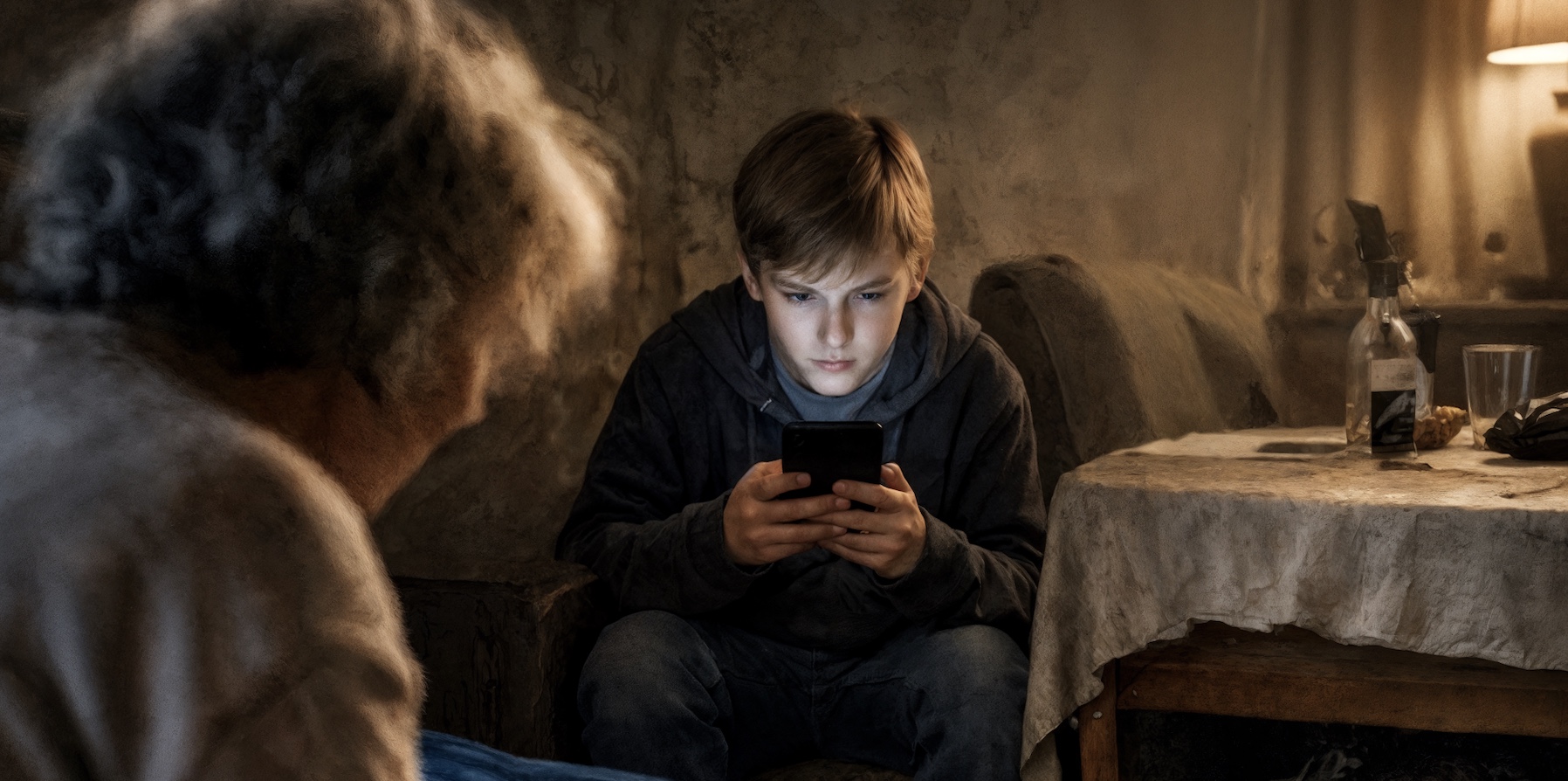
Oleg barged into the entryway long after midnight.
He didn’t just smell of the usual—motor oil and metal shavings from his auto shops. Cutting through that ground-in, familiar stink was another scent: sweet, cloying, чужой.
Cheap perfume.
Svetlana silently raised her eyes from her book. She’d stopped asking where he’d been a long time ago.
“Still reading?” he twisted his mouth as he kicked off his jacket and let it drop to the floor. “Trying to get smart?”
Without a word, she picked it up. For twenty years she’d been picking up whatever he threw—first socks, then cigarette butts, and now… an entire life.
“I ate already,” he tossed out as he headed for the kitchen.
“Okay.”
“What do you mean, ‘okay’?”
He opened the refrigerator and, with a look of disgust, scanned the pots of her soup and the cutlets he used to love.
“Nothing,” Svetlana said, feeling the familiar clamp in her stomach. She’d learned to smother every spark before it could turn into a blaze.
Oleg slammed the fridge shut as if it offended him.
“I’m tired of all of this, Sveta.”
She went still.
“Tired of what?”
“Of you. This… dreariness. This apartment. Your cutlets. I want to live differently.”
He’d “made it.” Two workshops—grown from a filthy garage where she’d once stood in rubber boots helping pour the concrete floor and paint the walls—now brought in decent money. And she didn’t. She had “gotten old.”
“Differently how, Oleg?”
“Without you.”
His words didn’t strike like thunder. They landed flat and cold, like a slab of stone.
“I want you to leave.”
“Where would I go? To my mother’s one-room place? Oleg, we—”
“No more ‘we’!” he snapped, suddenly shouting. “There’s me! My business! And my apartment!”
“It’s mine too. We bought it together—”
“I’m the ‘together’!” he jabbed a finger at his chest. “I busted my back, and you just… wiped dust.”
Twenty years of support. Twenty years of sleepless nights when he crashed, then took out another loan and tried again. Twenty years of her quiet faith that kept him afloat.
He called it “wiping dust.”
“So… come on,” he swept his arm around the living room—her photos, her throw on the couch. “Clear out.”
“You… you’re throwing me out?”
“I’m giving you a week to pack your things,” he said sharply, staring past her as if looking through the bridge of her nose. “And don’t touch anything. Everything here is mine. You won’t get a penny.”
He turned and went into the bedroom.
Their bedroom.
Svetlana remained standing in the middle of the room, which suddenly felt чужой—as if it belonged to someone else. The sickly perfume seemed to have soaked into the wallpaper.
That was the first night she spent on the couch in the living room.
She didn’t sleep. She lay motionless, staring at the ceiling, trying to build a logical chain in her head.
Useless. Logic shattered against something irrationally cruel.
In the morning she tried again—not as a victim, but as a partner. The way she had for twenty years.
“Oleg,” she met him by the coffee machine. “We can’t do this. It’s not… not human. Let’s sit down and talk. Like adults.”
He didn’t even look at her. He waited for the coffee to fill his mug—a new one with a brazen label: BOSS.
“I talked it through, Sveta. Yesterday.”
“But this is my life too. I have nothing except this home.”
“That’s your problem,” he said, taking a sip. “You should’ve thought earlier. Become someone instead of… a shadow.”
He said it calmly, like everyday conversation. And that was the worst part.
“I was your support,” she whispered.
“Supports break. Or you swap them for new ones,” he smirked. “You have six days.”
On the second day he started acting on it.
He brought home some garish, ridiculous poster in a frame: red cars and a half-naked girl.
“Walls look empty,” he grunted, and without asking, hammered a nail right above the spot where their old wedding photos and pictures of their son had hung.
He took the frames down and tossed them onto the side table. The glass on one of them cracked.
Svetlana watched him hang the poster. He wasn’t just pushing her out. He was erasing her past, painting over her life the way he’d once smeared paint over the walls in their first garage.
By the third day, the apartment was saturated with that cloying scent.
Oleg came home and carelessly threw a blazer onto the couch—onto her couch.
Svetlana went to pick it up and nearly choked. The blazer smelled as if it had been soaked in that perfume.
She pinched it between two fingers like something filthy and hung it in the closet. But the scent stayed on her hands.
She scrubbed her palms with soap until they turned red, but the stench wouldn’t go away. It was everywhere.
That same evening he brought home restaurant takeout. He opened the refrigerator and, without a word, pulled out her pot of soup and set it on the floor. He stacked his containers in its place.
“Smells sour,” he tossed at her.
Her attempts to “talk” and “appeal to reason” kept collapsing. He no longer saw a person in her.
On the fourth day she finally did it. She called their son, Egor.
“Mom? Hi! Is something wrong?” Egor always sensed her mood.
“No, sweetheart, of course not…” Her stoic armor was almost impossible to crack. “It’s just… your father’s not in the best mood. Probably tired.”
“‘Not in the best mood’?” Ice slid into Egor’s voice—the voice of a young programmer living on his own. “Mom, what is he doing now?”
“Everything’s fine, Egorushka. It’s just… maybe you could stop by? Talk to him?”
A pause. Long. Heavy.
“Mom. I… I’ve suspected for a while that something’s off. And last week I saw him.”
“Saw him?” she didn’t understand.
“At the mall. He wasn’t… alone. With some girl. They were picking out…” Egor hesitated, “…bed linens.”
Svetlana sat down.
“I didn’t want to tell you. I thought maybe I was wrong…”
“Egor…”
“Mom, listen,” his voice hardened into something adult, unfamiliar. “Where are you right now?”
“At home.”
“Is he there?”
“No. At work. At his shops.”
“Mom, I hired someone. Two weeks ago. Seeing him at the mall was just… the last straw.
Don’t do anything. Do you hear me? Don’t pack. Don’t leave. Act like normal. I’ll come—but not right away. I need to… finish something.”
“Egorushka, what are you—”
“Mom, just trust me. I’ll get proof. I have to.”
He hung up.
Svetlana stared at her phone. She hadn’t asked for help. But her son, it seemed, had understood everything without her saying a word.
On the fifth day, Oleg came back furious.
“You’re still here?” he growled from the doorway, not even taking off his shoes.
Svetlana silently nodded.
“Did you not understand me? The week’s almost over!”
“I have no money, Oleg. And I have nowhere to go.”
“I don’t care!” He marched into the living room and saw her sitting on “his” couch.
“Pack your things, old hag!” he suddenly roared so loudly the windows rattled. “Did you hear me? Get out of my life!”
He was raging. He wasn’t used to being disobeyed—not even for a second.
He grabbed a cardboard box left over from some appliance.
“Can’t do it yourself? I’ll help!”
He went to her bookcase—her only personal island in the entire apartment. Her books. Her photo albums.
And he started sweeping everything off the shelves into the box. No sorting. Tearing covers, crumpling pages.
“Don’t touch that!” she blurted.
“I’m touching it!” he laughed. “It’s all junk—just like you!”
He grabbed an old photo album with a velvet cover, the one with pictures of her parents, and hurled it into the box.
It hit the corner, and the metal trim snapped loose.
The moment that bent strip of metal scraped across the parquet floor, something inside Svetlana broke.
Not with a crash. No sobbing. Just a quiet click.
All the pain, the humiliation, the fear that had built up for twenty years—and boiled over these last five days—evaporated in an instant.
Only a ringing, frost-cold indifference remained.
She rose slowly from the couch. Oleg, drunk on his own impunity, grabbed another stack of books.
“Enough,” she said.
Her voice was so level and dull that he froze. Not from fear—from surprise. There were no tears in it. No hysteria.
“What do you mean, ‘enough’?” he smirked, but less confidently. “I’m just getting started!”
“I said: enough.”
Svetlana walked up to him. She didn’t look at him. She looked at the album.
She bent down, carefully pulled it out of the box, smoothed the velvet cover, and set it on the table.
“You win, Oleg,” she said, staring at the poster with the red car. “I’ll go.”
He blinked. He’d expected a battle, tears, curses. Instead he got surrender.
“Yeah!” He straightened, puffing himself up—victory at last. “That’s better! Should’ve done that ages ago!”
“I need to pack the essentials,” she said, just as evenly.
“Pack,” he permitted grandly. “Just be quick. Tomorrow, I don’t want to smell you in here.”
He threw the box onto the floor and, pleased with himself, disappeared into the bedroom, slamming the door. A moment later the TV came on. He was celebrating.
Svetlana stayed in the living room.
She stood for a minute, listening to the TV’s drone, then went to the couch and picked up her phone.
Her fingers didn’t shake.
She dialed Egor.
“Mom?” he answered instantly, as if he’d been waiting.
“Egor,” her voice was just as icy. “Dad threw me out. I told him I’ll leave tomorrow.”
“Mom, no! I—”
“Do what you have to do,” she cut him off. “Do it now. Come.”
She ended the call.
She didn’t start packing. Why would she?
She sat back down on the couch. For the first time in days, her back was perfectly straight.
She wasn’t a victim anymore. She was an observer.
She looked at the ridiculous poster, the scattered books, the cracked photo frame—and felt nothing but cold disgust.
The чужой perfume seemed thicker now. It seeped from everywhere—from the blazer in the closet, from the new poster, from Oleg himself behind the wall.
It smelled like rot. The rot of their life.
She waited.
An hour passed. In the bedroom, Oleg seemed to have dozed off to the murmur of the TV. He was calm—he’d solved his “problem.”
A key turned in the lock.
Svetlana didn’t flinch. Egor had his own keys.
Oleg heard it too. The TV fell silent.
“Who is it now?” he grumbled as he stepped into the hallway. “Sveta, who did you—”
He cut himself off.
Egor stood in the entryway.
And he wasn’t alone.
Beside him was a short, solidly built man in a plain jacket—Nikita Sergeyevich.
“Egor?” Oleg frowned. “And who’s that?”
“Hi, Dad,” Egor said, his voice calm, just like his mother’s. “This is Nikita Sergeyevich. He’s… a private investigator.”
Oleg blinked.
“A what? Son, have you lost your mind?”
“No.” Egor walked into the living room carrying a laptop. Nikita Sergeyevich followed without a word.
Svetlana watched her son. She hadn’t known the plan. She’d simply trusted him.
“Mom, sit down,” Egor said softly.
“What is this?” Oleg started to wind up again. “I didn’t invite you! And that—get him out of here!”
“He’s leaving,” Egor nodded. “His job is finished.”
The investigator placed a flash drive and a small voice recorder on the table in front of Svetlana.
“Everything’s here,” Egor said, looking at his father. “Two weeks’ worth. Nikita Sergeyevich did excellent work.”
“What ‘everything’?” Oleg screamed.
“Mom,” Egor ignored him, “Dad was right about one thing. You shouldn’t have been ‘wiping dust.’ You should’ve been watching him.”
He opened the laptop.
“I thought you had one… mistake, Dad. That thing at the mall. Turns out I was wrong.”
Oleg went pale.
“Egor… don’t you dare.”
“You’ve got three, Dad.” Egor turned the screen toward him.
A video was playing—shot from the side, from inside a car.
A parking lot outside one of his shops. Oleg got out of his SUV, hugged a young blonde, and kissed her. The same one from the mall.
“That’s… that’s edited!” Oleg breathed.
“Is it?” Egor tapped a key. “And this—is it edited too?”
Another clip. A restaurant. Oleg sat with a different woman, a brunette. He was holding her hand, leaning in close, murmuring something.
“And this,” Egor didn’t let him speak, “was filmed yesterday. At the apartment you rented on Zarechnaya Street.”
A third woman—a redhead. The two of them walked into a building.
Oleg stared at the screen. His face drained from red to an earthy gray.
“You spent the shop money on them, Dad,” Egor’s voice rang with restrained fury. “While Mom was saving pennies on herself. You bought them cars. You rented them apartments. All of it—with money from the business.”
“You…” Oleg looked at Svetlana, then at Egor. “You spied on me?”
“I protected Mom,” Egor snapped. “And here’s the funniest part: all three of them know about each other. And they hate you.”
Egor picked up the voice recorder.
“This is slander!” Oleg tried to reclaim his voice, but it came out hoarse. “You’re lying! I—”
“You’re right, Dad,” Egor cut him off. “Videos are just pictures—hurtful, sure, but not fatal. But this…”
He pressed Play.
Oleg’s voice poured from the speaker. Not the rough, yelling voice from home—another one: oily, boastful, drunk.
He was talking to someone—probably the blonde.
“…Relax, baby. The old one will move out soon. You think she’ll get anything? Don’t make me laugh. The shops? I transferred them to Pavel, my brother—six months ago. And the apartment? I can prove she never worked a day. She’s furniture. Just furniture. She’ll leave with her pots…”
Svetlana slowly turned her head. She didn’t look at Oleg. She looked at the recorder.
“Furniture,” she repeated out loud.
Oleg flinched like he’d been hit. He looked at his wife—at her calm, cold face—and understood.
This was the end.
He wasn’t the BOSS anymore. He was a petty, bragging little man caught in a lie by his own son.
“You—” He lunged toward Egor, trying to grab the recorder.
Egor stepped back.
“And that’s not all, Dad,” he said.
He nodded toward the flash drive.
“Nikita Sergeyevich is a professional. He doesn’t break into safes. He listens. He found your former accountant, Antonina Petrovna. The one you fired half a year ago—‘because she knew too much.’”
Oleg froze.
“She was very happy to share… copies of some books. Digitally.”
“I’m a programmer, Dad,” Egor went on, plugging the drive into the laptop. “I checked the Excel files she gave me. This isn’t just tax evasion. These are serious fraud schemes.”
Oleg sagged. He looked at the couch, but didn’t sit.
Slowly, like an old man, he lowered himself… onto the very cardboard box he’d been using to dump his wife’s books.
He slid down the wall and ended up on the floor among torn covers and scattered pages.
A heavy silence filled the room, broken only by the laptop’s soft hum.
“So,” Egor said, switching the recorder off. “Here’s how it’s going to be, Dad.”
Oleg lifted empty eyes to him.
“You’re not throwing Mom out. You’re leaving. Tonight.”
“Where?” Oleg whispered.
“I don’t care,” Egor replied, using his father’s own words. “You’ve got three apartments you’re renting. Go to any of them—if they’ll even let you in.”
“And… the business?”
“We’ll split it. Right now. You’re transferring one of the shops to Mom—the smaller one. And this apartment. Fully.”
“I… I can’t! They’re in my brother’s name! Pavel’s!”
“You can,” Egor’s voice left no room for argument. “Pavel is as much an ‘owner’ as you are. He’s in on it. He goes down with you. So you’ll call him and fix it. Right now.”
“And if I… don’t?” Oleg tried one last time.
“If you don’t,” Egor lifted the flash drive, “this goes straight to the tax authorities. And you both go to prison. Mom will be a witness—the woman you lied to and robbed.”
Egor held out his phone.
“Call.”
With shaking hands, Oleg dialed. Egor turned on speaker.
“Pash? Hi. Listen… we’ve got a situation…” Oleg stammered, glancing at his son.
“Say it,” Egor ordered quietly.
“…They got us. Over the black cash. Yes. It’s over. We need to—urgently—transfer my share of the small shop and the apartment… to Sveta. Yes, to Sveta! Because otherwise…” His voice broke. “…otherwise we’re finished. Both of us.”
Silence on the other end—then a burst of filthy cursing.
“You idiot, Oleg! I told you!”
“Do it!” Oleg snarled, suddenly finding strength in panic. “Just do it! Tomorrow—at the notary!”
He threw the phone onto the table.
“Happy now?”
Egor nodded, expressionless.
“Now leave, Dad.”
Oleg stood up. Without looking at his wife or his son, he shuffled into the hallway, pulled on the same jacket that smelled of oil—and walked out.
The door slammed.
Egor remained in the living room. Svetlana went to the window and flung it wide open.
Cold November air rushed in, driving out the cloying чужой perfume embedded in the walls.
“Mom…” Egor stepped closer. “He’ll sign everything. I—and Uncle Pasha—we’ll make sure.”
She nodded, staring at the dark trees in the yard.
“Mom… what will you do now?”
Svetlana turned. She looked at the scattered books, the broken frame.
Then she looked at her son. There were no tears in her eyes. No triumph—only calm.
“Me?” She picked up the velvet album. “Right now, I’ll clean up. And then, Egorushka… I’m going to sleep. In my own bed.”
Epilogue
Half a year passed.
The apartment smelled different now. Not of cheap perfume and not of motor oil. It smelled of freshly ground coffee, a little plaster dust—and faintly, lavender.
Svetlana was finishing a coat of paint in the living room—a deep, complicated blue. That red-car poster had been burned long ago at the dacha. She’d pulled the nail out and carefully patched the hole.
She didn’t “open a studio” or “learn languages.” She did what she’d always known how to do—create comfort. Only now, she did it for herself.
The workshop she’d gotten turned out to be surprisingly profitable, even if it was small. Egor helped her with paperwork and found a competent manager—a young guy who’d once worked under Oleg and quit when he couldn’t stomach the schemes.
Svetlana handled the books herself. She’d managed their household budget her whole life; now she managed the numbers of her own small business. And the numbers balanced.
She hung the old family photos on the wall in new, matching frames. The velvet album lay on a clean, polished table.
Egor dropped by one evening with groceries.
“Mom, you’re covered in paint,” he smiled, hugging her.
“Creative process,” she laughed. That light, free laugh was Egor’s greatest reward.
“How… is he?” Egor asked as he started unpacking the bags.
Svetlana shrugged.
“He called last week. Asked for money.”
“Did you give it to him?” Egor tensed.
“No.”
Oleg’s ending was predictable. Left with one last, troubled shop, he sank quickly into debt. The tax office—after Egor finally “alerted” them with an anonymous letter—picked at the remains. Uncle Pavel, barely saving himself, cut him off completely.
None of the three “babies” stayed once it turned out he wasn’t the BOSS but a bankrupt man. He ended up somewhere in a rented room on the outskirts, surviving on odd jobs.
“He said I ruined his life,” Svetlana added calmly, twisting open a jar of olives.
“And what did you say?” Egor asked.
“I told him he’d done a fine job of that all by himself. And I hung up.”
She was no longer “furniture.” And she was no longer a stoic woman who suffered in silence. She was simply Svetlana—a woman who chose herself.
“Are you staying for dinner?” she asked her son. “I made pasta today.”
“Gladly.”
She set out plates, and in that simple, ordinary gesture there was more life and dignity than in all twenty years of her past “endurance.”