When I married Dima, I honestly thought the hardest part was already behind us. We met at university, fell in love almost instantly, and for a while it felt like the world existed for just the two of us. Dima was attentive, kind, patient. He backed me up in everything, and I was certain we’d get through any challenge together.
I just didn’t realize that the biggest challenge would have a name—Valentina Petrovna—and she would be my mother-in-law.
We moved into her apartment right after the wedding. There wasn’t much choice: rent was expensive, and we didn’t even have enough saved for a down payment on our own place. Valentina Petrovna offered to let us stay “temporarily,” until we got on our feet. Dima worked as a programmer, and I was an accountant at a small company. Our salaries weren’t bad, but in Moscow’s housing market they were painfully insufficient.
That “temporary” arrangement dragged on for a year and a half. A year and a half of hell I swallowed in silence while putting aside whatever I could for our own apartment.
It started literally the day after we moved our things in. Early that morning I woke up to loud banging on our bedroom door.
“Marina!” Valentina Petrovna’s sharp voice cut through the quiet. “It’s already eight! Breakfast isn’t going to make itself!”
I looked at Dima in confusion, but he only mumbled something and turned to face the wall. Clearly, this was normal for him.
From that day on, my life turned into an endless carousel of household labor. Valentina Petrovna didn’t work—she’d retired the year before—but despite having plenty of free time, she shoved every single chore onto me.
I cooked breakfast, lunch, and dinner. I washed floors throughout the entire three-bedroom apartment, did laundry, ironed, ran to the store for groceries. I cleaned up not only after myself and Dima, but after Valentina Petrovna too—who seemed to scatter things deliberately and leave dirty dishes behind as if to make a point.
“You’re young and healthy,” she’d say the one time I tried to protest. “And I’m an old, sick woman. My blood pressure, my heart… the doctor told me I can’t overdo it.”
And yet this “sick woman” constantly went out with friends, to the theater, to exhibitions. She had endless energy for entertainment, but the second I asked her to help with even something simple—like chopping a salad—she instantly transformed into a frail old lady.
Dima didn’t notice what was happening. Or rather, he refused to notice. When I tried to talk to him, he waved me off:
“Masha, that’s my mom. She took us in, she helps us. Can’t you help her a little in return?”
A little? I worked eight hours at the office and then spent another four hours working at home. I didn’t have a single minute to myself. I woke up at six to make breakfast in time, and I went to bed after midnight after dealing with a mountain of dishes from dinner.
But the worst part wasn’t the work.
The worst part was the nonstop humiliation.
“Marina, how could you oversalt the soup like this?” she’d shout at the table—even though the soup was perfectly fine. “Do you even have taste buds?”
“Marina, you hung the laundry wrong again! It’ll dry stiff and it’ll be impossible to iron!”
“Marina, you bought the wrong tomatoes. I asked for red ones, not pink! Useless girl.”
Every day brought dozens of petty attacks, sarcastic digs, and degrading comments—on top of constant exhaustion.
I endured it. I counted the days and saved every spare ruble. Dima and I had already scraped together nearly half the amount we needed for a down payment. A few more months—and we could finally escape.
But the peak of it all was Valentina Petrovna’s birthday.
A month before the date she announced:
“I’m turning sixty. That’s a serious milestone. I want a proper reception. Relatives, friends—at least thirty people.”
I went cold. Thirty people. In a three-bedroom apartment. And it didn’t need to be said out loud who would be cooking for them.
“Mom, maybe we should order something from a restaurant?” Dima suggested. “It would be easier.”
“A restaurant!” Valentina Petrovna scoffed. “Why waste money when we have Marina? She’ll handle it perfectly. Right, Marina?”
She looked at me with open defiance. Her eyes practically said, Just try to argue.
I stayed quiet. Just a bit longer, I told myself. Hold on a little more and it will be over.
The month that followed was a nightmare. Valentina Petrovna changed the menu daily, rejected everything I suggested, and demanded increasingly complicated dishes. One day it was duck with apples, the next it was sturgeon aspic, then a homemade Napoleon cake—thirty servings.
“I told you it’s an important occasion!” she screamed when I dared to suggest something simpler. “What will my guests think if I serve basic salads?”
I made shopping lists, ran to stores after work, tested recipes late at night. My back ached, my legs swelled, but stopping wasn’t an option.
A week before the party she announced a full “deep clean.”
“Everything has to sparkle!” she ordered, perched on the couch with a cup of coffee, while I washed chandeliers, scrubbed the bathroom, and polished mirrors. “Look, there’s a spot here! And the windows need washing too. It’s filthy!”
I nodded and kept working. One thought repeated in my head like a prayer: Just a little longer. Just a little more.
Finally her birthday arrived. I woke up at five in the morning to cook everything in time. Dima left for work—he said he had an important project he couldn’t postpone. Or maybe he just didn’t want to stay and help. Lately I didn’t even know what to believe.
By two o’clock the apartment was full of guests: aunts and uncles, Dima’s cousins, Valentina Petrovna’s friends, neighbors. Everyone dressed up, bringing bouquets and gifts.
I managed to change into a simple blue dress and put on lipstick. But I didn’t even get a chance to sit at the table.
“Marina, sweetheart, bring more napkins!” Valentina Petrovna called five minutes into the meal.
“Marina, where’s the bread? There’s hardly any left!”
“Marina, Lyudochka’s glass is empty. Pour her some wine!”
I darted between the kitchen and the living room like a waitress at a banquet. Guests kept turning to watch me—some with sympathy, others with curiosity.
“What a wonderful helper you have, Valya!” one of her friends exclaimed. “She’s buzzing around like a little bee!”
Valentina Petrovna spread into a satisfied smile.
“Oh yes, our Marina is gold. She does everything— I didn’t lift a finger. She wanted so badly to make my birthday special! Isn’t that right, Marina?”
She looked at me, and I saw pure triumph in her eyes. She was enjoying it. She loved humiliating me in front of everyone, reminding me who was in charge.
“She cooked everything herself, set the table herself,” Valentina Petrovna continued, scanning the room. “I don’t even know how I’d manage without her! Marina is like a daughter to me. She helps with such pleasure, with such joy! See how hard she’s trying? She won’t even sit down with us—she’s running around serving everyone. So caring!”
Some guests nodded; a few smiled approvingly. And I stood there with an empty platter in my hands, feeling my patience finally hit its limit.
A year and a half. A year and a half of humiliation, insults, and impossible work. A year and a half of silence, clenched teeth, and it’s only temporary. But in that moment I decided—enough.
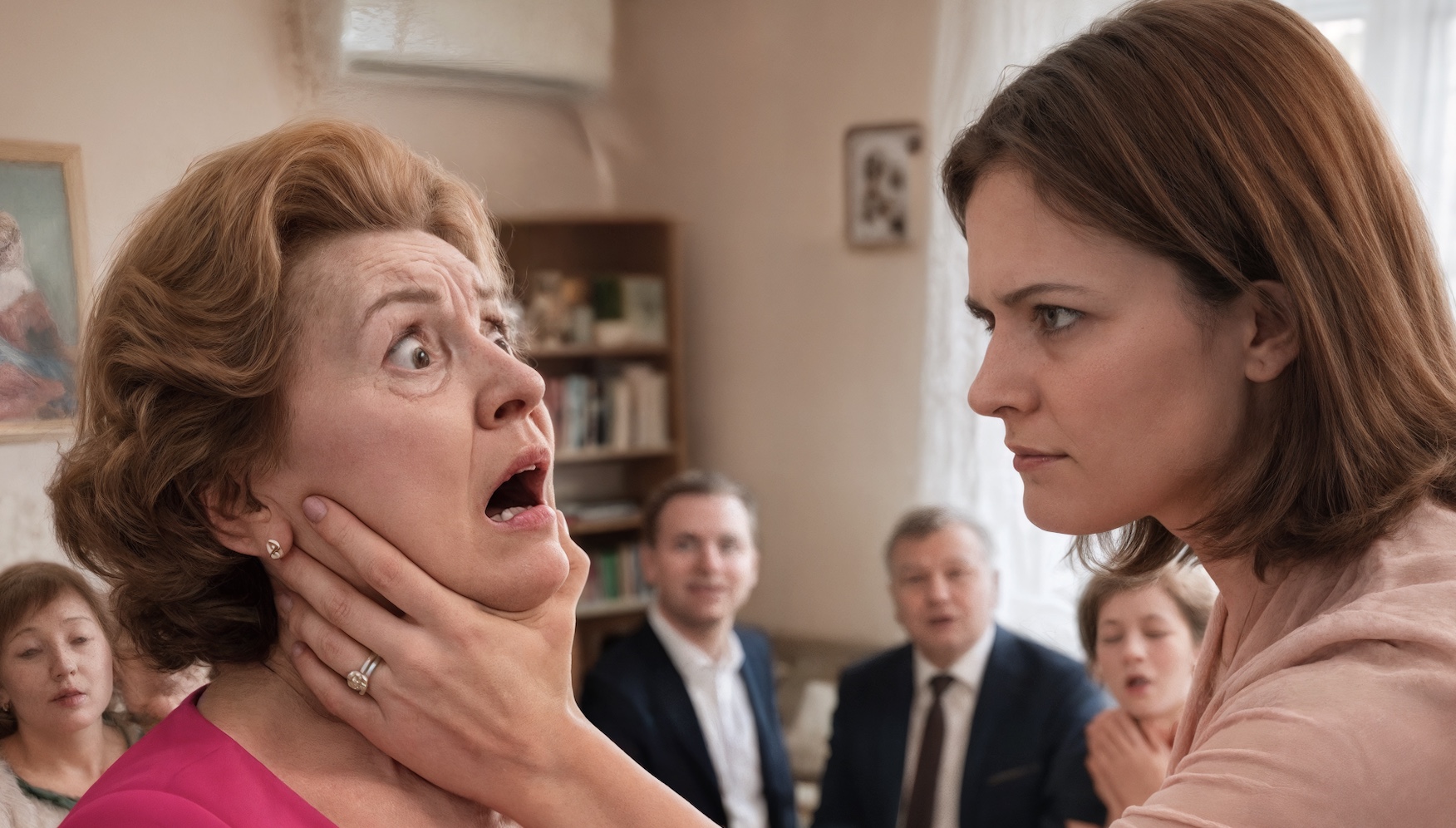
I set the platter down on the table. Slowly lifted my head and looked straight at Valentina Petrovna.
“No,” I said quietly, but clearly. “That’s not true.”
The room went dead silent. Conversations stopped mid-sentence. Everyone turned toward me. Valentina Petrovna froze with her glass in her hand, confusion stamped across her face.
“What did you say?” she asked, as if she couldn’t believe her ears.
“I said that’s not true,” I repeated louder. “I don’t do all this with joy. And I’m not trying to please you.”
“Marina!” Valentina Petrovna sprang up, her face turning crimson. “How dare you! On my birthday! In front of my guests!”
“I dare,” I answered, and my voice grew steadier. “Because I can’t stay silent anymore. You want the truth? Then you’re going to hear it.”
I looked around at the guests. They stared back, shocked and intrigued.
“For a year and a half I’ve lived in this apartment,” I began. “For a year and a half I’ve worked from morning till night—not only at my job, but here too. I cook every breakfast, lunch, and dinner. I clean the entire apartment. I wash, iron, and run all the errands. I do absolutely everything in this house.”
“And what’s so wrong with that?” Valentina Petrovna tried to cut in. “You live here for free!”
“For free?” I let out a bitter laugh. “Dima and I give you half of our salaries for utilities and household expenses—basically rent. But that’s not even the worst of it.”
I took a deep breath.
“This entire time Valentina Petrovna hasn’t treated me like a daughter-in-law—she’s treated me like hired help. She criticizes everything I do. She humiliates me, insults me, finds flaws in every little thing. The soup is oversalted. The laundry is hung wrong. The tomatoes are the wrong color. Every day there’s something new.”
“Marina, stop!” she tried to shut me down, but I kept going.
“And when her birthday came, I was the one who cooked every dish you’re eating right now. I did it after work. I ran from store to store looking for ingredients, tested recipes at night. I cleaned the apartment—washed the windows, the floors, the chandeliers. Valentina Petrovna sat on the couch that whole time and barked orders at me.”
The guests exchanged glances. One of the aunts coughed awkwardly.
“And today,” I felt my voice tremble with emotion, “today she told you that I do all of this happily. That I enjoy pleasing her. But that’s a lie. I’ve put up with it only because Dima and I have been saving for our own place. I count every day, every hour, until I can finally leave.”
“Ungrateful!” Valentina Petrovna shouted, real fury in her voice. “I took you in, gave you a roof over your heads, and you—”
“You didn’t take us in,” I interrupted. “You use me as free labor—while taking money from us for living here. And then you have the nerve to present it like you’re doing us some grand favor.”
I turned to the guests.
“I’m willing to help. I’m happy to help family when it’s truly needed. But I won’t let anyone humiliate me or treat me like an object. I’m a human being. I have dignity. And I won’t tolerate this anymore.”
A heavy silence settled over the room. Valentina Petrovna went pale, then flushed again. Her mouth opened and closed, but no words came out.
Then one of her friends—a gray-haired woman with sharp, intelligent eyes—spoke up unexpectedly.
“Valya, do you remember how you used to complain to me about your own mother-in-law?” she said. “How she worked you to the bone and never gave you peace?”
Valentina Petrovna whipped toward her.
“That was different!”
“No,” the woman shook her head. “It was exactly the same. And back then you said you’d never become that kind of person. You said you’d never treat your daughter-in-law like that.”
A low murmur rolled through the table. People began whispering.
“Marina, dear,” one of the aunts asked me carefully, “where is Dima? Does he know what’s going on?”
I gave a bitter smile.
“Dima refuses to see anything. To him, his mother is sacred. He doesn’t see what she’s doing.”
At that moment the door opened and Dmitry walked in. He had bought a cake—huge and beautiful—and carried it in with a pleased smile. But when he saw our faces, he stopped as if he’d hit a wall.
“What’s going on?” he asked, bewildered.
“Dima,” I walked up to him, “I can’t live like this anymore. Either something changes, or I’m leaving. Right now.”
“Masha, what are you talking about?” He reached for my hand, but I stepped back.
“Ask your mother,” I said. “Ask the guests. They heard everything.”
Dima looked around at the silent room, at his mother sitting with a face like stone.
“Mom?” he said uncertainly.
Valentina Petrovna stayed quiet, her lips pressed into a thin line.
“Dmitry,” the older friend spoke again, “your wife is right. I’ve known your mother for years, but what I learned today… it’s wrong. Masha isn’t a servant. She’s your wife. She’s family.”
Others nodded. Someone murmured agreement.
Dima looked from me to his mother, lost.
“I… I didn’t know,” he whispered. “Mom, is it true?”
“She’s exaggerating,” Valentina Petrovna finally forced out. “I only asked her to help…”
“Every day?” I asked. “From morning till night? While insulting me and belittling everything I do?”
Dima went pale. It looked like something finally clicked.
“Masha, I’m sorry,” he said, setting the cake down and stepping closer. “I really didn’t understand. I just… I’m used to Mom always being in control. I didn’t think it was this bad.”
“It was very bad,” I answered. “I stayed silent for a year and a half for you. For us. But I can’t anymore.”
He nodded, pain in his eyes.
“What do you want?” he asked softly.
“I want respect,” I said simply. “I want to be valued, not used. I want to be a partner—not a maid.”
Dima turned to his mother.
“Mom, we need to talk. Seriously. But first you owe Masha an apology.”
“Me?” Valentina Petrovna spluttered. “For what?”
“For everything,” Dima said firmly—and for the first time I heard steel in his voice. “For the way you treated her. For using her. For humiliating her.”
Valentina Petrovna stared at her son, and I could see pride battling with fear in her eyes—fear of losing him.
“Fine,” she finally said through clenched teeth. “Marina… sorry. Maybe I went too far.”
It wasn’t sincere. But it was a beginning.
After that, the celebration fizzled out quickly. Guests started leaving, saying goodbye and throwing strange looks our way—some sympathetic, some judgmental.
When everyone was gone, the three of us sat in the kitchen. The cake remained untouched on the table.
“What happens now?” Dima asked.
“Now,” I said, “either we set rules and there’s respect, or I pack my things and leave. My parents will take me in any time.”
We talked for a long time. For the first time, Dima truly heard me. And Valentina Petrovna finally understood that if she didn’t change, she would lose both her son and her daughter-in-law.
Of course, nothing transformed overnight. But it was a turning point. We agreed: I would help around the house, but chores would be shared fairly. No insults. No humiliation. Respect—or we move out.
Four months later we saved enough and signed a mortgage for our own place. A small one-bedroom on the outskirts, but it was ours. When we moved in, I cried with happiness.
We still keep in touch with Valentina Petrovna. She changed—not completely, of course; you can’t rewrite someone’s character. But she learned to respect me. She learned to say thank you. And she never again tried to turn me into unpaid help.
And I learned something important: you have to defend your dignity. You can’t stay quiet when your rights are trampled. And you should never, ever let someone humiliate you for the sake of a fragile illusion of “family peace.”
Because real peace begins with respect. And respect sometimes has to be demanded. Sometimes it has to be fought for—even if that means shattering the illusion of a perfect family at your mother-in-law’s birthday party, right in front of thirty guests.