A green cardboard folder with ties sat on Nataliya’s shelf for nearly a week. Her father-in-law had brought it himself: he came from the village on the early morning bus, turned down even a bowl of borscht, and asked just one thing:
“Nataliya, you’re the one who’s good with paperwork. Everything about the land, the lease is in there. Sort it out for me, please, because it’s such a mess that I can’t make head or tail of it anymore.”
She untied the ribbon only on Thursday, when Serhiy was late at work. Certificates, old electricity receipts, a deed for the land lease with a stamp that was almost unreadable… And between those was a contract for the purchase of a house in the neighboring village. Seller: Halyna Osypivna. Date—August 2005.
Nataliya set the contract aside, then picked it up again. That August, Serhiy had started university. She knew it by heart, as her husband loved telling how his father “secured” his tuition contract: he’d spent all summer traveling across the region with a crew, repairing roofs, returning tanned and exhausted. “My father got me through my studies,” Serhiy would say to friends around the table. But he never once mentioned Halyna Osypivna in those stories.
Beneath the contract lay two receipts for tuition payments. In the “payer” column, in the same rounded handwriting that had signed every birthday card Serhiy ever received, it read: Halyna Osypivna.
And at the very bottom of the folder—one sheet of school notebook paper, torn out and folded into quarters.
* * *
In ten years of marriage, Nataliya had never once heard Serhiy call his stepmother “Mom.” Only “Halyna Osypivna”—polite and formal, just as you’d address a teacher or a neighbor. At first, she thought that was the family habit. Later, she realized: it was only Serhiy’s habit.
She knew the story in fragments. Serhiy was seven years old when his father brought him to this house with two suitcases of clothes. His own mother had left to work abroad—“for half a year, son, just until I settle in and can bring you over.” That half-year stretched into a year, and then the letters stopped coming altogether.
Halyna Osypivna was thirty-three then. She had no children of her own.
The boy grew up, got his education, married, and moved to the city. He visited the village less and less—on Easter, for his father’s birthday. Then, five years ago, at his father’s sixtieth birthday, something happened that the family hardly spoke about after.
At the table, Halyna Osypivna quietly mentioned that Serhiy should call his father more often, since he kept his phone close every Sunday and waited for him. She said it gently—like reminding someone to take a hat when it’s freezing outside. But Serhiy, tired from the road and irritable since morning, suddenly snapped:
“Halyna Osypivna, you’re nobody to me. You can’t tell me how to live my life.”
The silence at the table was so deep, you could hear the clock ticking above the door. Halyna Osypivna got up, took the empty dish from the jellied meat, and went into the kitchen. She returned ten minutes later—with a teapot and a calm face. Only her eyes were red.
Since then, Serhiy would visit for an hour or two and rush back, not even staying for tea. He called his father. But he never called Halyna Osypivna.
* * *
That evening, Nataliya quietly placed the contract and the receipts in front of her husband.
Serhiy stared at the date for a long time. Then he looked up:
“What’s this?”
— Her mother’s house. The one in the neighboring village, near the pond. She sold it that summer when you were starting college.
— No way. Dad was working on roofs back then. I remember, he spent the whole summer…
— He worked, but even three summers like that wouldn’t have been enough for the first year. Look, see who actually paid.
Serhiy turned over the receipt. He read it. Then read it again, as if a different name might suddenly appear.
— Why didn’t anyone tell me?
Nataliya didn’t answer. She just handed him a piece of graph paper. It was a letter to Halyna’s sister, Olha, never sent. The handwriting was the same—rounded, slanted, with little tails on the letter ‘d’.
“Olya, you ask if I regret selling Mom’s house. Of course I do. Every board in there smells like Mom. But Serhiyko really wants to study, and Petro stays up nights, counting and worrying. It’s better for the boy to get an education. And if he doesn’t call me mom—it’s okay, I’m used to it. I don’t love him for that anyway. I just want him to be well, I’ll manage.”
On the side, written in smaller letters and with a different pen: “Don’t tell Petro I wrote to you. And let no one tell Serhiyko. He’s proud, he wouldn’t accept it.”
* * *
Serhiy stayed up all night. He sat in the kitchen, turning that sheet of paper in his fingers, remembering—like someone had unlocked a cupboard inside him that he’d kept shut for years.
The blue ‘Ukraina’ bicycle with a bell on the handlebars appeared in their yard in 1995, when all the boys in the street already raced each other. He hadn’t even asked where it came from. And in the fall, he noticed that Halyna Osypivna no longer wore the gold earrings with red stones her mother had gifted her. He noticed—and then forgot. He was eight. What could he know?
The first winter in a strange house. Every evening, he would settle on the windowsill and watch the road, convinced his mom would arrive that very day. Halyna Osypivna would pull up a stool, sit beside him with her knitting, and stay silent. She never tried to coax him to bed, never said no one would come. She simply stayed near, until he fell asleep with his forehead against the cold glass. Then she would gently carry him to bed and cover him with her own blanket.
Apple-filled pastries, since he didn’t eat cabbage ones. Woolen socks she knitted for him every fall until he graduated. Parent-teacher meetings at school—she was the only one who went, and when she came home, her first question was never about his grades but if he’d had lunch.
Around six in the morning, he called his father. His dad picked up right away—people in the village wake up early.
— Dad, is it true? About the house?
There was a long silence on the other end. Then Petro sighed heavily:
— Nataliya found out, didn’t she? I brought that folder just for this. I never knew how to tell you, I just couldn’t. She asked me to keep quiet, Serhiy. She said: he doesn’t need to know, let him not think he’s to blame. And all these years I watched you call her ‘Halyna Osypivna,’ over and over again…
He stopped short.
— Come home, son. She won’t say anything to you. So you say it.
* * *
On Saturday, a thick fog hung over the village—so thick that Serhiy nearly missed the turn to his father’s house. Marigolds and late asters were still blooming under the windows, though the nights had already brought frost. Halyna Osypivna had been planting them every spring for as long as he could remember.
From the open window drifted the smell of fresh pastries and baked apples.
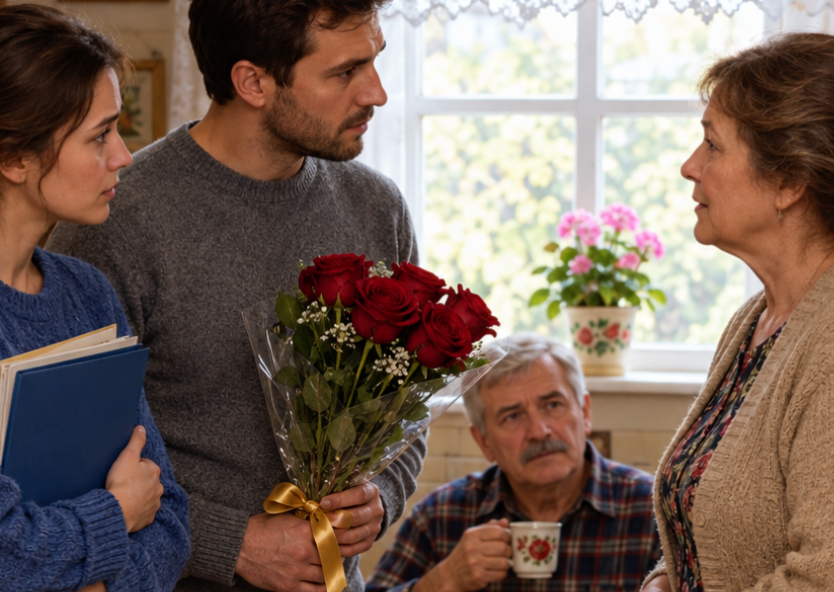
Natalia stepped out of the car with a folder in her hand. Serhiy followed, holding a bouquet of red roses and a cake wrapped in a clear box with a bow. As they reached the gate, Serhiy suddenly stopped.
“Go on,” Natalia whispered. “She’s already seen us through the window.”
In the kitchen, Halyna Osypivna stood by the table, which was covered with a checkered tablecloth. She poured tea from a large brown teapot into cups decorated with poppies. A tall pile of pastries sat on a plate, and a freshly sliced loaf of bread lay nearby. Petro sat by the window with a cup, pretending to study the yard intently.
“Oh, my dears!” Halyna Osypivna would have clapped her hands if it weren’t for the teapot. “Why didn’t you call? I could have made some cutlets, but as it is — it’s just pastries…”
“With apples?” asked Serhiy.
“With apples. You won’t eat them with cabbage.”
She said it simply, as if thirty years hadn’t passed, and somehow that made things harder for Serhiy than anything else he had read on Thursday.
He stood in the middle of the kitchen, cake in one hand and roses in the other, not sure what to do with them. Natalia took the cake from him and set it on the table.
“Halyna Osypivna…” Serhiy began, then fell silent.
She set the teapot down. She glanced at the folder in Natalia’s hands, then at her husband. Petro bent his head even lower over his cup.
“Petro,” she said quietly, a hint of reproach in her voice. “I did ask you, didn’t I?”
“You did,” Petro agreed without turning around. “You asked for twenty years. That’s enough now.”
“Oh, it’s nothing…” Halyna Osypivna fussed, moving the cups from place to place. “The house was empty, the roof was old—who would live there? I sold it, that’s all. Have a seat before the tea gets cold. Natalia, do you take sugar?”
“Why didn’t you tell me?” Serhiy asked quietly.
At last, she looked up at him.
“Why would I, son? So you’d torment yourself? You were already bristly as a hedgehog back then—no one could say a word to you. You graduated, and that’s all that mattered. Nothing else was needed.”
“Son.” She had always called him that—thirty-two years in a row. He’d never even noticed.
Serhiy laid the roses right on the tablecloth, between the pastries and the bread. He stepped forward and hugged her—awkwardly, the way you do when it’s for the first time. She was shorter than he remembered, and she smelled like dough and apples.
“Mom,” he said into her shoulder. “Forgive me. Mom… All these years I had a mother. And didn’t see it.”
Halyna Osypivna stood very still. Her hands, which had just been moving the cups, slowly lifted and rested on his back. She didn’t say a word. She just stroked him, like she used to when he’d fall asleep at the window, watching for someone on the road.
Natalia turned away and began searching the cupboard for a vase for the flowers.
Petro, who had been sitting with his back to everyone, set his cup on the windowsill and rubbed his eyes with a fist for a long time. Then he cleared his throat and said, to no one in particular:
“There you go. She waited long enough.”
* * *
The cake sat untouched until evening—everyone simply forgot about it. They talked until dark: about the house near the pond, about the blue “Ukraina” bicycle with a bell, about earrings with red stones. Halyna Osypivna laughed and waved her hand, while Serhiy kept catching himself wanting to say that one word again, just to hear how it sounded.
As they were about to get into the car, Halyna Osypivna hurried to the gate, her shawl draped over her shoulders, and handed her son a bag filled with homemade pastries.
“Son, you’ll be coming next Saturday, right?”
“I will, Mom.”
She stayed by the gate for a long while, even after the car had disappeared into the fog. And for the first time in many years, she didn’t have to hide in the kitchen to wipe away her tears so no one would see.