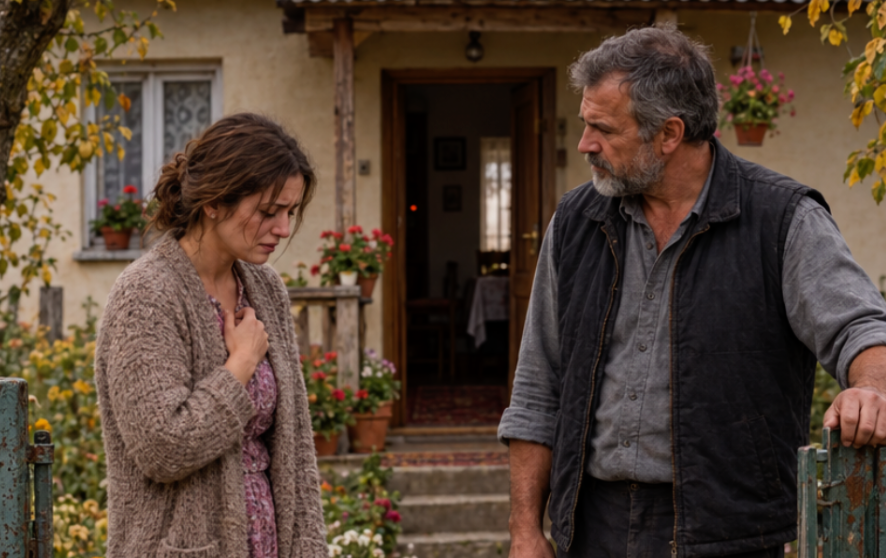
The brown suitcase had been sitting in the pantry for over two years, wedged between a sack of sugar and some empty jars, and Mykhailo never once opened it. He already knew exactly what was inside. The sweater Iryna had been knitting for their daughter for her graduation. School award certificates in a clear folder. A little box with earrings. A phone charger that Yulia forgot in her rush.
Opening the suitcase would mean admitting that he was wrong that day by the gate. And admitting mistakes was something Mykhailo had never learned to do.
* * *
That August, the apples were so plentiful they crashed down in the orchard all night long. Yulia arrived from the district center on Friday evening, just like always, but this time she wasn’t alone. A tall guy in a light shirt stepped off the bus with her, holding a cake box and flashing a wide smile.
“Dad, this is Denys.”
Denys talked a lot and spoke confidently. Over dinner, he managed to tell stories about his phone reselling business, the taxi job he did on the side, the car he was about to buy, and the apartment he and Yulia would be renting in the city by fall. Mykhailo silently sliced salo and listened. The more the young man promised, the less Mykhailo believed him.
When their guest went to spend the night at his cousin’s house on the next street, Yulia sat down across from her father.
“Well? Say something already.”
“What is there to say? He’s a smooth talker, honey. Today he’s into phones, tomorrow it’ll be taxis, but the money is always coming ‘next month’.”
“You’ve only seen him for four hours.”
“Two hours was enough for me. No steady job, nothing to his name, but he’s got plans for three lifetimes.”
“You never think anyone is good enough. Mom told me you didn’t like her parents at first either.”
Back then, Mykhailo kept quiet. But the conversation wasn’t over; it was just postponed. For two weeks, they argued over the phone, and on the last Sunday of August, Yulia came home to pack up her things.
“I’m moving in with him. We’ve already found an apartment.”
“Did you even listen to me? He’ll leave you at the first sign of trouble.”
“He won’t leave. You just don’t know him.”
And that’s when Mykhailo lost his temper.
“Oh, you think you know everything now! So smart, are you? Then go ahead and live your life your way. And don’t you dare come back here, you hear me? I don’t ever want to see you step on this porch again!”
He himself carried Iryna’s brown suitcase out of the house and set it by the gate. Yulia stood staring at it for a long time. Then, without a word, she packed as much as she could carry into her sports bag and left for the bus stop without looking back. The suitcase stayed by the gate until evening. When it got dark, Mykhailo dragged it into the pantry and closed the door.
* * *
For the first few months, she used to call. The phone would buzz on the windowsill, with “Yulechka” lighting up the screen—the way Iryna had once saved her contact. Mykhailo would watch until the screen went dark, never answering.
On New Year’s Eve, at half past midnight, a message arrived: “Dad, how are you? I miss you.” He read it twice. Then he pressed ‘delete,’ as if by erasing the message he could erase that argument by the gate too.
The calls stopped after that.
Mykhailo lived alone. Iryna had passed away five years earlier, one quiet spring, and since then, nothing on her shelf in the closet had been moved. Her scarf with tiny white flowers still lay there—the one she’d throw over her shoulders when going to the market. In the mornings, Mykhailo lit the stove, fed the chickens, and in the evenings, turned on the TV just to hear someone’s voice in the house. Weeks went by like this, then years.
* * *
The end of October was bitterly cold: by morning, puddles already had a thin layer of ice. Mykhailo went to the district center to buy winter boots, since his old ones had completely fallen apart. Near the stalls selling pickled cabbage, someone tugged at his sleeve.
“Mykhailo! I was just wondering—is it you or not? You’ve gone so gray!”
It was Zoya Tymofiyivna, his former neighbor from across the street. Three years ago, she had sold her house and moved to her son’s place in the regional capital.
“Still hanging in there. How are things with you, in the city?”
“Oh, you know me. Watching the grandkids. Listen, I’ve got to say—your Yulka is a real fighter.”
Mykhailo froze in place.
“You’ve seen her?”
“Back in the summer. She was working at the bakery near our market—I used to buy bread there. She looked tired, you could tell, but she was holding on. Working the counter by day, and baking for people—pies, cakes, all sorts of things—at night. Raising her child alone. That guy of hers—what was his name, Denys—left her while she was still pregnant. Not a single penny, not even a phone call.”
“A… child?”
Zoya Tymofiyivna looked at him—and it seemed that only then did she really understand.
“Mykhailo… that’s your granddaughter. She named her Irynka, after your wife. And I swear, she’s the spitting image of Iryna—same eyes, even tilts her head the same way when she’s listening.”
He never did buy those boots that day.
* * *
He couldn’t sleep that night. Mykhailo sat in the kitchen, under the glow of a single bulb, fiddling with his phone. At last, he found the number and pressed call.
“The number you have dialed is not in service.”
He tried again. And again. Each time, that same calm female voice.
A granddaughter. She must be facing her second winter now. And he didn’t even know what her laughter sounded like. Mykhailo pulled a small photo of his wife from his jacket’s inner pocket—the one he always carried—and gazed at it for a long time.
“Well, Iryna,” he said aloud. “I know. You don’t need to say anything.”
* * *
Zoya Tymofiyivna didn’t know the address. She only said that in the summer, Yulia had quit the bakery and, according to rumors, moved to the other end of town because the apartments were cheaper over there.
Over the next few weeks, Mykhailo traveled to the city three times. The first time, he went to the bakery near the market. The shop assistant just shrugged—said there had been someone like that, but she left back in August and didn’t say where she was going. The second time, he found the building where Yulia used to live with Denys. A woman he didn’t recognize opened the door, cradling a baby, and told him she’d been living there for a year already.
Mykhailo stood at the bus stop, freezing, thinking how big the city was, and how he didn’t know anyone there. Then he remembered Maryana, Yulia’s friend from school. She had also lived in the city for a long time, and her mother, Valentyna Trokhymivna, still lived in the village, just two streets away from him.
Valentyna Trokhymivna listened to him beside her fence, not asking any questions. She called her daughter and spoke to her for a long time, then copied an address onto the back of a pocket calendar and handed it to him.
“Fifth floor, no elevator. She’s working at the supermarket’s bakery now, her day off is Tuesday. But Mykhailo, please—don’t go yelling over there.”
“I won’t,” he said quietly.
* * *
Wet snow was falling on Tuesday. Mykhailo climbed the stairs of the five-story building, brown suitcase in hand, stopping at every landing. It wasn’t really the stairs—his heart just couldn’t keep up.
The doorbell didn’t work. He knocked. Footsteps approached on the other side, and a child’s voice asked something. The lock clicked, and the door opened on its chain.
Yulia stood there in her cozy sweater and apron, hands covered in flour. When she saw him, she froze.
“Dad?..”
Her gaze landed on the suitcase. Mykhailo saw the moment she recognized it, saw her lips tremble just a bit.
“Dad, you were the one who told me not to come back…”
“I did,” he nodded. “And you didn’t come back. That’s why I came myself.”
They fell silent. Someone slammed a door downstairs, making Mykhailo flinch.
“I brought you your things, daughter. The ones you didn’t take last time. Your mom’s sweater is there, your certificates. And a few other things.”
He reached into his pocket and handed her a small photo through the doorway. In it, Iryna stood under their apple tree, squinting in the sun and laughing.
“Your mom used to say I was as stubborn as a stump. She’d say, ‘Mykhailo, you’ll end up losing everyone because of your stubbornness.’ And I did. Forgive me, Yulia.”
Yulia took the photo. Her fingers trembled, but she didn’t take off her necklace.
Then, from behind her, a little girl peeked out, clutching her mother’s leg. She wore yellow tights and had a messy braid. She looked at the stranger with the suitcase, tilted her head to the side and asked:
“Mom, who is that?”
Mykhailo stopped breathing. Iryna used to tilt her head exactly like that when she was listening.
Yulia stayed silent for a long time. So long that he thought she might close the door any moment. Then, without looking away from her father, she said quietly:
“That’s your grandpa, Irynka.”
* * *
She didn’t invite him inside the apartment. She took off her necklace, brought the suitcase into the hallway, and stood back in the doorway.
“I can’t, Dad. Not today. I waited two years for you to pick up the phone. Just once.”
“I know.”
“You don’t,” she shook her head, “but maybe I’ll tell you someday.”
Mykhailo nodded and turned toward the stairs. He had just stepped onto the first step when he heard:
“Dad.”
He turned around.
“On Sunday. She sleeps until one. Come at two.”
“I will,” he replied, pausing. “What should I bring her?”
“You don’t have to bring anything,” Yulia lowered her eyes, then added very softly, “Bring some fruit. Ours, not from the store. She doesn’t really like store-bought ones.”
Irynka waved at him from behind her mother’s back, and the door closed.
* * *
Mykhailo rode home on the last minibus. Outside, wet snow was swirling in the darkness, the driver turned on the radio, and he sat there, pressing his palm to the pocket where the photo had been just an hour before, smiling without even noticing.
When he got home, he didn’t even take off his coat. He went straight to the storage room, where crates of Antonovka apples were stacked, and spent a long time picking the best ones: perfect, yellow, without a single blemish. He placed them in a basket. Then he opened a cabinet, took down a scarf with white flowers from Iryna’s shelf, folded in quarters, and laid it on top of the apples.
“Let the granddaughter wear it,” he said. “You don’t mind, do you, Iryna?”
Then he took the calendar off the nail and circled Sunday with a pencil. Twice, just to be sure he wouldn’t forget.