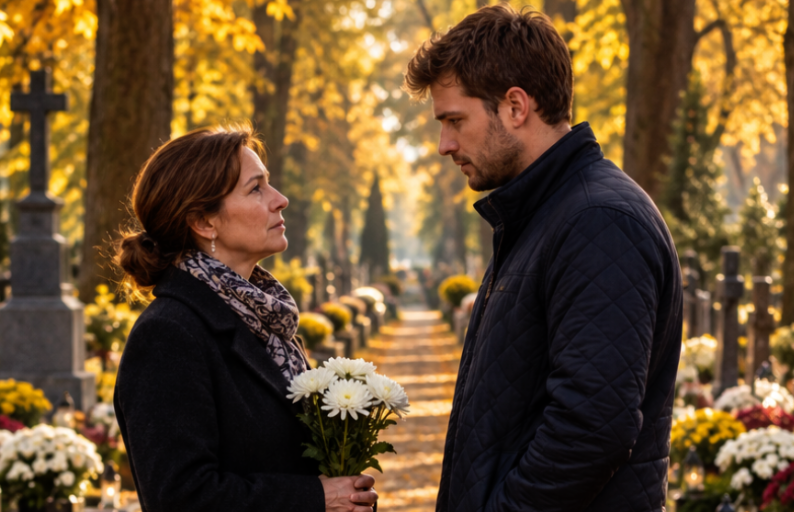
I visit Bogdan’s grave every Sunday. At exactly ten in the morning, I get off the minibus by Holoskovske Cemetery, buy three white roses from the elderly woman at the entrance, and slowly walk along the main path. After a year, I know this route by heart and walk it almost on autopilot: past the old oak, then left at the monument to the unknown soldier, then to the third row, spot number seventeen.
Black granite.
A photo of Bogdan, smiling his usual slightly apologetic smile.
But that Sunday was different.
About ten steps away from the grave, I spotted a man.
Young, around thirty years old. He wore a dark blue windbreaker. Standing with his back to me, he was adjusting a vigil lamp.
Tall, a little stooped, with short dark hair.
Unconsciously, I slowed my pace.
In the whole year, almost no one else came here except me and our sons.
Serhiy lives in Kyiv, while Maksym is out of town in Vynnyky. Both of them visit the grave about once a month, sometimes even less often.
The stranger must have heard the crunch of gravel under my feet.
He straightened up suddenly.
He turned around.
All I managed to catch was the anxious glint in his eyes.
Then the man almost ran off in the opposite direction.
I didn’t even have a chance to call out to him.
I just stood there, watching as his dark windbreaker flashed between the trees and disappeared around the bend.
There was a new vigil lamp burning on the grave.
And next to it lay a fresh bouquet of white chrysanthemums.
A burgundy satin ribbon was tied around the cellophane wrapping.
In golden letters, it said:
“To Dad — Danilo.”
I slowly lowered myself onto the bench opposite.
By the time my fingers touched the ribbon, they were already trembling.
Danilo.
In thirty-six years of living together, Bohdan had never once said that name in front of me.
Never.
I met Bohdan back in 1988 at a dance in the Park of Culture.
I was twenty-four at the time.
I taught piano at a music school, wore two long braids, and was always adjusting my glasses on my nose.
He worked as a trolleybus driver.
He was seven years older than me.
A strong man with calloused hands and a look in his eyes that always seemed just a little apologetic for his own existence.
Four months after we met, we got married.
My mom threw up her hands:
— Olena, you barely know him!
His mother quietly started baking the wedding bread and asked three times if I was pregnant.
Then Serhiy and Maksym came along.
Bohdan started doing side jobs — repairs and fix-ups.
After his shifts, he’d lay tiles, plaster walls, assemble furniture.
We were saving up for an apartment near Stryiskyi Park.
I gave private music lessons.
Life went by quietly.
No big dramas.
In summer we’d vacation in Zatoka.
For New Year’s, we’d go to my sister’s in Ternopil.
The only thing that sometimes unsettled me about Bohdan was his ability to close inward completely.
He never made loud scenes.
He never raised his voice.
He didn’t smash dishes.
He would just suddenly become very silent.
Withdraw into himself.
And over time, I learned not to ask unnecessary questions.
Last April, the doctors found out he had lung cancer.
Three months.
Just three months separated the diagnosis from his death.
I sat by his side in his hospital room, holding his hand as he took his last breath.
Until that Sunday, I had been absolutely sure I knew everything about my husband.
Now I sat opposite his grave, clutching a burgundy ribbon with someone else’s name, feeling like the ground was slowly slipping away from beneath me.
When I got home, I immediately opened Bohdan’s desk drawer.
The very one I hadn’t touched since the funeral.
Inside were old warranty papers for a drill.
Yellowed utility bills.
An expired passport.
Some notes.
And under a stack of papers, I found a brown envelope.
Inside were three bank statements.
And not from our joint account.
It was a completely different account—I had no idea it existed.
I started to read.
Transfers.
At first, eight hundred hryvnias.
Then it was twelve hundred.
Every month.
On a regular basis.
With no exceptions.
The recipient was Maryana Koval.
Sumy region.
Shostka.
The first transfer was made in February of the year 2000.
The last one—just ten days before Bohdan died.
I was sitting right on the bedroom floor, the letters on the page swimming before my eyes.
Twenty-three years.
For twenty-three years, my husband was sending money to a woman I had never heard of.
That night, I couldn’t fall asleep until nearly 3 a.m.
I scrolled through social networks.
I searched for any information I could find about Maryana Koval.
Eventually, I found a Facebook page.
A woman about my age.
Short gray hair.
Photos of her garden.
Recipes for pickled cucumbers and sauerkraut.
A few family snapshots.
In the family section, there was a son listed.
Danylo.
I opened his photo.
I zoomed in.
And instantly recognized the man I’d seen at the cemetery.
Read more
But the most haunting thing were his eyes.
Exactly like Bohdan’s.
Deep-set.
With that same slightly guilty expression.
Maryana lived on the outskirts of Shostka, in a private house.
On Thursday morning, I got on a bus and rode nearly six hours to reach her.
A dog was barking loudly in the yard.
By the gate, tied-up white chrysanthemums were drying.
White.
Just like the ones Danylo brought to the grave.
Maryana opened the door for me, wearing a colorful apron, her sleeves rolled up to the elbows.
She smelled of vanilla and a hint of garlic.
When she saw me, she froze.
Her fingers gripped the doorframe even tighter.
I told her my name.
She didn’t ask a single question.
She simply stepped aside, letting me come in.
We sat in the kitchen.
Maryana kept twirling a teaspoon between her fingers.
A photo of Danylo hung on the refrigerator.
He had his arm around a young woman.
Both of them were laughing.
“Danylo is thirty-two,” Maryana finally said, without looking up. “He was born in ninety-two.”
I stayed silent.
“Bohdan found out about him when the boy was five. I never wanted to interfere in your family. Truly, I didn’t. But Danylo was diagnosed with a heart defect. He needed surgery. I wrote to Bohdan.”
She paused.
“He came. He saw his son. And then he started helping. Every month. And kept doing so until his death.”
Her voice trembled.
But her eyes stayed dry.
“He made me promise never to tell you. Always said: ‘Olena isn’t to blame for anything. She shouldn’t suffer because of my mistakes.’ I promised to stay silent. And I never broke that promise.”
I took the evening train back to Lviv.
Sparse lights flickered past the window.
And inside, it felt like my whole world was collapsing.
Twenty-three years.
For twenty-three years, Bohdan kept this secret.
At night he’d lie down beside me.
Say goodnight.
Kiss me on the cheek.
And then transfer money to his son—the son I never knew about.
I couldn’t figure out what I felt more.
Hurt.
Or a strange gratitude for how far he went to protect me.
But no matter what you call this silence, it was still a deception.
And even after death, Bohdan turned out to be both the closest and the most distant person to me.
The following Sunday, I went to the cemetery again.
Fresh white chrysanthemums were already resting on the grave.
That meant Danilo had visited again.
I placed my three roses beside them and sat down on the bench.
My heart was pounding so hard it felt like it was rising right up in my throat.
About five minutes later, I saw him.
Danilo was standing near the old oak tree.
His hands were tucked into his pockets.
He was looking straight at me.
This time, he didn’t run away.
He just stayed there, waiting.
He was breathing heavily, like someone about to leap from a great height.
I stood up.
My legs felt like they were made of cotton.
But I walked toward him.
A step.
Another one.
The wind carried the scent of damp leaves and the wax of hundreds of burning candles.
A few steps away from him, I stopped.
We silently looked at each other.
He had the same little dimple on his chin that Bohdan had.
Then Danilo shrugged his shoulder.
Exactly the way my husband used to do when he was nervous.
“Danilo?” I asked, though I was no longer in any doubt.
“Yes.”
His voice was deep and a bit husky.
“I’m sorry. I didn’t mean to disturb you. Truly. I just sometimes come here. He did so much for me. I couldn’t not visit.”
Tears sprang to my eyes.
I bit my lip.
Don’t cry.
At least not now.
“He never told me about you,” I said. “I didn’t even know you existed.”
Danilo lowered his head.
Then he raised his hand, as if he meant to touch me, but stopped at the last moment.
“I understand. I don’t want anything from you. No money, no inheritance, nothing. I just wanted to come to visit him. To pay my respects.”
And then I did something I never expected of myself.
I stepped forward.
And took his hand.
His palm was cold.
And it was trembling, too.
“Come on,” I said. “There’s a nice café not far from here. Let’s have some tea. You can tell me about yourself.”
Danilo looked at me as if I’d just invited him to another planet.
He was silent for several seconds.
Then slowly nodded.
We walked down the cemetery alley together.
Not talking.
But now the silence wasn’t heavy anymore.
We spent nearly three hours in the café.
I found out that Danilo is a tester at an IT company in Lviv.
He lives in Sykhiv.
He’s married.
He has a three-year-old daughter.
“What’s her name?” I asked.
He hesitated a bit.
“Bohdana.”
I shivered.
Danilo noticed and blushed immediately.
“My mom suggested naming her after him. I wasn’t sure how you’d feel about that…”
I looked at him.
“That’s a beautiful name.”
He didn’t say anything.
“A very beautiful name.”
About a month later, I invited Danilo, his wife Marichka, and little Bohdana to my home.
I spent the morning baking an apple pie using Bohdan’s old family recipe.
Then I took the family photo albums from the cupboard.
They arrived a bit before lunchtime.
Bohdana was wearing a pink jacket and huge bows.
As soon as she entered the living room, she spotted the piano and immediately reached for the keys.
“May I?” the little girl asked quietly, looking at me with huge eyes.
I nodded.
She carefully pressed two fingers to the keys.
C.
E.
And then she laughed so brightly that it made my chest ache.
Marichka gave an apologetic smile.
“Sorry, she always wants to play with instruments…”
“Let her play,” I said.
We sat around the table, chatting about the most ordinary things.
About work.
About prices.
About the weather.
About how this year, winter just doesn’t seem to want to end.
And for the first time in many months, my apartment no longer felt empty.
When they were getting ready to head home, I stood by the window.
I watched Danilo as he buckled his daughter into her car seat.
Bohdana—yes, that’s what I now called her in my mind—waved at me with her tiny hand through the rear window.
The car started moving.
I closed the door.
Leaning my back against the doorframe.
I closed my eyes.
A photograph of Bohdan was sitting on the dresser.
That very one.
With his slightly apologetic smile.
I stared at it for a long time.
And then suddenly I realized that for the first time in an entire year, I was smiling back at him.
Without anger.
Without bitterness.
Without hurt.
Just smiling.