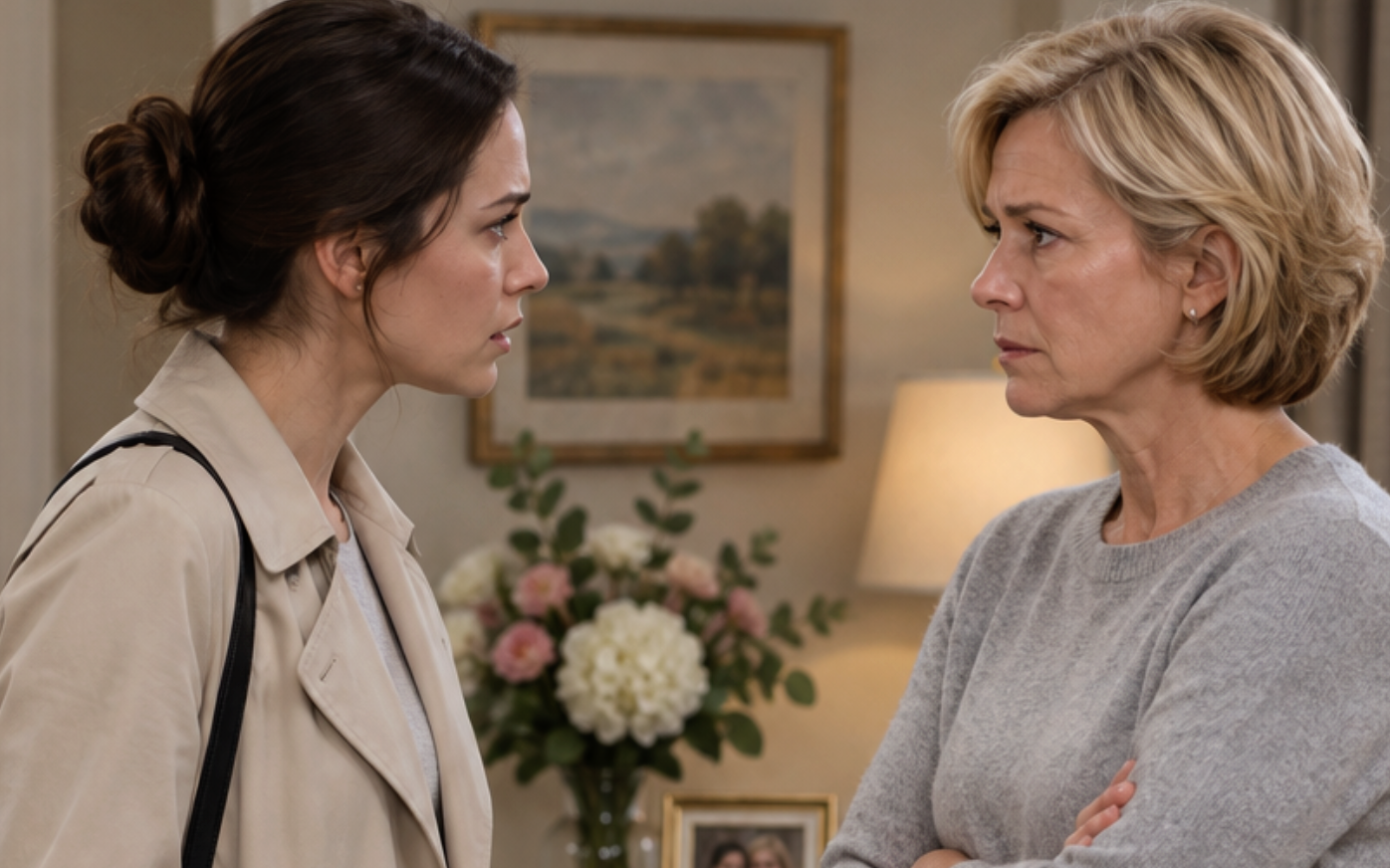
Lena was mixing dough in the kitchen, and feeling the soft, responsive dough beneath her hands brought her a sense of calm. Apple pie was Oleg’s favorite—she baked it every time she saw a dark, silent look in his eyes. For a moment, her upstairs neighbor popped in, sniffed the delicious aroma, and smiled as if someone had gifted her a holiday.
“Lenochka, the whole building will gather just for that smell,” said Nina Pavlovna. “I never understood how you manage to do it all.”
“There’s no real secret,” Lena replied. “The main thing is having someone waiting for you at home.”
“That’s exactly how you keep your home together. Well, I have to run now, my grandson’s on the phone.”
When the lock clicked, Lena took off her apron, fixed her hair, and heard her husband fumbling in the hallway, cursing at his slippers. She came out to him, towel in hand, still warm from the stove. Oleg didn’t even look up.
“Standing there all unkempt again,” he muttered. “You could’ve at least put on a dress.”
“I was baking your pie, Oleg. I’ll go change now.”
“Don’t bother. Who are you trying to impress here anyway?”
Lena stayed silent, set a plate in front of him, poured tea, and offered a slice of pie—hot, with a dark crust. Oleg poked at it with his fork and grimaced, as if he’d been served an old newspaper instead of pie. She sat across from him, resting her cheek on her hand.
“The dough’s raw. Apples are sour. Where’d you get them, the trash?”
“Same ones as last time. You ate three pieces back then.”
“I don’t remember. Must’ve been hungry, I guess.”
“Oleg, if something’s wrong, just say it. Did I oversalt it, or forget the sugar?”
“Everything’s wrong with you, Lena. You just don’t get it.”
“Then explain. I’m listening.”
“Explain to her, huh.” He pushed his plate away. “Just turn on the TV and leave me alone.”
She looked at him calmly—without tears or offense, just the way you look at someone you know who suddenly turns away in the street. And for the first time, she realized she’d been seeing him like this for a long time, only never admitted it to herself.
***
The next evening, Oleg came out of the bathroom freshly shaved, in a new shirt, trailing a sharp cloud of cologne behind him. Lena was sitting on the couch with a book and knew immediately—he wouldn’t be taking her anywhere. He fastened his cuffs, pointedly avoiding her gaze.
“We’re having a get-together with colleagues tonight,” he said. “I’ll be late.”
“Are you taking me with you?”
“Lena, don’t be childish. It’s a work thing.”
“Last month the work thing included wives.”
“This is different. You’d just be bored there.”
Lena set her book aside and looked at him directly, gently, as if asking about the weather. Oleg frowned and tugged at his tie knot.
“Are you ashamed of me, Oleg?”
“Don’t be ridiculous.”
“I’m not being ridiculous. I’m just asking.”
“Don’t start. I need to get going.”
He grabbed his keys and slammed the door—not quite closed, then came back and shoved it shut with his shoulder. Lena got up, slipped the lock, and stood there with her forehead pressed to the cold door. Then she pulled on her cozy cardigan and went up one floor.
“Come in, come in,” Nina Pavlovna opened the door right away. “I had a feeling—just put the kettle on.”
“I won’t stay long. I just need to talk.”
“Sit down. You look like someone else today.”
Lena opened up about everything—about the pie, the evening without her, and how Oleg looks at her like she’s an old piece of furniture he’s long overdue to toss. Her neighbor sat listening with her dry hand resting on her cheek, never rushing her.
“You know, I almost split up with my Vitya—God rest his soul—back in the day,” said Nina Pavlovna. “He got into this habit—always something wrong, always complaining. So I just told him: either say it to my face, or live on your own.”
“And what did he do?”
“He cried like a little boy. And after that, not a single harsh word in thirty years. Silence never works, Lenochka. They take your silence as permission.”
“Tomorrow, I’ll talk to him.”
“Talk. But don’t ask—demand.”
***
The next morning, Denis—Oleg’s younger brother—rang the doorbell. He often dropped by on his way and Lena was always happy to see him; things just felt easy, like family. He sat at the table, glanced at her, and immediately frowned.
“Len, what’s wrong? You look all washed out.”
“I’m fine, Denis. Eat.”
“No, you’re not. Is Oleg acting up?”
“Why would you think that?”
“I saw him yesterday. He was with some group, called you an old hen in front of them. Honestly, I just wanted to sink into the ground.”
Lena lowered her eyes, and suddenly her mug felt as heavy as a rock. She wanted to say Denis must have misheard, but she couldn’t bring herself to. He looked right at her, family-like, without pity.
“Has this been going on long?”
“About two months. I thought he’d snap out of it.”
“Len, sorry for getting involved. My brother’s a good guy, but right now he’s being an idiot. If he can’t appreciate you, that’s his loss—why are you paying the price for it?”
“And where am I supposed to go, Denis?”
“Go stay with your sister. Clear your head. Let him sit alone and think things over.”
After Denis left, Lena called Marina. Her sister picked up on the first ring, as if she’d been holding the phone in her hand.
“Lenochka, you sound like you’re calling from the bottom of a well. What’s happened?”
“Marina, can I come to stay with you?”
“You can stay forever if you want. The kids will be over the moon. When?”
“Soon. I’m thinking it over.”
“Think faster. And don’t bother explaining anything, I can hear it all in your voice.”
At work, her friend Vera stopped her at the entrance, looked her up and down, and dragged her by the elbow to a far corner of the hallway.
“Lena, spill it. Who’s crushed you like this?”
“Is it that obvious?”
“From a mile away. Oleg?”
“He’s become a stranger. Every word is like a jab.”
“Listen carefully—A man either lifts a woman up, or he drowns, pulling his wife down with him. If he’s dragging you under, let him sink alone.”
“That’s harsh, Vera.”
“But it’s honest. Real patience is for when a teething baby keeps you up, not when a grown man humiliates you. That’s not patience—it’s just getting used to pain.”
“I thought I could just tough it out.”
“You know what women get for suffering through? Another spoonful of the same old mess.”
***
Oleg was now coming home late, eating in silence, turning his back to the wall. His shirts smelled of someone else’s perfume—sharp, sweet, and nothing like his usual scent. He answered every question curtly, as if Lena was just some random person asking for the time.
“Oleg, we need to sit down and talk things through calmly,” she said one day.
“What’s there to talk about? All you have are dramas.”
“I have questions. You have answers. That’s what a conversation is.”
“Lena, just leave me alone. I’m worn out.”
That Friday, he didn’t come home for the night. She didn’t call or text him. Instead, she sat in the kitchen, tapping her finger on a teacup, listening to the steady tick of the hallway clock. As dawn broke, she got up, pulled down a big checkered suitcase from the top shelf.
She packed quietly, without sighs or tears. Two dresses, some underwear, important documents, a photo of her parents, and her grandmother’s jewelry box with a delicate gold ring inside. Just as she zipped up the suitcase, the doorbell rang. On the doorstep stood Valentina Ivanovna—calm, wrapped in a light scarf.
“Lena, good morning. I’m here for Oleg.”
“He’s not here. Please, come in.”
Her mother-in-law stepped into the hallway, saw the suitcase leaning against the wall, and sank slowly onto a stool, taking off her gloves. She didn’t gasp or clutch her chest.
“Are you leaving?”
“Yes, Valentina Ivanovna. I’m going to Marina’s.”
“For long?”
“I think for good.”
“I see.” She adjusted her scarf. “I won’t try to talk you out of it, Lenochka. I once stood like this with his father. Only, I never packed a suitcase. Spent the next twenty years regretting it.”
“Thank you for not trying to persuade me.”
“No reason to. Oleg’s being foolish right now, I can see that. I’ll talk to him the way I know how. And I have no right to keep you here.”
“You’re not mad?”
“At my son, yes. At you, no.”
She stood, walked over, and hugged her daughter-in-law with a dry but steady arm. They stood together for a moment, then Valentina Ivanovna left, quietly closing the door behind her. Lena listened to her footsteps on the stairs—slow, steady, without looking back.
***
She said a quick goodbye to Nina Pavlovna—the neighbor crossed her at the door and slipped a handful of mint candies into her pocket. On the train, her companion was an older woman in a blue scarf, a book resting on her lap. They began to talk over a second cup of tea.
“I hung on for twenty-one years,” the woman said. “Once my son grew up, I finally left. Thought I’d die of loneliness the first month.”
“And then what happened?”
“I bloomed. Got a garden, friends, even joined a club. You see, dear, a woman without respect withers away, like a flower without water. With respect—even a shack can feel like a palace.”
“Weren’t you scared?”
“I was. But fear is short-lived. Life is long.”
At Marina’s apartment, the smell of a casserole filled the air, and her nephews clung to Lena on both sides, not letting go until deep into the night. Her sister settled her in a small room with a window overlooking the courtyard, set a carafe on the nightstand, and sat on the edge of the bed.
“Get some sleep, Lenochka. We’ll figure things out tomorrow.”
“Thank you.”
“Don’t mention it. You’re family to me.”
A week later, Lena started at a small firm—they welcomed her warmly, without probing questions. On the fourth day, she suddenly felt dizzy at her desk and her vision went dark; a coworker called an ambulance. At the hospital, a middle-aged woman doctor looked at her results, folded her hands on her coat.
“Congratulations. You’re eight weeks along.”
Lena stayed silent for a long time, staring at the white ceiling with a faint crack in the corner. Marina sat beside her, holding her hand, giving her time. Then she gently asked:
“Lena, will you tell Oleg?”
“No.”
“Are you sure?”
“I’m not going back to him, Marina. I’ll raise this child myself. As long as you’re by my side, we’ll manage. Maybe I’ll write to his mother.”
“I’m not letting you go anywhere now.”
In the evening, Lena stepped out onto the balcony and stood for a long time, hugging her elbows. Inside, waves of doubt, fear, and a new, unfamiliar stubbornness washed over her. But this wasn’t despair anymore—it was a quiet and steady acceptance of herself.
“We’ll get through this,” she said out loud, though it wasn’t clear to whom.
The next morning, she went back to work. On her desk, someone had placed a big white mug with a short message: “You’re stronger than you think.” There was no note nearby.
“Was this you?” she asked her desk neighbor.
“Not me. But I’ll stand by every word.”
“Thank you.”
“Lena, this is just the beginning. You’ll see for yourself.”
And for the first time in these long, dreary weeks, Lena smiled—calmly, without breaking down. It was the smile of someone who has stopped fearing tomorrow and already knows: home is where people call you by your name with respect.