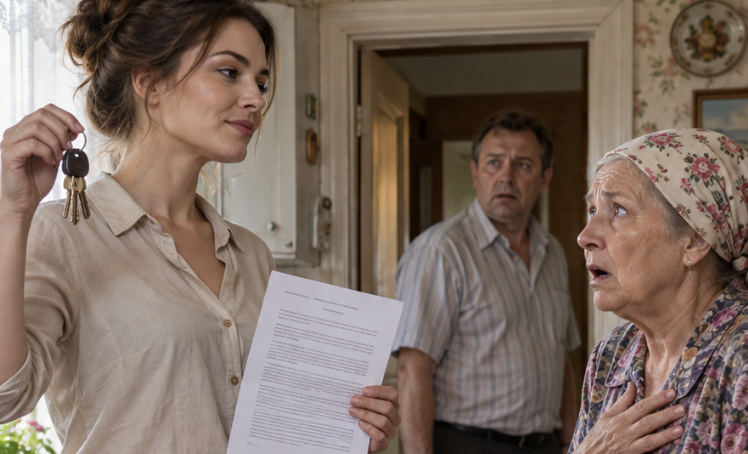
Kick me out? Fine. But first explain whose apartment this is,” I said, placing the envelope on the table.
Darina Iosifovna fell silent. Not because she was frightened. She simply hadn’t expected it.
She was used to me keeping quiet. Nodding. Leaving the room whenever she raised her voice. That was exactly what I had done for seven years. Seven years, four months, and eleven days, if you counted from the day of our wedding.
My name is Polina. I’m thirty-two years old, and until that evening, I had never once raised my voice at my mother-in-law.
We lived in Tver, in a two-room apartment on Kominterna Street. An old building, third floor, no elevator. But the ceilings were high, and in the mornings the bedroom filled with such beautiful light that sometimes you just wanted to stand by the window and breathe.
I loved that apartment. Every corner of it. Every crack in the hallway ceiling.
And I knew exactly who it belonged to.
But more about that later.
It all started when Kostya lost his job.
My husband, Konstantin Dmitrievich Revyakin, was thirty-five and worked as a design engineer. He was laid off in February when his company closed its Tver branch.
Of course he was upset. For the first two weeks, he searched for vacancies and went to interviews.
Then he stopped.
And then Darina Iosifovna called.
She lived alone in Kimry in a private house. Sixty-three years old, strong and energetic, with a voice loud enough to be heard through two walls.
When she learned that Kostya was unemployed, the first thing she said was:
“It’s all because of her. She’s dragging you down.”
She always talked about me in the third person.
Even when I was standing right next to her.
Kostya didn’t argue.
He rarely argued with his mother at all.
He would hang up, sigh, walk into the kitchen, pour himself some tea, and remain silent.
A week later, Darina Iosifovna arrived herself.
With two bags and her cat, Barsik, in a carrier.
“Temporarily,” she announced from the doorway. “Until Kostya gets back on his feet.”
I nodded.
As always.
The apartment immediately became cramped.
We had one bedroom and one living room. Darina Iosifovna took over the living room, arranged her belongings on the shelves, hung an icon and a photograph of her late husband on the wall.
Barsik claimed the armchair and hissed at me every time I walked past.
For the first few days, she behaved quietly.
She cooked borscht and ironed Kostya’s shirts, even though he had nowhere to wear them.
Then the comments began.
“Polina, you cut the potatoes too large.”
“Polina, why do you buy this milk? It’s expensive.”
“Polina, I heard you talking on the phone. Who was that?”
I worked as an accountant for a small company that supplied construction materials.
My salary was forty-two thousand rubles.
Not much, but after Kostya was laid off, it became the only income our family had.
Darina Iosifovna knew that.
And for some reason, it made her even angrier.
“In normal families, the man earns the money,” she would say in the evenings, looking at me over her glasses. “But here the wife runs off to work while the husband sits at home. Shameful.”
Kostya stayed silent.
So did I.
By March, I began noticing something strange.
Darina Iosifovna started whispering with Kostya.
In the kitchen, when she thought I was asleep.
Or in the living room behind a closed door.
I caught fragments of their conversations.
“…documents…”
“…transfer ownership…”
“…don’t wait too long…”
One evening, I walked into the living room to get my phone charger.
They both immediately stopped talking.
Kostya’s laptop was on the table, open to the Rosreestr property registry website.
“What are you looking at?” I asked.
“Nothing,” Kostya said, closing the laptop. “Just browsing.”
Darina Iosifovna smiled.
A thin smile, with only her lips.
A chill went through me.
Not fear.
Something else.
As though I were standing at the edge of something but couldn’t see how deep it was.
The next day, I checked the folder I kept in the wardrobe.
It was still there.
Untouched.
I counted the documents.
Everything was in place.
I breathed out in relief.
But then I moved the folder.
I took it to work and hid it in the bottom drawer of my desk under old invoices.
Why did I protect that folder so carefully?
Because it contained something Kostya didn’t know.
Darina Iosifovna didn’t know either.
Nobody knew.
The story was simple and complicated at the same time.
The apartment on Kominterna Street had not been bought by the Revyakin family.
My grandmother, Zoya Pavlovna Nechaeva, bought it in 1997.
She paid cash with money she had saved during thirty years of working at a textile factory.
The apartment was registered in her name.
In 2010, Grandma made a will.
Everything would go to me, her only granddaughter.
My mother died young.
I never knew my father.
Grandma was everyone to me.
She died in 2014.
I accepted the inheritance.
The apartment became mine.
When Kostya and I married in 2017, I was already its legal owner.
He moved in with me.
It seemed perfectly logical and natural.
The rented room in a dormitory on the outskirts of town where he had been living wasn’t exactly suitable for married life.
Then something happened that probably happens often.
Kostya never once asked whose name the apartment was registered under.
He simply lived there.
He replaced faucets, hung wallpaper, brought in furniture.
And gradually, he began to think of the apartment as his.
Darina Iosifovna was even more convinced that the apartment belonged to her son.
Or to the family.
Or perhaps, in her mind, through her son, it somehow belonged to her as well.
I never corrected her.
Why would I?
We lived peacefully.
Our money was shared.
Our plans were shared.
Back then, I thought it didn’t matter.
In April, Darina Iosifovna stopped pretending she was a guest.
“Polina, I need my own shelf in the refrigerator.”
“Polina, I’ve decided to rearrange the furniture in the living room. It’s more convenient for me this way.”
“Polina, don’t you think it’s time to buy a decent sofa? This one is completely worn out.”
That sofa had belonged to my grandmother.
I had grown up sitting on it.
One day I came home from work and saw that Grandma’s small green-patterned rug, which had always lain in the living room, had been rolled up and left standing in the hallway.
“Barsik was sleeping on it, and then he started clawing it,” my mother-in-law explained. “So I put it away.”
Without saying a word, I unrolled the rug and put it back where it belonged.
Darina Iosifovna looked at me as though I had kicked the cat.
Kostya said:
“Come on, Mom. It’s just a rug.”
But he said it to her.
Not to me.
And that was strange.
Because usually, he said things like that to me.
In May, Darina Iosifovna announced:
“I need to register my permanent residence here. For the clinic.”
I froze with a cup in my hands.
“For the clinic?” I repeated.
“Yes. I need to register with the doctors. My age, my blood pressure, my heart. I need a Tver permanent registration.”
“Darina Iosifovna, you can get temporary registration at your place of stay. That’s enough to receive medical care.”
Her lips tightened.
“Kostya, explain to your wife that your mother needs proper permanent registration, not some temporary piece of paper.”
Kostya was sitting at the kitchen table.
His spoon froze above his bowl of soup.
“Polina, maybe she really does…”
“No,” I said.
Silence.
Barsik meowed from the living room.
“No?” my mother-in-law repeated.
“No.”
She stood up.
Slowly and heavily, even though she was a strong woman and usually sprang to her feet.
“Fine,” she said. “I’ll remember that.”
And she walked into the living room.
After that conversation, Darina Iosifovna stopped greeting me.
She simply looked straight through me as though I were made of glass.
Barsik, apparently sensing his owner’s mood, started marking my slippers.
And Kostya began leaving the apartment.
Supposedly for job interviews.
He came home in the evenings smelling of cigarettes, even though he had quit smoking three years earlier.
I didn’t make a scene.
I waited.
In June, Darina Iosifovna made her move.
She organized a family council.
Kostya’s brother Oleg joined by video call from St. Petersburg.
His sister Alla joined from Vyshny Volochyok.
I found out about it when I came home from work.
They were sitting in the living room with the laptop on the table.
Two familiar faces appeared on the screen.
“Oh, Polina is here,” Alla said from the screen. “Perfect timing.”
Darina Iosifovna sat in the center of the room, upright as though she were sitting on a throne.
“We’ve discussed the situation,” she began. “Kostya is unemployed. There’s no money. The apartment needs repairs. We’ve made a decision.”
“What decision?” I asked from the doorway.
“The apartment needs to be sold. We’ll buy two smaller apartments. One for Kostya, one for me. Oleg will contribute some money from his side.”
I looked at Kostya.
He was staring at the floor.
“Kostya?”
He looked up.
“Mom has a point, Polina. We can’t manage things like this. This way we can at least live separately, and it’ll be easier for everyone.”
“Live separately,” I repeated.
Oleg cleared his throat on the screen.
“Polina, you understand. It’s a family decision.”
A family decision.
They had already decided everything.
Without me.
“And where am I supposed to live?” I asked.
Darina Iosifovna shrugged.
“You’ll rent something. You have a job.”
Alla nodded from the screen.
Kostya remained silent.
Something cracked inside me.
It didn’t break.
No.
It cracked, like river ice in March.
Still strong enough to hold you, but now you can see the water underneath.
“So you want to sell the apartment,” I said slowly. “My apartment. And divide the money among yourselves.”
“Yours?” Darina Iosifovna raised an eyebrow.
“Polina, don’t start,” Kostya said.
“Our apartment,” his mother corrected me. “The family apartment.”
I took a deep breath.
Then exhaled.
“Fine. Wait here for a minute.”
I went into the hallway, put on my jacket, and grabbed my bag.
“Where are you going?” Kostya called after me.
“I’ll be back soon.”
I went to my office.
It was already closed, but I had a key.
I went up to the second floor, opened my office, and pulled the folder from the bottom drawer of my desk.
I checked its contents.
Everything was there.
On the way back, I felt calm.
I even listened to music on the minibus.
When I entered the apartment, they were all still sitting in the living room.
Oleg and Alla had remained connected.
They were waiting.
Darina Iosifovna looked at my bag.
“What did you bring?”
I placed the folder on the table.
Opened it.
“Kick me out? Fine. But first explain whose apartment this is.”
My mother-in-law frowned.
I took out the first document.
The certificate of inheritance.
Notarized and dated 2014.
Apartment at the address: Tver, Kominterna Street, building number such-and-such, apartment number such-and-such.
Deceased owner: Zoya Pavlovna Nechaeva.
Heir: Polina Andreevna Nechaeva.
The second document was an extract from the Unified State Register of Real Estate.
A recent one.
I had ordered it in April when all the whispering in the kitchen began.
Owner: Polina Andreevna Nechaeva.
Sole owner.
No shared ownership.
No encumbrances.
The third document was a copy of Grandma’s will.
I spread them across the table like a hand of cards.
Silence.
Darina Iosifovna picked up the registry extract.
Her hands weren’t shaking.
No.
She was too proud for that.
But she read it for a long time.
Her eyes went over the same lines three times.
“What is this?” she finally asked.
“These are the documents for my apartment. It was never the family’s apartment. It belonged to my grandmother, and then it became mine. Before I married your son.”
Oleg leaned back in his chair on the screen.
“Wait,” he said. “Kostya, you didn’t know?”
Kostya had gone as white as the wall behind him.
“I… I thought we bought it together,” he muttered.
“We didn’t buy anything, Kostya. You moved in with me. Seven years ago. Into the apartment my grandmother worked thirty years to afford.”
Alla covered her mouth with her hand on the screen.
Darina Iosifovna slowly put the paper down on the table.
“It’s fake,” she said.
“Check it. Rosreestr is available online twenty-four hours a day. The cadastral number is right there.”
My mother-in-law looked at her son.
“Kostya.”
He said nothing.
“Kostya!”
“Mom, I didn’t know,” he said quietly.
“How could you not know who owns the apartment you live in?”
And that was the first time in seven years that I saw Darina Iosifovna genuinely confused.
Truly confused.
She sat there looking at the documents, then at her son, then back at the documents.
She had no idea what to say.
I did.
I had been waiting for this moment for four months.
“Darina Iosifovna. You came here temporarily. Three months have passed. You tried to register yourself permanently in my apartment. You organized a family council without inviting me so you could decide how to sell my property. You removed my grandmother’s rug. You refer to me in the third person while I’m standing two meters away from you.”
She opened her mouth.
“I’m not throwing you out,” I continued. “But there will not be another word about selling this apartment. Not another word about permanent registration. No more family councils about my home without me. This is my home. Mine. And I am the only person who makes decisions about it.”
Oleg disconnected first.
Without a word.
Without saying goodbye.
Alla mumbled something and disappeared from the screen as well.
Kostya sat with his head in his hands.
Darina Iosifovna stood up.
“I’ll leave tomorrow,” she said evenly.
“That’s your decision,” I replied.
She walked into the living room.
And closed the door.
Kostya and I remained alone in the kitchen.
“Why didn’t you tell me?” he asked.
“You never asked.”
“Polina.”
“Kostya. In seven years, you never once bothered to find out who owned the apartment you were living in. Not once. And then you agreed to sell it.”
He remained silent.
For a long time.
“Mom told me Dad bought the apartment. A long time ago, before we met.”
I wasn’t even surprised.
“Your father died when you were twelve. We met when you were twenty-eight. My grandmother bought this apartment in 1997, twenty years before our wedding.”
He covered his face with his hands.
“I’m an idiot.”
“No. You simply never checked whether what your mother told you was true.”
Darina Iosifovna left the next morning, just as she had promised.
She took Barsik with her.
Grandma’s rug remained where it belonged.
Before leaving, she stopped in the hallway.
She looked at me.
I thought she would say something harsh.
But she simply nodded and walked out.
Kostya and I lived together for another two months.
Quietly.
Carefully.
Like neighbors.
He found another job as an engineer at a different company.
The salary was lower than before, but it was stable.
In August, he was the one who said:
“Maybe I should rent an apartment. Live separately for a while. Think.”
“Maybe,” I agreed.
He moved out in September.
We didn’t argue.
We didn’t divide spoons or towels.
He packed his things.
I helped him put them into boxes.
Our divorce was finalized in November.
By mutual consent.
No claims against each other.
There was nothing to divide.
The apartment was mine.
His belongings were his.
And during all those years, we had never accumulated much jointly owned property anyway.
Darina Iosifovna never called me again.
Alla sent me one message:
“Polina, I’m sorry about that evening.”
I replied:
“Accepted.”
Oleg never wrote.
Kostya calls occasionally.
He wishes me happy holidays.
His voice is calm and even.
There’s no resentment.
No anger.
Just two people who spent seven years living beside each other and eventually went their separate ways.
I still live on Kominterna Street.
In my grandmother’s apartment.
The little green-patterned rug lies in the living room where it has always been.
In the mornings, sunlight floods the bedroom, and I stand by the window and breathe.
Last week, I did some minor renovations.
I replaced the faucets and painted the kitchen walls a warm beige.
I hung Grandma’s photograph on the wall.
The one where she is thirty-five, standing outside the textile factory gates and squinting into the sunlight.
Sometimes, in the evening, I sit on the worn old sofa with a cup of tea and look at that photograph.
Thank you, Grandma.
For the walls.
For the ceilings.
For the documents.
And for teaching me to stay silent only until the moment when words are truly necessary.
If stories where justice eventually wins resonate with you, stay with us.
There are many more stories like this ahead.