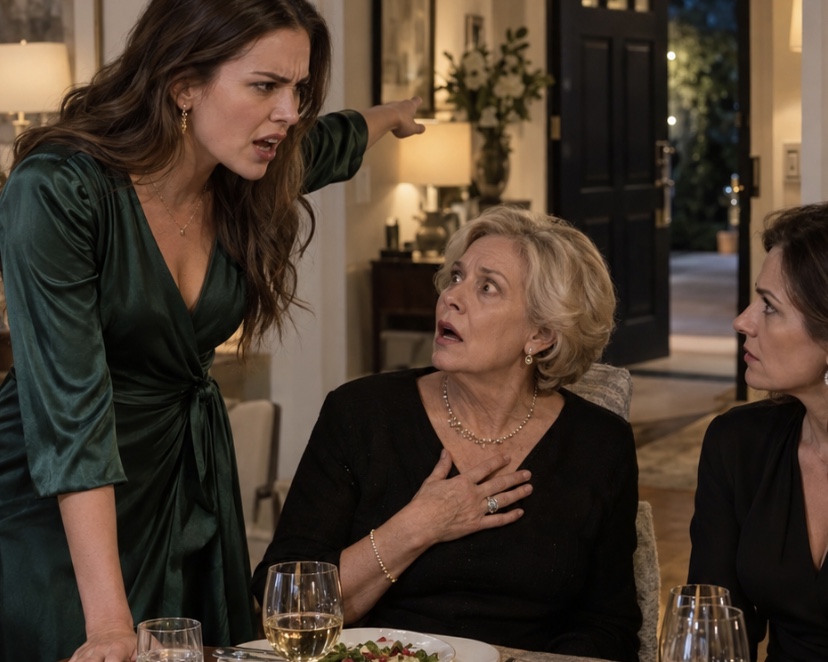
“You Don’t Like What I Cooked? Then Leave! This Isn’t a Restaurant!”
The fork struck the rim of the plate with a sharp clink—far too loud for the small living room, where a thick, suffocating silence had already settled over the table. Valentina Pavlovna pushed the salad toward the center as if it were spoiled food rather than something Liza had spent half the day preparing.
“The mayonnaise is store-bought,” her mother-in-law announced in the level, authoritative tone of a judge delivering a verdict. “I specifically asked for homemade mayonnaise. Is that really so difficult to remember?”
The guests—three of Valentina Pavlovna’s friends in festive blouses, their hair carefully curled for the occasion—fell quiet. They glanced from their hostess to the older woman, who had clearly not come to celebrate with everyone else. She had come to preside over a trial.
Liza stood by the stove, gripping a dish towel. Something inside her was tightening like a violin string wound further and further around its peg, held together only by a miracle. She looked at Vitya. Her husband sat with his eyes lowered to his plate and said nothing.
 
In another moment, she would open her mouth, and whatever came out would change the evening—perhaps even their entire family. But to understand how they had reached that point, it was necessary to go back a little.
The Beginning of a Long Ordeal
Valentina Pavlovna was the kind of mother-in-law people joked about and warned young brides against. No one had warned Liza, though. She had discovered the truth gradually, one meal and one year at a time.
It had begun innocently enough. At the first family dinner Vitya took her to, Liza brought an apple pie made from her grandmother’s recipe—warm and simple, with a golden crust that cracked beneath the spoon.
“A bit too sweet,” Valentina Pavlovna said, pushing her slice aside. “The women in my family don’t make such sugary pies.”
Vitya laughed, put an arm around his mother, and said something like, “Mom, don’t start.” Then he whispered in Liza’s ear, “Ignore her. She’s like that with everyone.”
Liza believed him. She wanted to believe him because Vitya was warm and caring, and she hoped his mother’s cutting remark had been an isolated incident—an unpleasant quirk that would soften with time.
It did not.
There was the wedding, then the move into their own apartment, followed by weekend family dinners. Every gathering became another stage on which Valentina Pavlovna methodically dissected her daughter-in-law’s cooking. The borscht was not rich enough. The cutlets were too dry. The dumplings tasted “as if they came from a shop rather than a proper home,” although Liza had spent three hours shaping every one of them by hand.
 
Vitya always muttered some weak defense.
“Mom, I like it.”
“Mom, you’re exaggerating.”
“Mom, that’s enough.”
The words were correct, but they sounded automatic, like lines repeated out of habit rather than conviction. He never raised his voice, never insisted, and never told his mother plainly, “Stop criticizing my wife.” He merely tried to end the conversation, and that was where his support ended.
The strange thing was that Vitya adored Liza’s cooking. He truly loved it—not out of politeness, but with the enthusiasm of a man who had grown up eating frozen dumplings and had finally discovered the taste of homemade food. He asked for second helpings, photographed her dishes for social media, praised her in company, and proudly took her baked goods to work, telling his colleagues, “My wife made these.”
When they were alone, he was her greatest admirer. Yet the moment his mother entered the room, his voice dimmed as if someone had switched off a light inside him.
For a long time, Liza did not understand why. Eventually, she realized that Vitya was afraid—not physically, of course, but emotionally. He dreaded confrontation and believed that a clash between two strong personalities could never end well. He preferred to endure an uncomfortable evening rather than risk an open argument.
 
But it was Liza who paid for his peace with her own patience.
A Holiday Demand
Winter was coming to an end when Vitya returned from work one evening and announced, before he had even properly entered the apartment:
“Mom suggested celebrating International Women’s Day here. She wants to invite her friends so we can sit together and have a proper celebration. She’s wanted a large gathering for ages, but her apartment is too small.”
Liza froze with the ladle still in her hand.
“Here?” she repeated, feeling cold inside. “Vitya, you know what will happen. She’ll spend the entire evening picking every dish apart, and I’ll stand there feeling as though I’m taking an examination before a panel of judges.”
“Oh, come on.” Vitya wrapped his arms around her from behind and kissed her neck. “It’ll be fine. You’re an amazing cook. Mom is just… picky. Everyone knows what she’s like. Nobody takes her seriously.”
“I take it seriously,” Liza said quietly. “Every time she does this, I feel so hurt afterward that I want to cry. You know how much it upsets me, but you’re still inviting her here—and bringing all her friends.”
 
“How can we refuse? It’s a holiday.” Vitya spread his hands as if they were discussing something as unavoidable as rain. “She’ll be offended if we say no. Can’t we just get through one evening?”
So Liza endured it. She always did, because she loved Vitya, because she did not want to be accused of turning a son against his mother, and because somewhere deep inside she still hoped that enough hard work and sincere effort would eventually earn her mother-in-law’s approval.
The Preparations
Liza decided that if she was going to prepare the feast, she would serve Valentina Pavlovna’s favorite dishes. She wanted her mother-in-law to see that she was trying—that she knew her tastes and remembered what she liked. There would be only one adjustment: Liza would prepare everything in the way Vitya preferred.
Valentina Pavlovna liked Olivier salad swimming in mayonnaise. Liza made the dressing herself but kept it lighter and fresher, because heavy store-bought mayonnaise always upset Vitya’s stomach. Her mother-in-law preferred meat braised until it practically fell apart. Liza left it slightly firmer and faintly pink in the center because her husband liked it juicy rather than cooked until it resembled shoe leather. Valentina Pavlovna adored very sweet pastries covered in thick cream. Liza made the cake less sugary because rich desserts gave Vitya heartburn.
Every dish was a compromise: flavors familiar to Valentina Pavlovna, subtly adapted to suit her son. Liza hoped the combination would please them both.
 
She spent almost the entire day in the kitchen. She arranged appetizers, decorated platters with herbs, and made the meat sauce twice because the first batch did not seem aromatic enough. By evening, her hands ached and her back throbbed, but the table looked magnificent—beautiful, abundant, and carefully arranged, like a photograph in a glossy cooking magazine.
Vitya came home carrying flowers for his mother and her friends. He walked around the table, inspected every dish, and gave an impressed whistle.
“You’re a magician. Seriously, this looks like something from an expensive restaurant.”
For the first time that day, Liza smiled. It was a weary smile, but a grateful one. She desperately wanted to believe everything would be all right.
The Celebration
The guests arrived together in a cheerful, noisy group. They brought flowers and chocolates, kissed their hosts, and settled around the table while admiring the apartment, the curtains, and the view from the window—everything except the food, which they had yet to taste.
Valentina Pavlovna entered last. She gave the table a quick inspection and nodded with restrained approval, like a manager reviewing an employee’s work before a formal evaluation.
The first few minutes passed peacefully, filled with conversation, toasts, and the bright chime of glasses. But as soon as the guests began sampling the appetizers, the atmosphere changed.
 
“This Olivier salad is so… light,” one of the women observed in a perfectly friendly tone.
Valentina Pavlovna set down her fork.
“The mayonnaise is store-bought,” she declared, and Liza immediately recognized the familiar note in her voice. “I specifically asked for homemade mayonnaise. Is that really so difficult to remember?”
“I made it myself,” Liza answered quietly. “It’s simply a lighter version. Vitya prefers it this way because rich mayonnaise gives him heartburn.”
“What does Vitya have to do with it?” her mother-in-law scoffed. “I’ve made Olivier salad with proper mayonnaise all my life, and nobody has ever complained.”
She moved on to the meat, speared a slice with her fork, and held it up to the light.
“It isn’t cooked properly. It’s almost raw.”
“It’s meant to be slightly pink,” Liza explained, feeling her voice begin to tremble. “It stays juicier that way, and Vitya likes it—”
 
“I did not spend forty years learning to cook for Vitya,” Valentina Pavlovna interrupted. Her friends, who had been eating peacefully until then, began exchanging uncomfortable looks. “Meat should be cooked through, not served half raw like it is in those fashionable restaurants that charge absurd prices.”
Then came the cake. Her mother-in-law cut herself a thin slice, tasted it, and grimaced.
“It’s dry, and there’s hardly any cream. Can you even call this a cake?”
“I deliberately made it less sweet,” Liza said, barely above a whisper. “Too much sugar gives Vitya heartburn.”
“Vitya again!” Valentina Pavlovna exclaimed, raising her voice until the other women froze with their forks in midair. “Did you think about me at all? I came to your home and brought my friends, and you serve us these diet imitations instead of proper food! Do you have any idea how humiliating it is to sit at my daughter-in-law’s table and be given food that cannot even be praised?”
The room seemed to shrink. Her friends stared at their plates, unwilling either to defend their hostess or openly criticize the woman who had invited them. In desperation, Liza looked at Vitya.
“Mom, that’s enough,” he said, but his voice was weary and powerless, as though he had been repeating the same line for years. “Everything tastes good. I like it.”
Then he gave that familiar little nod, somehow agreeing with both his mother and his wife without truly standing up for either of them.
That weak, empty, noncommittal nod became the final straw.
 
Liza stood beside the stove with the dish towel in her hands. Everything that had accumulated over the years—the humiliation in front of guests, the relentless fault-finding, her husband’s failure to offer real support, and the exhaustion of trying to satisfy someone who had no intention of ever being satisfied—flared inside her like a match dropped onto dry grass.
She tossed the towel onto the counter with one short, abrupt movement and looked her mother-in-law directly in the eye.
“You don’t like what I cooked?” Liza’s voice rang across the room, cutting through the clink of dishes. “Then get out! This is my home, not a restaurant!”
Silence fell so suddenly it was as though someone had turned off the sound. The guests sat motionless, forks still raised. One woman’s mouth dropped open, and she forgot to close it.
Valentina Pavlovna first went pale, then flushed red. She rose from her chair, steadying herself with a trembling hand on the edge of the table.
“Vitya,” she said with the outrage of an insulted queen, “did you hear that? Are you going to allow your wife to speak to your mother this way?”
Vitya remained silent for one second, then two, then three. Each one felt unbearably long. Liza stood with her back straight, ready for anything—even for her husband to take his mother’s side, as he always had before.
At last, he spoke.
“Mom,” he said softly but firmly, “Liza is right. You never like anything she cooks, no matter how hard she tries. If everything here is so terrible for you, perhaps it really would be better for you to leave.”
 
Valentina Pavlovna gasped as if he had struck her. She stared at her son, apparently waiting for him to change his mind, apologize, or blame the words on exhaustion or too much wine. But Vitya did not look away.
She spun around, snatched her coat from the hook in the entryway, and left without saying goodbye to her friends. The door slammed so hard that the chandelier trembled.
Her friends began gathering their belongings in confusion. One murmured an apology; another thanked Liza hurriedly for the meal while avoiding her eyes. Within minutes, only Liza and Vitya remained in the apartment, surrounded by a table full of unfinished food and an overwhelming, ringing silence.
Afterward
Liza sank into a chair, her knees trembling. The rush of adrenaline was fading, leaving behind a sticky, anxious fear. What had she done? How were they supposed to live with this now? Would her husband ever forgive her for throwing his mother out of their home in front of her friends?
Vitya came over, sat opposite her, and took both her hands in his. Liza braced herself for a reproach. Instead, she saw something close to admiration in his eyes.
“You just did what I haven’t been able to do for years,” he said quietly. “No one has ever managed to put my mother in her place. She has always emerged victorious from every argument—with my father, with the neighbors, and with me. But you simply looked her in the eye and told her the truth.”
 
“I was afraid I’d ruined everything,” Liza admitted as tears filled her eyes. “I thought you would resent me and that this would create a gulf between us.”
“Resent you?” Vitya shook his head, pulled her close, and held her tightly, as if the embrace could apologize for every year of weak and meaningless attempts to defend her. “I should have said those things a long time ago. Forgive me for staying silent. I saw everything—how she criticized you and how deeply it hurt—but I was a coward. Keeping quiet was easier than arguing with my mother. Today, you did what I never had the courage to do.”
Liza buried her face against his shoulder. At last, the tension that had been building for months began to drain away, dissolving into tears and relief.
Of course, life did not become easy overnight. Valentina Pavlovna took serious offense and held on to it for a long time. She stopped calling and ignored their messages. Through mutual acquaintances, they heard that her son had married “a rude woman with no respect for her elders.”
Vitya tried several times to reopen the conversation. He called and wrote, but every exchange ended with accusations against Liza and demands for an apology. Liza refused. She was willing to reconcile, but she would not once again accept blame for someone else’s cruelty.
Weeks passed, followed by months. Gradually, the anger lost its sharpness, like fabric fading beneath the sun. Valentina Pavlovna began calling again—briefly and coldly at first, then with a little more warmth.
There was no instant, perfect reconciliation. Nevertheless, something fundamental had changed forever. Her mother-in-law became more careful with her words, and Vitya grew more confident about defending his wife. Whenever his mother slipped into her old habit of criticizing Liza, he stopped her immediately, firmly, and without the old hesitation.
 
Liza still remembers that evening, but not with regret. She remembers it with a quiet warmth, as the day she stopped being merely a daughter-in-law who could be scolded over mayonnaise and undercooked meat. She became the mistress of her own home—a woman prepared to protect her dignity, even if doing so meant finally saying aloud everything she had held inside for years.
Sometimes, while setting a holiday table—calmly now, without waiting for the inevitable criticism—she catches herself smiling at the memory of her own voice ringing through the apartment on that spring evening.
And every time, she has the same thought:
She did the right thing.
She has never regretted it.