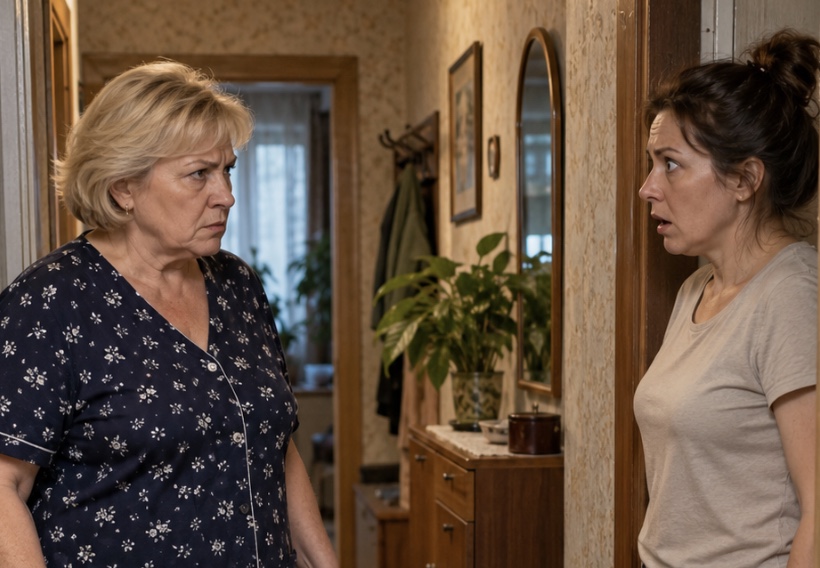
“Pack your things, Larisa. Maksim is coming home, and it’s time for you to figure out where you’re going to live,” Galina Pavlovna announced as she entered the hallway carrying two bulging bags.
Larisa had just taken a tray of roasted vegetables out of the oven. She stopped in the kitchen doorway and stared silently at her mother-in-law for several seconds.
It was an August Saturday morning, not yet nine o’clock. Larisa had planned to enjoy a quiet breakfast, sort through some paperwork, and then drive out of town to visit a friend. Galina Pavlovna’s arrival was unexpected enough, but what surprised Larisa even more was the woman’s confidence as she unfastened her sandals and inspected the hallway as though she had come to take possession of a newly vacated apartment.
“Good morning,” Larisa finally said. “How did you get in?”
“With a key.”
Galina Pavlovna held up a key ring.
Larisa immediately recognized Maksim’s key.
A week earlier, after yet another argument, Maksim had packed his clothes, documents, and laptop and announced that he would stay with his mother for a while. He had left without surrendering his key. Larisa hadn’t fought him at the door. She understood perfectly well that, sooner or later, they would have to bring their marriage to a definitive end.
Still, she hadn’t expected Maksim to send his mother in his place.
“Maksim gave you the key?”
 
“Who else would have given it to me? The neighbor?”
Galina Pavlovna walked farther inside and placed the bags beside the entryway cabinet.
“I won’t be here long. I just want to make sure everything goes calmly and help you pack. Afterward, we’ll bring Maksim’s things back.”
“What things?”
“His things.”
“Most of his belongings are already at your house.”
Her mother-in-law waved dismissively.
“There are still some shirts here, his tools, winter clothes. It doesn’t matter. We’ll sort everything out. The important thing is that you don’t make a scene today.”
Larisa slowly removed the kitchen towel from her shoulder and placed it on the counter.
“Galina Pavlovna, stop. Let’s begin by clarifying why you came here.”
“I’ve already explained.”
Galina Pavlovna opened the hallway closet, examined its shelves, and began pulling out Larisa’s bags.
“We’ll clear this shelf for Maksim. His jackets have always hung here. You can collect the rest of your boxes later if you can’t take everything today.”
Larisa stepped forward, took the bag from her hands, returned it to its place, and closed the closet door.
“Don’t open my cupboards.”
“I’m trying to help you.”
“I don’t need your help.”
“Of course you don’t. You don’t need anyone except your own sense of righteousness.”
Galina Pavlovna raised her chin.
“Maksim told me everything. You tormented him with your endless criticism, drove him out of his own apartment, and now you’re taking advantage of the fact that he’s too softhearted to stand up for himself.”
Larisa frowned and tilted her head.
The final statement was so strange that, for a moment, it pushed even her irritation aside.
 
“His own apartment?”
“Don’t pretend you don’t understand.”
“I’m not pretending. Whose apartment do you believe I’m supposed to vacate?”
Galina Pavlovna looked at her almost pityingly.
“Maksim has lived here for years.”
“I know that.”
“Then you understand perfectly well what I mean.”
At last, Larisa understood.
There had never been any legal uncertainty about the apartment. What she understood now was the story her husband had apparently told his mother—and why Galina Pavlovna had arrived with bags, Maksim’s key, and absolute confidence that she was entitled to give orders in someone else’s home.
Larisa had received the apartment from her father long before she ever met Maksim.
Her father had purchased the three-bedroom apartment while he was still working. Several years later, he decided to move into a small house in another region. He left the city apartment to his only daughter and transferred full ownership to her in advance.
Larisa had been thirty-two at the time.
The apartment needed updating. It wasn’t in disastrous condition and didn’t require an enormous investment, but it needed substantial work after one person had lived there for many years. Larisa replaced some of the electrical wiring, ordered a new kitchen, upgraded the plumbing, and changed the floors and interior doors.
She completed everything gradually, using her own money and carefully choosing every detail herself.
She loved that the apartment had finally become exactly what she had imagined: an uncluttered, spacious kitchen, a separate bedroom, a small home office, and a comfortable living room.
Maksim had not yet been part of her life.
They met several years later.
Larisa worked as an administrator at a private medical center. One August day, the clinic’s air-conditioning system broke down, and the building management company sent a technician.
That technician was Maksim.
He arrived in the hallway carrying his tools and spent a long time inspecting the equipment. He returned the next day because a replacement part was needed. Larisa helped him gain access to several locked rooms, and that evening, Maksim invited her for coffee at a nearby café.
 
At first, he didn’t rush the relationship.
Larisa appreciated that. There were no extravagant promises after a week and no attempts to move a suitcase into her apartment after a month.
They dated for seven months.
Only then did Maksim begin staying at her place for several days at a time. Eventually, he suggested that they live together.
“I’m tired of constantly traveling back and forth,” he told her. “If you don’t mind, I’d like to move in.”
“Then move in.”
Larisa made one thing clear from the beginning.
“But the apartment belongs to me. I’m used to living here in a particular way.”
Maksim laughed.
“I’m not after your property.”
At the time, the remark had sounded perfectly ordinary.
They married a year later.
The couple had no children, and they never purchased property together. Maksim moved into a fully furnished apartment, bringing only furniture for the home office, several boxes of personal belongings, and the equipment he used himself.
He knew the apartment’s history perfectly well.
In fact, during the first few years, he sometimes told acquaintances, “Larisa inherited the apartment from her father. We’re lucky we don’t have to worry about housing.”
Gradually, however, his phrasing changed.
At first, he simply said, “At our place.”
Larisa wasn’t bothered. They lived there together, and it would have been absurd to explain whose name was on the ownership papers every time they spoke to someone.
Later, Maksim began saying, “Our apartment.”
That also sounded natural in everyday conversation.
The problem wasn’t the words themselves. The problem was that, around his mother, Maksim never clarified the actual situation.
When Galina Pavlovna visited and examined the kitchen one day, she commented, “You’ve done a nice job renovating the apartment.”
“Yes, it turned out well,” Maksim replied.
 
He said it as though he had taken part in the main renovation, even though he hadn’t.
On another occasion, his mother suggested, “You should clear out the third room and turn it into a guest bedroom.”
“We’ll sort it out someday,” Maksim said.
Larisa overheard and corrected him.
“That room is my office.”
Her mother-in-law only shrugged.
Larisa didn’t attach much importance to the exchange at the time.
She had no idea that Galina Pavlovna was gradually constructing an entirely different version of reality in her mind.
The woman believed that the apartment either belonged to her son or was jointly owned by the married couple.
Maksim had never directly told her that.
He had done something more convenient: he had simply never corrected her.
For several years, their marriage was fairly ordinary. They worked, spent weekends together, occasionally traveled, and invited friends over.
The problems began later.
Money was the primary cause.
It wasn’t that the couple lacked anything. What bothered Larisa was Maksim’s belief that he could spend their joint savings without discussing it with her.
Galina Pavlovna had another son, Artyom. He constantly changed jobs, enjoyed expensive purchases, and regularly found himself in situations where he urgently needed financial help.
Sometimes it was a car repair.
Sometimes new electronics.
Sometimes a debt to a friend.
Sometimes a sudden trip.
Maksim always helped him.
At first, Larisa didn’t object.
“If you want to help your brother with your own money, then help him.”
Gradually, however, Maksim began taking money from their shared budget.
One day, Larisa noticed that the balance on their joint account had decreased.
“Did you buy something?” she asked.
“I sent money to Mom.”
“What for?”
“She needed to pay for repairs to her car.”
“Why didn’t you tell me?”
“Because she’s my mother.”
Larisa looked at him across the table.
“What does that have to do with anything? That was our money.”
“I’ll put it back.”
And he did.
Several months later, the same thing happened again. This time, Maksim had helped his brother.
Larisa once again insisted that expenses like that had to be discussed beforehand.
“I’m not forbidding you from helping your family. But you can’t take money that both of us are saving and spend it on your own.”
Maksim brushed off her objection.
“You turn every little thing into a formal hearing.”
“Because every one of those ‘little things’ is paid for partly with my money.”
The conversation ended badly. For a while, however, Maksim genuinely stopped touching their joint savings.
Larisa believed the matter had been resolved.
She was wrong.
In July, they began saving for a vacation planned for the end of August. They wanted to travel for two weeks and had already chosen their route. All that remained was to reserve their accommodations and buy the tickets.
One evening, Larisa opened her banking app and discovered that a substantial part of their savings had disappeared.
At first, she assumed Maksim had paid for the trip.
“Did you buy the tickets?”
 
Maksim was sitting on the sofa looking at his phone.
“What tickets?”
“For our vacation.”
“No.”
Larisa turned the screen toward him.
“Then where is the money?”
Maksim looked at the balance and immediately averted his eyes.
That was enough.
“Maksim?”
“Mom needed it.”
Larisa stood motionless for several seconds before sitting across from him.
“What did she need it for?”
“She wants to replace her car.”
Larisa couldn’t immediately find the words to respond.
“Are you serious?”
“Her old car keeps breaking down.”
“So you took the money we saved for our vacation?”
“Not all of it.”
“You took most of it.”
“We’ll save more later.”
Larisa let out a short, humorless laugh.
“When?”
“It’s not as though we’re leaving tomorrow.”
“We’re leaving at the end of the month.”
“Then we’ll postpone the vacation.”
Larisa stared at her husband.
 
He spoke as casually as though he had rescheduled a store delivery, not spent their joint savings without permission.
“Did you ask me?”
“Here we go again.”
“Did you ask whether you could take my portion of the money and give it to your mother for a car?”
“I didn’t divide it into your portion and mine.”
“Well, I do.”
Maksim’s expression changed visibly.
“This is exactly why it’s impossible to live with you. You keep track of everything.”
“Of course I do, especially when someone takes my money without permission.”
“These aren’t strangers.”
“What difference does it make who received it? You spent money that didn’t belong only to you.”
“Mom will repay it.”
“When?”
Maksim fell silent.
“When, Maksim?”
“I don’t know.”
“Then you’ll repay it.”
“Where am I supposed to find that kind of money right now?”
“That is your problem.”
The discussion didn’t end there.
It turned into an argument that lasted nearly two hours.
Maksim accused his wife of being greedy. Larisa replied that she had no intention of financing someone else’s car merely because her husband wanted to present himself as a generous son.
Eventually, Maksim stood up.
“That’s it. I’m tired of your constant complaints.”
He went to the bedroom, took out a travel bag, and began packing.
Larisa didn’t run after him or try to stop him.
“Where are you going?”
“To my mother’s.”
“Fine.”
Maksim zipped the bag and looked at his wife.
From his expression, it was obvious that he hadn’t expected that answer.
“I’ll stay there for a while.”
“Go ahead.”
 
“Maybe then you’ll understand how impossible it is to hear about money every day.”
“And maybe you’ll understand that you can’t spend someone else’s money.”
He picked up the bag.
“We’ll see which one of us misses the other first.”
Larisa opened the front door.
“While you’re there, think about how you’re going to return my portion of the savings.”
Maksim left.
He kept his key.
That evening, Larisa enjoyed a peaceful dinner alone for the first time in a long while.
The next day, she went about her usual business.
Later, she visited her father.
Two days afterward, she organized the closets and packed some of Maksim’s belongings into boxes.
She didn’t sit beside the phone waiting for him to call.
By the end of the week, her decision had become final.
Their marriage wasn’t ending because of one argument over vacation money. That transfer had merely revealed something Larisa had spent too long trying to dismiss as a temporary problem.
Maksim saw nothing wrong with confronting his wife with decisions he had already made.
Then he expected her to accept that behavior as normal.
Larisa began preparing divorce documents.
They had no minor children and no jointly owned real estate. If Maksim agreed and they both submitted the paperwork, they could complete the divorce through the civil registry office. If he refused, Larisa would proceed through the courts.
That possibility didn’t frighten her.
She simply wanted to end their story without unnecessary drama.
Maksim, meanwhile, expected events to unfold very differently.
 
For his first two days at his mother’s house, he deliberately refrained from calling Larisa.
On the third day, he repeatedly checked his messages.
On the fourth, he asked Galina Pavlovna, “Has Larisa written to you?”
“Why would she write to me?”
“I was just asking.”
On the fifth day, he finally sent his wife a brief message:
“Have you calmed down?”
Larisa replied:
“Yes.”
Maksim stared at the single word for a long time.
He had expected something else.
At the very least, he had expected her to ask when he was coming home.
Or to make another attempt to continue the argument.
Instead, the next message came from him.
“Should I come by for the rest of my things?”
“I’ll pack them. I’ll let you know.”
Maksim didn’t like her detached tone.
Galina Pavlovna noticed his dark mood and began asking questions.
At first, Maksim answered evasively.
Gradually, he presented his version of events.
In his account, however, the apartment mysteriously acquired a different owner.
“She thinks that because I left for a few days, she can take control of the whole place.”
“But both of you live there,” his mother said in surprise.
 
“Exactly.”
“You’ve invested years of your life in that apartment.”
Maksim didn’t respond.
In reality, Larisa had covered the principal expenses long before she met him. During their marriage, they had, of course, purchased ordinary household items, replaced a few appliances, and paid routine expenses together. None of that gave Maksim ownership of the apartment.
But he didn’t clarify this.
The next day, Galina Pavlovna heard an even more suggestive statement.
“It looks like she has decided to keep the apartment for herself.”
His mother put down her phone.
“What do you mean, keep it for herself?”
“Exactly what I said.”
“And what about you?”
Maksim shrugged.
“I don’t want a scandal.”
“That’s precisely why she’s becoming so brazen!”
Again, he remained silent.
His silence was enough.
Galina Pavlovna filled in all the missing details herself.
According to the version she constructed, her son had lived in his own apartment, brought his wife there, and then temporarily moved in with his mother when their relationship deteriorated. Larisa had seized the opportunity and decided to take the property from him.
“Why are you doing nothing?” Galina Pavlovna demanded. “You need to go back.”
“I don’t want to talk to her right now.”
“Then I’ll talk to her.”
Maksim pretended to hesitate.
“Mom, just don’t cause a huge scene.”
“I’ll handle it.”
That was how she ended up at Larisa’s apartment early on Saturday morning.
Now Larisa stood opposite her mother-in-law, trying to understand how far her husband’s deception had gone.
“Galina Pavlovna, did Maksim tell you that the apartment belongs to him?”
“Who else would it belong to?”
“Answer my question.”
“How many years have the two of you lived here?”
“That isn’t an answer.”
“Larisa, I’m not interested in your legal tricks. Maksim is my son. I know perfectly well how many years he has lived here.”
“Living somewhere doesn’t make a person its owner.”
“Husbands and wives share everything.”
“Not everything.”
Her mother-in-law angrily tugged at the closet door, but Larisa closed it again.
This time, she did it firmly.
“Don’t touch anything else in my home.”
“I’m clearing space for my son.”
 
“No one has taken his space.”
“Then pack your things.”
Larisa looked at her and suddenly smiled.
Not because the situation was funny.
There was simply no point in continuing to argue with words.
“Wait here.”
She went into the bedroom.
Galina Pavlovna remained in the hallway, looking around with obvious displeasure.
A couple of minutes later, Larisa returned carrying a folder.
“What is that?”
“The ownership documents for the apartment.”
“And why are you showing them to me?”
“So we can stop discussing Maksim’s fantasies.”
Larisa opened the folder and handed the documents to her mother-in-law.
Galina Pavlovna accepted them reluctantly.
She read the first page.
Then the second.
Then she returned to the first page.
Her face gradually lengthened in disbelief.
“Your name is the only one here.”
“Exactly.”
“Where is Maksim’s?”
“Nowhere.”
“Why?”
“Because the apartment has never belonged to him.”
Galina Pavlovna examined the date again.
“When was this?”
“Long before I met him.”
“Where did the apartment come from?”
“My father gave it to me.”
Her mother-in-law reread the ownership information as though her son’s name might appear on the second or third attempt.
It didn’t.
“But you married afterward.”
“So?”
“After marriage…”
“Marriage didn’t turn this apartment into Maksim’s property.”
Larisa took back the documents.
“Your son knows that perfectly well. He moved in seven months after we met, when I had already owned this apartment for several years.”
Galina Pavlovna abruptly opened her handbag and pulled out her phone.
“We’re going to settle this right now.”
Maksim didn’t answer immediately.
“Mom?”
“You told me Larisa was trying to keep your apartment for herself!”
Even from several steps away, Larisa heard the pause.
“I never said that.”
Galina Pavlovna’s face turned crimson.
“What do you mean, you never said it?”
“I said she didn’t want to let me in.”
 
“You said she had decided to keep the apartment!”
“Well…”
“The documents are right here! Larisa has been the owner since before the two of you even met!”
Another silence followed.
Maksim spoke more cautiously this time.
“Mom, why were you looking through the documents in the first place?”
Larisa raised an eyebrow.
Galina Pavlovna straightened sharply.
“Answer me! Whose apartment is it?”
“Technically, it’s Larisa’s.”
“What do you mean, ‘technically’?”
“Mom…”
“Maksim!”
“Hers.”
His mother closed her eyes for a second and slowly lowered the phone.
“Why did you send me here?”
“I didn’t send you.”
“Who gave me the key?”
Maksim remained silent.
“You told me to talk to her firmly.”
“Well, I didn’t ask you to throw her out.”
Galina Pavlovna was practically shouting now.
“What was I supposed to think after everything you told me?”
Larisa leaned against the doorframe and listened in silence.
She didn’t even need to intervene.
Maksim was destroying his own story.
“Mom, let’s talk about this later.”
“No, we’re talking now.”
“I’ll come over this evening.”
“Go wherever you want. But never drag me into your disputes again.”
She ended the call.
For several seconds, she stood holding the phone.
Then she looked at Larisa.
All her former confidence had vanished.
“He never directly said the apartment was his.”
“I’ve already realized that.”
“He always said ‘our place.’”
“We did live here together.”
“And I thought…”
“You thought whatever was most convenient for you. Maksim knew what you believed, and he never corrected you.”
Galina Pavlovna frowned.
“Why would he do that?”
“You can ask him this evening.”
Larisa returned the documents to the folder.
“Now, please take your bags.”
“They contain Maksim’s things.”
“All the more reason to take them.”
“What things?”
Larisa opened the door to the smaller room.
Two boxes and a travel bag stood against the wall.
“The rest of his clothes, tools, shoes, and personal belongings. I packed them in advance.”
Her mother-in-law looked first at the boxes and then at Larisa.
“Have you really decided to divorce him?”
 
“Yes.”
“Because of a single bank transfer?”
“No. Because he believes it is acceptable to take my money and then send his mother to throw me out of my apartment.”
“He said he would return the money.”
“Then he should return it.”
Larisa picked up one of the boxes and carried it into the hallway.
Unexpectedly, Galina Pavlovna didn’t argue. Apparently, after speaking to her son, she had lost all desire to give orders.
Together, they silently carried the belongings to the elevator.
Only the bag Galina Pavlovna had brought that morning remained.
“What is in this one?” Larisa asked.
“Maksim sent some of his clothes from home.”
“Take that too.”
Galina Pavlovna picked up the bag.
She paused near the front door.
“Larisa.”
“Yes?”
“I truly didn’t know.”
“Now you do.”
“He never told me…”
“But he never corrected you, either.”
Her mother-in-law nodded wearily.
“I suppose he didn’t.”
Larisa opened the door.
“Leave Maksim’s key.”
“I have it.”
Galina Pavlovna removed it from the key ring and handed it to her daughter-in-law.
Larisa took it.
“Goodbye.”
“Goodbye.”
As soon as the door closed, Larisa retrieved a box containing a new lock cylinder from the storage closet.
She had purchased it several days earlier.
It wasn’t part of some dramatic performance. Maksim had left with his keys, and Larisa had no intention of wondering whether he had made copies or who else he might give them to.
She took out a screwdriver, removed the fastener, pulled out the old cylinder, and installed the new one.
She tested it several times.
The key turned smoothly.
Then she put away the tools, opened the kitchen window, and finally returned to her breakfast. It had long since gone cold and no longer looked appetizing.
So she made herself another one.
At around four o’clock, Maksim called.
“Mom says you changed the lock.”
“Yes.”
“Are you serious?”
“Completely.”
“I live there, in case you’ve forgotten.”
“You’ve been living with your mother for a week.”
“I was planning to come back.”
“I know.”
“Then open the door for me this evening.”
“You can come over. A few of your things are still here.”
“Larisa, I don’t want to come for my things.”
“But those are exactly what I intend to discuss.”
Maksim exhaled sharply into the phone.
“You’re deliberately pushing everything to the extreme.”
“No. I’m finishing what you started.”
 
“What did I supposedly start?”
“You left. Then you gave your mother a key to my apartment. After that, you told her a story that made her come here to evict me.”
“I never told her to evict you.”
“You knew perfectly well why she was coming.”
“I didn’t.”
“Maksim, you’re forty years old. Don’t pretend you accidentally gave your mother the key and asked her to speak to your wife more firmly.”
He fell silent.
“I’ll be there at seven.”
“Fine.”
Larisa ended the call.
She packed the remaining belongings without rushing.
She found two jackets in the closet, a gym bag, a folder of work papers, and several chargers. His shaving supplies were still in the bathroom. Some tools and receipts for his equipment remained in the desk.
Larisa threw nothing away.
She packed every item carefully.
Shortly after seven, the doorbell rang.
Then it rang again.
A moment later, Maksim called her.
“My key doesn’t work.”
“That’s because the cylinder is new.”
“Open the door.”
Larisa walked over and opened it.
Maksim stood on the landing, his face tense with irritation.
“You really changed the lock.”
“I told you I had.”
He tried to step inside.
Larisa remained in the doorway.
“Don’t.”
“What do you mean?”
“Don’t come into the apartment.”
“Larisa, stop putting on a performance.”
“Your mother put on the performance this morning.”
“I’ve already argued with her because of you.”
Larisa gave a dry laugh.
“Because of me?”
“Don’t pick at every word.”
“I happen to appreciate precision.”
She carried out the first box.
“Your belongings are in here.”
 
Maksim stared at her.
“I never left permanently.”
“You are leaving permanently now.”
“You decided that all by yourself?”
“Regarding my apartment, yes.”
“And what about our marriage?”
“The divorce papers are ready.”
Maksim blinked.
“What papers?”
“The standard ones.”
“You’ve decided to divorce me because of one argument?”
“The argument ended a week ago. I’ve had plenty of time to think.”
“We can talk.”
“We can. Right here on the landing.”
Maksim’s face reddened.
“You’re humiliating me on purpose.”
“This morning, your mother opened my door with your key and told me to find somewhere else to live. After that, it’s particularly interesting to hear you complain about humiliation.”
“I didn’t know she would say that.”
“But you gave her the key.”
“I wanted the two of you to talk.”
“A key isn’t necessary for a conversation.”
Maksim looked away.
Larisa brought out the second box.
“This one contains your tools and documents.”
“Is that everything?”
“There’s another bag.”
“Larisa, stop.”
“Stop what?”
“You know exactly what I mean. We’ve spent years together.”
“Yes.”
“And now you’re simply putting my things outside.”
“I’m asking you to remove your property from my apartment.”
“There you go again—mine and yours.”
Larisa looked at him calmly.
“Maksim, your refusal to distinguish between mine, yours, and ours is exactly why we’re standing here.”
He opened his mouth but said nothing.
“The vacation money belonged to both of us,” Larisa continued. “You spent it by yourself. The apartment belongs to me, but you allowed your mother to believe it was yours. The key was given to you so you could live here, but you handed it to someone else. You have an astonishing talent for calling everything ‘ours’ when you want control over it—and calling it personal when you don’t want to accept responsibility.”
Maksim’s expression darkened.
 
“I’ll return the money.”
“I’m waiting.”
“Mom understands everything now.”
“That’s good.”
“Then why do we need a divorce?”
For several seconds, Larisa studied the man with whom she had spent almost five years.
“Because this isn’t about the apartment or a single transfer. It’s about how you do whatever is convenient for you and then expect everyone around you to adapt.”
“Everything can be fixed.”
“The money can be returned. The lock can be replaced. But I no longer trust you.”
Maksim placed the box against the wall.
“You decided all of this in advance.”
“No. For a long time, I refused to decide anything. That was my mistake.”
He walked to the window at the end of the landing and then returned.
“Mom said you showed her the ownership papers.”
“I had to. She was clearing a shelf for you in my closet and telling me to find somewhere else to live.”
Maksim grimaced.
“You didn’t have to stage that circus in front of her.”
“The circus began when you sent her here with a key.”
“I didn’t send anyone!”
Larisa raised one hand.
“Let’s not listen to the same version twice. She already told me you asked her to speak to me firmly.”
Maksim said nothing.
“I thought she would just talk to you.”
“About what?”
Again, there was no answer.
“To convince me to let you come back?”
“Among other things.”
“You could have called me yourself.”
“You wouldn’t have spoken to me.”
“So you needed your mother?”
Maksim frowned.
“It sounds ridiculous when you put it that way.”
“That’s because it was ridiculous.”
Larisa carried out the final bag.
“Take it.”
“And the divorce?”
“If you agree, we’ll submit the application together through the civil registry office. We have no children, and there is no jointly owned property to divide. If you refuse, I’ll proceed another way.”
Maksim looked at the closed apartment door.
For the first time during the conversation, he seemed to understand that he would not be going inside that evening.
It wasn’t because his wife was offended and wanted to frighten him.
Nor was she going to call him two days later and ask him to return.
This was the end.
“I’ll call you tomorrow,” he said.
“You can call about the money or the divorce.”
“What about us?”
“You packed ‘us’ into your travel bag and took it to your mother’s house a week ago.”
Maksim gave a crooked smile.
“That’s harsh.”
“But it’s clear.”
He picked up one of the boxes.
“All right.”
Larisa closed the door.
 
This time, she didn’t slam it.
A few minutes later, she heard the elevator arrive.
Maksim was gone.
Later that evening, Galina Pavlovna sent her a message.
“I spoke to Maksim. He must return the money. I will never interfere in matters concerning your apartment again.”
Larisa read it and replied briefly:
“Thank you.”
The following day, Maksim transferred part of the debt. He promised to return the remainder later. Larisa saved their correspondence and refused to discuss their relationship any further.
Several days later, they met at a café near her workplace.
Maksim appeared calmer.
“I agree to the divorce,” he said.
“Good.”
“Mom is still angry with me.”
“She has a reason to be.”
“She says I made her look like a fool.”
Larisa shook her head.
“No. You simply allowed her to believe the version that was most convenient for you.”
Maksim was silent for a moment.
“I suppose I did.”
For the first time, he didn’t argue.
At the end of August, they submitted the divorce application together. They had no minor children and no jointly owned real estate, so the process didn’t turn into a battle lasting for months.
Afterward, Larisa returned home alone.
She unlocked the door with her new key, walked through the familiar hallway, and placed her bag inside the same closet Galina Pavlovna had intended to clear for her son only a few weeks earlier.
Larisa’s belongings remained on the shelf.
Exactly where they had always been.
And yet, the apartment now felt noticeably more spacious.
It wasn’t because Maksim had removed several boxes of clothes.
It was because no one was telling the owner of the home that she had to surrender her place to someone else.
Maksim had sent his mother to drive his wife out, hoping to use someone else to handle an unpleasant confrontation. He expected Galina Pavlovna to pressure Larisa into yielding so that he could return without admitting his guilt or acknowledging his deception.
His plan collapsed within minutes.
All it took was one folder of documents—and a glance at the date printed on them.
The apartment had belonged to Larisa long before Maksim first crossed its threshold.
Only one person could therefore be made to leave.
And it was not the person Galina Pavlovna had come to evict on that Saturday morning in August.