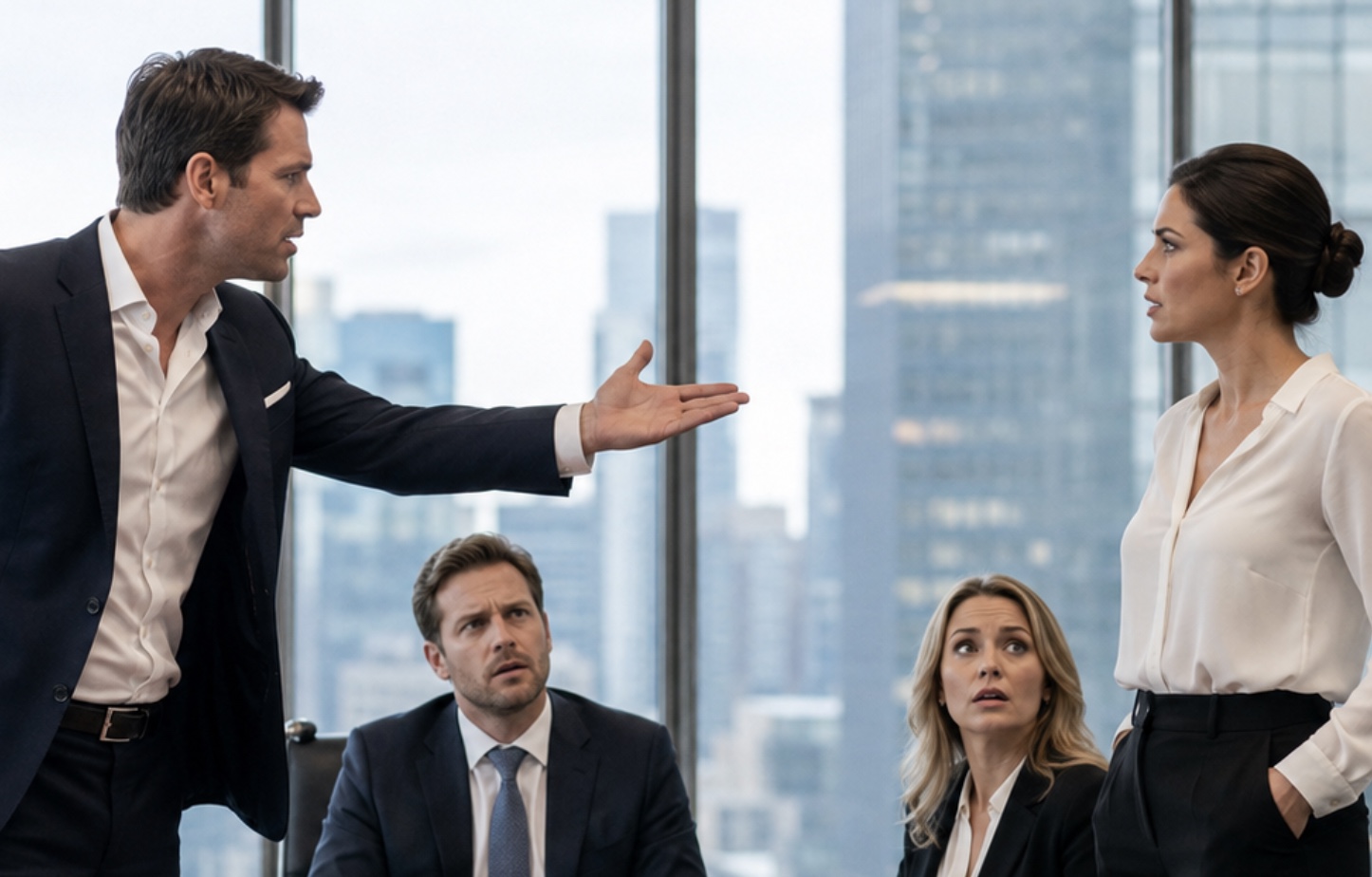
“Ask the secretary to leave. We need to discuss serious matters.”
He didn’t even look at me.
He simply nodded in my direction the way someone might gesture toward an empty wineglass for a waiter to refill, then turned back toward the window. Beyond the glass, construction cranes stood soaked beneath the cold November rain.
There were eight people in the conference room.
Seven of them worked for me.
The eighth had flown in on the morning flight to sign a contract my architectural bureau had spent an entire year pursuing.
And that eighth man had just ordered me out of my own conference room.
 
I had been running the firm for fourteen years.
“Tarasova & Partners” was my surname etched into the glass beside the entrance. It was my bank loan, repaid down to the last kopek. My sleepless nights before tenders. My reputation, built one exhausting project at a time.
Over the years, people had handed me their coats because they assumed I worked in the cloakroom.
Guests had asked me to bring coffee. Sometimes I brought it. Coffee gets cold, and projects don’t wait.
People had stood three steps away from the door marked with my name and asked:
“Where is your boss?”
I had learned not to react.
Long ago, I decided that the work mattered more than whatever someone assumed about me during the first five minutes.
Usually by the sixth minute, everything became clear.
Vadim Kozhevnikov had no intention of sitting down.
He was a large man in an expensive suit that probably cost as much as half our annual coffee budget. He paced slowly along the table, speaking without looking at anyone in particular.
“I’m used to working with the people at the top,” he said. “The people who actually make decisions. I’m not interested in explaining the concept to staff and then waiting while the staff passes everything upstairs.”
He checked his watch and twisted it slightly around his wrist.
“So let’s skip the middlemen. Who’s in charge here?”
Kostya, my lead architect, shifted sharply in his chair.
I saw the color rise immediately in his neck. He was thirty-four, but his temper still belonged to a twenty-year-old.
I gave him the smallest shake of my head.
Not now.
The room smelled of fresh printing ink. That morning, we had printed new presentation boards, and the scent still lingered.
A thick project folder lay on the table beside the scale model of the residential complex: towers, the courtyard amphitheater, and the internal light system Kozhevnikov had flown here specifically to see.
There was nothing else like it anywhere in the country.
It was ours.
More precisely, it was mine.
 
“Vadim Igorevich,” I said evenly. “Please sit down. You came to see the project. So let’s look at the project.”
At last, he turned toward me.
His eyes traveled over my plain dark suit, the glasses hanging from a chain, the absence of gold jewelry or any obvious symbols of authority.
“Young lady,” he said with a smirk.
I was fifty-three.
Men only called me “young lady” when they wanted to put me in my place.
“I thought I made myself clear,” he continued. “Call the person responsible for this project. My flight leaves tonight. I don’t have time for games.”
Marat, the man who had come with him, coughed and pretended to study the model.
Lera, my assistant, froze beside the door with a notebook in her hands, uncertain whether she was supposed to leave.
That was the moment something inside me stopped.
Everything suddenly became quiet and precise.
Like taking off your glasses and watching the world blur for half a second before snapping sharply back into focus.
I touched the arm of my glasses.
The metal was warm from my hand.
 
For fourteen years, I had only taken those glasses off when I was alone.
In front of clients, I wore them and worked.
The helpful woman in glasses.
The real boss somewhere out of sight.
“All right,” I said.
Then I sat down at the head of the table.
“The person responsible for the project is already here. Let’s begin.”
I opened the folder and started explaining the development.
Density.
Natural light.
Movement through the courtyard.
Why the amphitheater had been shaped the way it had.
Why the buildings were positioned at those exact angles.
I spoke for fifteen minutes, steadily and in detail, the way someone speaks about something she knows by heart.
Kozhevnikov listened.
At first with polite condescension.
Then with growing attention.
Marat began taking notes.
Formally, I was running the meeting.
But something in the room had already gone wrong.
The air had that invisible smell of smoke you notice long before you see the flames.
Kostya stared down at the table.
Lera still hadn’t sat down.
And when I finished, Kozhevnikov did not turn to me.
“Smart,” he said to Marat. “Have them prepare the cost estimate.”
Then his eyes slid briefly toward me.
“And I’d still like to discuss the details with the person who actually makes the decisions. The owner. Can you arrange that?”
Arranging a meeting with the owner turned out to be surprisingly easy.
The owner was already sitting across from him.
“I am the owner,” I said.
“Isolda Tarasovna Tarasova. The bureau is named after me for a very simple reason. It belongs to me.”
Kozhevnikov froze for half a second.
Then he did something I hadn’t expected.
 
He laughed.
Not cruelly.
Almost wearily, the way someone laughs at a ridiculous misunderstanding that has wasted his time.
“Well, all right,” he said, spreading his hands. “If you say so. But surely you understand, Isolda Tarasovna, that a project of this scale isn’t just about architecture. It’s about money, deadlines, permits. You need a firm hand.”
“That isn’t how we work here,” Kostya began.
“Young man,” Kozhevnikov cut him off without even turning. “I’ve been building for twenty years. I know what is and isn’t done. The person responsible for the money makes the decisions. I’m putting eight hundred million into this project. I need to know there’s someone at the top who can handle it.”
Then he turned away from me again and continued speaking to Marat.
He went through our presentation boards, pointing out what should be changed, simplified, or made cheaper.
When he reached our patented light system, he tapped the image with one finger.
“Pretty, of course. But let’s be realistic. Who’s going to pay for that?”
Eight hundred million.
He was calculating money.
I was calculating something else.
My team had spent six months working until midnight on this project.
Kostya’s marriage had ended during those months. His wife had gotten tired of coming home to an empty apartment.
Lera had prepared for her final university exams at night between our revisions.
And now Kozhevnikov was calling the courtyard amphitheater decorative nonsense when we had poured hundreds of hours into it, along with a very human understanding of how neighbors actually meet, sit, talk, and visit one another.
If I stayed silent, he would take the project from us.
 
He would reshape it around himself, strip away everything that had made it meaningful, and put some “firm hand” in charge—someone who would tell him exactly what he wanted to hear.
My name would still remain on the glass beside the entrance.
But only the name.
The room smelled of cold coffee and expensive perfume.
Not mine.
“Vadim Igorevich,” I said.
I removed my glasses and placed them on the table, the arms pointing toward him.
“The light system is not decoration. It is patented. The patent belongs to this bureau. Without it, your development is simply another group of towers, and the city already has plenty of those.”
I paused.
“You didn’t fly here for towers. You flew here for this.”
I spoke calmly.
I did not raise my voice.
I explained that the bureau controlled the project, that I was the person who signed the contract, and that changes to the concept could only be approved through me.
Argument after argument.
Fact after fact.
 
Kozhevnikov listened.
And for one brief moment, I thought he understood.
He nodded and folded his hands together.
“You know,” he said, suddenly softer, “you’re right. I overreacted. Long flight. I’m tired.”
He smiled.
“How about this? I’ll think everything over tonight, and tomorrow you and I meet calmly. Just the two of us. We’ll discuss everything properly. Like adults.”
He held out his hand.
I shook it.
His palm was dry and cold.
Kostya finally exhaled.
Lera sat down.
And for one minute, I felt lighter.
Maybe I had gotten through to him.
Maybe he had listened.
Then, as he was leaving, Kozhevnikov caught Marat lightly by the elbow.
He spoke quietly, apparently forgetting that sound carried perfectly through the half-open door into the emptying conference room.
“If she’s going to be this difficult about her patent, check what Velichko has. Maybe we can manage without Mrs. Tarasova. I don’t like people giving me conditions.”
The door closed softly.
My arguments.
My restraint.
My reasonable, professional conversation.
Everything I had been proud of a minute earlier had been neatly folded up and turned into evidence against me.
Too difficult.
 
Too principled.
Find a way around her.
That evening someone forwarded me a link.
Velichko’s bureau had publicly posted a question asking whether there were any ready-made solutions on the market for high-light courtyards.
There weren’t.
Velichko had no such system.
Nobody did except us.
Kozhevnikov returned the next day, just as promised.
Except his “quiet meeting, just the two of us” had somehow turned into a full conference room.
He brought two more people.
This time he didn’t ask my team to leave.
Quite the opposite.
He wanted an audience.
The night before, he had tried another approach.
Not directly.
From the side.
The manager of the business center where my firm rented an entire floor called me and politely asked whether “everything was all right with our lease” and whether we were “perhaps considering expanding—or, on the contrary, relocating.”
I had been paying rent in that building for thirteen years without missing a single payment.
Calls like that didn’t happen by accident.
Someone had been asking questions.
Looking for leverage.
Trying to find out what could make me uncomfortable and where pressure might work.
 
“Everything is fine,” I said. “We have no plans to move.”
I hung up and sat staring at the phone for a full minute.
So that was how Kozhevnikov fought.
When he couldn’t remove me from the table, he tried shaking the chair underneath me.
The next morning, however, he was all charm.
“Marat checked everything yesterday,” he began cheerfully, smiling as he swept one hand around my own conference room as though he owned it. “And do you know what we discovered? Apparently, I don’t have many alternatives. Your little firm really is the only one with this toy.”
He said “little firm.”
In front of my entire team.
“So,” he continued brightly, “I suggest we forget yesterday. No hard feelings. Isolda… what was it… Tarasovna.”
He smiled wider.
“I understand. A woman your age wants her projects to live on. Wants her name remembered. Ambition. I respect that.”
Two of his people chuckled.
“But let’s be honest. Managing a construction project like this isn’t about drawing pretty presentation boards. It means staying awake at night, fighting with contractors, drinking with officials. Are you sure that’s really what you want?”
He leaned back.
“Why not hand the operations over to someone younger and sharper? You can remain the… author. That’s a nice word. Author.”
More laughter.
He was joking.
That was the trick.
If you took offense at the joke, you became humorless.
Too sensitive.
Not tough enough for business.
Kostya’s jaw clenched so hard I saw the muscle jump.
He half rose from his chair.
“Do you even understand who—”
 
“Kostya.”
One word.
He sat back down.
I didn’t hurry.
Instead, I opened the project folder and removed a single sheet of paper.
It was the completion certificate from our previous major development—the glass complex on the waterfront that Kozhevnikov had almost certainly passed while driving in from the airport.
“This complex at the entrance to the city,” I said quietly. “The one with the wave-shaped facade. I managed it.”
I slid the sheet toward him.
“From excavation to opening day. Twenty-two contractors. Three lawsuits with suppliers. Financing delays caused by the bank. I handled all of it.”
The room went still.
“Nights you cannot imagine. So please don’t explain sleeplessness and arguments to me. I’ve been speaking that language longer than you’ve been building.”
Marat stopped smiling.
He studied the document carefully.
He knew the complex.
Everyone in the industry did.
One of Kozhevnikov’s guests lowered his eyes.
Even Lera straightened against the wall.
“And as for my age,” I continued, without raising my voice, “the courtyard you call a toy was not designed around construction cost alone. I calculated how many people would actually want to stay and live there.”
I looked directly at him.
“That is operations too. You simply don’t see it.”
A pause.
“Just as you didn’t see me yesterday.”
For a second, I thought the balance had shifted completely.
The room was with me.
You can feel those moments almost physically, the way you sense changing air pressure before a storm.
Kostya exhaled.
Marat gave the smallest nod, almost to himself.
 
Kozhevnikov felt it too.
And because he was clever, he retreated gracefully.
He wasn’t going to let anyone think he had lost.
“Temper,” he said with a smile, but this time there was no laughter in it. “I like that.”
He spread his hands.
“All right, Isolda Tarasovna. You’ve got my attention. Let’s not make any rushed decisions. I’ll stay another day. Tomorrow we sit down again and start fresh. Properly. Businesslike. Agreed?”
He reached across the table.
I shook his hand.
When everyone began leaving, Marat stayed behind near the door.
For the first time since his arrival, he looked at me not as a function of the meeting, but almost as one person looking at another.
“Don’t get too comfortable,” he said quietly.
“He doesn’t like losing in front of people.”
He glanced toward the corridor.
“This ‘fresh start’ tomorrow is about taking you off the board. It’ll be harder. If I were you, I’d prepare.”
He was right.
The next day, Kozhevnikov arrived with a lawyer and a complete solution already drafted.
No pacing.
No jokes.
He sat down, placed a contract in front of himself—a new version his lawyers had rewritten overnight—and spoke in the same clipped, businesslike tone he had used when demanding a “firm hand.”
“Here are the terms. Your bureau licenses the patent to me for the entire project. My team manages construction. You, Isolda Tarasovna, remain the author of the concept. Your name can be in the brochures, on the plaque, wherever you like.”
He tapped the contract.
 
“The fee is generous. I don’t nickel-and-dime people.”
Then his eyes met mine.
“But operations, money, and final decisions are mine. Everyone works with me this way. Whoever is at the top and pays the money controls the project. That’s my rule. Simple.”
He pushed the contract across the table.
Then he placed a pen beside it.
Eight hundred million.
The biggest contract in the history of my bureau.
Behind it stood six months of Kostya’s sleepless nights.
Lera’s exams studied for after midnight.
Fourteen years of my own life holding the company upright.
All I had to do was sign.
The project would become reality.
It simply wouldn’t belong to me anymore.
I picked up the pen.
Kozhevnikov leaned forward slightly.
Then I placed it back on the table.
Beside the contract.
Not on it.
“That’s a good rule,” I said.
“Whoever is at the top makes the decisions. Let’s apply it honestly.”
I removed my glasses again and placed them in front of me, arms pointing toward him, exactly as I had the day before.
“The patent is mine. The light system is mine. The only bureau in the country capable of building it is mine.”
I paused.
“So by your own rule, Vadim Igorevich, I’m the one at the top here.”
 
No one moved.
“And this is my decision. Under these terms—with this tone, with ‘little firm,’ with ‘leave the room, young lady’—there will be no contract.”
I closed the project folder.
Quietly.
No dramatic slam.
I simply placed my palm over it and pulled it toward myself.
“You did not fly here so I could bow to you. You flew here for this development. And the development leaves with me.”
His expression hardened.
“If you want to work with me as an equal, the door remains open. If you want to force me into submission, build ordinary towers without the light system.”
I looked him directly in the eyes.
“You already have twenty of those around the city. Nobody will notice another one.”
The room was completely silent.
Kostya stared at me as though he were seeing me for the first time.
Marat slowly nodded.
Not to Kozhevnikov.
To me.
And Kozhevnikov himself sat looking at the closed folder.
For the first time in two days, he had nothing to say.
He was finally realizing what everyone else had understood from the beginning.
Power in that room did not belong to the person who spoke the loudest.
Eight hundred million sat on the table.
I did not touch it.
 
And strangely, I felt neither frightened nor triumphant.
Only calm.
Steady.
As if I had finally removed a pair of glasses I had been wearing for fourteen years.
Two weeks passed.
Kozhevnikov did not return.
At first, he genuinely tried to find another solution.
He visited Velichko.
He contacted firms in Moscow.
He spoke with others.
But no ready-made high-light courtyard system appeared on the market.
Because systems like ours did not exist ready-made.
They took years to develop.
Ten days later, Marat called me.
Not Vadim.
Marat.
“He won’t call you himself,” he said.
“Too proud.”
 
I said nothing.
“But his investors rejected the project without your system. So if your offer to work as equals still stands, we’d like to come back to the table.”
“Properly this time.”
The offer still stood.
We are meeting next week.
Kozhevnikov will come.
He probably won’t be the first to offer his hand.
He’ll choose every word carefully.
He will never say out loud that he was wrong.
There will be no friendship between us.
 
Only work.
And that is enough.
Kostya now walks through the bureau as if he has grown several inches taller.
Meanwhile, someone in an architects’ professional chat wrote that “Tarasova burned eight hundred million because of female pride” and that “with a personality like hers, no client will stay.”
Maybe they’re right.
Maybe some clients won’t.
I don’t know how many more Kozhevnikovs will walk into my office and ask the secretary to leave.
I know only one thing.
I will never again walk out of my own conference room.