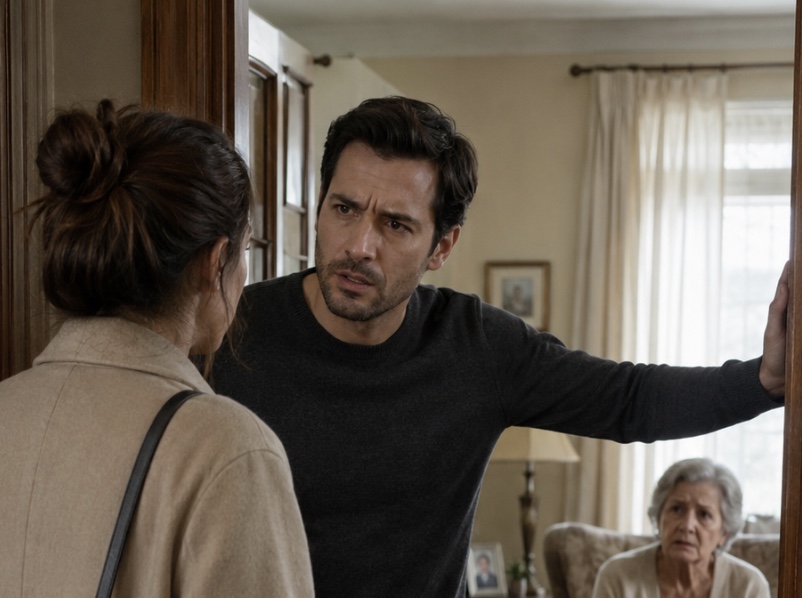
Nastya stopped counting the trips on the fourth day.
Every morning, she got up at six and traveled across the entire city to see Zinaida Pavlovna, Viktor’s mother, who had fractured her hip two and a half weeks earlier. The surgery had gone well. The damaged joint had been replaced with a titanium implant, but recovery was proving much slower than anyone had hoped.
For the first three days, everything felt warm and almost comforting.
Zinaida Pavlovna accepted Nastya’s help with genuine gratitude. Sometimes she would press Nastya’s hand against her cheek and whisper:
“Thank you, sweetheart.”
Viktor seemed grateful too. He would nod approvingly as he walked his wife to the door.
But by the end of the first week, that gratitude had disappeared.
Viktor began treating Nastya’s daily trips as something completely normal, something she was simply expected to do.
One evening, he casually said something that left a bitter taste in her mouth.
 
“Well, taking care of sick people is basically women’s work. You know, nursing and all that.”
“Nursing?” Nastya stared directly at him. “Your mother has a son. And that son isn’t me.”
“That’s not what I meant…”
“I know exactly what you meant, Viktor. You meant that none of this concerns you.”
He waved his hand dismissively, using the same familiar gesture he always used whenever a conversation became uncomfortable.
Nastya clenched her jaw and said nothing.
That time, she let it go.
She cut two hours from her working day, but the real cost was far greater.
The journey to Zinaida Pavlovna’s apartment, helping her wash, changing her bedding, cooking meals, and then traveling back home consumed another four hours every day.
Nastya’s income dropped by almost a third.
Her energy seemed to disappear twice as quickly.
One afternoon, she arrived at her mother-in-law’s apartment, helped her wash, changed the sheets, and made soup.
Then she sat down on the edge of the bed.
“Zinaida Pavlovna, I need to talk to you.”
“I’m listening, Nastya.”
“I have my own life too. My mother is sick, and I haven’t been able to visit her for almost three weeks. I shortened my working hours, but traveling here takes another four hours every day. Coming here and going back twice a day isn’t just helping anymore. It’s a second job. An unpaid one.”
Her mother-in-law nodded.
For a moment, understanding appeared in her eyes.
Then fear followed.
“I know you’re exhausted,” she said quietly. “A broken hip isn’t like a broken arm. Recovery can take at least two months. But I don’t have anyone else to ask.”
That evening, Nastya called Gennady, Zinaida Pavlovna’s brother. He lived only twenty minutes away from his sister.
“Gennady Pavlovich, Zinaida Pavlovna needs help. I can’t manage everything alone.”
“Nastya, you’re her son’s wife. I have my own family and my own responsibilities. This is your burden.”
“Interesting word. ‘Burden.’ When Zinaida Pavlovna gave you money to renovate your apartment, that was a family matter. But now that she needs help, suddenly she’s a burden. And somehow that burden has become mine. Very convenient arithmetic.”
 
There was a click.
Gennady had hung up without saying goodbye.
Nastya suggested that Viktor move in with his mother temporarily while she recovered.
He reacted as though Nastya had suggested he live in a tent.
“Move in with my mother? It takes an hour to get to work from her place! Absolutely not.”
“It takes me an hour and a half. And I go there every day. Twice.”
“Well… your schedule is more flexible.”
He hesitated, searching for the right words.
“My schedule has been squeezed down to the last inch, Viktor. But I understand—you can’t see that from your comfortable distance. Fine. At least give me money for taxis.”
Viktor did.
 
The amount was almost insulting.
It covered exactly four rides.
“Four trips,” Nastya said, looking at the money in her hand. “I make four rides in a single day—there and back, twice. This is enough for one day. What happens after that?”
“I don’t know. Figure something out. I’m not an ATM.”
“Figure something out.”
The universal phrase of people who had no intention of lifting a finger themselves.
Nastya put the money away without answering.
Her patience hadn’t completely shattered yet, but the cracks were already spreading.
Exactly two weeks later, Nastya didn’t return home.
She helped Zinaida Pavlovna into bed, changed her adult diaper, prepared breakfast for the morning, and lay down on the sofa in the next room.
There was no point spending an hour traveling home just to get five hours of sleep before turning around and coming back again.
Her phone rang at half past nine.
“Where are you?!” Viktor demanded.
His voice wasn’t worried.
It was angry.
“At your mother’s. I’m exhausted. There’s no point going home when I have to come back first thing tomorrow morning.”
“What about dinner?! I’m sitting here hungry!”
“Viktor, you’re forty-two years old. The stove probably came with an instruction manual when we bought it. I suggest you read it.”
“You’ve completely lost your mind! You think you can do whatever you want now? You shouldn’t be spending the night God knows where!”
“God knows where? Viktor, I am with your mother. The woman who cannot walk to the bathroom without someone helping her. Do you remember that woman exists? Or has she become some kind of abstract concept to you?”
“Don’t twist my words!”
“I’m not twisting anything. I’m putting things back in their proper places after you’ve spent weeks throwing them around. Good night.”
 
He hung up.
Nastya put down the phone and stared at the ceiling for a long time.
Anger and resentment had mixed together into something she could no longer swallow.
The next morning, she washed Zinaida Pavlovna, changed her sheets, made lunch, then sat beside her.
She finally said what had been building inside her for days.
“Zinaida Pavlovna, tomorrow morning will be the last time I come.”
“What do you mean—the last time?”
“Viktor won’t pay for transportation. He doesn’t compensate me for the income I’m losing. He doesn’t help with his hands, his time, or his money. Yesterday he shouted at me because I stayed here overnight instead of going home to cook dinner for him. I have nothing left, Zinaida Pavlovna. Physically or emotionally.”
Her mother-in-law covered her face with both hands.
Her shoulders began trembling.
“Nastya, please, just hold on a little longer. My bones will heal, and I’ll get back on my feet. Then you’ll be free.”
“Patience is when two people carry the same load together, Zinaida Pavlovna. Here, I’m carrying it alone, and the rope is already cutting through my hands. I’m sorry.”
 
Nastya gathered her things and left.
By then, a plan had formed in her mind.
It was simple, harsh, and necessary.
Either Viktor would finally accept his share of responsibility, or the alternative would become the answer.
And Nastya was ready for that answer.
That afternoon, straight from work, she sent Viktor a detailed message.
Every task appeared on a separate line.
Buy groceries.
Go to your mother’s apartment.
Change her diaper.
Change the bedding.
Start the laundry.
Prepare dinner.
She wanted to leave him no opportunity to say, “I didn’t understand,” or “You never told me.”
Viktor read the message.
He didn’t reply.
That evening, Nastya came home and found him stretched out on the sofa, staring at his phone.
An empty plate that had held sandwiches sat nearby.
“Did you go see your mother?”
 
“Not yet. I was just about to.”
“Just about to? At nine in the evening? Viktor, she hasn’t eaten since morning.”
“Give me a minute. I just need to finish something, then I’ll go.”
“You remember your own stomach three times a day. Breakfast, lunch, sandwiches in between—all perfectly scheduled. But the fact that your mother is lying there hungry is optional?”
Viktor sat up.
His expression twisted.
“Wait. You didn’t go there today?”
“No.”
“What do you mean, no?! She’s alone!”
“Exactly. She’s alone. And she has been alone this entire time while you lay on this sofa waiting for your wife to solve everything for you. Today is your turn.”
Viktor jumped to his feet.
Nastya turned toward the hallway.
“Stop! Where do you think you’re going?”
He stepped in front of her, blocking the way.
“Who is going to take care of my mother? I don’t have time!”
Nastya stopped.
She slowly looked up at him.
“You don’t have time. You don’t have money. Apparently, you don’t have a conscience either. Viktor, do you have anything at all besides a talent for dumping your responsibilities onto someone else?”
“You have to do it! You’re my wife!”
“I have to?”
Nastya gave a humorless smile.
“Show me the contract, Viktor. Show me the clause saying a wife must replace a grown son who can’t get off the sofa for his own mother. Go ahead. I’ll wait.”
He grabbed her arm.
 
Nastya yanked her hand free and slapped him across the face.
The sharp sound echoed through the hallway.
She didn’t wait for his reaction.
She walked to the coat rack, grabbed his jacket, boots, scarf—anything she could reach—and threw everything out onto the landing.
“You’re insane!” Viktor shouted, rushing after his things. “You’re sick! What the hell are you doing?”
“I’m creating fairness, Viktor. There is only one place you’re going tonight—your mother’s apartment. Go on. Show everyone what kind of son you are.”
She slammed the door shut.
Then turned the lock.
Twice.
Viktor stood on the landing holding his jacket with his boots tucked under one arm.
Anger, confusion, humiliation—everything tangled together inside him.
But there was nowhere else to go.
He called a taxi and went to his mother.
 
Zinaida Pavlovna was lying in the dimly lit bedroom.
Tears were running down her cheeks.
When she saw her son, she didn’t smile.
Instead, she turned her face toward the wall.
“Get out.”
“What? I came to help you!”
“Help me?”
Her voice trembled.
“Three hours ago, my neighbor Tamara came over. She did everything. Fed me, washed me, changed the bedding, started the laundry. I don’t need you. Get out.”
Viktor looked around.
She was telling the truth.
Food stood on the stove.
Laundry was spinning in the washing machine.
His mother had been changed.
The apartment was tidy.
Everything from Nastya’s list had been done by a stranger.
A neighbor.
Simply because she was decent enough to help another human being.
Viktor immediately thought that since everything was already done, he could go back to Nastya.
He took out his phone and called his wife.
“I’m at Mom’s. Everything’s fine,” he announced, his voice suddenly upbeat, almost triumphant. “I took care of everything. Food is ready, laundry is running, I changed her diaper.”
There was silence for three seconds.
 
Three very long seconds.
“Viktor,” Nastya interrupted in a calm, steady voice. “Tamara called me fifteen minutes ago. She told me everything. She came to your mother at six this evening, while you were still lying on the sofa eating sandwiches.”
“Nastya, listen…”
“No. You listen.”
Her voice remained completely even.
“You’re lying to me while standing beside your sick mother’s bed. You’re taking credit for someone else’s kindness. You know something, Viktor? I could understand laziness. I could understand greed. Even cowardice is something people can sometimes survive. But lying? That’s the end. That is the final nail.”
“Nastya, wait. Can we just talk normally?”
“I hate you for this lie. And I filed for divorce. Five minutes ago. Online. Goodbye.”
“You… you’ll regret this! Without me, you won’t—”
But the call had already ended.
Viktor stared at the dark screen.
He called again.
It rang.
And rang.
No answer.
At the same time, Zinaida Pavlovna was looking at her own phone.
 
A short message from Nastya appeared on the screen:
“Zinaida Pavlovna, I’m sorry. I filed for divorce. None of this is your fault. Please take care of yourself.”
She lowered the phone onto the blanket.
Shame burned inside her—heavy, suffocating, impossible to escape.
She had money.
More than enough.
There was enough in her account to pay for a professional caregiver for six months and cover Nastya’s taxis every single day.
She could have offered to help.
At least with transportation.
At least with part of the expenses.
But she hadn’t.
She had stayed silent.
She had been greedy.
She had convinced herself that Nastya was a free resource that would never run out.
But Nastya had run out.
Viktor came into the room.
Zinaida Pavlovna looked at her son.
She didn’t ask a question.
 
She simply stated the obvious.
“Nastya left you.”
He nodded.
Without a word, he sat down on a chair against the wall.
“You lost the only person who loved you without obligation,” his mother said quietly. “Not for money. Not because she had to. She simply loved you. And I’m guilty too. I stayed silent when I should have spoken. I held onto my money when I should have offered it.”
Viktor stood up and walked into the next room.
He closed the door behind him.
Then he sat on an old sagging chair and stared into space.
He had lost his wife.
 
He had lost his home.
And in exchange, he had gained a sick mother, a crushing sense of shame, and her lifelong contempt—cold, steady, and merciless, like a diagnosis that could never be cured.
Meanwhile, Nastya checked the lock one last time, turned off the lights, and went to bed long before midnight.
In the morning, she planned to call a professional caregiving service.
Not for Viktor.
For Zinaida Pavlovna.
Because despite everything the older woman had done wrong, she was still a human being who needed help.
Nastya knew how to separate one truth from another.
And that was exactly what made her stronger than everyone else in the story.