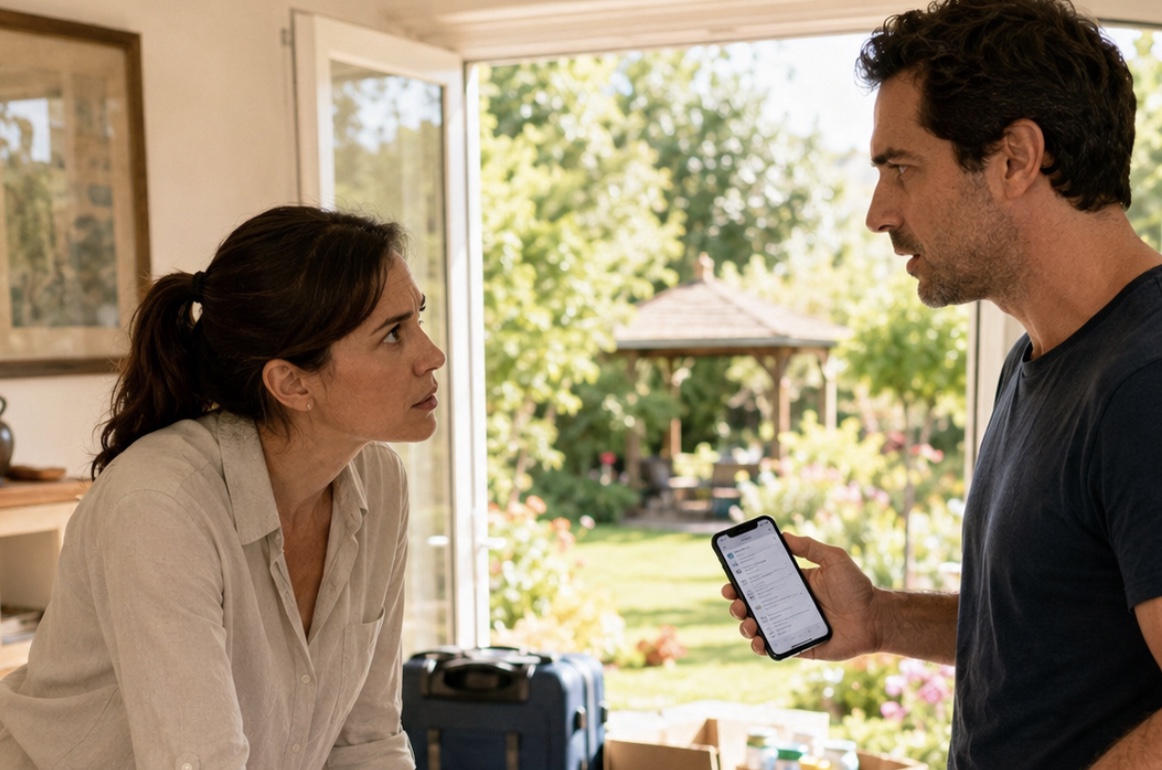
— I’m not going to spend the entire summer serving your relatives. They can find somewhere else to vacation, — Victoria said firmly, folding the printed guest list in half.
Maxim looked up from his phone. The family group chat was still glowing on the screen, where his mother was already discussing who would sleep in which room and on what dates everyone would be “coming to Vika’s country house.”
— Why are you making such a big deal out of this? — he asked after a pause. — People just want to relax.
— Then let them relax. Just not at my expense and not in my house without my permission.
Maxim frowned and placed his phone face down on the table.
— Vika, they’re family. They’re not strangers.
— Exactly. Which is why they should have asked first. Not presented me with a finished plan, not scheduled June and July week by week, not discussed how many towels they would need. They should have asked the owner of the house.
She spoke calmly, but her fingers tightened noticeably around the folded sheet of paper. It contained names, dates, requests, and even notes written by Nadezhda Vasilyevna: “Inga and the children — large bedroom,” “Lenya — sofa on the veranda,” “Vika to buy grains, meat, vegetables,” and “Don’t buy disposable dishes; they can wash the proper ones.”
At first, Victoria could hardly believe they were serious.
That morning, she had opened her husband’s family chat. She had been added during the winter, and normally the group was filled with birthday wishes, pictures of cats, and arguments about which doctor was best at the local clinic.
This time, however, the conversation was moving so quickly that it looked less like people planning a vacation and more like an entire village preparing to relocate.
It had begun with her mother-in-law writing:
“There’s plenty of room at Maxim and Vika’s country house. We could all get together there.”
Then Maxim’s sister, Inga, asked whether she could come with her two sons for three weeks because “the boys need fresh air.”
Maxim’s brother Leonid announced that he would take his vacation in July and arrive with his wife.
One of Maxim’s aunts wanted to know whether the house had a microwave.
A nephew asked about the internet connection.
Meanwhile, Nadezhda Vasilyevna was already confidently assigning responsibilities: Victoria would cook, Maxim would pick everyone up from the train station, and Yuri Petrovich, Maxim’s father, would “take care of the barbecue.”
Not one person had written:
“Vika, is that okay with you?”
The house belonged to Victoria.
Not to Maxim.
Not to his parents.
Not to “the whole family,” as her mother-in-law liked to say.
Victoria had inherited the small two-story house and its garden from her grandmother, Raisa Stepanovna. Six months after her grandmother’s death, Victoria had officially accepted the inheritance, completed all the paperwork, and became the sole legal owner.
Maxim had helped transport boards, paint the gate, and repair the front steps. Victoria had always appreciated that.
But helping someone repair a property did not turn it into your own.
— Mom was only suggesting it, — Maxim muttered. — She didn’t mean anything bad.
— Your mother has already told Inga she can sleep in Grandma’s bedroom. The room where I keep my grandmother’s things. Was that “just a suggestion” too?
Maxim looked toward the window.
— Well, Mom didn’t know.
— She absolutely knew. I told her in the spring that I don’t allow guests to stay in that room.
— Oh, come on, Vika. You don’t have to make an issue out of every little thing.
Victoria slowly placed the folded list on the table.
— This is not a little thing. It’s my house. If I stay silent now, tomorrow your relatives will treat it like a free summer camp with meals included.
Maxim rubbed his face irritably.
— You make it sound as though they’re coming to eat you out of house and home.
— Aren’t they? Look at the list. “Buy groceries,” “cook,” “wash the bedding,” “make separate porridge for the children.” Who exactly is supposed to do all that?
— Well, you’ll be there anyway.
Victoria didn’t answer immediately.
She looked at her husband carefully, as if hearing something in his voice for the first time.
This was no misunderstanding.
He truly believed that if his wife was staying at the country house, then naturally she would be responsible for everyone else.
— I’ll be there to rest, Maxim. In my own home. Not to work as the unpaid manager of a boarding house.
He was about to respond when his phone lit up again.
A new message appeared from Nadezhda Vasilyevna:
“Maxim, ask Vika where she keeps the big cooking pots. We’ll never manage food for twenty people with small ones.”
Victoria gave a short laugh.
— There’s your answer.
Maxim picked up his phone, read the message, and darkened visibly. But instead of supporting his wife, he wrote to his mother:
“I’ll ask later.”
— Not later, — Victoria said. — Now.
— What do you mean, now?
— Right now, write in the group that there will be no mass family arrival.
— Vika, don’t do anything drastic. Mom will be offended.
— Maxim, your mother is already running my house, and you’re worried that she’ll be offended when I say no?
He stood up and began pacing around the kitchen.
He always did that when he didn’t want to answer directly.
Victoria watched him and remembered how everything had started.
During the first years of their marriage, Nadezhda Vasilyevna had seemed loud but kind. She could arrive without warning carrying a jar of pickles, complain about grocery prices, sit for two hours, and leave.
Victoria rarely argued with her.
Her mother-in-law liked being useful. She liked giving instructions. But at first, it never crossed a serious boundary.
Everything changed when Victoria inherited the country house.
First Nadezhda Vasilyevna asked to “have a quick look.”
Then she and Yuri Petrovich came for a weekend.
Then she brought Inga and the children because “the boys need somewhere to run around.”
Victoria welcomed them, cooked for everyone, made the beds, washed the bedding after they left, and told herself it was only a couple of days.
But a couple of days quickly became a habit.
Inga stopped asking, “Can we come?”
Instead, she started asking, “Which weekend is free?”
Once, Leonid arrived with a friend Victoria knew nothing about until the man was standing at the gate.
Nadezhda Vasilyevna began storing her old buckets and garden tools in the shed, explaining that “they’ll be useful at our shared country house.”
That was the first time Victoria corrected her.
— It isn’t shared.
Her mother-in-law had smiled a little too widely.
— Of course it’s yours. But we’re all family.
Victoria hadn’t argued, but the words had left an unpleasant feeling behind.
Now that feeling had become a solid knot in her chest.
And she was no longer interested in expressing herself through polite hints.
Victoria picked up her phone and opened the family chat herself.
— What are you doing? — Maxim asked cautiously.
— Writing.
— Vika, don’t. Let me talk to them.
— You already did. Or rather, you didn’t.
She typed a message, read it once, and sent it:
“Good evening, everyone. I want to clarify something now so there are no misunderstandings later. The country house belongs to me. There will be no large family vacation there for the entire summer. I have not invited anyone, and I did not agree to anyone assigning bedrooms, dates, or responsibilities. At most, individual visits may happen if they are discussed with me beforehand. Please do not plan your vacations in my home without my permission.”
The message was delivered.
For several seconds, the group went silent.
Then notifications appeared one after another:
“Nadezhda Vasilyevna is typing…”
“Inga is typing…”
“Leonid is typing…”
Her mother-in-law replied first:
“Vika, did you get offended? We only wanted to get together as a family.”
Victoria answered:
“I’m not offended. I’m setting boundaries.”
Inga immediately wrote:
“So my children aren’t allowed to get fresh air? I see.”
Victoria stared at the screen and slowly exhaled through her nose.
Beside her, Maxim watched the conversation tensely.
“Your children are allowed to get fresh air. At a health resort, a holiday camp, a rented cottage, with friends, or even on your own balcony. But not in my house for three weeks without an invitation,” Victoria replied.
Leonid wrote only:
“Harsh.”
Then Yuri Petrovich sent a message:
“Nadya, I told you that you should have asked first.”
After that, the chat became quiet.
Maxim sat down again.
— Well, there you go. Now everyone’s offended.
— Let them be offended. Being upset doesn’t give someone the right to use another person’s property.
— You could have said it more gently.
— I stayed gently silent for three years. The result is sitting right in front of you.
She tapped the guest list with one finger.
That night was difficult.
Maxim barely spoke to her. His answers were short. He washed the same cup for an unnecessarily long time and then went into the bedroom.
Victoria didn’t follow him.
She knew that anything either of them said would only start another argument.
Instead, she took out the folder containing the country house documents. She checked the ownership papers, official records, and renovation receipts, then put everything away again.
Not because she planned to prove her ownership to anyone.
She simply needed to remind herself that the house was hers.
And protecting it was nothing to be ashamed of.
The next morning, Nadezhda Vasilyevna called.
— Vika, why did you humiliate everyone in the group yesterday? — she began without even saying hello.
Victoria stood by the window, watching a groundskeeper clear wet leaves from the path.
— I didn’t humiliate anyone. I stated the truth.
— You could have told me privately.
— You didn’t ask me privately before deciding how to use my house.
There was heavy breathing on the other end of the line.
— We thought you were a normal hostess. People come, everyone helps out, the children have room to play. Why be so selfish?
— I’m not protective of the house. I’m protective of my time, my energy, and my peace.
— What is there to do anyway? Cook something, clean up, change the sheets. A woman always takes care of those things in a home.
Victoria closed her eyes for a moment.
Not because she felt weak.
Because she didn’t want to answer too sharply.
— In my home, a woman does what she chooses to do.
— Oh, Vika. You’ve become difficult.
— No. You’ve simply reached the point where I stopped smiling.
Her mother-in-law changed her tone. Her voice became softer, almost wounded.
— I only wanted what was best. I wanted to bring the family together. Everyone hasn’t seen each other in ages. Your house sits empty, and people need somewhere to relax.
— My house does not sit empty. It contains my memories, my belongings, and my work. And even if it stood completely empty, that wouldn’t make it ownerless.
— It isn’t exactly a strange place for Maxim either.
— Maxim is my husband. That does not make him the owner.
A heavy silence followed.
Nadezhda Vasilyevna clearly hadn’t expected such a direct answer.
— So now you’re going to count who owns what and who doesn’t?
— Yes. When someone starts giving orders about my property, I will.
Her mother-in-law said a short, cold “I understand” and hung up.
An hour later, Inga called.
Victoria didn’t answer.
Then a message arrived:
“You could have handled this like a human being. The children were already excited.”
Victoria replied:
“The adults got the children excited without asking the owner first. I’m sorry it happened that way, but my decision hasn’t changed.”
That evening, Maxim came home from work in silence.
He took off his jacket, went into the kitchen, poured himself a glass of water, and stood beside the table for several minutes.
— Mom cried, — he finally said.
— I’m sorry.
— That’s all?
— What do you want me to say?
— That maybe we could find a compromise.
Victoria turned toward him.
— A compromise is when two sides discuss something before making plans. It isn’t when one side takes over my house for the summer and then asks me to be nicer about it.
— They’re not taking it over.
— Then why has Inga already bought tickets for June?
Maxim looked up sharply.
— How do you know?
— She wrote to me. Apparently she thought it would pressure me.
He ran his hand through his hair and sat down.
— Damn.
— Exactly.
It turned out that Inga really had bought tickets for herself and the children for three weeks.
Leonid planned to come later by car.
Nadezhda Vasilyevna had already told several relatives that “Vika will meet everyone, find them rooms, and feed them.”
And now the family did not see Victoria’s house as someone else’s property.
They saw her refusal as the problem.
The following day, Victoria drove to the country house alone.
She needed to check the place after winter, open the windows, organize the storage room, and inspect the water pump.
Maxim wanted to come with her, but she refused.
— I want to spend some time there quietly.
— You don’t trust me?
— When it comes to your relatives, not yet.
He lowered his eyes.
He didn’t argue.
The drive took almost two hours.
When Victoria approached the property, her heart gave an unpleasant jolt.
Two large checkered travel bags and a child’s scooter were sitting beside the gate.
Inga was seated on the bench nearby.
Her sons were running around.
And Nadezhda Vasilyevna was chatting with the neighbor over the fence with such confidence that she looked as if she had arrived at her own property.
Victoria stopped the car, turned off the engine, and stared ahead for several seconds.
Then she got out.
— Good afternoon, — she said.
Inga jumped to her feet.
— Finally! We’ve been waiting an hour. The children’s legs are tired.
Nadezhda Vasilyevna turned around. Her smile immediately became strained.
— Vika, we decided to come for a couple of days after all. We thought we could talk things through in person. There’s no point fighting over the phone.
Victoria slowly looked at the bags.
— Who invited you?
— Don’t start this at the gate, — Inga snapped. — Open the house. The children need the bathroom.
Victoria took out her keys.
But not the gate key.
She opened the trunk of her car, took out a bottle of water, and handed it to the boys.
— They can ask the neighbor to use her bathroom if she agrees. You are not going into the house.
Inga stared at her.
— Are you serious?
— Completely.
Nadezhda Vasilyevna threw up her hands.
— Vika, you’re making children stand outside?
— No. You brought children to a locked house after the owner refused to host you.
The neighbor, Anfisa Grigorievna, who had been watching curiously from behind the fence, cleared her throat.
— I have a bathroom. I’ll let the children use it. The adults can sort out their own problems.
Inga grabbed her younger son’s hand and led him toward the neighbor’s house, giving Victoria a look as though she had committed an unforgivable crime.
Nadezhda Vasilyevna stayed by the gate.
— You’re humiliating us in front of people.
— No. I’m refusing to let you move into my house by manipulation.
— What manipulation? We’re family.
— Family members don’t arrive with luggage after being told no.
Her mother-in-law stepped closer.
— Does Maxim know about this?
— He’s about to.
Victoria took out her phone and called her husband.
He answered quickly.
— Vika, did you get there safely?
— Yes. Your mother, Inga, and the children are standing outside the gate with bags. They came here expecting to move in.
There was silence.
— What?
— You heard me.
— I’ll call Mom right now.
— Don’t call her. Tell me something first. Did you know?
— No, — he answered immediately. — I swear I didn’t.
Victoria listened carefully to his voice.
There was no guilty hesitation.
Only confusion and anger.
— Then come here. You’re going to deal with this in person.
— I’m leaving now.
She ended the call.
While Maxim was on his way, Victoria unlocked the gate, stepped onto the property, and locked it behind herself from the inside.
The luggage remained outside.
Nadezhda Vasilyevna knocked angrily against the metal gate.
— What are you doing?
— Going into my house.
— And what about us?
— You’re waiting for Maxim and deciding where you’re going next.
Inga returned from the neighbor’s house with the children and turned red with anger.
— You won’t even let us into the yard?
— No.
— I have tickets! I took vacation time!
— You did that after I told you no.
— Because I thought you’d calm down!
Victoria looked at her evenly.
— That is exactly the problem. You didn’t hear “no.” You heard, “keep pushing.”
Inga turned away sharply, took out her phone, and began calling someone.
Nadezhda Vasilyevna paced along the fence, loudly sighing, sometimes pleading and sometimes accusing.
The children became tired and sat down on the bags.
Victoria felt sorry for them.
But pity didn’t change the central fact.
The adults had brought the children deliberately, hoping to use them as emotional leverage at the gate.
An hour and a half later, Maxim arrived.
He got out of the car quickly and slammed the door harder than usual.
— Mom, what is this? — he asked.
Nadezhda Vasilyevna’s expression immediately changed.
— Son, we only wanted to settle this peacefully. Vika won’t let us in. She’s making the children stand by the road.
Maxim looked at the luggage, at Inga, at the boys, then at his wife.
Victoria said nothing.
She needed to see what he would do on his own.
— Mom, Vika already told you no, — he finally said.
Nadezhda Vasilyevna looked stunned.
— You’re taking her side?
— I’m taking the side of common sense. You don’t show up with luggage after the owner has told you not to come.
Inga exploded.
— Maxim, are you serious? These are your nephews!
— Which makes it even worse that you’re using them as an excuse.
The younger boy looked up.
— Mom, are we going home?
Inga immediately pulled him close.
— See? The child is upset!
Victoria opened the gate and stepped outside.
— The child is upset because adults promised him someone else’s house.
Nadezhda Vasilyevna stared at her son indignantly.
— Maxim, say something to her! You’re the man of the family!
He gave a tired laugh.
— Mom, being the man of the family doesn’t mean giving away something that doesn’t belong to you.
That sentence changed everything.
His mother’s face hardened.
She understood that her son wasn’t going to open the gate for them.
Not that he could have.
He didn’t even have a key.
Victoria had stopped keeping a spare set after Nadezhda Vasilyevna once arrived without warning to “air out the house” and rearranged several of Victoria’s belongings while she was there.
— So I’m a stranger to you now, — her mother-in-law said.
Maxim looked exhausted.
— Mom, don’t do that. You caused this yourself.
Inga eventually called a taxi to a small hotel in the nearby village.
Finding available rooms took time, and she clearly didn’t like the price.
She paced along the roadside, speaking with the hotel administrator and throwing angry glances at Victoria.
Nadezhda Vasilyevna sat silently on one of the bags.
The boys drank water and scratched patterns into the dirt with a stick.
When the taxi finally arrived, Victoria tried to help put the child’s scooter into the trunk.
Inga snatched it out of her hands.
— You don’t need to pretend to be kind.
— I’m not pretending. The children shouldn’t have to suffer because of adults’ decisions.
Inga said nothing.
Before leaving, Nadezhda Vasilyevna walked over to Maxim.
— You’ll regret this.
He didn’t argue.
— Maybe. But today, for the first time, I don’t regret refusing to stay silent.
The car drove away, raising a cloud of dust.
The area around the gate became quiet again.
Anfisa Grigorievna peeked over the fence.
— Well? Survived the invasion?
Victoria smiled tiredly.
— For now.
— You did the right thing. I once let my sister stay for one week. For the next three years she kept talking about “her favorite garden bed.” Other people’s property starts feeling like family property very quickly when the owner stays quiet.
Maxim stood beside Victoria, staring at the closed gate.
— I’m sorry, — he said after the neighbor had gone. — I honestly didn’t think they would actually come.
— What did you think would happen?
— That they’d complain for a while and eventually give up.
— Because I always gave in before.
He nodded.
— Yes. And I took advantage of that. Not intentionally, but I did.
Victoria unlocked the gate and walked into the yard.
Maxim followed.
The house greeted them with the smell of wood, dust, and faint traces of the apples Victoria had stored on the veranda the previous autumn.
She opened the windows, checked the water, and walked through the rooms.
Her grandmother’s bedroom remained untouched.
The bedspread was still neatly arranged.
Scarves were folded inside the dresser.
A photograph of Raisa Stepanovna stood on the shelf.
Victoria stopped at the doorway.
— They wanted Inga to sleep in here, — she said.
Maxim came closer but did not enter.
— I understand.
— No, you don’t. To them, this is just another room. To me, this is where Grandma spent her final years reading letters, keeping photographs, and waiting for me every Friday. I don’t have to turn it into a guest room for people who couldn’t even be bothered to ask.
Maxim stayed silent for a long time.
— I’ll write in the group myself, — he finally said. — Clearly. So nobody discusses coming here again without permission.
— Do it.
He took out his phone and typed for several minutes.
Victoria didn’t help him.
She wanted the words to be his.
“Family, I’m saying this once. The country house belongs to Victoria. She decides who stays there. I will not invite anyone without her permission, and I will not support anyone trying to arrive without an invitation. What happened today with Mom and Inga was unacceptable. Let’s respect other people’s property and boundaries.”
He sent it and showed Victoria the screen.
She read it.
— Not bad.
— Just not bad?
— For your first attempt, it’s good.
Maxim laughed quietly, though the laughter faded quickly.
Replies appeared almost immediately.
Leonid wrote:
“Understood.”
Yuri Petrovich replied:
“Correct.”
Inga left the group.
Nadezhda Vasilyevna said nothing.
The following two weeks were uncomfortable.
Her mother-in-law didn’t call Maxim, but relatives kept passing along comments that “her son was under his wife’s thumb,” that “Vika had torn the family apart,” and that “the country house had become a fortress.”
Inga posted photographs from the hotel with captions about a “ruined vacation,” but stopped after several people asked why she had traveled somewhere she hadn’t been invited.
Maxim remained gloomy.
Not because he was angry with Victoria.
Because for the first time, he was seeing his family from the outside.
He was embarrassed by his mother.
By his sister.
By himself.
One evening, he started the conversation on his own.
— I remembered something Mom said last year. She told Leonid he could store his boat at our country house.
Victoria looked up from her book.
— And you said nothing.
— Yes. I thought there was plenty of room anyway.
— And then I spent two months asking him to take that boat away.
— I remember.
— Maxim, you’re not a bad person. But you treat my patience like it’s a shared family resource.
He sat down beside her.
— I don’t want to do that anymore.
— We’ll see what you do.
It didn’t take long for him to get the chance.
At the beginning of June, Leonid unexpectedly arrived at the country house.
He came alone.
No wife.
No luggage.
Just a box of screws and a new latch for the shed.
— I’m not here to vacation, — he said, raising both hands when Victoria opened the gate. — Maxim told me the shed door doesn’t close properly. I’ll fix it and leave.
Victoria studied him.
— Your idea?
— Mine. And I wanted to apologize. I was talking in the group as if everything had already been decided too. That wasn’t right.
Leonid repaired the door, drank a glass of fruit compote on the veranda, and really did leave an hour later.
No attempt to stay.
No hints.
No resentment.
Later, Yuri Petrovich visited.
He brought a blackcurrant seedling.
— Raisa Stepanovna, may she rest in peace, liked these, — he said. — Plant it if you want. If not, give it to your neighbor.
Victoria was unexpectedly moved.
She ran her fingers over the leaves and nodded.
— I’ll plant it.
Her father-in-law helped dig the hole, then sat on the bench beside the house.
— Nadya can be difficult, — he said without any introduction. — She’s spent her whole life deciding things for everyone. But you did the right thing. If you’d let them in, they would have done the same thing every summer.
— Did you tell her that?
— I did. She doesn’t hear much once she’s already made up her mind.
He left that evening, leaving behind no noise, no mess, only a neatly watered seedling and the unexpected feeling that someone in Maxim’s family understood.
Nadezhda Vasilyevna appeared only at the end of July.
Victoria and Maxim were painting a bench in the yard when the gate creaked.
His mother stepped inside wearing a simple light-colored outfit.
She had no luggage.
Only a shopping bag.
Victoria immediately tensed but said nothing.
— I won’t stay long, — Nadezhda Vasilyevna said. — May I come in?
The words sounded strange coming from her.
Even Maxim stopped stirring the paint.
Victoria straightened.
— Yes. If you really mean not long, and there are no surprises.
Her mother-in-law nodded.
She walked into the yard, looked around, and set the bag on the bench.
— There are strawberries in there. From the market. No hidden meaning. I just brought them.
— Thank you.
Nadezhda Vasilyevna rubbed her palms together awkwardly, as though she didn’t know what to do with them.
— I handled things badly with Inga.
Maxim looked silently at his mother.
Victoria didn’t interrupt either.
— I thought if I brought everyone together, it would be like the old days. Loud, cheerful, children running around, adults sitting around the table. I didn’t think about the fact that it isn’t my house. Well… I did think about it. But I decided that since you’re Maxim’s wife, we could work everything out afterward.
— That was exactly the problem, — Victoria said.
— I know.
Her mother-in-law said it reluctantly, but sincerely.
Then she reached into her bag, took out a ring of keys, and removed an old key with a blue tag.
— This is the key to your gate. I still had it from last year. I haven’t used it since that incident, but I kept it. I shouldn’t have. Take it back.
Victoria accepted the key.
The metal was warm from her mother-in-law’s hand.
Maxim stared at it as though it were not simply a key, but evidence of an entire era of unhealthy family habits.
— Thank you for returning it, — Victoria said.
— I told Inga she shouldn’t have come that day either. She’s still angry, but maybe she’ll understand eventually.
— That’s up to her.
— Yes.
They sat in the yard for almost an hour.
The conversation was awkward and occasionally sharp, but the old pressure was gone.
Several times Nadezhda Vasilyevna began telling Victoria where she should put a bucket or how she should trim a bush, but stopped herself halfway through.
Once she even interrupted herself:
— No. I’m keeping quiet. It’s not my property.
Victoria couldn’t help smiling.
— You can give advice. Just don’t turn it into orders.
— That’s harder than it sounds, — her mother-in-law sighed.
— I believe you.
After Nadezhda Vasilyevna left, Maxim came up behind Victoria and wrapped his arms around her.
She didn’t pull away.
— Are you happy? — he asked.
— No. I’m peaceful. That’s better.
He rested his chin on her shoulder.
— Me too.
August was quiet.
Only people Victoria personally invited came to the country house.
Sometimes it was her friend Olesya and her daughter.
Sometimes Victoria’s mother.
Sometimes Maxim’s parents came for the day, but only after calling and getting permission.
Nobody assigned bedrooms.
Nobody demanded a menu.
Nobody asked where the huge cooking pots for twenty people were kept.
The house became a home again instead of a battlefield over Victoria’s obligation to be convenient.
At the end of summer, Victoria discovered an old notebook in her grandmother’s dresser.
Raisa Stepanovna had recorded renovation expenses, planting schedules, household purchases, and, between them, short personal notes.
On one page Victoria read:
“A house is not held together by walls. It is held together by an owner who knows whom to let inside.”
Victoria sat on the veranda for a long time with the notebook in her hands.
Maxim brought her water and sat down beside her.
— What did you find?
She showed him the sentence.
He read it and said quietly:
— Your grandmother was a wise woman.
— Very.
— Do you think she would let me in after everything that happened?
Victoria looked at her husband.
He wasn’t smiling.
He was serious.
— Now? Yes. At the beginning of summer? I’m not sure.
Maxim nodded.
— Fair enough.
He didn’t take offense.
And that was perhaps more important than any apology.
In autumn, Nadezhda Vasilyevna created a new family group chat.
She named it:
“Visits by Agreement.”
Her first message read:
“If we want to visit someone, we ask first. Even if we really want to go.”
Leonid responded with a laughing emoji.
Yuri Petrovich wrote:
“Golden words.”
Inga said nothing.
But a week later, she sent Victoria a private message:
“Could we come with the children for one day sometime? No overnight stay. We’ll bring our own food.”
Victoria read the message, thought about it, and replied:
“Yes. Next Saturday from noon until seven. Grandma’s room stays closed. You clean up after yourselves.”
Inga replied:
“Okay.”
One word.
No resentment.
No accusations.
No attempt to negotiate for more.
Sometimes respect begins exactly like that.
When they came, the day went surprisingly well.
The children ran around the garden.
Maxim grilled vegetables and meat outside.
Inga washed the plates her sons had used and repeatedly asked Victoria where she could put things.
She didn’t throw things down wherever she wanted.
She didn’t give instructions.
She asked.
Victoria watched without any sense of triumph.
She didn’t need anyone to humiliate themselves by admitting she had been right.
She only needed them to stop treating her house as a free bonus that had come with her marriage.
That evening, after everyone left, Victoria walked around the property.
A child’s ball had been forgotten on the grass.
She picked it up, placed it on the bench, and locked the gate.
Then she checked the house, turned off the downstairs lights, and stopped outside her grandmother’s bedroom.
Everything inside remained exactly where it belonged.
Maxim came to stand beside her.
— Tired?
— A little. But it feels different now.
— How?
— When guests come because you invited them, you don’t feel like you need to defend yourself from them.
He took her hand.
— Thank you for refusing to stay silent back then.
Victoria looked out at the dark garden beyond the window.
The branches moved gently in the night air.
The scent of damp earth and apples drifted through the house.
Her home had survived a strange summer: hurt feelings, arguments, luggage abandoned at the gate, family accusations, the return of an old key, and the first genuine apologies.
But after that summer, the house finally became truly hers.
Not only according to legal documents.
In the way it felt.
Victoria had not driven Maxim’s family out of her life.
She had driven out their assumption that her consent was optional.
And that had been the right decision.
Because hospitality ends where people stop asking permission.
And someone else’s property does not become communal simply because it would be convenient for others to believe that it is.
Victoria closed the door, slipped the key into her pocket, and smiled peacefully for the first time in a long while.
The summer had turned out well after all.
Just not for the people who had planned to spend it at her expense.