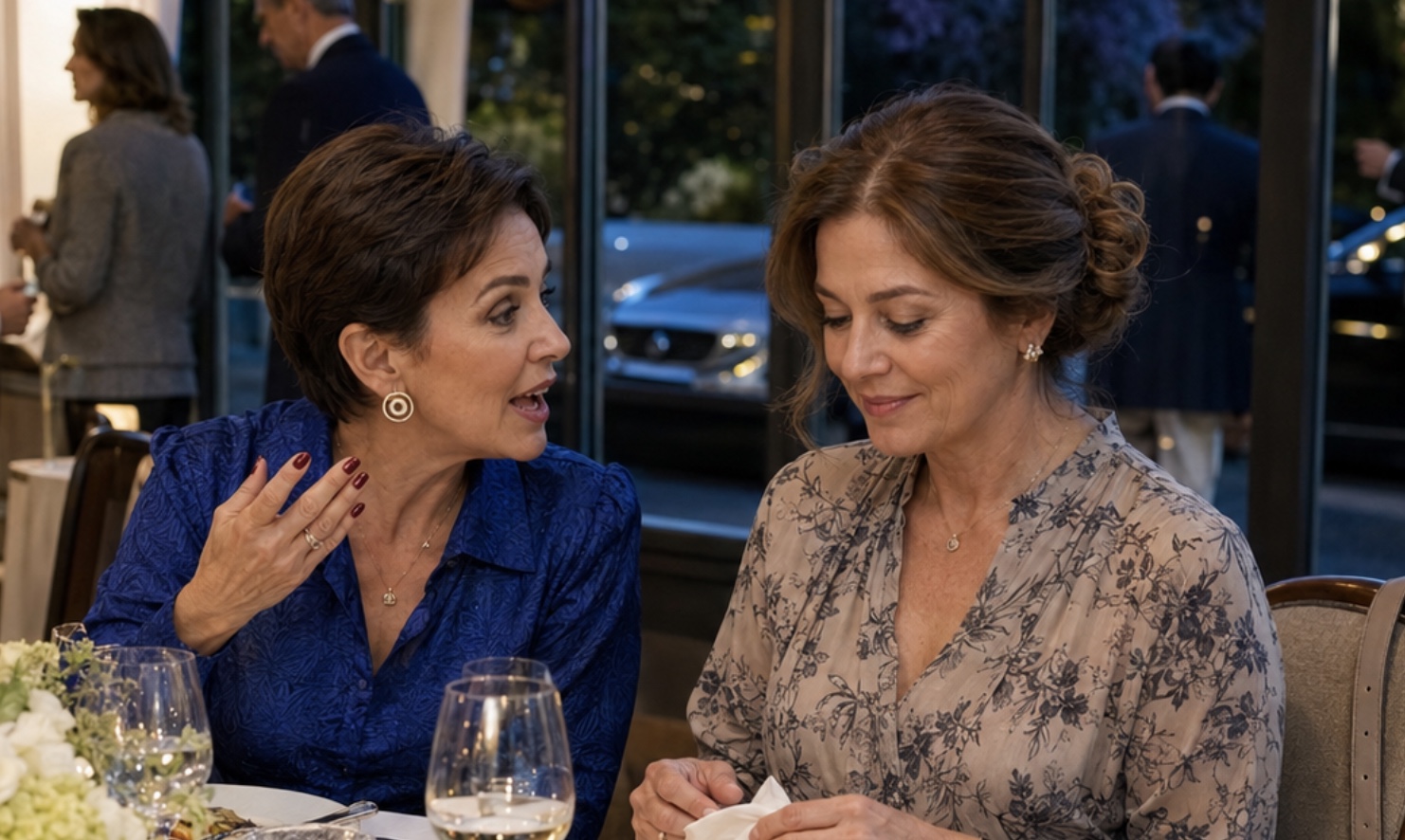
I heard Alla’s voice before I had even fully opened the door to the banquet hall. Sharp, loud, impossible to miss—the kind of voice morning radio hosts use to wake people up. She was standing in the middle of a small group, holding a glass of juice.
I was half an hour late. Kostya had been delayed on a service call. The refrigeration unit at the supermarket on Zarechnaya Street had broken down. By the time he replaced the compressor, washed up, and changed his clothes, we had missed the bus and had to wait for the next one.
“…and can you imagine, girls? He’s now in charge of the entire regional division. Three hundred employees report to him. Three hundred!” Alla swept her eyes around the group and finally stopped on me. “Oh, look who’s here—our quiet one. We were just talking about our husbands.”
I hung up my coat and took a seat. There was only one empty chair left, directly across from Alla. Someone pushed a plate of cold cuts toward me, while someone else poured lemonade into my glass.
It was an ordinary school reunion. Twenty-five years had passed since graduation. We had booked an inexpensive restaurant and each contributed three thousand rubles. Fewer people showed up than expected—eighteen out of our class of thirty-two.
“Three hundred people,” Alla repeated, smiling at me. “Can you imagine that kind of responsibility? Every day he makes decisions that affect salaries, deliveries, the whole operation. He comes home and spends another two hours on his laptop. I tell him to relax, but he simply can’t. People are waiting for his decisions.”
I tasted the Olivier salad. Nothing special. Too much potato and not enough mayonnaise.
Nina, who had once shared a desk with me at school, leaned closer and quietly asked,
“Where’s your husband?”
“At home. He couldn’t make it. Work.”
“What does he do?”
“He repairs and services commercial refrigeration equipment.”
I answered quietly, but Alla apparently heard me. Or perhaps she had simply been waiting for the opportunity. She placed her glass on the table and looked at me with that same expression I remembered from ninth grade—the kind that somehow managed to look down on you even when she was sitting at exactly the same height.
“You know, girls, life turns out differently for everyone,” Alla said, supposedly addressing the whole table, though her eyes stayed on me. “Some women marry men who build careers, grow professionally, achieve things. Others spend their lives with ordinary working men. You know—the type who work with their hands all day and live from paycheck to paycheck. That’s a life too, of course. Just… a different kind of life.”
The table fell silent.
Nina lowered her eyes toward her plate. Someone coughed awkwardly. At the far end of the table, Zhenya—our former math genius, I think—suddenly began talking to the person beside him, clearly just to fill the uncomfortable silence.
I sat there feeling my face burn.
Not with shame.
With anger.
I had plenty I wanted to say, but the words seemed stuck in my throat.
I thought of Kostya.
The night before, he had returned from a service call at half past eleven. He quietly reheated dinner and sat alone in the kitchen. I woke up and came out.
“Why aren’t you asleep?” he asked.
“I could ask you the same thing.”
“I’m starving. No strength left. Sorry I woke you.”
Then he ate pasta that the microwave had barely warmed properly.
An “ordinary working man.”
Kostya could dismantle an industrial refrigeration unit and identify the problem simply from its sound or vibration. People called him when other technicians had already given up and recommended buying completely new equipment. Kostya would arrive, work for two hours, and somehow the machine would be running again.
No, he didn’t earn what a regional director with three hundred employees probably earned.
But we had our apartment, even if we were still paying the mortgage. Our daughter was studying to become a chef. Our refrigerator was always full.
What more did we actually need?
But I said none of that aloud.
Alla would have laughed.
Or worse—she would have pitied me.
To someone like her, being “a brilliant technician” wasn’t an achievement worth mentioning. She measured people by the number of employees beneath them and the titles printed on their business cards.
I remembered our after-school program.
Alla had already loved being in charge back then. Perfect bows in her hair, an expensive pencil case with three compartments, always raising her hand before everyone else even when she didn’t know the answer.
She simply needed to be noticed.
In high school, we were assigned to make a wall newspaper together.
Well, “together” wasn’t quite accurate.
She pushed me out of the project, then told our teacher I was missing deadlines, even though Alla herself had been the one delaying everything.
But she already knew how to present herself.
And now there she was, sitting opposite me.
Fit figure. Expensive-looking dress. Perfect haircut. Elegant earrings.
Talking about her husband and his three hundred employees.
And there I was in a blouse I had bought on sale, saying nothing.
“Everyone has different circumstances,” Nina finally tried to defend me. “Money isn’t everything.”
“Oh, Nina, that’s what people without money always say,” Alla laughed at her own joke.
Several people smiled automatically.
“I’m not judging anyone. I’m simply saying that choosing a husband also means choosing your standard of living. You can marry someone ambitious and driven, travel, experience the world, never deny yourself anything. Or you can…”
She paused.
“Well, you understand.”
And again she looked directly at me.
I pushed my plate away. I had lost my appetite.
I wanted to stand up and leave, but that would have looked like defeat.
Alla would have enjoyed that.
“So what exactly does your husband do?” I asked, forcing my voice to remain calm.
Alla immediately brightened.
Apparently, she had been waiting all evening for someone to ask.
“He’s a regional director for a major grocery chain. Twenty-eight stores across the region. Every day he deals with suppliers, leases, employees, management problems. His phone never stops ringing even after he comes home. I tell him, ‘Turn it off for once.’ But he says, ‘I can’t. Business doesn’t wait.’ That’s responsibility. Not everyone could handle it.”
“And where do you go on vacation?” Nina asked, probably trying to steer the conversation somewhere safer.
“Last year we went south, into the mountains. We stayed in a two-story suite overlooking a gorge. Sixty thousand rubles a night. Expensive, yes, but worth every penny. You wake up and the clouds are practically level with your window. And the silence—you can actually hear birds singing.”
She described it like she was reading from a luxury travel brochure.
That was another thing I remembered about Alla.
She never simply told you about her life.
She presented it.
Like a performance at the blackboard.
Then the conversation turned to children.
Alla’s daughter attended a private language school, while her son played tennis with a personal coach.
“You can’t save money when it comes to children,” Alla said. “They’re an investment.”
I suddenly noticed that beneath the table I had been tearing a paper napkin into tiny pieces.
There was already a small pile scattered across my lap.
Then my phone rang.
Kostya.
I stepped into the hallway, where the air smelled faintly of kitchen food and disinfectant.
“How are you?” he asked. “You’re not cold, are you? It started raining. Want me to come pick you up?”
“No, don’t. It’s still early. How’s work?”
“Fine. Finished the service call. I’m at the workshop now, rebuilding two compressors. Call me when you’re done. I can take the bus over or ask one of the guys to give me a ride.”
His voice sounded completely ordinary.
I listened to him and suddenly felt tears sting my eyes.
He had spent the whole day crossing the city from one job to another. Earlier he had changed a compressor weighing nearly seventy kilograms. And instead of resting, he was sitting in the workshop repairing two more.
Yet he was worried about whether I might be cold.
“I’m fine,” I said. “I’ll call you later.”
“All right. Say hello to your classmates.”
I returned to the hall.
By then everyone was discussing old school trips and who had secretly had crushes on whom. Alla looked bored. Nostalgia clearly wasn’t her preferred subject.
I sat down again.
Nina pushed a plate of sandwiches toward me.
“You’ve barely eaten anything. Try the ones with fish.”
I nodded.
Before long, Alla started again.
This time it was her husband’s car.
“Executive class. Black. Leather interior. Four-zone climate control.”
I thought about our old foreign car. Kostya had bought it used three years earlier.
It drove perfectly well and rarely broke down.
He changed the oil himself. Replaced brake pads himself too.
“Why pay someone for work you can do with your own hands?” he always said.
I agreed with him.
“…and you know what I’ll tell you, girls,” Alla continued, lowering her voice as though she were about to share some profound truth. “Success isn’t luck. It’s hard work every single day. My husband gets up at six in the morning and goes to bed at one at night. He sacrifices his health, his time, his nerves. Meanwhile, someone else sits around in a workshop waiting for repair calls and decides life is good enough. Different level of ambition. Different attitude toward yourself.”
She didn’t mention Kostya by name.
She didn’t need to.
She was looking straight at me.
Everyone at the table understood exactly whom she meant.
That was when I became genuinely furious.
Not because she was insulting my husband. She didn’t even know him.
What hurt was that she was doing it publicly, in front of people I had spent so many years with.
And nobody stopped her.
They nodded, looked away, studied their salads.
Not one person said,
“Alla, enough.”
Then I understood.
They were afraid of her.
Afraid of her confidence, her loud voice, her expensive earrings.
If you challenged her, she might turn her attention on you.
Better to remain silent.
The main course arrived. Someone turned on music, and several couples went to dance.
I sat there thinking about Kostya.
He had probably finished repairing the compressors and was home by then, sitting in the kitchen with a book.
He loved reading about new refrigeration technologies.
“You have to keep learning,” he always said. “Otherwise the market leaves you behind.”
There was a stack of technical magazines beside his bed.
And unlike people who bought books just to display them, Kostya actually read his.
Around ten o’clock, a man entered the banquet hall.
Tall, well dressed, carrying an expensive briefcase.
Alla’s whole face lit up.
“Oh! That’s my husband! He promised he’d stop by!”
The man approached and politely greeted everyone.
I looked at him carefully.
He had a tired face, dark circles beneath his eyes, and his tie had been loosened.
He sat beside Alla, placed his briefcase on an empty chair and exhaled heavily.
He looked completely exhausted.
“Meet my classmates,” Alla said rapidly, listing names. Then she gestured toward me. “And this is the husband of our… old desk partner’s wife—”
She didn’t even bother saying my name properly.
Her husband nodded politely, muttered a greeting, and reached for a sandwich.
Alla caught his hand.
“Don’t eat that. You’re not supposed to. I ordered something separate for you in the car.”
“I’m hungry,” he said quietly.
“You can wait. Eat at home.”
He withdrew his hand.
For several minutes he simply sat staring into space.
Then his phone rang and he stepped away.
Alla watched him leave.
“See? He even found time to come to my reunion, even though he had three meetings today and a video interview with Moscow. That’s what a real man is—he always makes time for his family.”
I looked at the clock.
Ten-thirty.
Kostya was probably asleep already.
Or waiting for me to call.
Alla’s husband returned, looking even more exhausted than before. He sat on the edge of his chair and began speaking quietly to his wife.
I wasn’t trying to listen, but pieces of their conversation reached me.
“…report was rejected… supplier missed the deadline… tomorrow at eight…”
“You’re the director,” Alla replied. “Delegate things. Why are you running around like a hamster on a wheel? Hire better people.”
“I can’t delegate something I’ll still be held responsible for.”
“Then you’re hiring the wrong people.”
“Alla, not now. Please. I’m really tired.”
She finally went quiet.
And suddenly I saw what I had somehow missed all evening.
Behind that polished picture of a “successful marriage” sat an ordinary exhausted man.
He barely slept.
He ate whenever he had the chance.
His time didn’t belong to him.
Three hundred employees meant three hundred possible problems.
Twenty-eight stores meant twenty-eight sources of headaches.
That impressive executive car was mostly a place where he spent four hours a day answering phone calls.
Around eleven-thirty, people began leaving.
I put on my coat.
Nina caught up with me in the hallway.
“Don’t take Alla too seriously. She’s always been like that. Remember in ninth grade when she bullied that new girl just because the girl didn’t want to be friends with her? She hasn’t changed.”
“I’m not offended,” I lied. “It was just unpleasant.”
“I understand.”
Nina hesitated.
“My husband’s a construction foreman, actually. He spends the whole day on building sites and comes home exhausted. But he still plays with the kids, and on weekends we go out of town together. If he disappeared into meetings from morning until night, what would be the point?”
I nodded.
Nina said goodbye and left.
I called Kostya.
He answered immediately.
“Finished?”
“Yes. You’re still awake?”
“Yep. The kettle’s hot. Come home.”
“I’m on my way.”
Outside, the air smelled of wet asphalt and autumn leaves.
I stood at the bus stop thinking about Alla, about her husband’s exhausted eyes, and about all her boasting.
I suddenly wondered if there was less confidence behind it than fear.
A constant need to prove something.
To prove, prove, prove.
The bus arrived twelve minutes later.
I took a seat by the window.
The city was growing quiet.
When I got home, I kicked off my shoes and slipped into my house slippers.
Tea was waiting on the kitchen table.
Kostya poured me a cup and placed a plate beside it with two sandwiches—bread, butter, and cheese.
He knew that I usually came home hungry from gatherings because I felt awkward eating much around people.
“So, how was it?” he asked.
I took a sip of tea.
I wanted to tell him everything.
But I couldn’t.
Repeating Alla’s words would only hurt him.
He wouldn’t show it. He would probably shrug and say,
“People say all kinds of things.”
But I knew he would remember.
And the next time I invited him somewhere, he would find an excuse not to go.
Not because his pride was wounded.
Because he wouldn’t want to embarrass me.
“It was fine,” I said. “We sat around, talked. Alla Soboleva was there. She married some kind of director.”
“Oh, Soboleva.” Kostya smiled. “The one you told me about? The girl who used to boss everyone around at school?”
“That’s her.”
“So what’s she like now?”
“The same. Still bossing everyone around.”
Kostya nodded and didn’t ask anything else.
That was another thing he was good at.
He never forced his way into someone’s feelings.
He simply sat beside me, drinking tea from his favorite mug. It had the words “Best Technician” printed on it—a birthday gift from his coworkers.
And suddenly I understood what I had been missing all evening.
With him, I didn’t need to prove anything.
I didn’t need to defend myself.
I didn’t need to perform.
We sat in the kitchen until one in the morning.
Then Kostya put the cups into the dishwasher, checked the front door lock, and went to bed.
I stood by the window for another few minutes.
The next morning, the front door closed quietly when Kostya left for work.
There was a note on the table:
“I’ll be home around seven. Lunch is in the fridge.”
I read it and smiled.
There he was.
My “ordinary working man.”
Up at six.
Off to work without complaining.
Leaving lunch for me before he went.
And the refrigerator, by the way, was exactly minus eighteen in the freezer and plus four in the main compartment.
Kostya had adjusted it himself.
Three days later, Nina called.
“You won’t believe this. I ran into Alla at the shopping center. She looked terrible. Her husband lost his job. Well, technically he was laid off. His position was eliminated. Another company bought the chain and started restructuring. The entire regional management team was cut. He’s unemployed now. Alla says it’s temporary and that he has offers from other cities, but they don’t want to move. And…”
Nina hesitated.
“Don’t tell anyone this, but she looked really upset. No makeup, red eyes. She asked whether I knew anyone looking for an English tutor. She used to work part-time at a language school. I guess money is getting tight.”
After the call, I sat for a long time staring at the wall.
The news didn’t make me happy.
I’ve never been able to enjoy another person’s misfortune.
But I couldn’t help thinking how quickly life could turn.
One day you have an executive car and a sixty-thousand-ruble hotel room overlooking a mountain gorge.
The next day you are searching for extra tutoring work and worrying about whether you can still afford private school.
That same day, Kostya was installing a refrigerated display case in a new grocery store.
He came home cheerful.
“The owner liked my work. Offered me two more locations.”
And then I understood something.
As long as there were supermarkets, warehouses, cafés, restaurants, and canteens in the city, my husband would have work.
Refrigeration equipment always broke down.
And someone would always need a person capable of fixing it.
Not from behind a laptop.
Not from an office.
Not through a video meeting with Moscow.
With his own hands and twenty years of experience.
That evening, I finally told Kostya about Alla.
He listened and shook his head.
“You know, I’ve been thinking,” he said after a moment. “What if we actually go somewhere on vacation next year? Not to some fancy mountain resort,” he added with a smile. “Maybe a health spa or sanatorium. My back’s been bothering me a little.”
“Let’s do it.”
He went into the other room and returned with a travel brochure.
Apparently, he had already looked into several places.
We sat at the kitchen table until midnight, turning pages, studying photographs, reading reviews and debating whether we should pay extra for a balcony or take a simpler room.
It was an ordinary evening.
Ordinary plans.
Ordinary conversation.
And I felt happy.
Far happier than I had felt for even a minute in that banquet hall.
The following week, I ran into Alla at the supermarket.
She was standing beside the frozen-food section, carefully studying the price tag on a bag of dumplings.
I was going to walk past her, but she noticed me.
“Oh… hi.”
Her voice sounded completely different from the reunion.
Quiet.
“Hi.”
“I…”
She hesitated, put the dumplings into her basket and looked away.
“Listen, I wanted to apologize. For that evening. I said things I shouldn’t have. I just…”
“Forget about it.”
“No, really. I shouldn’t have behaved that way. It was stupid.”
She never looked me in the eyes.
She picked up her basket and quickly headed toward the checkout.
I watched her go.
She was dressed simply.
No expensive earrings.
No heels.
An older jacket.
Apparently, things really had changed.
That evening, I told Kostya about meeting her.
He shrugged.
“Well, she apologized. That’s something. Maybe she understood a few things.”
“You think so?”
“I don’t know. But don’t stay angry with her. What good would that do you?”
Even now, I sometimes remember that reunion.
When Kostya comes home, washes his hands and sits down at the kitchen table for tea, I look at him and know with complete certainty that I don’t need anyone else.
There is a quiet, dependable world hidden inside those ordinary evenings over tea.
A world where nobody has to report their achievements.
Nobody has to compete.
Nobody has to prove their worth.
And sometimes I wonder:
Have you ever stopped to think about what in your life is truly real—and what exists only to impress other people?