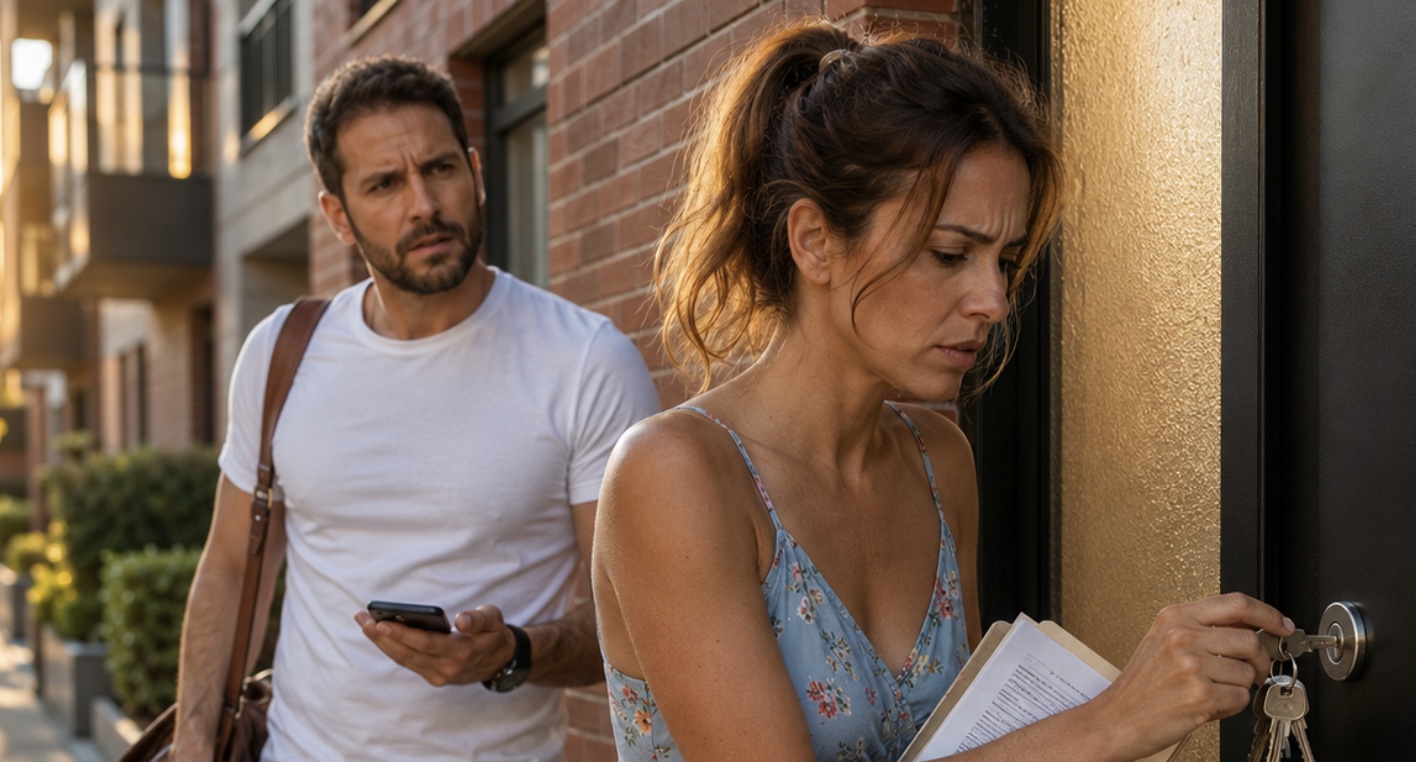
When Lena returned from vacation, she discovered that her key no longer fit the lock. Her mother-in-law had made the decision for them. But one document left inside the apartment changed everything.
The key would not turn.
Lena tried again, pushing it deeper into the keyhole and twisting it first to the left, then to the right. Metal scraped against metal, but nothing happened. The lock refused to move.
“Let me try,” Gleb said.
He gently moved her aside, took the keyring, and inserted the key himself. It went halfway in and stopped completely.
The stairwell smelled of fresh paint. Someone had repainted the railings on their floor while they were away in Anapa.
Two weeks.
Fourteen days during which, as they would soon discover, far more had changed than the color of the railings.
“Maybe it’s jammed,” Gleb said, crouching to examine the keyhole.
Lena leaned against the wall and looked at their luggage. Two large suitcases and one small case covered with Dasha’s stickers. Their daughter was sitting on the steps one floor below, picking at a unicorn sticker on her tablet case.
“This isn’t our lock,” Gleb said.
He straightened. His face had taken on the same expression he wore whenever he studied the utility bills: clenched jaw, pale skin above his upper lip.
“What do you mean?”
“The lock is different. Look. Even the metal plate is new. It’s shining.”
Lena bent closer.
He was right. The plate gleamed with fresh chrome against the old wooden door covered in brown imitation leather. It was their door, their worn brown upholstery—but the lock belonged to someone else.
It took Lena three attempts to call her mother-in-law. The first two times, her wet fingers missed the call button. The July heat was so intense that her shirt clung to her back.
“Hello, Zinaida Pavlovna. We’re back.”
“Oh, already? How was your vacation?”
Her voice was calm. Almost cheerful, as though nothing unusual had happened.
“We can’t get into the apartment. There’s a different lock.”
There was a pause.
It was brief, but Lena heard it. She heard it and remembered it.
“Oh, yes. I meant to tell you. I changed the locks.”
“What?”
“I had them replaced. The old ones were completely worn out, so I called a locksmith. He finished everything in two hours. These are good locks, Israeli ones. Much better than what you had before.”
Lena looked at Gleb.
He was standing against the doorframe, listening. She had not put the phone on speaker, but the stairwell was so quiet that every word Zinaida Pavlovna said could be heard clearly.
“Zinaida Pavlovna, this is our apartment.”
“Of course it is. Who’s arguing with that? I was only trying to help you. I’ll bring the keys tomorrow morning.”
“Tomorrow?”
“Well, what do you expect me to do? I’m in Kolomna, visiting Raisa. It takes an hour and a half to drive back. It’s already late.”
It was seven in the evening. In July, the sun was still shining as brightly as it did during the day. But apparently, as far as Zinaida Pavlovna was concerned, it was already too late.
“We have nowhere to sleep,” Lena said.
The words seemed to stick in her throat, as though she had to force each one out.
“Oh, don’t exaggerate. Go to Gleb’s workplace and stay there. Or get a hotel room. It’s only one night.”
Gleb took the phone from her. Despite the heat, his fingers felt cold.
“Mom, you changed the locks in our apartment without asking us.”
“Gleb, darling, I only wanted to make things better. The locksmith happened to be available, and I thought there was no point waiting.”
“You thought.”
“Yes. What’s the problem?”
“Bring us the keys today.”
“Gleb, I already told you. It’s late.”
“Mom. Today.”
He ended the call and handed Lena the phone. The screen felt hot in her palm.
Dasha had fallen asleep on the stairs.
She was six years old, with sun-browned knees and a scrape from the rocks at the beach. Her head rested against one of the suitcases. Lena folded her cardigan and placed it beneath the girl’s cheek before sitting down beside her.
Gleb paced across the landing.
Three steps to the wall, turn around, three steps back. The soles of his sneakers whispered against the freshly painted concrete.
“She isn’t coming,” Lena said.
“She’ll come.”
“She won’t. You know your mother.”
He stopped and looked out of the stairwell window.
Below them were the courtyard, the swings, and the old birch tree the residents promised to cut down every year. Gleb knew that view by heart. He had grown up in this apartment.
And now he was standing outside its door, unable to enter.
“She didn’t just replace the locks,” Lena said quietly.
She spoke softly because Dasha was sleeping—and because quiet words sometimes sounded more precise.
“She wanted to show us that she could. That this apartment isn’t really ours. That she’s the one who decides.”
Gleb said nothing.
He sat on the top step, pulled out his phone, and began searching through something. Lena saw the reflection in his glasses: a white screen covered with small text.
He was looking for emergency locksmith services.
The locksmith arrived forty minutes later.
He was a short man in his fifties, dressed in blue overalls and smelling of machine oil and mint chewing gum. His hands were large, with dark grime permanently embedded in the skin.
“You want me to open it?” he asked, examining the lock.
“Yes,” Gleb said.
“Do you have proof that you own the apartment?”
Lena opened her mouth, then closed it again.
The property documents were inside the apartment, stored in a folder marked “Important,” which Gleb had created when they moved in.
“They’re inside,” Gleb said.
“Then I can’t do it. I’m not legally allowed to open the door without documents. You might not be the owners.”
“We are the owners.”
“I believe you. But I need proof. Otherwise, get the local police officer to confirm it.”
Gleb called his mother again.
She did not answer.
He tried a second time. Then a third. The ringing continued at a steady, even rhythm, like the pulse of an idling engine.
She finally answered on the fourth attempt.
“Gleb, I’ve already gone to bed.”
“Mom, we need the apartment documents. The locksmith won’t open the door without them.”
“What documents?”
“The ownership certificate. A property extract. Anything.”
“But all your documents are inside the apartment.”
“We can’t get inside because you changed the locks.”
Silence.
Then came a long sigh—the kind Zinaida Pavlovna used as a weapon. A deep, rising sigh that suggested the entire weight of the world had fallen onto her shoulders.
“So what am I supposed to do?”
“Bring the keys.”
“But I’ve already changed my clothes.”
“Mom.”
“All right, all right. I’m leaving now.”
She ended the call.
Gleb turned to the locksmith.
“Can you wait?”
“For an hour and a half? No, my friend. Call me again when you have access—or when you find the documents.”
The locksmith packed up his tools and left, leaving behind the smell of machine oil and a business card on the windowsill.
Lena remained on the stairs, thinking.
Not about the locks.
She was remembering the first time Zinaida Pavlovna had arrived for what she called an “inspection,” three years earlier.
She had let herself in at ten in the morning using a key she was never supposed to have. Gleb had given her a spare “for emergencies” long before.
Lena had just finished a night shift and was still asleep.
She came into the hallway wrapped in a robe and found Zinaida Pavlovna standing there, silently examining the shoes.
“Do you take your shoes off on this mat?” she asked.
“Yes,” Lena replied, still trying to wake up.
“The mat is dirty. You need to replace it.”
That had been the beginning.
Afterward came the unannounced visits, the rearranged pots and pans, and the constant remarks about how Dasha needed more porridge instead of “those cereals you feed her.”
Then there had been the incident with the curtains.
Zinaida Pavlovna removed and washed them while Lena and Gleb were at work. The curtains shrank dramatically.
“They were old anyway,” she said.
And now she had replaced the locks.
Lena took out her phone and opened the photo gallery.
She scrolled past their vacation pictures: Dasha on the beach, Gleb cooking meat over a grill, a sunset, another sunset, jellyfish swimming in a plastic bucket.
Then she found a picture she had taken two days before they left.
She had photographed the shelf containing their documents for insurance purposes, worried that the apartment might flood or that something else might happen while they were away.
In the photograph, between several folders and envelopes, there was a blue document.
An extract from the Unified State Register of Real Estate.
Lena enlarged the image.
The quality was good enough to read the text.
The address.
The cadastral number.
And the names of the owners:
Gleb Andreyevich Kulikov and Elena Sergeyevna Kulikova.
Joint ownership. One-half each.
She read it again.
One-half belonged to Gleb.
One-half belonged to her.
Zinaida Pavlovna’s name appeared nowhere.
“Gleb, look.”
He came over and leaned toward the screen. His glasses slipped down his nose as he read. Lena watched his eyes move across the lines, narrowing as he focused on the tiny print.
“That’s the property extract.”
“I know. I photographed it before we left. Just in case.”
“Our names are on it.”
“And your mother’s name isn’t.”
He looked at her over the top of his glasses.
Somewhere inside the building, pipes began to hum as a neighbor upstairs turned on the water.
Dasha shifted in her sleep and mumbled something about seashells.
“Call the locksmith,” Lena said.
“Will a photograph be enough?”
“He asked for a document. This is a document. It has our names, our address, and the official registry stamp.”
Gleb took the business card from the windowsill and dialed the number.
The locksmith returned twenty minutes later. Apparently, he had not gone far.
He examined the photograph, enlarged it, and read through the information.
“Elena Sergeyevna Kulikova?”
“That’s me.”
“Passport?”
Lena took her passport from her handbag.
The locksmith compared the details and nodded.
“All right. I’ll open it.”
It took him fifteen minutes.
Lena stood beside him, watching as he removed the shiny metal plate, worked on the mechanism, and pulled out the lock cylinder.
The brand-new, gleaming “Israeli” lock finally gave way with a dry click.
The door opened.
The apartment smelled unfamiliar.
Not dirty. Not unpleasant. Just foreign.
There was the scent of lavender cleaning spray, something Lena never bought, and another sweet smell, like perfume—but not hers.
“She cleaned in here,” Lena said, looking toward the kitchen.
The kitchen gleamed.
The stove had been scrubbed spotless. The sink shone. Their towels had been replaced.
Instead of their green waffle-knit towels, there were white ones embroidered with roosters.
Zinaida Pavlovna loved roosters.
Her entire house in Kolomna was decorated with them: roosters on the curtains, oven mitts, refrigerator magnets, and kitchen towels.
“Look at this,” Gleb said from the hallway.
He pointed at the wall.
Their wedding photograph, which usually hung above the cabinet, had been shifted to the right.
Beside it was another picture.
It showed a young Zinaida Pavlovna standing with her late husband inside this very apartment. The photograph had been taken in the 1980s. Behind them was a carpet on the wall and a display cabinet filled with crystal glasses.
Lena stepped closer.
The gold-colored frame was new.
So was the nail holding it.
“She hung a photograph of herself in our apartment.”
“Right beside our wedding picture,” Gleb said.
They stood in the hallway, staring at the two photographs.
Young Zinaida in what had once been her home.
Gleb and Lena on their wedding day.
It looked as though someone had been marking territory.
They carried Dasha into her bedroom.
She did not wake when Gleb lifted her. She only yawned and rested her cheek against his shoulder. The skin on her sunburned nose had already begun to peel.
Lena closed the bedroom door and went into the kitchen.
Gleb sat at the table with a mug of water in front of him.
Not tea. Not coffee.
Just water.
“We need to talk,” Lena said.
“I know.”
“Not you and me. We need to talk to her.”
“I know.”
He rotated the mug slowly between his hands.
It was white, decorated with a rooster.
Lena opened the cupboard and took out her own mug, the one with the chipped handle. Zinaida Pavlovna had not thrown it away, but she had pushed it into the farthest corner behind a stack of saucers.
“She believes this is her apartment,” Lena said, sitting across from him.
“It belonged to my father. After he died, it was legally transferred to us. Everything was done properly.”
“Legally, yes. But not in her mind. In her mind, she is still the owner. She lived here for thirty years, Gleb. She raised you here. She chose that chandelier. She helped put down that flooring.”
Gleb looked up.
“Are you defending her?”
“No. I’m trying to understand what we’re dealing with. This wasn’t an accident. She didn’t simply ‘want to help.’ She changed the locks, replaced our towels, hung her picture on the wall, and refused to give us keys.”
He drank some water. His throat moved as he swallowed.
“What are you suggesting?”
“For a start, we take away her spare key. The one she isn’t even supposed to have. We took her key eighteen months ago after the curtain incident.”
“She must have made another copy.”
“Exactly.”
The kitchen clock ticked.
Zinaida Pavlovna had brought it the previous year, saying no kitchen could function without a clock. It was round and decorated with little flowers, like something from an old Soviet cafeteria.
Lena hated it, but Gleb had asked her not to remove it because his mother might be offended.
The clock showed eleven.
“She still hasn’t arrived,” Lena said.
“We’re already inside.”
“But she said she was leaving.”
Gleb checked his phone.
There were no calls and no messages.
“Maybe she went back to sleep.”
Lena did not respond.
She stared at the flowered clock and thought about how much of Zinaida Pavlovna lived inside their apartment.
The rooster towels.
The flowered clock.
The curtains she had once washed and ruined.
The photograph on the wall.
The secret duplicate key.
And now the lock.
Every object and every gesture said the same thing:
I am in charge here.
Zinaida Pavlovna called the next morning at a quarter to eight.
Lena was still sleeping, but the phone was vibrating so violently against the bedside table that the glass of water beside it trembled.
“Hello?”
“Good morning, Lenochka. I’m bringing the keys. I’ll be there in an hour.”
Lena sat up.
Through the wall, she could hear Dasha moving around, probably playing with her tablet.
“Zinaida Pavlovna, we’re already inside.”
“What do you mean, inside?”
“We called a locksmith. He opened the door.”
“He broke the new lock? The Israeli lock?”
There was more outrage in her voice about the damaged lock than shame over what she had done.
Lena noticed that.
She pressed the phone closer to her ear and closed her eyes.
“Come over, Zinaida Pavlovna. We need to talk.”
“About what?”
“Everything.”
Gleb woke when he heard her voice.
He lay on his back, staring up at the ceiling.
The ceiling was white and spotless.
His mother had repainted that too.
“She’s coming?” he asked.
“She’s coming.”
“Good.”
He got out of bed and went into the bathroom.
Lena heard the water start running. Then it stopped. Then it started again.
She knew what he was doing.
He was standing there with his hands beneath the tap, trying to gather his thoughts. He always did that when he needed to prepare himself for something difficult.
Zinaida Pavlovna arrived at ten.
She rang the doorbell, even though she apparently had keys to the new lock.
Perhaps she wanted to demonstrate that she respected their boundaries.
Or perhaps she was no longer certain her keys would work after the locksmith had finished.
She stood in the doorway, a small, slender woman of sixty-three with short, copper-dyed hair. She wore hoop earrings, a beige blouse tucked into trousers, and ballet flats decorated with little bows.
She was holding a bag.
“I brought cabbage pies,” she said, handing it to Lena.
The pies were still warm.
They smelled of oil and fresh dough, and for one brief moment, the familiar scent distracted Lena. It reminded her of her grandmother’s village kitchen, a place where she had always felt safe—where no one changed locks or hung photographs to claim ownership.
“Come in,” Lena said.
Zinaida Pavlovna entered, removed her shoes, and placed them neatly beside the wall.
She walked into the kitchen and stopped.
She examined the table, the rooster towels, and the flowered clock.
Everything was still in place.
Her shoulders relaxed almost imperceptibly.
Gleb stood near the window with his back to her.
“Sit down, Mom.”
She took a seat and folded her hands on the table.
She still wore her wedding ring on her right hand, although her husband had been dead for nine years. Her fingers were thin, with raised blue veins.
“Well,” she said in the tone of someone asking what everyone was complaining about this time, “why did you want me to come?”
Gleb turned away from the window.
“Mom, you changed the locks in our apartment.”
“I already explained. The old locks were loose.”
“They weren’t. I replaced them last year.”
“Then you did a poor job.”
“Mom.”
“What do you mean, ‘Mom’? I’m the one who looks after things while you’re lying on the beach. I watered your plants, watched the apartment, and—”
“We never asked you to watch the apartment,” Lena said.
Zinaida Pavlovna turned toward her.
Her look was sharp and quick, like a needle.
“I’m not talking to you.”
“Zinaida Pavlovna, the apartment belongs to both Gleb and me. This conversation concerns all of us.”
Silence followed.
The clock continued ticking.
From Dasha’s room came muffled laughter at something playing on her tablet.
“What is this?” Zinaida Pavlovna demanded, her voice becoming higher and thinner. “Are you putting me on trial? I lived in this apartment for thirty years. I brought my baby son home here. I repaired this place while Andrei was away working. I—”
“Zinaida Pavlovna,” Lena interrupted.
She opened the photograph of the property extract on her phone and placed the device face-up on the table.
“This is the official property record. The owners are Gleb Andreyevich Kulikov and Elena Sergeyevna Kulikova. Each of us owns one-half.”
Zinaida Pavlovna looked at the screen.
She did not lean closer or pick it up. She merely stared down at it.
“So?”
“So replacing the locks in someone else’s apartment without the owners’ permission is illegal. Entering someone else’s home without permission is also illegal. So is removing belongings, rearranging the home, or hanging things on the walls.”
“Someone else’s apartment?”
Her lips trembled.
Not with pain.
With anger.
Lena watched the knuckles of her clasped hands turn white.
“You’re calling this someone else’s apartment? To me?”
“Mom,” Gleb said, sitting between them. “No one is saying you’re a stranger. But this apartment has legal owners. Lena and I are those owners.”
“Then what am I? A servant? A neighbor?”
“You’re my mother. But this is our home.”
The conversation continued for two hours.
Later, Lena could not remember it in full. She recalled only fragments, like scenes from a movie watched through half-closed eyes.
Zinaida Pavlovna cried.
She said she had given her entire life to the family and was now being thrown away.
No one was throwing her away.
Gleb repeated that four times before eventually giving up.
Lena showed her the photograph of the property document again when Zinaida Pavlovna declared that Andrei would never have allowed anyone to treat his wife this way.
Andrei was Gleb’s late father, the man who had left the apartment to his son in his will.
The same man who, while still alive, had repeatedly asked Zinaida not to interfere in their son’s family.
Lena knew this from Gleb.
Gleb knew it from his father.
“Mom, Dad left the apartment to me,” Gleb said. “Not to you. That was his decision, and you know it.”
For the first time in two hours, Zinaida Pavlovna became silent.
She sat at the table, staring at her hands.
At her wedding ring.
At her thin fingers and raised veins.
The flowered clock ticked.
The cabbage pies grew cold.
“I only didn’t want to become unnecessary,” she finally whispered.
She spoke so quietly that Lena almost missed the words.
But she heard them.
Gleb walked his mother to her car.
Lena remained in the kitchen.
She put the pies in the refrigerator and rinsed the mugs.
There were three of them: her own mug with the chipped handle, Gleb’s blue mug, and the white rooster mug from which Zinaida Pavlovna had been drinking.
Then Lena removed her mother-in-law’s photograph from the wall.
She did it carefully so she would not damage the wallpaper.
The nail remained behind.
A tiny hole in the wall that could easily be filled.
She placed the photograph on the shelf in the hallway.
She did not hide it.
She did not throw it away.
She simply put it there.
Then she returned to the kitchen and looked at the flowered clock.
She took it down, wrapped it in one of the rooster towels, and placed it beside the photograph.
Gleb returned twenty minutes later.
He stood in the hallway, looking at the shelf.
“You took down the clock?”
“And the photograph.”
“She’ll be upset.”
“Gleb.”
He looked at her.
She stood in the kitchen doorway wearing shorts and one of his old T-shirts. Her hands were still wet from washing the dishes.
“I don’t want to live in her apartment,” Lena said. “I want to live in ours.”
“It is ours.”
“Not while her clock, her towels, her photograph, and her lock are still here. With all of that around us, this is still her territory, and we are living here with her permission.”
He was silent.
“I’ll replace the lock,” he said eventually. “Today.”
“And don’t give her another key.”
“I won’t.”
“And talk to her. Not over the phone. Have a real conversation about boundaries. Explain that she is your mother, not the owner of our lives. Tell her it’s possible to love people without controlling them.”
He nodded.
He removed his glasses and wiped them against the edge of his shirt.
Without his glasses, his face looked different. Younger. More uncertain.
Like the face of the boy who had grown up in this apartment and still had not completely decided who it belonged to.
They replaced the lock that same day.
The new one was ordinary, without any claims of being imported from Israel.
There were two keys.
One for Gleb.
One for Lena.
There was no third key.
Dasha woke around lunchtime and asked why her grandmother had come without presents. Usually, Grandma brought candy or coloring books.
This time, she had brought only pies.
“Grandma was in a hurry,” Lena said.
“What are the pies filled with?”
“Cabbage.”
“Yuck. I want apple.”
Lena smiled for the first time in twenty-four hours.
The muscles in her face seemed to have forgotten how to do it, and the smile came out crooked—but it was real.
That evening, Gleb called his mother.
From the kitchen, Lena could hear fragments of the conversation.
His voice was calm and quiet.
He was not angry, but he was firm.
“No, Mom, you don’t need a spare key. If anything happens, the neighbor has our phone number. No, it doesn’t mean we don’t love you. Mom, listen to me. Please listen.”
He spoke to her for forty minutes.
While he talked, Lena unpacked their suitcases.
She took out clothes that smelled of sun and sea and placed them in the washing machine.
At the bottom of one suitcase, she found a seashell Dasha had secretly packed.
It was small and pale pink, with sand trapped inside.
Lena placed it on the windowsill.
Gleb came out of the room and sat on the sofa, tilting his head back.
“How did it go?” Lena asked.
“She cried.”
“And then?”
“Then she said I was ungrateful. After that, she went quiet. Finally, she said, ‘Fine.’ You know the way she says it when she doesn’t agree but is too tired to keep arguing.”
“I know.”
“She isn’t going to change, Lena.”
“I know. But boundaries aren’t for changing her. They’re for protecting us.”
He looked at her.
She stood there holding the seashell, looking back at him.
Outside, the daylight was fading.
It was a long, warm July evening, and the scent of sun-heated asphalt drifted up from the street.
“Thank you,” he said.
“For what?”
“For the photograph.”
“What photograph?”
“The property document. If you hadn’t taken that picture, we would have spent the night on the stairs.”
Lena shrugged.
“Sometimes paranoia is useful.”
“That wasn’t paranoia. That was you.”
Zinaida Pavlovna’s photograph remained on the hallway shelf for a week.
Then Lena placed it in a drawer.
She did not throw it away or move it into storage.
She put it in the drawer where they kept spare batteries, old postcards, and the key to the mailbox.
She washed the rooster towels and folded them into a bag.
The next time Zinaida Pavlovna came, Lena would return them.
The tiny hole from the nail remained in the wall.
It was small, almost invisible.
Lena noticed it every time she walked past.
She could fill it.
She could hang something of her own over it.
For the moment, she simply left it there.
Zinaida Pavlovna called three days later.
Her voice was casual and ordinary, as though nothing had happened.
“Would Dasha like to go ice-skating? I read that they’ve opened a rink at the shopping center.”
“It’s July, Zinaida Pavlovna.”
“So what? It’s an indoor rink.”
Lena paused.
Outside, Dasha was riding her bicycle around the courtyard. The sound of the little bell floated all the way up to the fifth floor—light, clear, and cheerful.
“Saturday would be fine,” Lena said.
“Wonderful. I’ll come and pick you up.”
“No. We’ll meet you there.”
“There?”
“At the entrance to the shopping center.”
A pause followed.
Lena could hear Zinaida Pavlovna breathing on the other end of the line.
Perhaps she was counting to ten.
Or perhaps to twenty.
“All right,” she finally said. “At the entrance.”
Lena set the phone on the table.
She looked at the wall where Zinaida Pavlovna’s photograph had once hung.
At the tiny hole left by the nail.
Then she looked at their wedding photograph.
Gleb in his suit.
Lena in her wedding dress.
Both of them laughing.
They had been twenty-six years old.
Back then, they had not thought about locks, boundaries, or kitchen towels embroidered with roosters.
Lena picked up Dasha’s seashell from the windowsill and turned it between her fingers.
A few grains of fine beach sand spilled onto her palm.
It smelled like summer.
She placed the little pink shell on the shelf in the hallway, exactly where her mother-in-law’s photograph had once rested.
Small, pale pink, and filled with sand.
Their own.