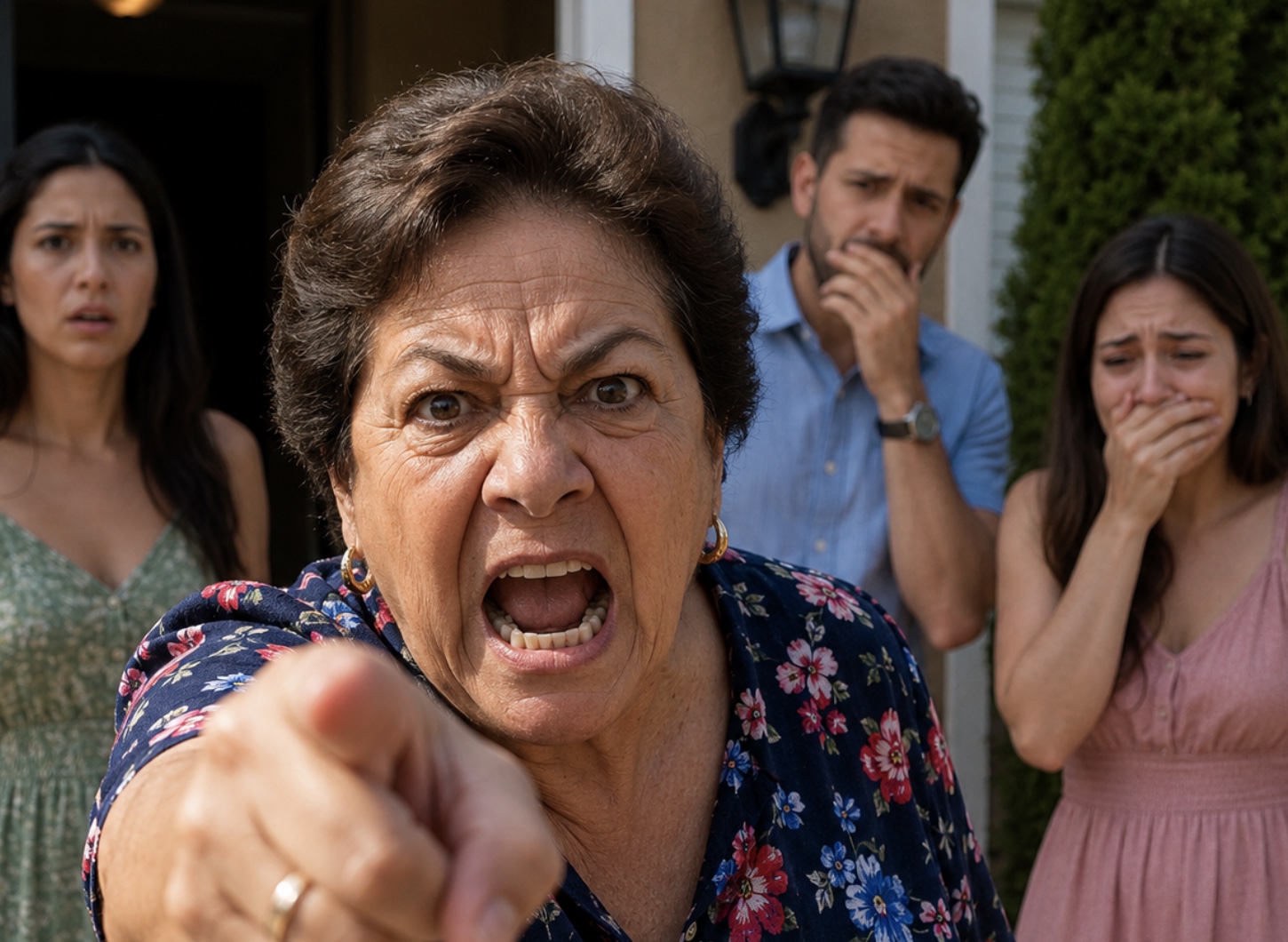
“Have you completely lost your minds?! Who gave you permission to stuff yourselves with my berries?”
Oksana flinched so violently that the tea nearly spilled from her cup.
She had been standing on the porch, enjoying a rare moment of peace. The children were picking strawberries, her husband was working in the garage, and for once she had been granted five uninterrupted minutes to herself.
Then her mother-in-law’s harsh, demanding voice shattered the silence like a stone thrown through glass.
“Mom said we could!” Vovka protested in his small, trembling voice.
His words were immediately drowned out by another furious scream.
“I told you to get away from there! You, you pathetic little mama’s boy—leave before I take this stick to both of you! Look at you, gobbling everything up as though nobody feeds you at home! Do you have any idea how much berries cost nowadays? I was going to take them to the market and sell them! And you’ve descended on them like a swarm of locusts!”
Oksana placed her cup on the wooden railing.
Without hesitation, she hurried around the side of the house and followed the narrow path leading deeper into the garden, toward the vegetable beds.
She rounded the corner and froze.
Elizaveta Petrovna stood beside the strawberry patch, broad-hipped and imposing in a brightly patterned housecoat thrown over an old nightgown. Her face was flushed from the heat and from rage. In one hand, she gripped a long wooden stick, waving it threateningly inches from Alyonka’s face.
The little girl pressed herself against her brother. Her fists were clenched so tightly that crushed strawberry juice dripped between her fingers like blood.
She stared at her grandmother with enormous, bewildered eyes.
The confusion and pain in those eyes made Oksana’s heart twist.
Her daughter—her little girl—was standing before the very woman who was supposed to protect her from harm. Instead, her grandmother was shaking a stick at her as though she were a thief who had broken into the garden.
“Grandma, we didn’t do anything wrong,” Alyonka whispered. “Mom said we were allowed.”
“Mom said!” Elizaveta Petrovna mimicked cruelly. “And who owns this land, I’d like to know? I do! The land is mine, so everything growing on it belongs to me! You planted a few things here and now you think you can eat my berries without asking? I was going to sell them at the market. That money was supposed to supplement my pension, and you little parasites have eaten it all!”
She continued shouting, but Oksana could barely hear the words anymore.
She was looking at her children.
Vovka was frightened, yet he had placed himself between his grandmother and his younger sister. Alyonka’s shoulders were trembling.
In that instant, Oksana saw everything she had spent years building begin to collapse.
Year after year, she had poured her strength into this family and into maintaining some kind of relationship with her mother-in-law. She had believed that kindness, patience, and time might eventually melt the ice in Elizaveta Petrovna’s heart.
Now she understood that all her effort had been wasted.
“Elizaveta Petrovna,” Oksana said, stepping forward, “I asked the children to pick strawberries for this evening. We agreed that this half of the garden was for our use. You established the boundaries yourself when we first moved here. I remember standing in this exact spot while you pointed everything out. You said the land up to the currant bush was yours, and everything beyond it was ours.”
Elizaveta Petrovna stared at her as though Oksana were not a person but an annoying obstacle.
“For your use?” Her eyes glittered with a feverish, almost wild light. “And what exactly is that supposed to mean? I am the owner here. I can let you use it today and take it back tomorrow. Don’t stand there lecturing me about some old agreement!”
“But we created all of this,” Oksana said, sweeping her hand toward the carefully maintained rows. “Gleb and I did it with our own hands. Every bush, every planting hole. You were the one who offered us this part of the property. You said you could no longer manage everything alone and that we should build something here while helping you.”
Her voice grew steadier.
“We removed the old, diseased apple trees. We paid for several truckloads of fertile soil because the ground was nothing but heavy clay. We planted everything from scratch. This used to be an abandoned patch of land covered in waist-high weeds, nettles, and burdock. Do you remember that?”
Oksana paused, looking directly into her mother-in-law’s eyes.
“Do you remember how I worked here from sunrise until dark while Gleb was at his job?”
To Elizaveta Petrovna, however, years of labor meant nothing.
Only one fact mattered: the property was registered in her name.
In her mind, that gave her the right to control everything growing there—and everyone living there.
“Yes, I remember!” she snapped dismissively. “But the land is still mine! The documents say so! I was planning to take those strawberries to the market. Have you seen the prices, Oksana? They pay eight hundred rubles a kilogram, sometimes a thousand if the berries are large. A thousand rubles, do you hear me? That was supposed to be extra money for me, and now you’ve eaten my income!”
She struck the ground with the tip of her stick.
“You never want to help me, and my pension isn’t even enough to pay for my medicine!”
Her gaze returned to the children.
There was so much hostility in it that Oksana instinctively moved in front of them.
“Elizaveta Petrovna, they are only berries. We grow all this for the family. For ourselves. For the people we love.”
“For the family?” her mother-in-law shrieked. “What family are you talking about? You are not my family, Oksana. You are a stranger to me, and so are your children. Gleb is mine. He is my own flesh and blood. But you and your little brood are outsiders.”
Her face twisted with contempt.
“I allowed you onto my property. I allowed you to live in my house. And now you steal my strawberries without permission!”
At last, Oksana heard the truth she had suspected for years but had always refused to admit.
To this woman, she had always been a stranger.
She always would be.
Oksana had woken before dawn to weed and water the garden. She had spent entire afternoons making homemade dumplings whenever Elizaveta Petrovna’s sister came to visit—filled with cottage cheese, cherries, or potatoes, exactly the way she liked them.
She had washed her mother-in-law’s clothes. She had gone to the pharmacy whenever Elizaveta Petrovna’s blood pressure rose. She had sat beside her bed, bringing tea with raspberry jam and gently asking whether she needed anything else.
She had endured endless complaints.
The soup was too salty.
The floor had not been cleaned properly.
The children were too loud.
Oksana laughed too freely.
Nothing had ever been good enough.
And now she and her children were being called intruders.
Outsiders.
Unwanted guests.
Oksana looked at her mother-in-law and saw a woman who had always viewed her as the enemy—the outsider who had stolen her son.
That same woman now stood in the garden, brandishing a stick and screaming at her grandchildren over a handful of strawberries.
Strawberries Oksana herself had planted.
Strawberries she had watered, weeded, and protected.
By every law of labor, time, and decency, those berries belonged to her.
Suddenly, she realized that her entire life in this house had been built on an illusion.
She had spent years trying to become part of a family that had never intended to accept her.
“Mom,” Gleb’s voice came from behind them. “What is going on? I could hear you shouting from the garage.”
He approached the garden.
Oksana looked at her husband and felt her throat tighten.
She already knew what he would say.
Come on, Mom, there was no reason to scare the children.
He would gently scold her, soften the conflict, and find some way to make everything appear less serious than it was.
That was what Gleb always did.
He acted as mediator, shield, and peacemaker. He asked Oksana to be wiser and more patient. He reminded her that his mother was old and would never change. It was easier to give in than to start another fight.
And Oksana always gave in.
She surrendered for the sake of peace.
For the children.
For the sake of preserving the fragile arrangement they called a family.
With every concession, however, she felt something important inside her slowly dying.
She was losing herself.
She was becoming a servant in her own home—the permanently guilty daughter-in-law who could never do anything right.
“Gleb darling!” Elizaveta Petrovna’s rage instantly transformed into tearful indignation.
She possessed an astonishing ability to switch from fury to wounded helplessness whenever her son appeared.
“Just look at what your wife has done! She sent the children into the garden to pick my strawberries! I was going to sell them, and she—”
“What do you mean, your strawberries?” Gleb interrupted.
His voice was calm, but there was an unfamiliar firmness in it.
“Oksana and I restored this garden. We arrived when this place was practically empty. We built everything here with our own hands and our own strength. You know that better than anyone.”
Elizaveta Petrovna frowned.
She was not accustomed to being interrupted by her son.
She was even less accustomed to hearing him speak to her in that tone.
For his entire life, Gleb had been her obedient boy. He had never dared contradict her. He feared her tears, her disappointment, and her accusations.
But now there was something different in his voice.
Something she had never heard before.
“What exactly are you trying to say?”
“I’m saying those berries are ours. We planted them, watered them, and cared for them. We have put more work into this property than you have in the past ten years.”
Gleb took a breath.
“And every day you find a new reason to criticize us. The children stepped too close to a garden bed. They laughed too loudly. A tool was left in the wrong place. There is always another complaint, another argument, another scandal.”
He looked directly at her.
“I am tired, Mom.”
“You are tired?” Elizaveta Petrovna cried. “After everything I have—”
“Elizaveta Petrovna,” Oksana said, cutting in, “I remember everything.”
She stepped closer.
“I remember the day we moved here. You stood on that porch and looked at me as though I carried some terrible disease. You told me, ‘Understand this, Oksana. I do not accept you. I accept only my son. You are an outsider here. But Gleb wants to live with you, so for his sake, I will allow you to stay.’”
Oksana’s voice did not tremble now.
“I swallowed those words. I did not argue. I never asked why you hated me before you had even tried to know me. I believed that things would change with time. I thought that if I became a good wife, a good mother, and a good daughter-in-law, you would eventually understand that I was not your enemy.”
As she spoke, Oksana realized that she was no longer afraid.
A strange sense of freedom spread through her chest.
She would not remain silent anymore.
She would not endure another humiliation.
“But now I understand that nothing will ever change,” she continued. “You will not accept me in ten years or in twenty. As long as I live, you will continue to see me as an outsider.”
Her eyes hardened.
“But I will not allow you to treat my children this way. I heard everything you said to them. I saw you shaking that stick in Alyonka’s face. These are your own grandchildren. You are supposed to love them and protect them, yet you threatened them over a few strawberries.”
Oksana drew a breath.
“You crossed a line today.”
Once she began, she could no longer stop.
Years of silence, humiliation, fear, and swallowed pain poured out of her.
She no longer wanted to hold any of it inside.
“Gleb,” she said, turning toward her husband, “the children and I are going inside to pack our things. You need to decide who you are going to live with.”
“What do you mean, decide?”
“I mean exactly what I said. I am tired of living on top of a volcano. I am tired of wondering when she will erupt again, who she will scream at, and how she will humiliate me in front of our children.”
Her voice cracked.
“The children are afraid of her, Gleb. Yesterday, Vovka told me that Grandma had called him a bad boy. Do you know what he had done? He left a small shovel in the wrong corner of the shed.”
She looked at her husband, and everything she felt was visible in her eyes—pain, desperation, fear, and the last fragile trace of hope.
“This cannot continue.”
She waited for him to make a choice.
For once, she needed him to choose them.
“Gleb darling, don’t listen to her!” his mother exclaimed, panic rising in her voice. “She is exaggerating everything! I love my grandchildren. I adore them! I do everything for them. I simply care about the household and like things to be orderly, but she—”
“Children, go inside,” Oksana said.
Vovka took Alyonka by the hand.
They hurried along the garden path without looking back, crossed the yard, climbed the porch steps, and disappeared through the door.
Oksana followed them.
Once inside, she closed the door, leaned against the frame, and shut her eyes.
Only then, away from Elizaveta Petrovna’s gaze, did she feel the full weight of what had happened.
A storm raged inside her—anger, humiliation, pain, despair, fear for her children, and fear of what tomorrow might bring.
Still, she held herself together.
She had no right to collapse now, not while her children sat in the kitchen, confused and frightened, unable to understand why their grandmother had suddenly treated them like enemies.
Through the open window, Oksana could hear the argument continuing outside.
Gleb’s voice remained firm.
His mother’s voice shifted between tearful pleading and furious accusation.
Oksana could not distinguish every word, only the changing tones.
Then, suddenly, there was silence.
A moment later, footsteps sounded on the porch.
The front door opened, and Gleb entered.
He looked exhausted, almost broken, but there was determination in the way he carried himself.
“Oksana,” he said. “We’re leaving.”
She lifted her eyes to him.
She had expected almost anything else.
The usual attempts to calm her down.
A request to wait a few days.
A promise that he would speak to his mother.
The familiar explanation that Oksana was upset and did not understand what she was saying.
But she had not expected this.
“I told her we’re moving out,” Gleb continued. “I told her I cannot keep choosing between her and my family. I cannot wake up every morning wondering what mood she will be in, what she will say, or whom she will insult.”
He rubbed a hand over his face.
“She tried to change my mind. She said we would never survive on our own. She reminded me how expensive apartments are. Then she promised to help us if we stayed.”
A bitter smile crossed his face.
“I told her I had received enough of her ‘help’ to last the rest of my life.”
Gleb walked toward Oksana and took both her hands in his.
There was such honesty in his expression that tears blurred her vision.
“I thought about everything today,” he said quietly. “When I was standing in the garage and heard her screaming at our children—when I heard how she spoke to Alyonka and called her a stranger—I remembered all of it.”
He swallowed hard.
“I remembered how often you cried during our first year here. I did not know what to do. I convinced myself that living here was the best option. I believed my mother would eventually calm down, become accustomed to you, and accept our life.”
His grip tightened around Oksana’s hands.
“I thought time was on our side. I thought she would eventually understand that I was married, that I had children, and that I had built a life of my own.”
He lowered his eyes.
“I was wrong. Forgive me for not saying this sooner. Forgive me for being afraid.”
Oksana watched him and saw a transformation taking place before her.
The frightened son who had spent his life seeking his mother’s approval was finally becoming a man prepared to take responsibility for the family he had created.
“She never would have accepted us,” Oksana whispered.
“I know.”
Gleb nodded.
“She believes we are guests in her house. She still sees me as her little Gleb, a boy who is supposed to sit beside her, obey her, and ask permission for every decision.”
His voice grew stronger.
“But I am not a child anymore, Oksana. I am a husband and a father. And I choose you.”
He looked into her eyes.
“Do you hear me? I choose the family I created. If she refuses to accept you, then that is her decision. We will start again somewhere else. Without her.”
Oksana smiled through her tears.
She held tightly to her husband’s hands, her eyes filled with more gratitude than words could express.
She had waited for this moment for years.
She had hoped and believed that one day he would finally choose them.
That day had arrived.
At last, he understood that their family could no longer survive in his mother’s shadow.
“To be honest, I think I understood it a long time ago,” Gleb continued. “She does not truly need anyone. She needed a son who would obey her, give her money, solve her problems, and satisfy every demand.”
He glanced toward the window.
“The moment I stopped being obedient, I stopped being a person to her. She never saw me as an adult. She saw only her ‘Gleb darling,’ the boy who was obligated to do whatever she said.”
His voice became quieter.
“When I told her we were leaving, she did not even look at me. She turned away and started picking strawberries, as though I had already disappeared.”
“We’ll pack now,” he said. “My friend Ilya is renting out his two-bedroom apartment in town. I will go look at it tomorrow. If everything is suitable, we can move in immediately.”
He squeezed her hands again.
“I’ll take extra work if I need to. We will manage. It is better to rent someone else’s apartment and live as a real family than remain in this house, afraid to step onto the porch because we never know what my mother might say.”
His eyes moved toward the kitchen, where the children were waiting.
“I do not want to fear my own mother anymore. And I do not want our children to be afraid of their grandmother.”
They stood together in the middle of the room.
For the first time in many years, there was no invisible wall between them.
No resentment left unspoken.
No suffocating tension.
No fear.
There was only love and the belief that somehow, together, they would survive.
The following three days were filled with packing, telephone calls, negotiations, tears, and grievances that no one dared put into words.
Elizaveta Petrovna did not leave her room while they prepared to go. She remained behind the closed door and said nothing.
Vovka and Alyonka helped pack their belongings.
They were solemn and serious, almost like adults.
Neither of them asked why they were leaving.
Perhaps they understood without needing an explanation.
On the morning of their departure, Elizaveta Petrovna stood near the gate and watched Gleb load the last boxes into the car.
She did not cry.
She did not shout.
She made no attempt to stop them.
She simply leaned against the small fence and stared.
Her face revealed nothing.
Before climbing into the car, Gleb walked over to her.
“Mom,” he said, “if you ever want to see your grandchildren, I will not forbid it. But I will never allow you to scream at them again. I will not allow you to hurt them.”
Elizaveta Petrovna gave no answer.
She looked at him, and there was neither anger nor love in her expression.
Only emptiness.
Gleb sighed, climbed behind the wheel, and started the engine.
They drove away.
The house receded behind them.
Oksana looked into the rearview mirror and watched her mother-in-law’s figure grow smaller until it disappeared completely.
She did not feel relief.
Instead, she felt bitterness, sadness, and a strange hollow ache.
But beneath it all, there was hope.
Now, perhaps, their lives could finally become different.
Three years passed.
The summer was unusually warm and bright.
Elizaveta Petrovna sat on an old bench and looked across her property.
The garden had changed.
It was neglected now, thinner and less alive.
The vegetable beds that had once stretched in neat green rows were covered with goosefoot, nettles, and thorny weeds.
The currant bushes produced only small, pale berries that no one bothered to pick.
The strawberries had failed for the third year in a row. Without proper care, the plants had become sparse and wild, producing tiny, sour fruit.
Elizaveta Petrovna sighed and rubbed her aching lower back.
Every morning, she walked into the garden carrying an old watering can and tried to save something.
She watered a few bushes.
She pulled weeds.
She struggled to clear the overgrown paths.
But her hands were no longer strong enough.
Her back constantly hurt, and what little energy she had disappeared quickly.
There was no one to help her.
She had driven away her son, her daughter-in-law, and her grandchildren.
She had chased them out over a handful of berries.
Over strawberries that had ultimately cost her everything.
She remained on the bench, staring at the abandoned garden as memories drifted through her mind.
She remembered Oksana carrying heavy buckets of water from one end of the property to the other, carefully watering every bush.
She remembered how Oksana rose before dawn to weed the garden before the children woke.
She remembered the homemade dumplings she used to prepare, the ones Elizaveta Petrovna loved so much.
She remembered being sick and finding Oksana beside her bed, bringing tea, adjusting her blanket, and gently stroking her shoulder.
The memories tightened painfully around her heart.
Why had she done it?
Why had she driven away the only people who had truly remained beside her?
She remembered Alyonka standing in the strawberry patch with crushed berries in her hands.
The girl had looked at her with enormous eyes.
There had been no anger in them.
No hatred.
Only confusion and fear.
She remembered Vovka shielding his sister, although he had been frightened himself.
She remembered Gleb saying, “We’re leaving.”
And she remembered that she had not even tried to stop them.
“Why?” she whispered, looking over the weed-choked beds. “Why did I do it? What did I need those berries for?”
Slowly, painfully, she rose from the bench.
It took several seconds for her to straighten her back.
Then she shuffled toward the house.
She wanted a cup of hot tea.
Inside, she opened the door of an old cabinet and noticed a worn photograph album tucked away on the highest shelf.
She pulled it down with trembling hands.
On the first page was Gleb in his school uniform, his hair sticking up in every direction, looking remarkably like Vovka.
He appeared awkward and funny, standing beneath an enormous schoolbag with an uncertain smile on his face.
The next photographs showed Elizaveta Petrovna with her late husband, both of them young and happy.
Farther into the album came the few photographs she had with her grandchildren.
There was Vovka, laughing as he held a tiny puppy.
There was Alyonka, looking so much like her mother that it was almost startling—the same eyebrows, the same shape of the eyes.
Elizaveta Petrovna turned the pages, and each photograph made the weight inside her chest heavier.
She remembered holding Vovka when he was a baby.
She remembered the first time he had called her Grandma.
She remembered Alyonka learning to walk while holding tightly to her hand.
Those moments had been real.
The love had been real.
Yet three years earlier, Elizaveta Petrovna had allowed pride, resentment, and senseless anger to bury it all.
She could have changed everything that day.
She could have said, “Forgive me. I lost my temper. I did not mean it.”
She could have embraced her grandchildren and told them the strawberries were theirs, that they could eat as many as they wanted.
She could have released her pride and let go of the bitter jealousy she felt because her son had built a life in which she was no longer the most important person.
But she had been unable to do it.
She had treated her daughter-in-law as an enemy and her grandchildren as strangers.
Nothing had managed to break through that bitterness—not their kindness, not their help, and not the years they had spent beside her.
Now she was alone.
Every morning, she woke in an empty house where no one waited for her.
No one called her Grandma.
No children laughed or ran through the hallway.
No one asked whether she needed medicine, tea, or help in the garden.
Only now did she understand that what happened that day had been her final and greatest mistake.
And the price she paid for it was loneliness.