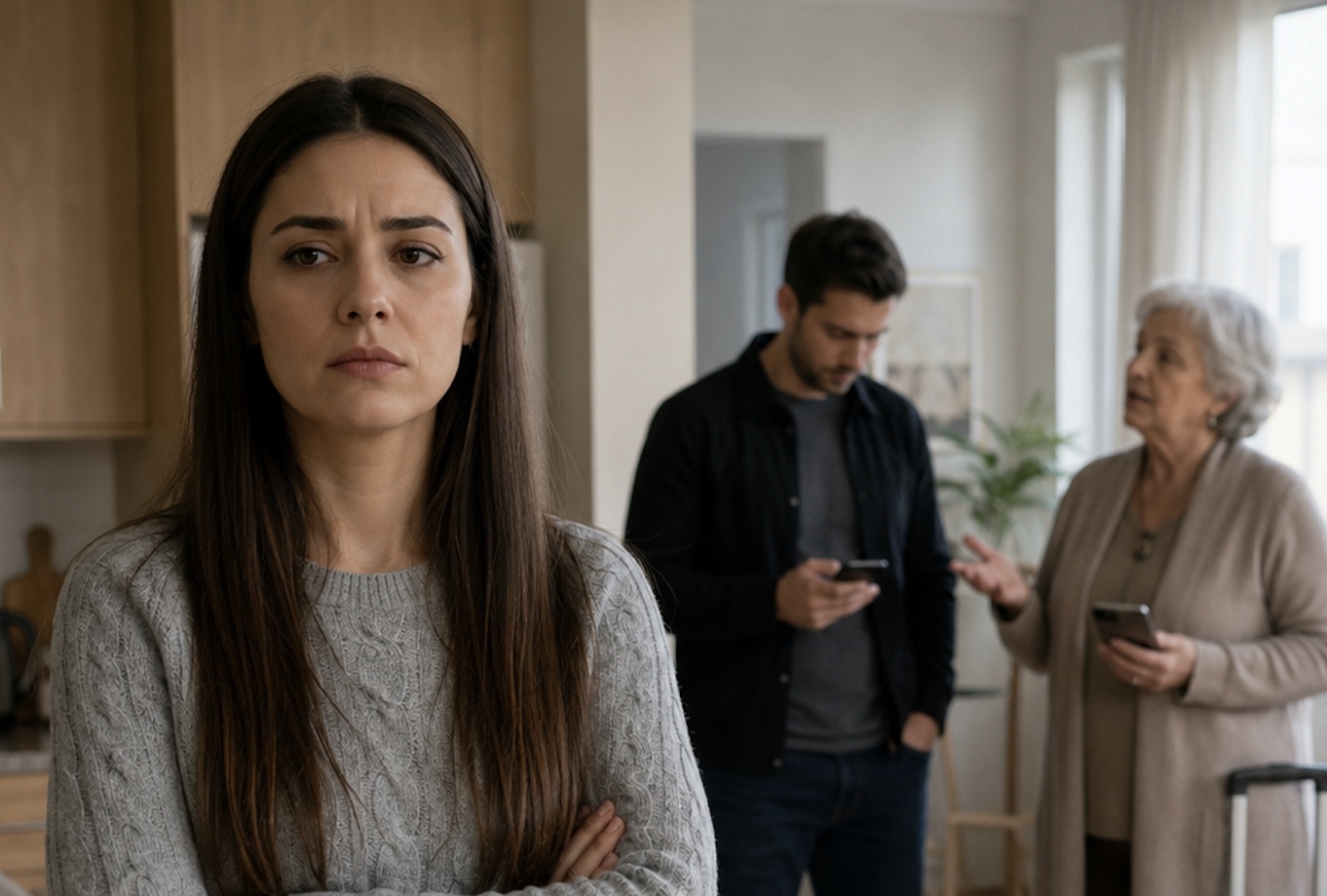
For eight years, Galina had been building a family, saving toward the mortgage, and keeping quiet. Then her mother-in-law arrived with a suitcase, and Galina did something no one expected from her.
Not even Galina herself.
She found the suitcase in the hallway when she came home from work. It was brown, scratched at one corner, with a broken wheel that Zinaida Pavlovna had repaired with duct tape back when her husband was still alive.
Galina set her grocery bag on the floor. The carton of milk tipped onto its side. From the kitchen came the smell of cabbage and something sweet, almost vanilla. Only one home in the world had ever smelled like that.
And it was not this one.
“Galya, is that you?”
Her mother-in-law’s voice came from the far end of the apartment—from the room Galina had converted into a home office three years earlier. Her desk was there, along with her laptop and the folders containing their mortgage documents. A large world map hung on the wall, bought at IKEA before the wedding. Galina had marked the cities she and Kostya planned to visit one day with colored pins.
“It’s me,” she answered into the empty hallway.
She did not take off her coat.
She walked into the kitchen. A pot of cabbage soup stood on the stove. On the table lay a cutting board covered with half-chopped dill.
And a knife.
It was not one of theirs.
Zinaida Pavlovna always brought her own.
Kostya called twelve minutes later. Galina knew the exact time because she had been staring at the clock above the refrigerator, unable to look away. The second hand jerked near the number four as though it kept getting stuck.
“Gal, I wanted to tell you, but I didn’t get the chance.”
“Tell me what?”
“Mom came over. Just temporarily. A pipe burst in her apartment and flooded the whole bathroom.”
He spoke quickly, swallowing the ends of his words the way he always did when he was lying.
Or frightened.
After eight years, Galina knew the difference.
“A pipe,” she repeated.
“Yes. The plumber said it’ll take at least a week. Maybe two. They might have to replace the entire riser.”
“Kostya.”
“What?”
“You could have called me this morning.”
He fell silent. Wind rushed through the phone, followed by the slam of a car door.
“I thought you’d be reasonable about it. She’s my mother.”
Galina closed her eyes. Her fingers tightened around the phone until the plastic casing creaked.
Eight years.
A mortgage.
Two children.
One miscarriage, after which Zinaida Pavlovna had said, “Perhaps it was for the best. What would you do with a third child?”
“I’m being perfectly reasonable,” Galina replied.
Then she ended the call.
Zinaida Pavlovna appeared in the kitchen five minutes later. She was short, no more than five foot two, thin and sharp-boned, with cropped hair she dyed copper once a month. Her eyebrows were drawn in brown pencil slightly higher than they should have been, giving her face a permanently astonished expression.
She was wearing a floral housecoat.
Her own housecoat.
The one she had brought in the suitcase.
“I made cabbage soup. Kostik likes it with sauerkraut. I know. You’re always feeding him things out of jars.”
Galina opened the refrigerator, took out the milk, and placed it on a shelf.
“Thank you, Zinaida Pavlovna.”
“Oh, don’t call me that. Eight years, and you’re still using my first name and patronymic. Call me Mom.”
Galina did not answer.
She stared at the refrigerator shelf where her yogurt starter had been that morning. A jar of sauerkraut covered with gauze now stood in its place.
Someone had moved the starter.
Or thrown it away.
“I baked apple pastries for Artyom. And some for Nastenka too. When do they get home from school?”
“Artyom at four. Nastya at five.”
“That late? Why so late? Children used to be home by two.”
Galina shut the refrigerator. Her palms were damp. She wiped them against her jeans and sat at the table.
Children used to play outside without phones.
Husbands used not to waste money on poker apps.
Mothers-in-law used not to move into someone else’s home without asking.
But Galina said none of that.
She looked at Zinaida Pavlovna’s knife lying on her cutting board and thought that the entire situation could be expressed through that single object.
Kostya came home at eight.
Galina heard him taking off his shoes in the hallway, the rustling of his jacket, the two little coughs he always made before entering a room. She used to find that habit endearing.
The children were already eating. Seven-year-old Artyom was chewing an apple pastry and swinging his legs beneath the table. Ten-year-old Nastya was reading something on her phone without looking up.
Zinaida Pavlovna sat at the head of the table.
At the head.
In Galina’s usual place.
“Kostik! Wash your hands. The soup is getting cold.”
He entered the kitchen and kissed his mother on the top of her head.
He did not kiss Galina.
Perhaps he forgot.
Perhaps he sensed that he should not.
“Hi, Gal.”
“Hi.”
“How was your day?”
“Fine.”
He sat down. Zinaida Pavlovna poured him a bowl of soup, set it in front of him, and handed him a spoon. She had already sliced the bread into thin pieces, exactly the way he liked it.
Galina always cut it thick.
Kostya had never complained.
His mother complained for him.
“Thanks, Mom. It’s delicious.”
“Of course it is. I know how to cook for you. I’ve known for thirty-six years.”
Galina stood and carried her plate to the sink.
It was still nearly full.
“Why didn’t you eat?” Kostya asked.
“I’m not hungry.”
She went into the bathroom and turned on the tap.
She did not wash her hands or splash water on her face.
She simply stood there, listening to the stream strike the porcelain.
Through the wall, Zinaida Pavlovna was telling Artyom about his grandfather, who had served in the military and never complained about anything.
Artyom laughed.
Nastya remained silent.
Galina shut off the water and studied herself in the mirror.
Thirty-four years old.
Dark circles beneath her eyes that had not been there a year ago.
Light brown hair pulled back with an elastic band.
Lips pressed into a thin line.
When had she become a woman with lips like that?
That night, Kostya lay beside her and immediately turned his back.
Galina counted his breaths.
Fourteen per minute when he was awake.
Nine when he fell asleep.
On the twelfth breath, she spoke.
“Kostya.”
“Mmm?”
“How long is she staying?”
“Oh, come on, Gal. A week. Maybe two.”
“You said they had to replace the riser.”
“Yes.”
“The building management company is responsible for that. What does it have to do with your mother staying here?”
He rolled over.
She could not see his face in the darkness, but she felt the warmth of his breath.
“Why are you starting this?”
“I’m asking a question.”
“She’s sixty-three, Gal. She lives alone. She has high blood pressure and bad knees. Life is hard for her.”
“Life is hard for me too.”
“You’re thirty-four.”
“And?”
He turned his back again.
She listened as his breathing slowed.
Ten.
Nine.
Asleep.
Galina remained awake in the dark.
In the room next door—her former office—the folding bed creaked as Zinaida Pavlovna settled in for the night. Kostya had brought the bed from the garage.
It stood exactly where Galina’s desk had been that morning.
The desk had been moved to the balcony.
She discovered that when she went in to get her laptop. The laptop had been placed on the floor beside the wall, next to the mortgage folders.
The world map was still hanging there.
But someone had removed the pins.
Four pins: Barcelona, Istanbul, Prague, and Tbilisi.
They lay together on the windowsill like useless pieces of rubbish.
Galina woke the following morning to the smell of pancakes.
Not her pancakes.
Hers smelled of sunflower oil and vanilla sugar.
These smelled of clarified butter and something heavy and milky.
Zinaida Pavlovna was feeding Artyom in the kitchen. Nastya stood by the door wearing her backpack.
“Mom, I’m leaving.”
“Wait. Eat something first.”
“I don’t want to.”
Nastya looked at her grandmother, then at Galina.
Something passed over the girl’s face—an understanding no ten-year-old should have possessed.
“Bye, Mom.”
She left.
Galina poured herself coffee.
Coffee had already been made. Zinaida Pavlovna had brewed it in a cezve, although Galina always used the coffee machine.
“I made it the way Kostik likes it.”
“Kostik drinks coffee from the machine.”
“Since when? He has always preferred Turkish coffee. I know my son.”
Galina put the cup down.
The coffee was bitter, with grounds at the bottom.
She made herself another cup with the machine.
Behind her, Zinaida Pavlovna sighed loudly enough to be heard.
Artyom finished his pancake and wiped his mouth on his sleeve.
“Grandma, do you live with us now?”
“Only temporarily, sweetheart.”
“How long is temporarily?”
Zinaida Pavlovna smiled.
Galina caught the expression from the corner of her eye. It was warm and genuine, the smile of a loving grandmother.
In eight years, Galina had never received a smile like that.
“We’ll see, sweetheart,” Zinaida Pavlovna said. “We’ll see.”
Those words sank to the bottom of Galina’s stomach and stayed there, heavy as a coin dropped into a glass of water.
At work, Galina opened the banking app.
Not immediately.
First she drank a second cup of coffee, answered three emails, and stared through the window at the parking lot, where someone’s old Renault had been left crookedly across two spaces.
Then she opened it.
Their joint account contained one hundred and twenty thousand rubles.
The mortgage payment—thirty-nine thousand—would be withdrawn in six days.
Then there were utilities, groceries, Nastya’s school expenses, and Artyom’s activities.
There was barely enough.
Galina scrolled through the transaction history.
Yesterday, 6:47 p.m.: a transfer of twelve thousand rubles.
Recipient: Zinaida P.
No note.
The day before, 2:30 p.m.: eight thousand.
Recipient: Zinaida P.
Three days earlier: five thousand.
During the previous month, Kostya had sent his mother forty-one thousand rubles.
That was the money Galina had been putting aside to replace the window in the children’s room.
The window had been freezing over since November.
Artyom had been coughing for months.
She closed the application.
Then she opened it again.
She scrolled back to April.
March.
February.
The transfers appeared every month.
Twenty thousand.
Thirty thousand.
Fifteen thousand.
Since January, she counted one hundred and seventy thousand rubles.
Her hands began to shake.
Not from anger.
From something else.
From the feeling of failing to notice a crack in a wall for years, then stepping closer and realizing the entire structure was about to collapse.
Galina closed the app and went to the restroom. She locked the door and stood with both hands braced against the sink.
The tiles were cold.
She pressed her forehead to them and remained like that until someone tugged on the handle.
That evening, she did not eat dinner.
Zinaida Pavlovna had made meat patties, potatoes, and salad.
The kitchen looked as though a different woman had always lived there.
The towel hung differently.
The sponge had been moved.
A pot of geraniums stood on the windowsill, even though Galina hated geraniums.
“Galya, have something to eat. You’ve become much too thin.”
“Thank you. I ate at work.”
She had not eaten at work.
She had spent her lunch break alone in a conference room, rereading the bank statements she had saved as PDF files.
Kostya came home late.
He smelled of beer and cigarettes, although he had supposedly quit smoking two years earlier.
Or claimed that he had.
“Kostya.”
“What?”
“We need to talk.”
“Let’s do it tomorrow, Gal. I’m tired.”
“One hundred and seventy thousand.”
He stopped.
One foot was in a slipper. The other was bare.
Only the night-light was on in the hallway, leaving half his face in shadow.
“What?”
“You transferred one hundred and seventy thousand rubles to your mother since January. From our joint account. Without asking me.”
Silence.
The kitchen tap was dripping.
She had been asking him to repair it for months.
Drip.
Drip.
Drip.
“Gal, she’s my mother. She needs help.”
“What does she need one hundred and seventy thousand rubles for?”
“Her pension is fourteen thousand. She has medicine and bills. You know that.”
“I know Artyom’s window freezes and that he has been coughing since November. I know I was saving money to replace it. And I know that money is gone.”
At last, he put on the other slipper and walked past her into the kitchen.
He poured himself water.
He drank for a long time, as if he could not stop.
“Do you want me to abandon my mother?”
“I want you to speak to me before transferring money. My money too, Kostya. It is a joint account.”
“I earn more.”
He had never said those words before.
Not because he had never thought them.
Because he knew everything would be different once they were spoken.
Galina nodded.
Then she turned and went into the bedroom.
She did not cry.
She lay on top of the blanket fully dressed and stared at the ceiling. There was a stain from a leak caused by the upstairs neighbors a year earlier.
Kostya had promised to paint over it.
On the third day, Zinaida Pavlovna rearranged the furniture in the former office.
The folding bed was replaced by a sofa Kostya had bought through an online marketplace. Two delivery men brought it during the afternoon while Galina was at work.
She discovered it when she came home.
“Mom is more comfortable this way,” Kostya explained. “Her back hurts.”
“Kostya, that was my office.”
“Oh, come on, Gal. You can use your laptop in the kitchen. Mom has a bad back.”
Galina looked into the room.
The sofa stood against the wall. Beside it was a small nightstand, also new.
On top sat a photograph of a young Kostya in a school uniform beside Zinaida Pavlovna, whose hair was styled in a tight perm.
The world map was gone.
“Where is the map?”
“What map?”
“The world map. The one with the pins. It was hanging on the wall.”
“Oh, that. Mom said it was collecting dust. I put it in the storage closet.”
Galina went to the closet.
The map had been rolled into a tube and wedged between a pair of skis and an old vacuum cleaner.
The pins were missing.
On the fourth day, Zinaida Pavlovna enrolled Artyom in a chess club.
“A boy needs to learn how to think. He spends far too much time on that phone.”
“He already has swimming lessons,” Galina said.
“Swimming is just fooling around. Chess develops the mind.”
“Zinaida Pavlovna, I decide which activities my son attends.”
Her mother-in-law raised her penciled eyebrows.
The surprise on her face appeared twice over—natural and drawn.
“Your son? What about Kostya? Isn’t Artyom his son too?”
“He is our son. We make decisions together.”
“Well, Kostik said chess was a good idea.”
Galina walked out of the kitchen.
In the hallway, her chin began to tremble. She pressed her palm against it as though applying pressure to a wound and remained there until the trembling stopped.
Of course, Kostya had said nothing about chess.
But he would never argue with his mother.
He never had.
Not once in eight years.
Zinaida Pavlovna spoke.
Kostya nodded.
The system functioned perfectly.
Until Galina.
On the fifth day, her friend Svetka called.
Svetka was the only person Galina told everything. She worked as an accountant, was going through her second divorce, and had a talent for calling things exactly what they were.
“Svet, she’s living with us.”
“Who?”
“My mother-in-law.”
“How many days?”
“Five.”
“The pipe?”
“The pipe. Except the riser has already been repaired. I called her building management company. The work was finished the day before yesterday.”
“Gal.”
“Yes?”
“Block the card.”
Galina remained silent.
Cars rumbled beyond the window. Her lunch break would end in seven minutes.
“Svet, that would cause a huge scandal.”
“The scandal is that your child has been coughing for three months while the money for his window went to your mother-in-law for reasons no one can explain. The scandal is that you have been pushed out of your own office. Blocking the card is not a scandal. It is a boundary.”
Galina listened while twisting a pen between her fingers.
It was blue, printed with her company’s logo. The cap had teeth marks on it.
“I can’t simply block it.”
“You can. You both own the account. You have every right.”
“He won’t understand.”
“He will. Men always understand when the money stops. Before that, they are deaf. Afterward, their hearing becomes excellent.”
Galina laughed.
For the first time in five days.
It was a brief, unfamiliar laugh, as though she had forgotten how to do it.
She blocked the card during lunch on the sixth day.
She opened the app and went to the card settings.
There were three cards: hers, his, and a shared one.
She left the shared card alone.
She selected his card, the one connected to his phone and used for all the transfers.
Galina pressed “Block.”
Then she confirmed the action.
Done.
Afterward, she transferred forty thousand rubles from the joint account into a private account she had opened three years earlier without telling Kostya.
Every month, she deposited three or four thousand rubles into it.
The balance had reached eighty-seven thousand.
Now it held one hundred and twenty-seven thousand.
Her hands did not shake.
That surprised her.
She had expected trembling, a racing heart, something dramatic.
Instead, she felt only calmness.
A strange, solid calm, like the air before a thunderstorm.
She called a window company and scheduled an inspection for Saturday.
Kostya discovered the block at 4:43 p.m.
She saw the time because her phone was lying faceup on her desk.
“Gal, my card isn’t working.”
“I know.”
“What do you mean, you know?”
“I blocked it.”
Silence.
A long silence.
Galina counted the seconds.
She reached eleven.
“You did what?”
“I blocked your card.”
“Why?”
“Because you transferred one hundred and seventy thousand rubles to your mother from our joint account without telling me. Because the pipe in her apartment was repaired three days ago, yet she is still living in our home. Because you threw away my pins.”
The final accusation escaped before she could stop it.
Not the money.
Not the apartment.
The pins.
Four cities they had once planned to visit together.
Four dreams he had removed as if they were rubbish.
“What pins, Gal? What are you even talking about?”
“Come home. We will discuss it face-to-face.”
She ended the call and realized she had been gripping the pen so tightly that the cap had cracked.
He arrived forty minutes later.
Galina was already home.
Zinaida Pavlovna was ironing clothes in the former office. Nastya was doing her homework in the children’s room. Artyom was drawing dinosaurs at the kitchen table.
Kostya entered the apartment and came straight into the kitchen.
“Unblock it.”
“Sit down.”
“Unblock the card, Galina.”
He used her full name.
That had happened only twice in eight years.
The first time was when she scraped his car in a parking lot.
The second time was now.
“Sit down, Kostya.”
He sat.
Artyom looked up from his dinosaurs, glanced at his father, then at his mother, and quietly left the kitchen.
Seven years old, and already able to sense danger.
Galina placed a printed document in front of Kostya.
Six months of bank statements.
Every transfer.
Every date.
Every amount.
“One hundred and seventy thousand rubles in six months. We have a mortgage, Kostya. We have two children. Artyom needs a new window. Nastya needs a mathematics tutor. And I need my office back.”
“She is my mother.”
“I am not disputing that. But it is our money.”
“I earn—”
“You have already said that. Now I will tell you something. I earn fifty-two thousand rubles a month. I run this entire household. I cook. I take the children where they need to go. I pay the bills. You earn more money, but you do not do more.”
He leaned back and rubbed both hands over his face.
His stubble scraped against his palms.
“What do you want?”
“Three things. First, every transfer to your mother must be discussed between us, and we set a limit that does not harm our family. Second, Zinaida Pavlovna returns to her apartment. The pipe has been repaired. I checked. Third, I get my office back.”
She paused.
“With the map.”
“What map?”
“The world map. With the pins.”
He looked at her for a long time.
Galina held his gaze.
There was something new in her, and he could see it, though he could not name it.
She could.
It was the woman who had stopped waiting for permission.
Zinaida Pavlovna came out of the room a minute later.
She had heard everything, of course.
The walls in those old apartment buildings were thin.
“Kostik, what is happening?”
“Mom, we need to talk.”
“I heard what she said. I’m not deaf.”
She turned to Galina.
Her eyes were wet, but her voice remained steady.
“Are you throwing me out?”
“No, Zinaida Pavlovna. But you have an apartment of your own. I do not have another home besides this one.”
“Kostik, say something to her.”
“Mom…”
“Tell her I am your mother. Tell her I raised you alone. Tell her I stayed awake night after night when you were sick.”
“Mom.”
“What?”
He swallowed.
His Adam’s apple moved.
“She’s right.”
Zinaida Pavlovna lowered herself onto a chair.
Slowly, as though her legs had suddenly stopped supporting her.
Her hands rested on her knees, palms turned upward.
A defenseless gesture.
Galina looked toward the window because the sight was unbearable.
Her mother-in-law was not a monster.
She was a lonely sixty-three-year-old woman who did not know what to do with herself.
But that did not mean Galina had to surrender her home.
That night, Galina lay awake.
Kostya was awake too.
She could tell from his breathing.
Fourteen breaths per minute.
“Gal.”
“Yes?”
“I didn’t know about the window.”
“You did. I told you three times.”
“Well… maybe I didn’t hear you.”
“Maybe.”
Silence.
The kitchen tap continued dripping.
Drip.
Drip.
“I’ll take Mom home tomorrow. I’ll call a plumber too, so she can see everything is safe.”
“All right.”
“Will you unblock the card?”
“When you return my office. With the world map. And after we sit down together and calculate how much we can send your mother without taking anything away from the children.”
“You’ve become hard.”
“I haven’t become anything. I have always been this way. You simply never noticed.”
He turned toward her.
In the darkness, she felt his hand settle over hers.
His palm was warm and heavy.
She did not pull away.
But she did not squeeze his hand either.
The next morning, Zinaida Pavlovna packed her suitcase.
The same brown suitcase with the scratched corner and the broken wheel wrapped in duct tape.
Galina stood in the doorway.
“Zinaida Pavlovna.”
“What?”
“You can visit on weekends. The children love you.”
Her mother-in-law did not turn around. She continued folding her things.
The floral housecoat.
The geranium.
The knife.
“I don’t need your charity.”
“It is not charity. It is an invitation.”
“What is the difference?”
Galina thought for a moment.
“Charity is offered from above. An invitation means someone genuinely wants to see you.”
Zinaida Pavlovna finally turned.
Her penciled eyebrows lifted.
This time, not from surprise.
From something else.
Perhaps because, for the first time in eight years, her daughter-in-law had said something completely honest to her.
“I could bring pastries on Saturdays. Artyom likes the apple ones.”
“He does.”
“Fine.”
She fastened the suitcase.
The lock clicked.
Kostya took his mother home after lunch.
Galina entered the room.
The sofa still stood against the wall, with the nightstand beside it. The photograph of school-aged Kostya was gone.
Zinaida Pavlovna had taken it with her.
Galina opened the storage closet and pulled out the rolled-up map.
She spread it open.
Four tiny holes remained where the pins had been: Barcelona, Istanbul, Prague, and Tbilisi.
She found the pins in the pocket of her winter coat.
She could not remember how they had ended up there.
Perhaps Kostya had put them inside.
Perhaps Zinaida Pavlovna had.
Perhaps no one had, and the pins had somehow found a place to wait.
Galina hung the map on the wall again.
She returned the four pins to their cities.
The new holes did not align perfectly with the old ones.
But almost.
Then she took a fifth pin from the cushion on her desk and pushed it into Kaliningrad.
Not because she had always dreamed of going there.
Because it was close.
It was possible.
And she could go alone if she wanted to.
She brought her laptop in from the balcony, placed it on the desk, and turned it on.
The screen lit up.
From the children’s room, Artyom coughed.
The window inspector was coming on Saturday.
Kostya returned that evening.
He entered the office and saw the map, the desk, and the laptop.
He stood there for a moment.
“A fifth pin?”
“Kaliningrad.”
“Why Kaliningrad?”
“Because I can.”
He nodded.
He understood something in that answer.
Or perhaps he had only begun to understand.
No one was cooking cabbage soup in the kitchen.
No one was cutting bread into thin slices.
The tap was still dripping.
“Will you fix it?” Galina asked.
“Tomorrow.”
“Today.”
He looked at her.
She was not smiling.
But she was not angry either.
She stood against the doorframe in a gray sweater, holding a cup of coffee from the coffee machine.
“All right,” he said.
Then he went to get a wrench.
The tap stopped dripping twenty minutes later.
The window inspector arrived on Saturday.
He was a young man in a blue jacket carrying a measuring tape and a tablet. He measured the window, entered the details, and named the price.
“Thirty-seven thousand rubles, including installation.”
“When can you do it?”
“Next week.”
“Go ahead.”
Galina signed the agreement at the kitchen table.
Kostya stood nearby without saying anything.
When the inspector had gone, he asked, “Gal, where did you get the money?”
“It’s mine.”
“What do you mean, yours?”
“I have a separate account. I’ve been saving for three years.”
He sat down and rubbed the back of his neck.
“Three years?”
“Yes.”
“Why didn’t I know?”
“Because you never asked.”
The words hung between them like wet laundry on a line—heavy and impossible to ignore.
He remained silent for a long time.
Then he stood, walked over, and embraced her.
It was not tender.
It was not passionate.
He held her tightly, the way people hold someone when they are afraid that person might leave.
Galina stood motionless in his arms.
He smelled of cologne and faintly of motor oil.
A familiar smell.
But she did not raise her arms to hold him.
Not yet.
Zinaida Pavlovna arrived on Sunday carrying pastries.
Apple for Artyom.
Cabbage for Kostya.
Cherry for Nastya.
For Galina, she brought a jar of gooseberry jam. It was cloudy green in a glass jar secured with a rubber seal.
“I made it myself,” she said at the door, pushing the jar into Galina’s hands.
“Thank you.”
“Don’t mention it. I made too much. It would only have gone to waste.”
Galina put the jar on a shelf.
Not hidden inside a cupboard.
Somewhere visible.
Not because she liked gooseberries.
Because it was a beginning.
An awkward, crooked beginning, disguised behind the words “it would only have gone to waste.”
But a beginning nevertheless.
Artyom grabbed two pastries and ran off.
Nastya took one and whispered, “Thank you, Grandma,” so quietly that Zinaida Pavlovna asked her to repeat it.
“What did you say, Nastenka?”
“Thank you.”
“Oh. Well, all right.”
She sat at the table.
In her own chair.
Not at the head.
Galina noticed.
Zinaida Pavlovna noticed that Galina had noticed.
Their eyes met briefly.
Like two people who would never become friends but might eventually learn not to be enemies.
Kostya brought tea.
Four cups—for himself, his wife, his mother, and his daughter.
Artyom received juice.
“Mom, how is the apartment?” he asked.
“Fine. They repaired the pipe and replaced the tiles. That plumber you sent was competent. Thank you.”
“Galya found him.”
Zinaida Pavlovna turned toward her daughter-in-law.
“Thank you, Galina.”
Not Galya.
Not Galinochka.
Just her name.
As though she were seeing her clearly for the first time.
“You’re welcome.”
That evening, after everyone had left and the children were asleep, Galina entered her office.
The map hung on the wall.
Five pins.
Four dreams.
One real destination.
She opened her laptop and searched for flights to Kaliningrad.
The twenty-third.
Friday.
Departure at seven in the morning.
Four thousand two hundred rubles one way.
She did not buy the ticket.
Not yet.
But she left the page open.
Rain fell outside.
A fine autumn rain that tapped against the windowsill in the rhythm Galina had loved since childhood.
She used to fall asleep to that sound in her grandmother’s room in Tula, in a house that no longer existed.
Galina turned off the light.
The laptop screen glowed blue.
Kaliningrad.
4,200 rubles.
Departure at seven.
Tomorrow she would unblock Kostya’s card.
They had reached an agreement: no more than fifteen thousand rubles a month for his mother, and any larger amount would be discussed together.
He had agreed.
Not immediately.
Not easily.
But he had agreed.
Galina would unblock the card.
First, however, she would finish her coffee.
The cup stood beside the laptop.
White, with a crack along the handle, bought during their first year in the apartment.
The coffee had gone cold.
She drank it anyway.
A single drop remained at the bottom.
Galina turned the cup upside down and placed it on the desk.
Tomorrow.
For now, there was only the night.