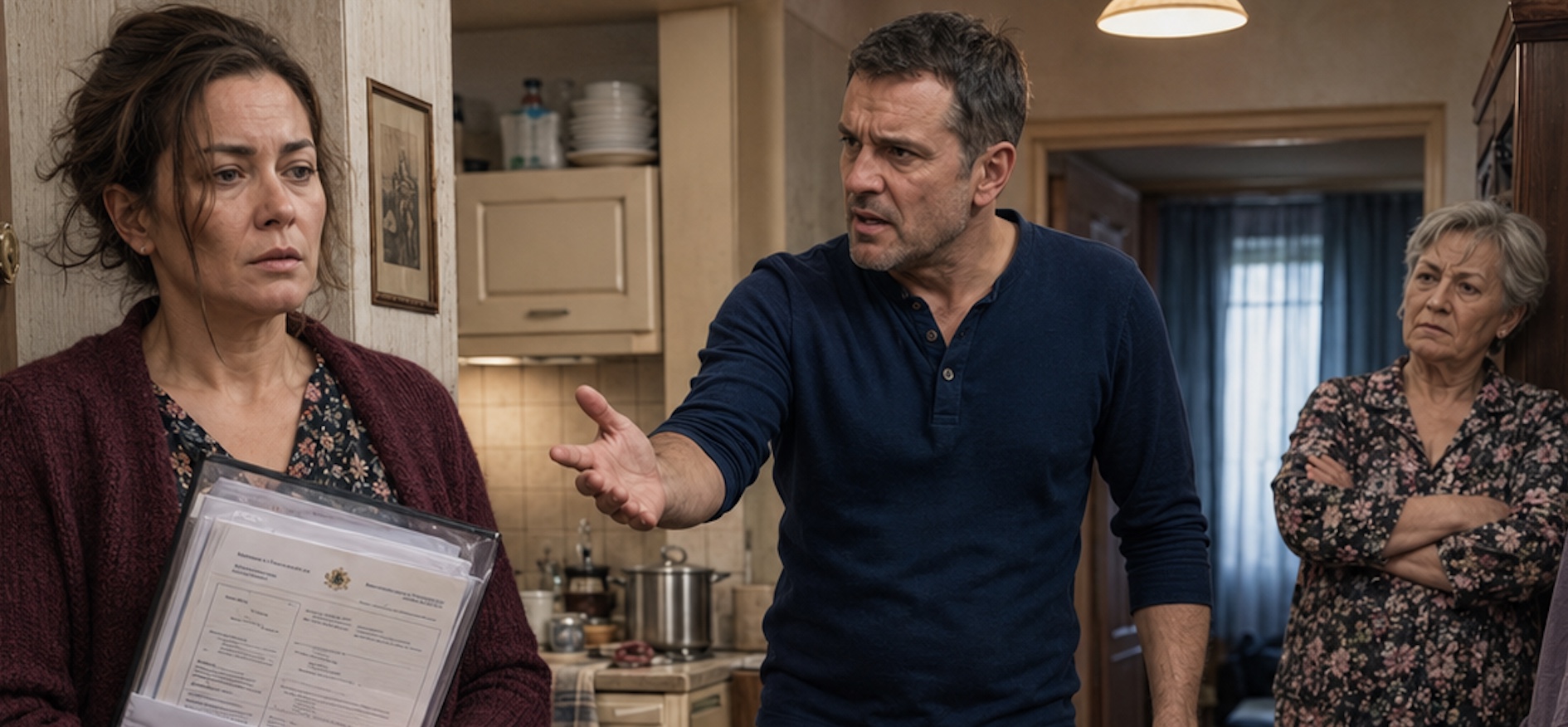
“Leave?” Natalia remained frozen in the hallway, still holding a bag containing milk and a loaf of bread. Along the wall, unfamiliar shopping bags, fluffy pom-pom slippers, and Raisa Lvovna’s plaid suitcase were already crowded together.
At first, Natalia could not even hear herself breathing.
She noticed only the small details.
A blue robe covered in enormous flowers was hanging from the hook in the bathroom instead of hers. An unfamiliar hairbrush lay on the cabinet beside the mirror. Her pots of petunias had vanished from the living-room windowsill.
And her favorite armchair beside the television—the one where Natalia spent her evenings drinking tea and staring into the darkness beyond the courtyard—was already occupied by her mother-in-law.
Raisa Lvovna sat deep in the chair, comfortably tucked into it as if she owned the place, her legs folded beneath her while she watched a television series as though she had been living there for years.
Ilya stood beside the kitchen doorway, leaning one shoulder against the frame. He spoke in that calm, lazy tone that had always made Natalia’s palms turn cold.
“If you don’t like my mother, then leave. Why are you trying to create a scene? She’s lonely by herself. She’ll stay with us for a while.”
With us.
Ilya especially loved that phrase.
Spoken with his effortless masculine confidence, it had the power to transform someone else’s belongings into his own.
Our home.
Our kitchen.
Our wardrobe.
Yet Natalia had chosen the wallpaper in that apartment. Natalia had bought the handles for the cabinets. The renovations had been funded by her salary from the confectionery factory where she worked as a food technologist. For two years she had saved every spare ruble so she could replace the windows, level the walls, and enclose the balcony.
The apartment had been left to her by her aunt long before Natalia married.
It was a modest two-bedroom flat in an old brick building, with a narrow kitchen, creaking parquet flooring in one of the rooms, and a warm enclosed balcony where Natalia grew flowers and kept a small shelving unit for jars of homemade preserves.
When Ilya moved in after their wedding, he arrived lightly, carrying two travel bags, a box of tools, and the natural ease of a man who immediately began acting like the owner of someone else’s home.
At first, Natalia had found it endearing.
He brought a microwave, installed a shelf in the bathroom, screwed hooks into the hallway wall, and joked with the neighbors as if he had lived in the building for years.
Back then, Natalia believed that was what married life was supposed to look like. A man became part of your home so naturally that eventually no one remembered who had owned the first key.
Her mistake had not been allowing him to move in.
Her mistake had been failing to understand how quickly a person could confuse kindness with entitlement.
“No one told me your mother was moving in,” Natalia said, feeling the back of her neck slowly go numb.
Raisa Lvovna looked away from the television without the slightest hint of embarrassment.
“Oh, what was there to discuss? I’m not a stranger. I’ll stay for a little while, until I feel better. It’s depressing being alone in that apartment.”
A little while.
Every invasion began with those words.
A few bags in the hallway.
A few belongings in the bathroom.
A pair of slippers beside the door.
A few plates moved to a different shelf.
A few flowers pushed out of the way.
Then one day, you found yourself standing in your own hallway, listening to your husband suggest that you leave if you did not approve of his mother.
Natalia slowly removed her coat, as though one sudden movement might shatter the composure she was struggling to maintain.
“Why are my flowers on the balcony?”
Raisa Lvovna sighed as if Natalia’s pettiness exhausted her.
“They give me headaches. Besides, the windowsill looks much more spacious without them. I’m going to put my jars there.”
“Your jars?”
“Yes,” Ilya interrupted. “Mom brought preserves. You’re always saying homemade food is better.”
Natalia looked at her husband and suddenly understood everything with painful clarity.
He had not misspoken.
He had not lost his temper.
He had not blurted something out without thinking.
Everything had already been decided before she came home.
The bags.
The robe.
The jars.
The flowers.
The armchair.
Most importantly, there was his tone.
It was not the tone of someone asking permission. It belonged to a person who had already assumed consent.
Natalia walked into the living room.
Raisa Lvovna’s folded blanket lay on the sofa. Her medicine, glasses case, and a small bottle of valerian drops had already appeared on Natalia’s cabinet beside the television.
The familiar order of the kitchen had shifted as well. The cups had been moved to another shelf. The sugar bowl now stood beside the stove. The bowl of apples had disappeared. In its place sat a jar of pickles and a packet of ring-shaped biscuits.
The apartment looked as though not merely a person but an entirely new set of rules had entered it.
Natalia did not raise her voice.
She did not know how.
Arguments had never been her natural territory.
At the factory, she spoke clearly, worked precisely, and defended production standards so firmly that the men on her shift sometimes whispered, “Don’t try cutting corners with Natasha.”
At home, however, she always seemed to lose confidence before she could even begin speaking.
For too long, she had believed that a peaceful marriage could be preserved by becoming an even quieter wife.
During the first week, Raisa Lvovna behaved as though she had simply returned to an apartment she had temporarily allowed the young couple to use.
She inspected the refrigerator, frowned at the dinners Natalia prepared, refolded clean laundry because “this way is neater,” opened cabinets, boiled water without asking, handled Natalia’s spice jars, and regularly made comments that appeared to be addressed to no one but always struck exactly where intended.
“You can immediately tell whether a home has an older woman in it.”
“These soups are far too thin. A man can’t possibly fill himself up on this.”
“Why were the towels hanging over there? I moved them. Now everything is where it belongs.”
Ilya dismissed all of it with the same explanation.
“Mom is older. You can tolerate it.”
The sentence became his universal key.
His mother was older, so she never had to explain herself.
His mother was older, so Natalia was expected to step aside again.
His mother was older, so her moods, habits, and loneliness mattered more than the fact that the legal owner of the apartment was beginning to feel like a tenant.
At first, Natalia tried to convince herself that nothing truly terrible was happening.
Raisa Lvovna did live alone.
After the death of her second husband, she had clearly deteriorated. She began calling Ilya more frequently, complaining about her blood pressure, the silence, the long evenings, and the way her empty apartment seemed to echo.
Natalia understood.
She genuinely felt sorry for the woman.
But compassion and being displaced from your own life were two very different things.
For a long time, Natalia simply failed to recognize the exact moment when one became the other.
Raisa Lvovna soon expanded her territory beyond the kitchen and the armchair.
“The smaller room would be more comfortable for me,” she announced one morning while Natalia was putting on her jacket before work. “It’s quieter in there.”
They called it the smaller room, although it had once been Natalia’s aunt’s bedroom.
After the renovation, Natalia had turned it into a space of her own.
The cabinet containing important documents stood there, along with an ironing board, a clothes dryer, a small desk, boxes of seasonal belongings, and a shelf filled with books.
In the evenings, Natalia sometimes sat there with her laptop, sorted through work papers, or simply closed the door and disappeared from the world for ten minutes.
“My things are in there,” Natalia replied.
Raisa Lvovna waved a dismissive hand.
“You can sort them out. I need windows that don’t face the courtyard. It’s too noisy.”
“The courtyard is quiet.”
“It’s noisy to me.”
Ilya, fastening his belt, glanced over his shoulder.
“Natasha, just move your junk somewhere else. You’re not going to die because of one room.”
For some reason, the word “junk” hurt more than anything else.
Not because he was talking about possessions.
Because he was talking about a boundary.
Her tiny private space in that home no longer carried any weight in her husband’s mind.
Nothing belonged exclusively to her.
Nothing was untouchable.
Everything could be labeled junk and pushed aside for his mother’s convenience.
In the end, Raisa Lvovna took over the room.
Not all at once.
Gradually.
First she placed her suitcase inside.
Then she hung her robes in the wardrobe.
After that, she brought in a bag of knitting supplies and an oversized pillow “for her back.”
Natalia came home from work to find her desk shoved against the wall, her books rearranged without order, and her aunt’s old floor lamp missing entirely.
She later discovered it on the balcony beneath a blanket.
The balcony, too, stopped belonging to her.
The flowers had to be moved lower because Raisa Lvovna disliked “that constant smell of soil.”
Jars of compote occupied the upper shelf. Someone else’s drying rack for herbs appeared across the railing.
One day, Natalia lifted a pot containing a pink petunia and noticed that the soil was dry and the leaves had begun to droop.
Even the flowers had become unwanted guests in that apartment whenever their existence conflicted with her mother-in-law’s comfort.
Natalia’s sister Kristina arrived on Sunday.
She did not call beforehand, as only the closest relatives dared not to do.
She opened the door with her usual quick movement, carrying a cottage-cheese pie from a bakery, and stopped in the hallway.
“I don’t understand,” she said, staring at the unfamiliar slippers. “Have you suddenly become an old lady, or has someone moved in?”
Natalia tried to laugh it off, but the laugh would not come.
Kristina knew her face too well.
The sisters stepped onto the balcony, where the weak November daylight still lingered.
Wet asphalt looked gray beneath them. The swings in the courtyard were empty, and cigarette smoke drifted from a neighboring balcony.
Natalia remained silent for a long time.
Then, surprising even herself, she told Kristina everything.
The bags.
The flowers.
The smaller room.
The jars.
Ilya’s tone.
And the sentence, “If you don’t like my mother, then leave,” which no longer sounded like a momentary outburst. It sounded like an honest summary of their marriage.
Kristina listened without exclaiming and without offering meaningless reassurance.
She had always been that way.
Not especially gentle.
Precise.
“Why should you be the one to leave an apartment where you paid for every handle on every cabinet?” she asked after Natalia finished.
That question frightened Natalia more than any piece of advice could have.
It contained none of the familiar fog in which she had lived for the past several years.
Not “be patient.”
Not “she’s an elderly woman.”
Not “perhaps things will improve.”
Only the bare truth.
It was Natalia’s apartment.
Her walls.
Her renovation.
Her utility bills.
Her wardrobe.
Her inheritance from her aunt.
So why, within that simple geometry, was Natalia the person expected to leave?
She looked at her flowers sitting close to the floor and suddenly understood that she had been trying to answer the wrong question.
The real issue was not how she should deal with someone else’s mother.
The real issue was how she could remain kind and accommodating while being slowly pushed out of her own home.
That evening, after Kristina left, Natalia took the folder of property documents from the cabinet.
The deed of gift.
The official property register extract.
Receipts for the windows, tiles, doors, and kitchen cabinets she and her aunt had chosen before her aunt died.
Natalia sat on a stool in the smaller room, which was already half occupied by unfamiliar robes, and examined one document after another.
With every new page, something inside her grew stronger.
It was not even anger.
It was clarity.
They were not merely disrespecting her.
They were driving her out.
Quietly.
Without obvious threats.
Through unfamiliar bags.
Through tone.
Through “you can tolerate it.”
Through cups moved to different shelves.
Through tiny invasions that outsiders could easily dismiss as unimportant.
And then, one day, her husband finally said the words aloud.
If you don’t like it, leave.
He said them because he was certain Natalia would step back half a step.
Then another.
Then another.
Until she reached the front door.
That night was difficult.
Ilya slept beside her, deeply and peacefully.
Natalia lay facing the wall, thinking not even about divorce but about how easily someone could become a stranger inside her own life if she spent too long treating endurance as a virtue.
Shortly before dawn, she got out of bed, put on her robe, and went into the kitchen.
There, beneath a dim light, surrounded by the smell of yesterday’s buckwheat and someone else’s heart medication, her decision finally transformed from a thought into an action.
That morning, she called German Petrovich.
Years earlier, he had ordered a large assortment of desserts from Natalia’s factory for his sister’s golden wedding anniversary. Afterward, he called Natalia several times with minor questions, asking where he could find decent baking molds.
Later, when he learned that Natalia was living alone following her aunt’s death, he helped her choose a reliable lock for the old front door.
That was how he remained in her phone contacts—a locksmith who never asked unnecessary questions too early.
“Good morning, German Petrovich. I need the locks replaced. Could you come today?”
He answered after a brief pause.
“If it’s urgent, I can come after lunch. Do you want the entire old set removed?”
Natalia looked toward the room where Raisa Lvovna was already rustling through a packet and clinking a spoon against a glass.
“All of it.”
“Understood.”
Afterward, everything proceeded with surprising calm.
Natalia cooked porridge, prepared tea, washed the dishes, went to work, completed her shift, and returned home as though no decision had been made.
Ilya complained about dinner again.
Raisa Lvovna oversalted the soup again, and somehow Natalia still ended up being blamed.
Everything followed its familiar routine.
Only now, hidden inside the hallway closet, an empty suitcase was waiting.
That night, Natalia packed her husband’s belongings.
Not everything.
Only what he would need.
Shirts.
Trousers.
Chargers.
His razor.
Documents.
Underwear.
The tools he kept in a drawer beneath the shoe cabinet.
She worked without tears and without rushing.
She arranged everything with the same precision she used when organizing production charts at the factory.
One item after another.
Neatly.
In order.
The most difficult part was not touching his belongings.
The most difficult part was realizing that she felt no hysteria inside.
Only the tired, adult understanding that if the owner of a home was told to leave, she had two choices.
She could either abandon herself, or she could show the door to the people who had said it.
The following morning, Ilya emerged from the bathroom while drying his neck with a towel and stopped in the hallway.
“What is that?”
The suitcase stood directly beside the front door.
Neatly closed.
Already looking as if it belonged to a stranger.
Raisa Lvovna leaned out of the kitchen.
“Natasha, what kind of performance is this?”
Natalia stepped out of the smaller room holding the document folder.
She wore an ordinary work sweater. Her hair was tied back, and her face was calm.
Even Natalia found that calmness unfamiliar.
“This isn’t a performance,” she said. “It’s my answer.”
At first, Ilya did not understand.
“Answer to what?”
“To what you told me. You suggested that I leave the apartment my aunt gave me, the apartment I pay for, and the apartment you moved into after I had already renovated it. I thought about your suggestion. You and your mother will be the ones leaving.”
Raisa Lvovna threw her hands into the air.
“Son, are you hearing this? She’s completely lost her mind.”
Natalia placed the folder on the hallway cabinet and removed the documents.
“The deed of gift. The property register extract. The renovation receipts. All in my name. Everything here belongs to me. You have behaved for far too long as though I were only a temporary guest. That ends today.”
Ilya stepped toward her, suddenly wide awake and furious.
“You can’t just throw me out.”
“I can ask you to go exactly where you told me to go,” Natalia replied. “To your mother’s apartment. According to you, she’s lonely there.”
“Natasha, stop destroying the family,” Raisa Lvovna suddenly said in a softer voice.
The anger had vanished. Now she sounded gentle and persuasive, using the tone people adopted when they wanted to manipulate someone through guilt.
“We can discuss everything. Why are you making such a fuss over a few minor inconveniences?”
For the first time during the entire conversation, Natalia smiled.
There was no warmth in it.
“This family wasn’t destroyed today. It was destroyed the moment the owner of this apartment was told to leave.”
The statement was so simple that Raisa Lvovna could not immediately find a response.
Ilya grabbed the folder and rapidly flipped through the documents as though he expected to discover a mistake.
But documents did not argue.
They did not become offended.
They did not cry or beg to be understood.
They simply lay on the cabinet and proved who owned the apartment, whose flowers had once stood by the window, and who had paid for the new doors.
“So what happens now?” Ilya demanded. “You’re going to change the locks?”
“Yes.”
He stared at her in disbelief.
Perhaps only then did he begin to understand that the woman standing before him was no longer the familiar Natalia who remained silent and then went to put the kettle on.
This was someone who had taken out the property documents, packed his belongings, and called a locksmith.
The doorbell rang with timing so perfect it was almost comical.
German Petrovich entered, removed his hat, and took in the suitcase in the hallway, the strained faces, and the papers lying on the cabinet.
He asked only one brief question.
“Shall we begin?”
“Begin,” Natalia replied.
Raisa Lvovna’s face flushed.
“And who exactly are you?”
He looked at her calmly.
“A locksmith. I was called here.”
Ilya stood with his jaw clenched so tightly that the muscles moved beneath his skin.
He desperately wanted a scandal.
Shouting.
Tears.
Any emotional scene that would allow him to tell people later that Natalia had become hysterical.
But there was no scene.
There was only a hallway containing his packed suitcase, a folder of legal documents, an unfamiliar locksmith, and a wife who, for the first time in years, was speaking neither in a whisper nor through tears.
Raisa Lvovna made one final attempt to reclaim control through wounded pride.
“You’ll regret this. A woman can’t manage alone for very long.”
Natalia looked at her carefully.
“I was carrying all three of us. I think I’ll manage perfectly well with only myself.”
The sentence struck harder than shouting ever could have.
Because it was the unembellished truth.
Ilya finally picked up the suitcase.
Not peacefully.
Not with acceptance.
He seized it with an angry jerk, but he took it.
Raisa Lvovna collected her jars and the bag containing her robes while muttering about ingratitude and cruelty.
Natalia stood beside the doorway and, for the first time, felt no guilt, no weakness, and no fear of the silence that would remain after they left.
When the door closed behind them, German Petrovich was already laying out his tools.
“We’ll install good locks,” he said. “No surprises.”
Natalia nodded.
“Good ones.”
While he worked, she walked through the apartment as though seeing it for the first time.
Several of Raisa Lvovna’s jars remained on the windowsill. Two were empty, while she had taken the one containing pickles.
A robe had been left hanging over a chair in the smaller room, forgotten in the hurry.
A soap dish remained in the bathroom.
On the balcony, the petunias stretched toward the glass on thin, dusty stems, almost as though they had truly been waiting to be returned to their proper place.
Natalia lifted one flowerpot and then another.
She carried them back to the windowsill.
Only then did she notice that her hands were trembling.
Not from fear.
From the fact that everything she had done had finally reached her body.
Kristina arrived an hour later.
She walked in carrying a bag of lemons and two bottles of water. When she noticed the new lock cylinder in the door, she gave a quiet whistle.
“Look at you.”
Natalia sank wearily onto a stool and suddenly began to laugh.
Quietly, almost soundlessly, but genuinely.
Kristina placed the bag on the table and sat beside her.
“Was it hard?”
“Very,” Natalia admitted. “But not as hard as spending another month living as though I were the unwanted person here.”
Kristina nodded.
“That’s your answer.”
That evening, for the first time in a long while, the apartment was filled not with unfamiliar voices but with its own small sounds.
The new lock clicked.
The kettle began to boil.
The balcony window creaked.
Natalia’s flowers stood once again on the windowsill.
Her blanket lay across the armchair beside the television, and no one complained that it had been “thrown there carelessly.”
The cups returned to their proper shelf in the kitchen.
Even the air seemed different.
Not lighter.
Cleaner.
Ilya called twice.
Then he sent messages.
At first they were angry.
Then wounded.
Then almost peaceful, as though he still believed the old order could be restored with a single conversation.
Natalia did not respond.
Not out of revenge.
There was simply nothing left to discuss.
Some sentences are spoken only once, yet permanently alter the geography of a marriage.
“If you don’t like my mother, then leave” was one of those sentences.
Late that evening, Natalia opened the cabinet containing her important papers, returned the folder to the shelf, and closed the door.
Then a strange thought occurred to her.
She had not left.
She had not left her apartment.
She had not abandoned herself.
The people who left her life were the ones who had mistaken her patience for a claim of ownership.
And that was the most precise form of justice possible.