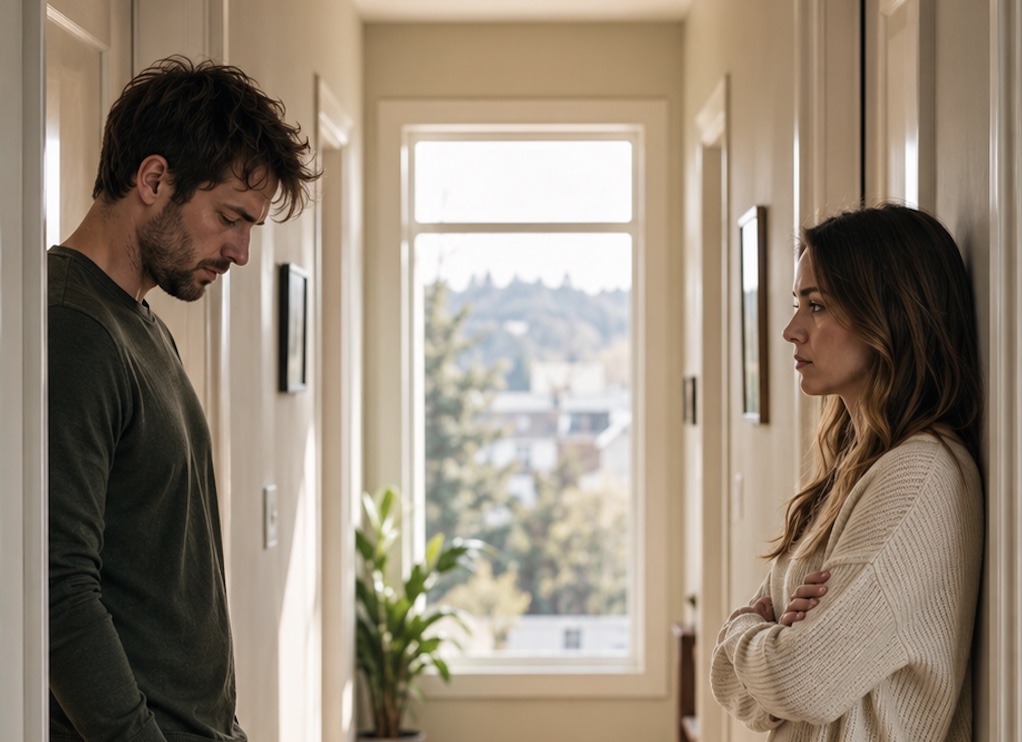
“Send her back tomorrow,” Gennady said without looking up from his phone.
He said it so casually, as if he were asking her to buy bread on the way home. Nadezhda was standing by the stove, stirring the stew, and her hand froze halfway through the motion. The vegetables bubbled softly, steam rose toward the ceiling, and her mind suddenly went hollow and echoing, like a stairwell in winter.
Her mother had arrived three days earlier. From Glebovskoye, from that same old house with the crooked fence and geraniums on every windowsill. She had not come for no reason. Her blood pressure had been jumping for the second week in a row, and the village paramedic had only spread his hands helplessly and advised her to see “city doctors.”
Nadezhda had bought the bus ticket herself, met her mother at the station herself, and carried the heavy checkered bag up to the fourth floor herself.
And now Gennady wanted her mother gone. Because “there isn’t enough space.” Because “I’m tired of strangers in the apartment.” Because “your mother snores through the wall, and I can’t sleep.”
Nadezhda turned off the gas. She moved the pot onto the cold burner.
Then she wiped her hands on a towel embroidered with sunflowers. Her mother had brought it as a gift, and it still smelled faintly of an old village wardrobe and dried lavender.
“Gena, her blood pressure is one hundred eighty. She can’t sit on a bus right now.”
“And I can’t live in a public waiting room,” he finally looked at her. “Three days, Nadya. She’s been sitting here for three days, and her appointment isn’t for another week. Am I supposed to put up with this for a whole week?”
Put up with it.
He said it as if her mother were some natural disaster, a flood people tried to hold back with sandbags. Nadezhda bit her lip and stayed silent. Not because she had nothing to say. But because she knew that if she started now, she would not stop. And she needed to think, not shout.
They had met nine years earlier at a mutual friend’s birthday party.
Back then, Gennady had seemed reliable to her. Not handsome, not witty — reliable. Broad hands, a calm voice, the habit of finishing even the smallest tasks properly. If he hung a shelf, it was straight. If he fixed a faucet, he did it without unnecessary talk. When he married her, it was the proper way too — after a year and a half, with an application, rings, and a civil registry office ceremony.
But over the years, that reliability began to resemble a wall. Not the kind you lean against for support, but the kind you bang your forehead against. Gennady made all the decisions himself. Which television to buy. Where to go on vacation. When to invite guests, and when not to.
Nadezhda worked as an assistant accountant at a construction company. She earned decent money and managed the family budget. But Gennady treated her salary like “extra money,” and his own as “the main income.” And when he said, “We can’t afford it,” what he really meant was, “I don’t want to.”
He had never liked her mother from the beginning. No, he did not argue with her. He simply ignored her. Tamara Vasilievna came once a year, brought jam, sat quietly in the kitchen, and tried not to get in the way. She even washed dishes silently, as if apologizing for existing in their space.
And now — “send her back tomorrow.”
That night, Nadezhda could not sleep. Her mother really was snoring behind the wall — quietly, with a little whistle, like a broken alarm clock. Gennady demonstratively pulled the blanket over his head and turned toward the wall.
Nadezhda stared at the ceiling. There was a stain from an old leak there, shaped like a map of some unknown country. She studied its outlines and found herself thinking not about her mother and not about Gennady. She was thinking about herself.
For nine years, she had given in. She had believed family mattered more, that compromise was love. But compromise meant two people taking turns making concessions. When only one person always gave in, it was no longer compromise. It was a set of rules written by someone else.
She remembered how, three years earlier, she had wanted to bring her mother over for New Year’s.
Gennady said no, they were renovating. The renovation ended in February. Then she wanted to take her mother to a cardiologist at the regional hospital. Gennady said he needed the car for work. That time, her mother had called an ambulance in the middle of the night — alone, in an empty village house.
Nadezhda quietly got up, went to the kitchen, poured herself a glass of tap water, and drank it in one gulp. The water was cold, almost icy. The chill rolled down her throat and settled somewhere in her chest, but her head became clear.
She opened the cabinet above the sink. There, behind the jars of grains, stood an old tin kettle — her mother’s, from Glebovskoye. Tamara Vasilievna had brought it because, in the village, it was considered bad luck to arrive as a guest empty-handed.
Nadezhda picked up the kettle. It was light, empty.
And suddenly she understood that she had already made her decision. Not now — earlier. Maybe yesterday, when he said “put up with it.” Or maybe three years ago, when her mother called an ambulance alone. The decision had simply finally caught up with her.
In the morning, she got up at six.
Gennady was still asleep, his face buried in the pillow. Nadezhda went into the hallway.
There were two suitcases on the overhead storage shelf. Both were his. One was large and gray, with a cracked handle. The other was smaller, brown, made of imitation leather. Once, they had taken those suitcases to Anapa, and Nadezhda remembered Gennady grumbling at the station because of the line at the ticket office, while she carried both suitcases herself because he was “tired and carrying the bags.”
She took the suitcases down without making a sound. Her wool socks slid across the linoleum, and her hands moved precisely, without hurry. She opened the big suitcase on the hallway floor. Then she opened the wardrobe.
Shirts. She folded them neatly, as if in a store — one on top of another, collar to collar. Four work shirts, two dress shirts. Then trousers — three pairs, the ones he wore. A gray sweater. A blue sweater. Socks — in pairs. She always folded them in pairs, even washed them in pairs so they would not get lost.
The smaller suitcase was for the little things. Razor. Shaving foam. Phone charger — the one he kept on the bedside table, even though Nadezhda had asked him a hundred times not to leave wires near the bed. Documents — passport, driver’s license, insurance papers.
She worked quietly and methodically, the way she did at work when preparing a quarterly report. Every item in its place. Every object considered.
The locks clicked shut with a short, dry sound. Nadezhda placed both suitcases by the front door, next to the shoe rack. His black work boots she put on top of the brown suitcase.
Then she returned to the kitchen.
Her mother woke up before Gennady.
She came into the kitchen wearing the robe she had brought with her — flannel, with tiny flowers, washed soft like an old bedsheet. She saw her daughter sitting at the table with a cup of tea and sat down across from her.
“Nadyusha, why are you up so early?”
“I couldn’t sleep, Mom.”
Tamara Vasilievna looked at her closely. She had the eyes of a woman who had seen enough in life not to ask unnecessary questions. Still, she asked:
“Was it him again?”
Nadezhda nodded. Then she was silent for a while, warming her palms around the cup. The tea had already gone cold, but she held it anyway — a childhood habit from winter days when they used to warm their hands around mugs of boiling water after coming in from outside.
“Mom, you’re not going anywhere. Your cardiologist appointment is on Tuesday. We’ll go together.”
“And Gena?”
“Gena will leave. Not you.”
Tamara Vasilievna opened her mouth, then lowered her eyes to the tablecloth. It was a village tablecloth too — linen, with embroidery along the edge. Nadezhda’s grandmother had embroidered it once. Tamara Vasilievna ran her finger over the pattern and said quietly:
“Nadyusha, don’t do this because of me.”
“This isn’t because of you, Mom. It’s because of me.”
She said it evenly, calmly, without drama. But inside, something tightened and then released — like a clothesline finally lifted off a hook. She had been holding that line for nine years, and her hands had grown numb from the strain.
Gennady came out into the hallway at a quarter to eight.
Nadezhda heard him shuffling in his slippers along the corridor. Then the slippers stopped. The silence lasted about five seconds.
“Nadya!”
She did not jump up. She did not run. She finished her tea — cold, almost tasteless — and only then went out into the hallway.
He was standing in front of the suitcases. Barefoot, in sweatpants and a sleeveless undershirt, his face still rumpled from sleep. He looked at the suitcases as if they had appeared out of nowhere, like props in someone else’s play.
“What is this?”
“Your things, Gena.”
“What do you mean, my things?”
He still did not understand. Or he did not want to understand. Nadezhda stood leaning against the doorframe, her arms crossed over her chest. Her hands were not shaking, and that surprised her.
“Yesterday you told me to send my mother away. I decided that if someone has to leave, it won’t be her.”
Gennady blinked. Then he smirked — that familiar smirk she knew by heart. The one he used when he thought she was joking.
“Nadya, stop it. Put the suitcases away.”
“I won’t.”
“I said, put them away.”
He stepped toward her, and Nadezhda caught his smell — pine cologne mixed with the warm scent of sleep. Once, that smell had seemed safe to her. Now it made her throat tighten.
“Gena, the apartment is in my name. You know that.”
He knew. Nadezhda had received the apartment from her grandmother as a gift before the marriage. Gennady was not registered there, although he had brought it up twice, and both times Nadezhda had agreed “later.” Now she was grateful for that “later.”
“Are you serious?” His voice changed. It became lower, quieter, and in that quietness something threatening began to ring. “Are you seriously throwing your husband out of his own home?”
“I’m seriously asking you to leave. While Mom is getting treatment, you can stay with Slavik. Or with your parents. Then we’ll talk.”
“What Slavik? What parents? Have you lost your mind?”
He raised his voice, and from the kitchen came a sound — the quiet clink of a cup against a saucer. Her mother had heard. Nadezhda knew that her mother was now sitting motionless, hands clenched on her knees, the way she always did when voices were raised in the house.
“Gena, don’t shout. Mom can hear you.”
“I don’t care what she hears! This is my home!”
“No,” Nadezhda said. “This is my home. And the people who live in it are the people I want to see here.”
He fell silent. Not because he agreed. But because, for the first time in nine years, he heard something in her voice that he did not recognize. Not shouting. Not tears. Not the familiar surrender.
He heard a wall.
The same kind of wall he had been all those years — only now it stood in front of him.
After that, everything spun into motion.
Gennady did not leave right away. First, he walked around the apartment saying that Nadezhda had “gone crazy,” that “her mother had turned her against him,” that they had “set up a women’s kingdom.” Then he called his mother, Valentina Fyodorovna, and she arrived forty minutes later wearing a raincoat over a house dress, red patches burning on her cheeks.
“Nadezhda, what is going on?” Valentina Fyodorovna stood in the doorway, staring at the suitcases as if they were a personal insult.
“Come in, Valentina Fyodorovna. Would you like some tea?”
“What tea? You’re throwing your husband out!”
Nadezhda put the kettle on. Not the electric one — the same green kettle her mother had brought, with the little loose screw on the lid. She filled it with water and lit the gas. While the kettle heated, she turned to her mother-in-law.
“Valentina Fyodorovna, my mother is ill. She needs medical tests. Your son demanded that I send a sick woman back because her snoring bothers him. Do you think that is normal?”
Her mother-in-law opened her mouth and then closed it again. Gennady stood behind her, waiting expectantly, like a child who had called his mother to deal with someone who had offended him on the playground.
“Well, snoring is something you can somehow…” Valentina Fyodorovna began. “Maybe earplugs…”
“Her blood pressure is one hundred eighty,” Nadezhda repeated calmly. “The village paramedic can’t manage it. Her cardiologist appointment is in four days. I’m not sending her back.”
Valentina Fyodorovna looked at her son.
Gennady stood with his hands shoved into the pockets of his sweatpants, staring at the floor. And in that gesture — hands in pockets, eyes lowered — Nadezhda suddenly saw what she had not noticed before. He was not evil. He was weak. A weak man who had learned to compensate for his weakness with control.
The kettle whistled. Nadezhda took it off the stove, and the whistle cut off.
“Gena, I’m not divorcing you. Not yet. I’m asking you to give me and Mom one week. One week. Stay with your parents. Then we’ll sit down and talk like adults. Without ultimatums.”
“You’re the one giving me an ultimatum,” he muttered.
“No. I’m setting priorities. Do you feel the difference?”
He did not answer. Valentina Fyodorovna cleared her throat, tugged her son by the sleeve, and said quietly:
“Come on, Gen. You’ll sort it out later.”
He left. He grabbed the suitcases — one in his hand, the other under his arm — and walked out without saying goodbye.
The door slammed. His cap, forgotten on the coat rack, swayed slightly. Nadezhda locked the door with both locks.
Tamara Vasilievna was sitting in the kitchen, crying. Quietly, almost soundlessly — only her shoulders trembled under the flannel robe. Nadezhda sat beside her and hugged her.
“Mom, stop.”
“Nadyushka, I told you I shouldn’t have come. I could have endured it. I would have stayed in the village and rested.”
“Mom, enough enduring. Enough for both of us.”
She said “both of us,” and those words warmed something in her chest. Like when you put frozen hands under warm water. First it stings, then it releases.
Tamara Vasilievna wiped her eyes with the corner of her robe and looked at her daughter.
“Will he come back?”
“I don’t know, Mom. But if he does, he’ll come back different. Or he won’t come back at all.”
“And if he doesn’t?”
Nadezhda thought about it. Outside the window, the courtyard was making its usual morning sounds — children running to school, the entrance door banging, a bus humming somewhere in the distance. An ordinary October morning. Everything was as usual. Only inside her, nothing was as usual.
“If he doesn’t, then he doesn’t need to.”
The week passed strangely. Not heavily and not easily — simply strangely.
Without Gennady, the apartment became quieter, but not empty. For the first time in many years, Nadezhda noticed how high the ceilings were. How the morning light looked — slanting, honey-colored, falling in stripes across the floor and warming her heels if she stood barefoot by the window.
Her mother settled in. She got up early, cooked porridge, and left the pot on the stove covered with a towel. She still washed the dishes silently, but now Nadezhda would say, “Mom, make some noise at least, or I get scared that you’re not here.”
On Tuesday, they went to the cardiologist.
The elderly doctor in glasses listened to Tamara Vasilievna’s heart for a long time, frowned, prescribed medication, and told her to come back in a month. On the way home, her mother bought two poppy-seed buns from a kiosk, and they ate them right on the bench near the entrance, washing them down with bottled water.
“Just like when you were little,” her mother said.
“Better,” Nadezhda replied. “When I was little, you didn’t let me eat outside.”
Tamara Vasilievna laughed, and Nadezhda suddenly realized she had not heard her mother laugh in several years. Not because her mother had forgotten how. But because there had been nowhere for that laughter to live. Alone in the village, there was nothing funny. In her son-in-law’s home, it was awkward.
Gennady called on the fifth day. His voice was different — not commanding, not offended. Tired.
“Nadya, can we talk?”
“We can. Talk.”
“Not over the phone. Let’s meet.”
They met in a café near the apartment. An ordinary café — plastic chairs, the smell of coffee from a machine, a girl behind the counter flipping through a magazine. Gennady arrived in a clean shirt, freshly shaved. He sat across from her and placed his hands on the table.
“My mother has been driving me crazy all week,” he said.
“About what?”
“About everything. About how I act like my late father. How I command everyone. How I don’t listen.”
Nadezhda said nothing. Valentina Fyodorovna could certainly have said that. She knew what her husband, Gennady Senior, had been like.
He had commanded too, decided everything for everyone too, believed the home was his territory too. He had died of a heart attack at fifty-three, and after his death Valentina Fyodorovna told her friends, “I kept silent for twenty-eight years. I don’t want to be silent anymore.”
“And what do you think?” Nadezhda asked.
“I think I was wrong. Not in everything, but in the main thing.”
He said “not in everything,” and Nadezhda almost smiled. Even in admitting a mistake, he still kept a small piece of being right for himself.
“Gena, this isn’t only about Mom. It’s about how you speak to me. ‘Send her away.’ ‘Put it back.’ ‘I said so.’ That isn’t a conversation. Those are orders.”
He interlaced his fingers. Then he loosened them, exhaled, and looked her in the eyes.
“I got used to it. My father was like that. I thought it was normal.”
“It isn’t normal, Gena. I am not your subordinate. And Mom is not an inconvenience.”
The waitress brought coffee. She placed two cups on the table and left. The coffee was bad, from a machine, but Nadezhda drank it in one gulp — hot, bitter, with a plastic aftertaste. Strangely, that very aftertaste seemed to her like the taste of truth. Not beautiful truth, but real truth — uncomfortable and rough.
He came back after ten days. Not with suitcases, but with a pharmacy bag. He handed it to her mother.
“Tamara Vasilievna, this is for you. A blood pressure monitor. Electronic, wrist model. My mother recommended it.”
Her mother took the bag with both hands, looked at her son-in-law over her glasses, and said nothing. But Nadezhda noticed how her lips trembled — not from hurt, but from surprise.
Gennady took off his shoes and went into the kitchen. He saw the green kettle on the stove and froze.
“What kind of kettle is that?”
“Mom’s,” Nadezhda said. “From Glebovskoye.”
He gave a quiet snort. Scratched the back of his head. Then he picked up the kettle, turned it in his hands, and noticed the loose screw on the lid.
“Nadya, give me a screwdriver. I’ll fix it.”
Nadezhda reached into the drawer. She found a screwdriver and handed it to him. He sat at the table, held the lid between his knees, and carefully tightened the screw. He bit his tongue in concentration, like a schoolboy. Tamara Vasilievna stood in the doorway, holding the bag with the blood pressure monitor to her chest, and watched him.
The screw tightened. The lid stopped wobbling. Gennady put the kettle back on the stove and looked at Nadezhda.
“It’s a decent kettle,” he said. “Only the enamel is chipped.”
“That’s all right,” Nadezhda replied. “It doesn’t get in the way.”
She was not talking about the kettle. And he seemed to understand. Because for the first time in all their years together, he did not argue and did not start explaining that he had meant something else.
That evening, her mother fell asleep early. Her blood pressure was one hundred forty — better than it had been a week earlier.
Nadezhda covered her with a blanket and stood for a moment in the doorway. Her mother’s robe hung over the back of a chair, smelling of lavender — the smell of a village wardrobe, the smell of a home one could return to.
She went out to the kitchen. Gennady was sitting at the table, sorting through some papers — work papers, not family ones. When he saw her, he pushed the folder aside.
“Nadya, I’ve been thinking.”
“That’s frightening to imagine,” she said, and he gave a small smile. Not the old smirk — a different one, unsure and unfamiliar.
“Maybe she really shouldn’t spend the winter alone in the village. Maybe she should stay until spring?”
Nadezhda looked at him. Then at the green kettle. Then back at him.
“Did you decide that yourself, or did your mother suggest it?”
He was silent for a moment. Honestly silent — not searching for a lie, but deciding whether to tell one.
“My mother suggested it. But I agreed myself.”
It was not much. But for Gennady, who for nine years had said “I said so” and considered that enough, it was a lot.
Nadezhda poured water into the green kettle and put it on the flame. The fire wrapped around the bottom, and the quiet, cozy smell of heated enamel spread through the kitchen.
“All right,” she said. “Until spring. But she will snore.”
“I’ll survive somehow,” he replied.
And for the first time in a long while, she believed that yes, he would survive.
They both would.
Not because everything had suddenly become perfect. But because someone had finally fixed the thing that had been loose for a very long time.