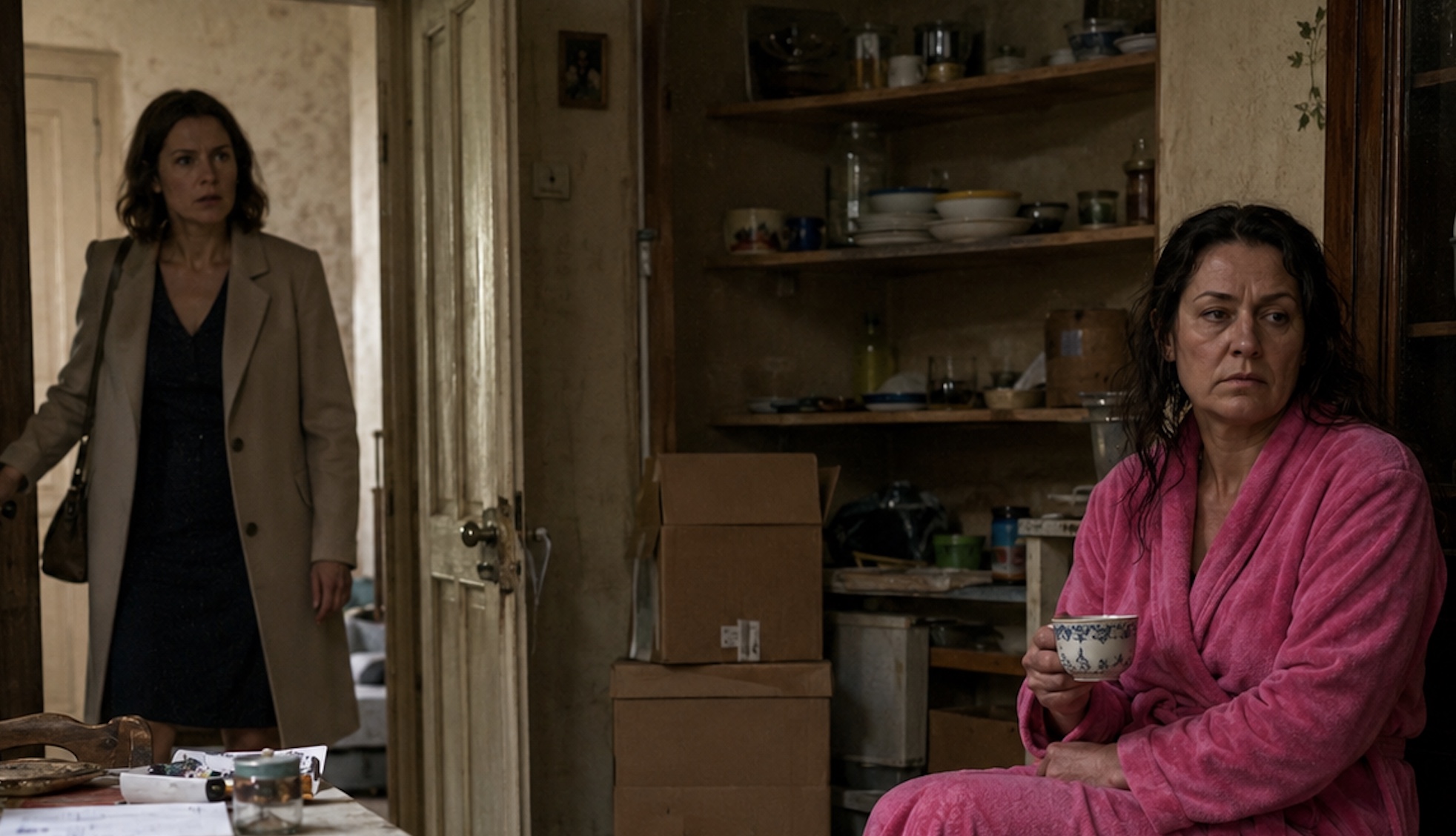
The key turned in the lock smoothly, without the slightest resistance. Svetlana noted almost automatically that the mechanism probably needed oiling, but the thought vanished the moment the door opened into the apartment.
There was a light on in the hallway.
On the shoe rack stood unfamiliar sneakers — small women’s ones — and a pair of pink rubber boots with unicorns printed on them. From the kitchen came the smell of freshly brewed coffee.
Svetlana froze on the threshold. The keys slipped from her fingers and hit the laminate floor with a sharp clatter.
A woman stepped out of the room.
She looked about thirty-five, thin, with dull ash-brown hair gathered into a careless bun. She was wearing a house robe — the very same one Svetlana had given her mother two years earlier. Blue, with embroidered cornflowers.
The woman looked at Svetlana without fear. If anything, there was weary irritation in her eyes.
“I live here,” she said with displeasure. “And who are you?”
Svetlana opened her mouth, then closed it again. The air inside the apartment felt foreign. It did not smell of her mother’s perfume. It smelled of laundry detergent and something faintly childish, milky.
“I… this is my mother’s apartment,” she said, her voice hoarse and oddly unconvincing. “Who are you? How did you get in here?”
A little girl peeked out from behind the woman. She looked about five, with fair braids and curious eyes, a pillow mark still pressed into her cheek. She clutched a stuffed rabbit with one torn ear to her chest.
Svetlana had seen that rabbit before.
It used to sit on a shelf in the wardrobe, in the room her mother called “the children’s room,” although there had been no children in that apartment for thirty years.
“Mom, who is that?” the girl asked.
The woman pushed the child behind her back. The gesture was automatic, maternal.
Svetlana felt nausea rise in her throat.
She recognized that gesture. Her mother used to do the same thing when Svetlana was little and a stranger came too close.
“I’m calling the police,” Svetlana said, reaching for her phone.
“Go ahead,” the woman replied calmly. “I have an agreement.”
“What agreement?”
“A free-use agreement. Galina Ivanovna gave it to me. The owner of the apartment.”
Svetlana went still. The phone trembled in her hand.
“You’re lying.”
The woman walked over to the chest of drawers in the hallway, pulled open a drawer, and took out a folder. She handed it to Svetlana.
Inside was an agreement printed on two sheets of paper, with her mother’s signature at the bottom.
Svetlana recognized the handwriting immediately. Neat letters, little flourishes, purple ink. Her mother had always used only purple pens — a habit left over from her years working in accounting.
The agreement was properly drawn up, with the passport details of both parties listed.
Anna Sergeyevna Belikova. Born in 1982.
Svetlana read the surname twice and felt nothing.
Not yet.
“I’m calling my mother,” she snapped.
“Call her,” the woman said with a shrug.
The dial tone went on for a long time. Five rings, six, seven. Svetlana was about to hang up when her mother’s voice finally sounded in the receiver.
“Yes, Sveta, what happened?” Galina Ivanovna sounded calm, almost sleepy. In the background, a radio was announcing the weather forecast.
“Mom, there are strangers in your apartment. Some woman with a child.”
There was a pause on the other end. Perhaps one second. Perhaps two.
To Svetlana, it felt endless.
“Don’t you dare touch them,” her mother said at last. Her voice had changed. It had hardened. “That is my home, and I have the right to let in whomever I choose. You are nobody in that apartment while I am still alive.”
Svetlana stood in the hallway, pressing the phone to her ear.
Her mother’s words struck her like a slap.
Nobody.
While I am still alive.
She looked at the strange woman in the cornflower robe, at the little girl with the stuffed rabbit, and the world around her slowly turned upside down.
“Mom, explain…”
“There is nothing to explain,” Galina Ivanovna cut her off. “Anna lives there, and that is final. Stay out of it, Svetlana. I said what I said.”
The line went dead.
Svetlana lowered her hand.
Anna was watching her with the same calm expression.
“Convinced now?” she asked.
Svetlana did not answer.
She bent down, picked up the keys from the floor, and suddenly froze. Her gaze had fallen on an old photograph standing on the chest of drawers.
It had always been there, for as long as Svetlana could remember.
A young Galina Ivanovna in a white headscarf was holding a newborn wrapped in a blanket. The photograph was black and white, with one bent corner.
Only now did Svetlana notice what she had never noticed before.
The baby’s face had been scratched out.
Carefully, but roughly, as if someone had scraped it away with a fingernail or a blade. Only a pale blank patch remained where the tiny features should have been.
“What is this?” Svetlana asked, pointing at the photograph.
Anna looked at it, and for the first time, something like uncertainty flickered across her face.
“I don’t know,” she said. “Galina Ivanovna put it there when she moved out. I never touched it.”
Svetlana did not remember how she left the apartment.
Only the cold air in the stairwell brought her back to herself. The elevator doors closed, and she saw her reflection in the mirrored panel.
A thirty-eight-year-old woman. A successful real estate agent. Married. Wearing an expensive coat, her hair perfectly styled.
And eyes like those of a beaten dog.
She drove home without seeing the road.
The navigator guided her in an indifferent voice, repeating the same instructions over and over. Svetlana replayed every detail in her mind.
The agreement.
The robe.
The rabbit with the torn ear.
And the photograph.
The photograph with the baby’s face scratched out.
Dmitry met her in the kitchen. He saw his wife’s face and immediately put down the phone on which he had been reading work emails.
“What happened?”
Svetlana sat down without taking off her coat and told him everything.
Dmitry listened carefully, without interrupting. In fifteen years of marriage, he had learned to read his wife’s moods from a single glance. His legal mind, sharpened by years of practice, began working at once.
“Your mother had the right to sign a free-use agreement,” he said when Svetlana finished. “The apartment belongs to her. She is the owner. But if we want to challenge it, we need grounds. Incapacity, for example. Or…”
“Dima,” Svetlana interrupted. “There was a photograph on the chest of drawers. I looked at it hundreds of times and never noticed. But today I saw it. The baby’s face was scratched out.”
“Wait. What does the photograph have to do with this?”
“It means my mother is hiding something.” Svetlana stood and walked to the window. Outside, the evening city was darkening, the lights blurred by the drizzle. “That Anna woman… you should have seen her. She wasn’t even frightened of me. She was expecting me to come. Mother must have warned her.”
Dmitry leaned back in his chair and rubbed the bridge of his nose.
“Let’s go step by step. What do you know about this Anna?”
“Nothing. Absolutely nothing.”
“Did you see the year of birth in the agreement?”
“1982.”
Dmitry was silent for a moment, calculating in his head.
“Your mother was nineteen then.”
Svetlana slowly turned away from the window.
The thought she had been pushing away all evening finally took shape in words.
“I’m going to Mother’s dacha,” she said. “Right now.”
“Sveta, it’s already nine in the evening.”
“I don’t care. I won’t sleep until I find out what’s going on.”
She left the house without changing clothes, taking only the car keys.
Dmitry followed her out, pulling on a jacket over his home T-shirt.
“I’m coming with you.”
“No,” Svetlana turned to him. “You know her. With you there, she’ll shut down. And when I’m alone, she has always known how to break me in two seconds. But this time I need to be on my own ground so I don’t let her do it. Let me handle this myself.”
Dmitry nodded.
He knew the relationship between his wife and Galina Ivanovna. He knew, and he stayed silent the way husbands do when they do not want to step into the wars of their wife’s family.
“Call me every couple of hours. If anything happens, I’ll come immediately.”
Svetlana got into the car and drove onto the highway.
The country road was empty on a weekday evening. The windshield wipers rhythmically swept the rain from the glass, creating the illusion of calm movement.
Inside Svetlana, everything was boiling.
She remembered.
She remembered how, at twenty, she had brought her mother a photograph of the boy she was dating.
“Is he promising?” her mother had asked, without even looking at the picture.
She remembered being thirty-five and hearing the gynecologist’s diagnosis: tubal infertility.
And she remembered what her mother had said then.
“I told you not to put off having children.”
As if it had happened because Svetlana had chosen a career. As if it had not been the result of a neglected infection she had carried on her feet during her university exams.
The dacha greeted her with lit windows and the smell of smoke from the stove chimney.
Galina Ivanovna was not asleep.
She was sitting on the veranda in an old rocking chair, drinking tea and staring into the darkness beyond the window. When she heard the car engine, she did not even flinch.
She had been waiting.
Svetlana entered without knocking. She deliberately did not take off her muddy shoes, leaving wet leaves on the clean doormat.
Her mother followed this tiny act of rebellion with her eyes and smirked.
“No respect at all. Marching in with your shoes on.”
“Who did you give my apartment to, Mom?”
The question came out sharper than Svetlana had intended.
But there was no going back now.
“My apartment,” Galina Ivanovna corrected, setting down her cup. “Not yours. Mine. Your apartment is in the city, with a mortgage, by the way. And I didn’t give you a single kopeck for it because you’re proud and independent. This one is mine.”
Svetlana sat opposite her. She tried to speak calmly, but her voice trembled.
“Who is Anna? Why does she have an agreement? Why is she living in our apartment with a child while I find out about it by accident?”
“Because you haven’t set foot there once in the last six months,” her mother snapped. “You came to water the ficus. That plant has been dry for a month, and you only noticed now.”
“Don’t change the subject. Who is she?”
Galina Ivanovna pressed her lips together and remained silent for a long time.
Then she stood, went to the sideboard, took out a bottle of homemade liqueur, and poured some into her tea.
Her hands did not shake, but her movements were slow and heavy.
“She is a tenant. I let her stay because I felt sorry for them. They had nowhere to live. What business is it of yours?”
“Mom,” Svetlana raised her voice. “You let a stranger with a child into the apartment without telling me, and when I arrive, this stranger tells me she lives there. What am I supposed to think?”
Galina Ivanovna turned sharply.
Her eyes flashed with a dangerous fire Svetlana had known since childhood. That was the look her mother had before scandals after which Svetlana would cry into her pillow and write in her diary that she hated herself.
“You should think about the fact that you lived your life exactly as you pleased!” her mother’s voice rose to a shriek. “You never denied yourself anything! You built your career, found yourself a man, you have money! But no children! Your womb, Sveta, is a dry well. You didn’t want to give birth. You kept postponing and postponing, and now the train has left. But Anna gave birth. Do you understand? She brought a living soul into this world.”
Svetlana felt blood rush to her face. Her ears began to ring.
A dry well.
Her mother had said it casually, as if discussing the weather, without even flinching.
“Do you… do you know why I can’t have children?” Svetlana whispered.
“Because God does not give them to those who do not ask.”
“No, Mom. Because when I was in my third year at university, you called me every day and told me what a worthless daughter I was. How I disgraced you because I wasn’t married yet. I ran to an exam in tears, and then I was hit by a car because I wasn’t watching the road. I had internal bleeding, an infection, complications. Do you even remember that?”
Galina Ivanovna went pale, but quickly recovered.
“You always look for someone to blame. I wanted what was best for you, and you twisted everything.”
“Who is Anna?” Svetlana repeated firmly.
Her mother said nothing.
She turned toward the window, arms crossed over her chest. Her posture was closed, defensive.
And suddenly Svetlana understood: her mother was hiding something.
Not just the story with the tenant, but something far more serious.
Something that made this powerful woman, who never justified herself to anyone, avoid her daughter’s eyes now.
“I have the right to know,” Svetlana said quietly. “You gave the keys to a strange woman. You let her into the home where I grew up. Into my room.”
“Your room is empty,” Galina Ivanovna said without turning around. “You haven’t lived there for twenty years. Anna is not a stranger. She…” Her mother faltered. “She has more right to live there than you do.”
Svetlana stood.
Slowly, she walked over to her mother and positioned herself so she could see her face.
“Why?”
Galina Ivanovna stared at the floor.
The wrinkles around her mouth looked sharper than before. Her lips trembled.
For one second, Svetlana thought her mother was about to cry.
But she did not.
“Leave,” she said dully. “I’m tired.”
“I’m not leaving until you explain.”
“Go, Sveta. Please.”
Svetlana had heard the word “please” from her mother so rarely that it affected her more than shouting would have.
She stood there for another minute, then turned and walked out.
She got into the car and sat motionless for a long time, staring at the lit windows of the dacha.
Her mother did not come out.
She did not call after her.
Only a shadow moved behind the curtains, and there was something frightening in that restless movement.
At home, Dmitry was waiting with dinner and worry in his eyes.
Svetlana told him about the conversation, and by the end of the story, her husband looked darker than a storm cloud.
“She’s hiding something,” he repeated the thought she had already had. “And judging by everything, that something is directly connected to Anna. She’s not just a tenant.”
“What do we do?”
“We search for information.” Dmitry opened his laptop. “Anna Sergeyevna Belikova, born in 1982. That’s enough to check some records.”
“Dima, is that legal?”
“I know someone at the passport office who owes me a favor. An unofficial one.”
Svetlana nodded.
For the first time that evening, she felt something like support.
Dmitry had always been like that. When emotions boiled over, he turned into a lawyer and laid the problem out piece by piece.
The next few days turned into waiting.
Svetlana went to work, showed apartments, smiled at clients, and checked her phone every five minutes.
On the third day, Dmitry came home with printouts.
“Sit down,” he said from the doorway. “There’s something here you need to read.”
Anna Sergeyevna Belikova.
Born in the town of Kolchugino, Vladimir Region.
A former resident of Orphanage No. 4.
Parents unknown.
In the line marked “mother” there was a dash.
In the line marked “father” there was a dash.
Date of birth: November 4, 1982.
Svetlana read the date three times.
Then she took her phone and began scrolling through old photographs in cloud storage. She found the album she had digitized several years earlier at her mother’s request.
She searched for a long time until she stopped at one particular image she had copied from an old photo.
A young Galina Ivanovna stood against the background of a hospital ward. In her arms was a bundle with a baby inside.
On the back, written in purple ink in her mother’s handwriting, were the words:
“Anechka, November 1983.”
“This can’t be,” Svetlana whispered.
She climbed into the family archives, stored in a box on the mezzanine.
There she found her parents’ marriage certificate.
February 7, 1984.
Two months after Anna’s birth.
“She gave birth before marriage,” Svetlana said aloud, though her own voice sounded muffled, as if coming through cotton wool. “She gave birth and gave the baby up. Left her at the maternity hospital. Then she married Father, who probably knew nothing. Or knew and kept silent.”
Dmitry took the documents from her hands and studied them carefully.
“It looks that way. Anna is your sister, Sveta. Your half-sister.”
The world swayed, then settled back into place — but in a completely different shape.
All the childhood wounds, all her mother’s reproaches, all that “you ungrateful daughter” suddenly acquired a new meaning.
Her mother had not simply demanded perfection from Svetlana.
She had tried to atone through her.
To make up for the sin she had committed at nineteen, when she had been afraid of shame and abandoned her first child.
“She gave the apartment to her,” Svetlana said quietly. “To her secret daughter. And she threw me out.”
Dmitry sat beside her and put an arm around her shoulders.
“We can challenge the agreement. If we can prove your mother acted under a mistake or pressure.”
“What pressure, Dima? She found Anna herself. She let her in herself. She spent her whole life going to church and praying, and I thought it was just old age. Turns out she was praying away a sin.”
Svetlana stood abruptly.
She went to the window and threw it open, letting in the cold spring air. She needed to clear her head, where one thought kept pounding again and again.
She had a sister.
A sister she had seen only once in her life, and who now lived in the apartment that had belonged to her mother and her childhood.
“I need to talk to Anna,” she said.
“Maybe you should talk to your mother first?”
“Mother will lie. She always lies when it comes to her past. I didn’t even know she had gone away for a year before marrying Father. She told me she’d been caring for her sick grandmother. Her grandmother died three years before that. I checked the documents. I believed her fairy tales my whole life.”
Svetlana pulled on jeans and a sweater and grabbed the keys.
“I’m going to Anna. Alone.”
“Sveta, let me come with you,” Dmitry said, standing up.
“No,” she turned to him. “If I show up with a lawyer, Anna will close off and call the police. I need to understand what kind of person she is. Maybe she doesn’t even know whose daughter she really is.”
“Or maybe she knows very well,” Dmitry said quietly. “Be careful.”
Svetlana drove to her mother’s building, parked in the courtyard, and sat in the car for a long time, gathering herself.
Then she went upstairs and rang the doorbell.
This time, she did not use her own key.
She had the right to.
But she did not want to.
This was someone else’s territory now.
Anna opened almost immediately. It was obvious she had been expecting her.
Behind her, in the hallway, the same little girl — Sonya, it seemed — was playing with a doll. When she saw Svetlana, she grew wary, but she did not run away.
“Come in,” Anna said. “But I’m not alone. Sonya isn’t at kindergarten today.”
“I know,” Svetlana said.
She entered the hallway and took off her shoes.
She looked at the coat rack. Hanging there was her mother’s old jacket, the one Galina Ivanovna had worn back in the nineties. Anna was apparently wearing her old things.
They went into the kitchen.
Anna put the kettle on and sat opposite her. Sonya played in the room. They could hear her talking to her doll.
“Go on,” Anna said. “Why did you come?”
Svetlana gathered her courage.
Suddenly she was frightened.
What she was about to say could destroy this woman’s life.
Or perhaps give her the answers she had been waiting for all her life.
“How did you meet my mother?” Svetlana asked.
Anna shrugged.
“She found me herself. About two years ago. She came to the orphanage — well, to the orphanage archive, really. It doesn’t operate anymore, but the documents were preserved. She said she was looking for former residents to help them. At first I didn’t believe her. Who would need me? An orphan with thirty years behind her? But she came every week. She brought groceries. Then she helped me find work. Then she offered me this place.”
“Did she tell you anything about herself?”
“She said she was a lonely woman. That her daughter was busy with her career, that she had no grandchildren, that she needed someone to care for.” Anna looked carefully at Svetlana. “I know you’re her daughter. She told me about you.”
“What did she tell you?”
“That you’re successful, that you work in real estate, that you’re married. But that your relationship isn’t very good.”
“That’s putting it mildly.”
The kettle boiled.
Anna poured the tea and pushed a cup toward Svetlana.
Her hands were calm, her movements smooth.
There was no aggression in her.
Svetlana suddenly realized she felt almost no hostility toward this woman.
Only exhaustion, and a strange pulling ache somewhere under her ribs.
“Can I ask you something directly?” Svetlana said.
“Ask.”
“Do you know who your biological mother is?”
Anna froze with the spoon of sugar in her hand.
Slowly, she lowered it back into the sugar bowl and brushed the grains from her fingers.
“I was told my parents were unknown. I was abandoned. Back then, there were many like me.”
“And what if I told you your parents are known?”
Silence fell over the kitchen.
Even Sonya went quiet in the other room, as if she sensed the tension.
“What are you trying to say?” Anna’s voice dropped to a whisper.
Svetlana took out her phone, found the photograph with the inscription, and showed it to Anna.
“This is my mother, Galina Ivanovna. You know her handwriting. It says, ‘Anechka, 1983.’ You were born in the autumn of 1982. Coincidences like that don’t happen.”
Anna looked at the screen for a long time.
Then she lifted her eyes to Svetlana.
There was no surprise in her gaze.
Only pain.
Old, deep pain — the pain of a child who had once been abandoned.
“I knew,” she said barely audibly.
“What?”
“I knew,” Anna repeated louder. “She admitted it to me six months after she found me. She told me I was her daughter. That she had left me at the maternity hospital because she was afraid. That she had regretted it all her life. And then…” Anna faltered. “Then she made me swear. I had to keep silent and not try to meet you.”
“Why?” Svetlana felt her fingers growing cold.
“She said you wouldn’t understand. That you were cruel and selfish. And that if you found out about me too soon, you would do everything to separate us.”
Svetlana leaned back in her chair.
The air in the kitchen suddenly became heavy and stale.
Her mother had played both of them.
She had found the daughter she had abandoned, and at the same time, she had turned her against Svetlana.
Two women bound by blood had been forbidden to know each other.
Forbidden to meet.
So that their mother could remain at the center — savior, martyr, victim.
“Listen,” Svetlana leaned forward. “I don’t want to separate you. I didn’t even know you existed until yesterday. But I have the right to know what is happening in my family.”
“Your family?” Anna gave a bitter smile. There was no malice in it, only pain. “Svetlana, you had a family. A mother, a father, an apartment, an education. I had nothing. Only the orphanage, then a dormitory, then random jobs. I gave birth to Sonya from a man who disappeared the moment he found out I was pregnant. If it hadn’t been for Galina, I’d be washing stairwells now and living in a communal apartment.”
“Galina abandoned you,” Svetlana said quietly. “She was the one who left you in a maternity hospital in the middle of a freezing winter. Do you understand? And now she came back as a benefactor, trying to pray away her sins. But you don’t owe her worship.”
“Who do I owe, then? You?”
“No one. You owe no one anything. But she has no right to manipulate you either.”
Sonya began crying in the room.
Anna apologized and went out, leaving Svetlana alone in the kitchen.
Svetlana looked around.
On the windowsill stood a jar of dried herbs. On the refrigerator hung a child’s drawing — a house, the sun, three stick figures.
The crooked letters underneath read:
“Me, Mama, and Grandma Galya.”
Something pierced Svetlana.
There was no Aunt Svetlana in the drawing.
She did not exist in this world at all.
Anna returned with Sonya in her arms. The little girl was sobbing and rubbing her eyes.
“She got scared of something,” Anna explained. “It’ll pass.”
Svetlana looked at the girl, at her fair hair curling slightly at the temples.
Something in Sonya’s face faintly reminded her of their mother. The same eye shape, the same lips.
But Svetlana already knew that resemblance could sometimes be accidental.
Or suggested.
She did not yet realize just how much.
“Can I ask you a strange question?” Svetlana hesitated.
“You’ve already said so many strange things today that one more question won’t make much difference.”
“Did you ever take a DNA test? To prove your relationship with Galina?”
“No. Why would I? She confessed herself. What more do you need?”
“Certainty,” Svetlana said. “I want certainty.”
Anna shook her head, holding her daughter close.
“You’re a strange woman. You don’t believe your mother. You don’t believe me. Who do you believe at all?”
“Facts.”
They said goodbye stiffly.
Svetlana left the apartment and went down to the courtyard.
The evening was warm, but she was trembling.
She got into the car and called Dmitry. “We need to get everyone in one room,” she said. “Mother, Anna, and me. No fourth person. This will be an adult conversation.”
“Sveta, are you sure?”
“Mother is using both of us, Dima. She tells Anna I’m a monster. She tells me Anna is nobody. And then she sits back and waits for us to tear each other apart. Enough. This knot needs to be cut once and for all.”
“When?”
“In two days. Anna has Thursday off. I’ll arrange it.”
She ended the call and dialed her mother.
Galina Ivanovna did not answer for a long time, but eventually picked up. Her voice sounded weak and ill.
“What do you want, Sveta?”
“On Thursday, we’re meeting at the apartment. You, me, and Anna.”
“What for?”
“To tell each other the truth. The whole truth.”
A silence fell on the other end of the line. It lasted so long that Svetlana thought the connection had dropped. Then her mother spoke again, and her voice no longer sounded sick.
It was steel.
“Fine. I’ll come. But don’t complain afterward if the truth turns out to be different from what you expected.”
Svetlana hung up and leaned back in the chair.
Her heart was pounding against her ribs.
What had her mother meant?
What other secret was she hiding?
Thursday arrived quickly and inevitably, like a sentence being carried out.
Svetlana woke with a headache and a heavy sense of approaching disaster. Dmitry offered to go with her, but she refused. This conversation had to be heard only by blood. Only by those it directly concerned.
The apartment smelled of Corvalol.
Galina Ivanovna had arrived first. She was sitting in the armchair, straight as a stick, her face pale. Anna stood by the window with her arms crossed. Sonya had been sent to a neighbor’s.
Svetlana entered last, locked the door behind her, hesitated for a moment, then put the key in her pocket.
“Well, here we are,” Galina Ivanovna said. “Who wants to start?”
“I’ll start.”
Svetlana stepped into the middle of the room. She took a folder of documents from her bag and placed it on the table.
“Here is the family history. My parents’ marriage certificate: February seventh, nineteen eighty-four. Here is Anna Belikova’s birth record: November fourth, nineteen eighty-two. And this,” she laid out the photograph, “is a picture from the family album. The inscription is in Mother’s handwriting: ‘Anechka, 1983.’ Mom, explain to both of us what this means.”
Galina Ivanovna stared at the photograph without blinking.
Then she raised her eyes to Svetlana.
There were tears in them.
But they were angry tears, not repentant ones.
“Fine,” she said hoarsely. “You want the truth. Then listen. I gave birth to a girl in November of nineteen eighty-two. I was nineteen. I was not married. The child’s father was married, had three children, and held a Party position. My parents told me: either you leave this child here and forget this shame forever, or we disown you. I was afraid. I broke. I signed the refusal papers.”
Silence settled over the room.
Anna stood without moving. Only her whitening knuckles revealed what was happening inside her.
“I thought I would forget,” Galina Ivanovna continued. “I married your father, Sveta. I gave birth to you. I thought I would atone for it. But I didn’t. Every night, I saw that baby in my dreams — the baby I abandoned. Every night. Two years ago, I started searching. I found Anna. I learned that she’d had a hard life, that she was alone with her daughter. And I decided I would give her everything I could.”
“Give her everything?” Svetlana repeated. “The apartment? Money? And what will be left for me?”
“You already got yours,” her mother snapped. “You grew up in a family, with a father, in comfort. You had an education, a career, a husband. What more do you lack?”
“Mom,” Svetlana’s voice trembled. “Are you really asking what I lack? You destroyed me my whole life. You demanded that I be perfect. You told me I disgraced you because I didn’t marry at twenty. You called me while I was studying and screamed into the phone that I was a worthless daughter. Do you even remember the accident?”
“Don’t you dare!” her mother raised her hand sharply. “Don’t you dare blame me for your problems!”
“These are not just my problems, Mom. These are the consequences of the way you raised me. I was hit by a car because I was running to an exam and sobbing after one of your scandals. I had internal bleeding. They removed one fallopian tube, and the other became blocked because of an untreated infection. I’m infertile. Not because God punished me. Because you drove me to it.”
Anna gasped and pressed a hand to her mouth.
Galina Ivanovna froze as if she had been struck.
Red, unhealthy patches spread across her face.
“You’re lying,” she whispered.
“I’m not lying. I simply never told you because you would have turned it into another story about what a failure I am.”
“I wanted what was best for you,” her mother said slowly, as though tasting each word. “I wanted everything to be right for you. Traditional. A family, children, a home. But you always did everything out of spite.”
“I wasn’t doing anything out of spite. I was living my life. You were the one trying to live it for me.”
The room went quiet.
Anna stood by the window, tears running down her cheeks — silent, clear, like spring rain.
Svetlana looked at her mother and waited for something. Repentance. Anger. A scream.
But Galina Ivanovna said nothing.
Then she rose heavily from the armchair and walked over to the table where the old photograph lay.
“Do you want to know why the face was scratched out?” she whispered. “Because I couldn’t look at it. I couldn’t see the face of the child I had betrayed every day. I tried to erase it, but only the paper wore away. The memory stayed.”
Then Anna spoke.
Her voice was quiet but firm.
“Why didn’t you tell me right away? Why all this game?”
Galina Ivanovna turned to her, and her face twisted with pain.
“I was afraid. You would have hated me. I wanted to do something good for you first. So you would understand I wasn’t a monster.”
“You are a monster,” Anna said softly. “You broke both our lives.”
Galina Ivanovna swayed and grabbed the edge of the table.
Svetlana instinctively moved to help her, but stopped herself.
Her mother had chosen this path herself.
“The apartment,” Galina Ivanovna rasped. “I promised the apartment to Anna.”
“The apartment will legally go to whoever is named in the will,” Svetlana said. “And if you think you can simply erase one daughter for the sake of another, you’re mistaken.”
“Not for another,” her mother looked at her with despair. “For myself. I want to stop feeling like the lowest creature on earth before I die.”
At that moment, Anna stepped forward.
So sharply and decisively that Svetlana even moved back.
“I don’t need your apartment,” Anna said. “I refuse to be a bargaining chip in your relationship. You abandoned me, and now you’re trying to buy me. Sonya is not an instrument for your salvation.”
With that, she headed into the hallway.
She yanked her coat from the rack and shoved her feet into her boots.
Svetlana caught up with her by the door.
“Wait, Anna. Let’s talk calmly. You don’t have to leave.”
“I can’t stay here,” Anna said without lifting her eyes. “I thought I had found a family. But it turns out I was just a part of someone else’s script. I need time to think. And so does Sonya.”
“Where will you go?”
“We have somewhere. Don’t worry.”
The door slammed shut.
Svetlana remained alone in the hallway.
From the room came sounds — either sobbing or wheezing.
Galina Ivanovna was sitting in the armchair with her face buried in her hands.
Svetlana did not go to her.
Instead, she called Dmitry and said briefly:
“It’s over. Anna left. Mother is hysterical. I’m going home.”
That same evening, Galina Ivanovna was taken away by ambulance.
A hypertensive crisis, possible stroke.
Someone from the hospital called Svetlana, and with a heavy heart, she went there.
Her mother lay under an IV drip, pale, small, almost unrecognizable. When she saw her daughter, she turned away toward the wall.
“I didn’t want this,” she whispered. “I truly didn’t want it to end this way.”
Svetlana stood beside the bed, not knowing what to say.
Then she went out into the corridor.
She took out her phone and called Anna.
The dial tone went on for a long time — almost five minutes — before a tired voice finally answered.
“Yes?”
“Anna, it’s Svetlana. Mother is in the hospital. I understand if you don’t care right now, but I thought you should know.”
“Thank you for telling me,” Anna said after a pause. “But I won’t come.”
“I’m not asking you to. I wanted to ask something else. Did you find a place to stay?”
“We’re in a hostel. A decent one, not some basement. Don’t worry.”
“Anna, I want to help you. Not as a sister, because I don’t even know whether you really are my sister or not. Just as a person who understands that none of this is your fault. You became a pawn in a game our mother started. Sorry — Galina Ivanovna.”
“Why would you help me?”
“Because I’m a victim too,” Svetlana pressed her forehead against the cold hospital window. “And I know what it feels like when everything you believed in turns out to be a lie. Let’s meet in a few days, when things calm down. Without Mother. Just to talk.”
“All right,” Anna said. “Come on Wednesday. Around three. I’ll send you the hostel address.”
Several days passed.
Galina Ivanovna remained in the hospital. The doctors said her condition had stabilized, but they were careful with their prognosis.
Svetlana visited every day, but there were no more conversations.
Her mother was silent, and so was her daughter.
Everything that mattered had already been said in that apartment.
On Wednesday, Svetlana went to the hostel.
Anna met her in the lobby. She looked awful — thinner, exhausted, with dark circles under her eyes — but she held herself calmly. Sonya was playing in the corner with a tablet.
“Do you want something to eat?” Anna asked.
“No. Let’s just talk.”
They found a sofa at the far end of the lobby.
They sat beside each other, though not too close, preserving a careful distance.
Two women whom life had forced into collision through the will of a third.
“I’ve thought a lot these past few days,” Svetlana began. “And I realized I don’t hate you. Not at all. None of this is your fault.”
“I don’t hate you either,” Anna replied. “But it’s hard. Sonya keeps asking where Grandma Galya is, why we left. I don’t know what to tell her.”
“Tell her the truth. That adults sometimes make mistakes, and those mistakes hurt the people they love.”
Anna gave a faint smile and reached into her bag.
She took out a crumpled envelope, pulled a sheet of paper from it, and handed it to Svetlana.
“What is this?”
“Remember when you asked about a DNA test? I did one a month ago. Without Galina knowing. I wanted to check whether Sonya really was her granddaughter. I wanted to make sure it was all real.”
“And?” Svetlana took the sheet.
The lines of the medical report swam before her eyes — charts, percentages, conclusions.
“Read the final result,” Anna said quietly.
The probability of biological kinship between Galina Ivanovna and Sonya Belikova is 0.01 percent. Biological relationship is excluded.
Svetlana read it three times.
Then she lifted her eyes to Anna.
Anna was looking at her calmly, with a doomed kind of stillness.
“Sonya is not her granddaughter. And I am not her daughter,” Anna said. “Galina was mistaken. Or maybe she deliberately deceived herself. Her real daughter died in infancy. I checked the archives. That Anechka she gave birth to in 1982 lived for three months and died of pneumonia. I am simply a similar child, an abandoned baby with the same date of birth. Coincidences like that are everywhere in orphanage records. Galina found me, saw a resemblance, clung to it, and convinced herself it was fate. That I was that same Anechka.”
Svetlana felt sick.
She remembered her mother’s face in the hospital room. Her words about atonement, about a sin that had to be prayed away.
All of it had been built on a mistake.
No, not even a mistake — an illusion that Galina Ivanovna had created for herself because the truth was too terrible.
Her child had died.
There was no daughter who had grown up and given birth to a granddaughter.
There was only a ghost, and her mother had replaced that ghost with a living human being.
“Does she know?” Svetlana asked.
“I didn’t tell her. I couldn’t.”
“You have to tell her.”
“No,” Anna shook her head. “It would kill her. Literally. Her heart is weak, her blood pressure is unstable. If she finds out that for two years she was caring for a stranger, that her real daughter has been dead for thirty years… she won’t survive it.”
Svetlana stood and walked across the lobby.
Thoughts collided inside her, scattered, reassembled, then shattered again.
Everything had collapsed.
Tradition, blood, sins — all of it turned out to be a house of cards, brought down by one breath.
“What will you do now?” Svetlana asked.
“I’ll leave. I have an aunt in the Kaluga region. She invited me a long time ago.”
“And the apartment?”
“The apartment is yours,” Anna said firmly. “I won’t take anything. I’m not family. It would be theft.”
Svetlana thought of her mother.
Of how she was sitting in a hospital room, staring at the ceiling.
Of all her scripts, now ruined.
Of family pride trampled by one simple kinship test.
And suddenly, unexpectedly, Svetlana felt not triumph, but pity.
Bitter, sharp pity, like wormwood.
“I’ll rent you an apartment,” she said. “For six months. Not in this district — somewhere farther away. So you can calmly find work and not worry about housing.”
“Sveta…”
“This isn’t charity. It isn’t atonement either. It’s easier for me this way. I don’t want you and Sonya living in a hostel. You’re a good person, Anna. You did nothing wrong. The fact that Mother used you is Mother’s fault, not yours.”
Anna lowered her head and said nothing.
Then she looked at her daughter and nodded.
“Thank you. We’ll pay it back as soon as we can.”
“Agreed,” Svetlana said, standing. “And now I need to go to the hospital.”
She arrived at the ward that evening.
Galina Ivanovna was half-reclining against the pillows, watching television. The sound was off; only the picture flickered.
When she saw her daughter, she switched off the screen.
“You came,” she said.
“I came.”
Svetlana sat on the edge of the bed.
She looked at her mother for a long time.
Galina Ivanovna had lost weight and looked worn down, but her eyes were still alive and sharp — the eyes of a woman who had spent her whole life fighting: against circumstances, against family, against herself.
“Mom, I want to tell you something.”
“Say it.”
“I haven’t forgiven you. And I probably won’t. You destroyed my life with your demands and expectations. But I’ve stopped hating you. It took too much strength, and I need that strength for something else.”
Galina Ivanovna swallowed back tears.
She did not answer. She only nodded, as though accepting a sentence.
“And one more thing,” Svetlana paused. “Anna and Sonya have left. I helped them find a place to live.”
“Left,” her mother repeated. “Of course.”
They were silent for a while.
Outside the hospital window, dusk thickened, and the light from the hospital lamps reflected in the glass.
“You wanted to preserve traditions,” Svetlana said quietly. “But you destroyed everything. With your own hands. With your fear. But you know what? I think I’ve decided to adopt a child. Not for your sake. In spite of you. Because I want to become a mother not by blood, but by choice. By love. For real.”
Galina Ivanovna closed her eyes.
A tear rolled down her wrinkled cheek — slow, heavy, as if it carried the pain of all the past decades within it.
A tear of shame.
Or perhaps of belated love, love that had arrived too late forever.
Svetlana stood, adjusted the blanket over her mother, and left the ward.
The corridor was empty and quiet. Somewhere at the nurses’ station, a nurse was sorting through papers.
Svetlana walked toward the elevator and thought about the meeting she had the next day with an adoption lawyer.
And that in the evening she needed to call Anna to ask how she and Sonya had settled in.
And that, for the first time in many years, she felt not emptiness, but a strange, fragile, unmistakable sense of peace.
The elevator arrived.
Svetlana stepped inside, and the doors closed behind her, cutting off the past.
She pressed the button for the first floor and rode down.