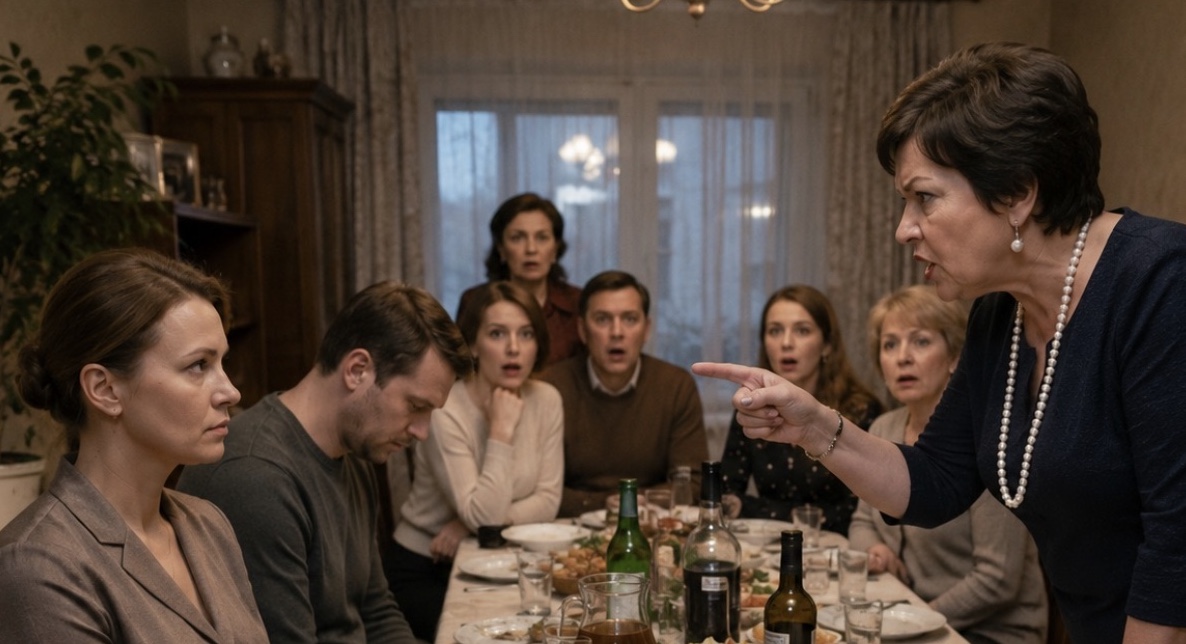
“Those cucumbers in the salad are from your own garden, I suppose, Tanya?” Tamara Ilyinichna narrowed her eyes as she studied the plate. “Or did you buy those too? Vadim was saying you only drag store-bought things into the house. Money doesn’t grow on trees, you know.”
I moved the saltshaker to the edge of the table. Someone else’s celebration always exhausts you faster than your own. Today we were celebrating the tenth birthday of Kirill, my husband’s nephew. In the cramped three-room apartment of Viktor, Vadim’s older brother, the air smelled of fried fish and heavy, cheap perfume.
“They’re store-bought, Tamara Ilyinichna,” I answered evenly, without even raising my eyes. “I don’t have time for a garden. I work.”
My mother-in-law sighed loudly enough to make sure the three aunts at the far end of the table turned around. She knew how to command a room. At sixty-two, Tamara Ilyinichna still had the voice of a school headmistress and the habit of straightening her shoulders before every reprimand.
“She works,” my mother-in-law said, turning toward her sister, Aunt Vera. “People work three shifts at the factory and still manage to grow their own cucumbers. But this one is a consultant. Sits at a computer, shuffling numbers around. Meanwhile, my Vadik is wearing himself out. Just look how pale he is. Son, eat something hot at least!”
Vadim, sitting across from me, twitched his shoulder and reached for the beer bottle. He had been avoiding my eyes all evening. He was wearing a new expensive shirt we had bought the week before at the shopping mall. Bought, of course, with my card, because his salary account had once again shown a technical zero.
“Mom, come on,” Vadim muttered, taking a sip. “Everything’s fine.”
“What’s fine?” Tamara Ilyinichna leaned forward, and her heavy plastic beads knocked against the edge of the salad bowl. “That you’re killing yourself working two jobs while your wife just collects receipts? I can see who carries that household. You bought a new car, didn’t you? You did. And who pays for it? You do. And sweet Tanya only paints her nails and gives clever advice to strangers for money.”
I slipped my hand into the pocket of my jacket. My fingers touched cold metal. It was my old ballpoint pen, the one with a deep scratch on the cap. I always carried it with me — a habit from the days when I had to sign hundreds of audit reports a day. I began slowly turning it in my pocket, feeling the scratch catch against the pad of my thumb.
“Vadim decided to change the car himself,” I said quietly.
“Of course he did!” my mother-in-law lifted her chin triumphantly. “A man must grow. A man must provide. But any man will break if he has to drag along a woman starving for a beautiful life. You live off my son!” she hissed, leaning toward me across the table.
The room fell silent at once. Even the children in the hallway stopped fighting over the old plastic construction set. Viktor, the host, coughed into his fist and suddenly became very interested in the pattern on the wallpaper. His wife Elena stood up abruptly and went to the kitchen for clean forks.
“Tamara Ilyinichna,” I took my hand out of my pocket and placed the pen on the tablecloth beside my plate. “Don’t.”
“Don’t what?” My mother-in-law was getting louder, sensing that her audience had frozen in place. “Does the truth hurt? Vadik has been bringing money into the house since he was sixteen, after his father died. He paid for every rag on your back. You think I don’t know how much those blouses of yours cost? He told me himself what kind of demands you have. And he endures it. He stays silent. Because he’s noble.”
I looked at Vadim. He was carefully scraping the remains of mayonnaise from his small plate. Not a single muscle moved on his face. He was used to this. He knew that when his mother began one of her performances, the best thing to do was simply wait it out. Mother would talk, mother would calm down, and at home we would somehow deal with it.
“Vadim, tell your mother,” I said, staring into his empty eyes.
“Tanya, stop it,” he said quietly through clenched teeth, without lifting his head. “Not in front of everyone. Mom is just worried. Her blood pressure is acting up again.”
“Exactly, my blood pressure!” Tamara Ilyinichna immediately picked up, theatrically pressing her dry hand to her chest. “You’ll be the death of me. One works, the other spends. And I’m supposed to stay silent? Don’t count on it. I won’t let anyone hurt my son. You grew up in some backwater and thought you’d settle down in the regional center under the wing of a fool?”
I picked up the metal pen from the table and put it back into my pocket. Inside, everything felt empty and very cold. It wasn’t even anger. It was a heavy, leaden exhaustion that had been accumulating for the last four years.
“I think I’ll go,” I said, rising from the table. “Vitya, Lena, thank you for the celebration. I left Kirill’s gift on the cabinet.”
“Go, go,” my mother-in-law’s voice flew after me. “Run away if you have nothing to say. Look how proud she is. It’s easy to show pride when you’re living on someone else’s money.”
Vadim didn’t even get up to walk me to the hallway. Only the beer in his glass trembled when my bag brushed against the edge of the table.
A Double Bottom
The apartment was dark when I got home. I didn’t turn on the hallway light. I simply kicked off my shoes and went into the kitchen. On the windowsill stood an old ficus in a clay pot. The soil was dry and gray. I filled a plastic cup with tap water and poured it into the pot. The water hissed as it sank in.
Vadim arrived two hours later. He slammed the shoe cabinet loudly, walked into the kitchen, whistling some tune. He probably thought I was already asleep or crying into my pillow.
“So why did you put on that show?” he asked from the doorway, switching on the overhead light. “Mother is lying there with her drops now. Vitya had to go calm her down.”
I was sitting at the table, smoothing an old utility bill with my fingers.
“I wasn’t the one who put on a show, Vadim,” I replied.
“Oh, come on,” he waved his hand and opened the refrigerator. “You know what she’s like. She blurted something out, so what? She has this fixation that someone is going to rob me blind. Her father counted every kopeck all his life, and before the divorce he transferred everything to his mistress. Mother was left on the street with two kids. That’s why she gets triggered.”
He took out a piece of cheese, threw it onto the cutting board, and began slicing it crookedly.
“She called me a kept woman in front of your entire family,” I said very quietly. “And you sat there eating mayonnaise.”
Vadim flinched. He dropped the knife.
“Tanya, we’re family!” he raised his voice, turning toward me. “These are our private matters. Why does my mother need to know who earns how much? It’s calmer for her to think I have everything under control. What does it cost you? Let her think I’m the man of the house. Does that really make your life worse?”
“Yes,” I said. “It does.”
“Listen,” he sat down across from me, and the smell of cheap beer and tobacco smoke drifted from him. “Speaking of money. The car payment is due tomorrow. Transfer forty-five thousand to my Sber card. They’re delaying my advance at work, so I’m a little short.”
I looked at his well-groomed hands. Vadim worked as a logistics manager at a small private company. Officially, he earned forty thousand rubles. The rest came as bonuses — if he was lucky. For the past six months, luck had not been on his side. Still, he had chosen a Korean car in the highest trim. One and a half million on credit. He insisted it had to be registered in his name — a man should drive his own car.
“I won’t be transferring you any more money this month, Vadim,” I said.
He froze with a piece of cheese near his mouth. Then he smiled indulgently.
“Here we go. Now you’re offended. Tanya, don’t be stupid. If we miss the payment, my credit history will be ruined. Then I won’t get a loan for the country plot. Vitya, Mother, and I already agreed — we’re buying land in the gardening community. Mother dreams so much of having her own vegetable garden.”
I remembered the previous year. I remembered how Vadim’s “secret business” selling car parts had collapsed. He had ended up owing money to some former army buddy. He came to me at night, white as a sheet, begging for help. I withdrew eight hundred thousand rubles from my personal savings account. I paid off his debt. And I said nothing. I didn’t tell Tamara Ilyinichna. I didn’t arrange a family scandal. I spared his masculine pride. I wanted to do the right thing. That had been my biggest mistake.
“You didn’t agree to buy land, Vadim,” I said. “You simply decided that I would pay for it.”
“Where did you get that idea?” He jumped up and started pacing around the kitchen. “Mother is putting in her pension savings, Vitya is selling his old car. I’m contributing too. So what if I borrow a little from you? I’ll pay it back. You’re our financial genius, aren’t you? Money is always dripping into your accounts. Are you really going to be stingy with family?”
On Thursday evening, my mother-in-law arrived without warning. Vadim had not yet come home from work. She entered without taking off her coat, which smelled of autumn dampness and valerian. She walked into the kitchen, where I was reviewing reports for a large retail chain.
“We need to talk, Tanya,” she said sternly, sitting on the chair by the door.
I put my laptop aside.
“I’m listening, Tamara Ilyinichna.”
My mother-in-law unbuttoned the top button of her coat. Her gaze softened, almost motherly. That tone made something inside me tighten like a string.
“Tanya, a man must feel like the head of the family, otherwise he’ll simply collapse onto the sofa and burn out. If you take everything onto yourself, there will be no family.”
I said nothing, looking at the scratch on my metal pen lying beside the papers.
“I’m saying this for your own good,” my mother-in-law continued, leaning toward me. “My Vadik is sensitive. He tries. He bends over backward to live up to this apartment. After all, the apartment is yours, inherited from your grandmother. He feels like an outsider here. That’s why he shows off, why he bought an expensive car — so he wouldn’t be ashamed in front of your colleagues. And you nag him. You throw money in his face. My son tells me everything, Tanya. Every kopeck he has to ask you for.”
“He doesn’t ask, Tamara Ilyinichna,” I replied, looking straight into her eyes. “He simply takes.”
“And he has the right to!” Her voice instantly returned to its familiar schoolmistress pitch. “He is your husband! He feeds you. And whatever pennies you collect through your consultations are just pocket money for yourself. The man is the head. And we’ll register the land under his name and Viktor’s. Don’t stick your nose into family business. Your job is to create comfort, especially since God didn’t give you children.”
She stood up, sharply pulling her coat into place.
“Have three hundred thousand ready by Saturday,” she threw over her shoulder from the hallway. “Vitya found a good plot near old Ruza. We need to bring the deposit. Vadik said you have the money. Don’t ruin the boy’s life, Tanya.”
The door slammed shut. I sat in silence, listening to the cheap plastic clock ticking on the wall.
Three hundred thousand. Exactly the amount that remained in my main business account after paying all quarterly taxes.
A Statement Without Mistakes
Saturday morning began with rain. Large drops hammered against the metal window ledge so loudly it felt as if someone small and insolent was trying to break into the apartment.
Vadim woke up in a good mood. He shaved for a long time, hummed to himself, then sprayed on my favorite expensive perfume — the one I had once brought back from a business trip.
“Well, Tanya, what time are we leaving?” he asked, peering into the kitchen. “Mother and Vitya are meeting the agent at noon. We need time to withdraw the money. Did you transfer it to my card?”
I was sitting at the table in front of my open laptop. Beside it lay a stack of white A4 paper, freshly printed on our home printer. The top sheet showed a strict table with the logo of a large green bank.
“I didn’t transfer anything, Vadim,” I said without turning around.
“What do you mean you didn’t?” His voice immediately lost its morning softness. “Tanya, we agreed. Mom is already on the phone with the realtor. The plot will be gone. It’s a great location, six hundred square meters, gas right at the boundary. Why are you starting this again?”
“Sit down,” I pointed to the chair beside me.
“I don’t want to sit down!” he nearly shouted, rushing to the table. “It’s eleven o’clock! We need to go. Stop pulling your stupid consultant tricks. Where is the money?”
“The money is here,” I tapped the stack of paper with my finger. “All the money from the last three years, Vadim. Sit down and look.”
He yanked the chair and sat, crossing his arms over his chest. That familiar expression of condescending superiority appeared on his face — the same one he wore whenever I talked about tax deductions or investment portfolios.
“So what is this?” he snorted. “Some papers. You really have nothing better to do.”
I picked up my old metal pen from the table. Removed the cap. Placed the tip on the first line of the top sheet.
“This is the complete statement from my sole proprietor business account and our shared household card, the one you have access to. Three years. Here, in blue, are my earnings. On average, one hundred and sixty thousand rubles a month after taxes. Here, in red, are your transfers to the ‘family budget.’ Your forty thousand rubles, thirty-five of which immediately went back to your car credit card.”
“So what?” Vadim turned pale but kept up the act. “I’m a man. I spend money on gas, maintenance, business expenses. I need to look the part for work.”
“And here,” I turned the page, “are your ‘business expenses.’ Electronics store — eighty thousand, a new phone. Bought in installments, which I paid off from my account in November. Here are restaurants and bars on Fridays, when you were supposedly staying late at the warehouse. Average check — seven thousand rubles. And here is the repayment of your debt to your former army buddy. Eight hundred thousand rubles. One transfer from the savings account of Vlasova Tatyana Igorevna. That is, mine.”
Vadim said nothing. He stared at the numbers, and his fingers, resting on his knees, began to tremble slightly.
“Why… why did you dig this up?” he muttered. “We agreed not to bring up that debt. It was an emergency.”
“It wasn’t an emergency, Vadim. It was a pattern. All this time, your mother has been telling the relatives that I live off you. And you nod along. Because it suits you. You like being a hero at my expense.”
“Tanya, Mother is an elderly woman…” He tried to catch my hand holding the pen. “Why does she need all these details? Let her think what she wants. The main thing is that everything between us is fine.”
“Everything between us is not fine,” I pulled my hand away. “You are not buying that land near Ruza today. At least not with my three hundred thousand rubles. Go get dressed. Your mother asked us to bring the money by noon, didn’t she? Then we’ll go. All together.”
“Where?” Real, living fear finally appeared in his eyes.
“To your mother. To the real estate agency. I want to see how you plan to register this land.”
The Final Point
The agency office on the outskirts of the city smelled of cheap plastic and wet umbrellas. Tamara Ilyinichna was already sitting on a leather sofa, regally arranging the folds of her wool coat. Beside her, Viktor fussed with some photocopies. The realtor, a young woman with tired eyes, was filling out a preliminary agreement on the computer.
“Well, finally!” my mother-in-law threw up her hands when she saw us in the doorway. “Vadik, son, why are you so late? The realtor has been waiting. Vitenka already checked all the documents, everything is clean. Tanya, did you bring the money? Give it here, the girl will take you to the cashier.”
I walked to the desk and sat on an empty chair. Vadim remained standing by the door, his head pulled into his shoulders.
“The money is in my account, Tamara Ilyinichna,” I said calmly.
“Then you should have withdrawn it!” my mother-in-law frowned in irritation. “We agreed — cash directly to the owner, it comes out cheaper that way, without taxes. Vadik, why are you standing there like a stranger? Tell your wife to transfer it through the app. Everyone has instant payments now.”
Viktor came closer, peering into my face.
“Tanya, honestly, why drag this out?” he said awkwardly. “The owner of the plot is already nervous. He has to leave. We’re paying a three-hundred-thousand deposit, and the rest in a month, after I sell my car. Vadik has already put in his share, more or less.”
I took the printed bank statement out of my bag. I placed it on the desk directly over the contract forms. My metal pen with the scratched cap landed on top with a soft knock.
“Vadim hasn’t contributed a single kopeck, Viktor,” I said.
Silence hung in the room. The realtor stopped typing and stared at her monitor, pretending she was not there.
“What kind of nonsense is this?” Tamara Ilyinichna rose from the sofa. The beads on her chest rattled threateningly. “What are you inventing in front of strangers, Tanya? Vadik personally told me he had put money aside from bonuses. He is valued at work. His management appreciates him!”
“Here is the statement,” I pushed the pages toward Viktor. “Look, Vitya. You’re a reasonable man, you work in an auto shop, you know how to count. Here is Vadim’s income for this year. Zero rubles in bonuses. Here are his card expenses. All his ‘bonuses’ went to gas and restaurants. And these eight hundred thousand that I transferred last March were to cover his debt from the failed car parts scheme. If not for my money, your brother would not be buying land right now. He would be dealing with bailiffs.”
Viktor took the pages and began quickly scanning the lines, moving his lips as he read. His face gradually turned crimson.
“Vadik…” Vitya turned to his brother. “What is this? You told me you handled everything yourself. You said Tanya had a crisis with her company and you saved her business.”
Vadim said nothing. He stared at the dirty linoleum, his hands stuffed in the pockets of his jacket, twitching nervously.
“Why are you listening to her?” my mother-in-law jumped toward the desk and snatched the papers from Viktor’s hands. “It’s fake! She made up these numbers just to disgrace my son in front of the family! You live off my son!” she shrieked again, pointing a dry finger at me. “He brought you, a penniless girl, into his home! Registered you there! Pays for every skirt you wear!”
“The apartment belongs to me, Tamara Ilyinichna,” I stood up. My voice sounded surprisingly calm, almost ordinary. “I inherited it from my grandmother before the marriage. Vadim is only registered there. And I also pay the utilities for that apartment. Look at page three — automatic payment from my business account. Every month. Seven thousand eight hundred rubles.”
My mother-in-law froze. She looked from the papers to Vadim, then to Viktor. Her certainty collapsed as if cut from beneath her. She smiled condescendingly, but the smile came out crooked and pitiful.
“Vadik…” she said softly, almost in a whisper. “Tell her. Tell her she’s lying. You’re my man. You’re the head of the family.”
Vadim did not answer. He simply turned and left the office, slamming the plastic door behind him.
It turned out to be impossible to argue with a bank statement.
“The three hundred thousand rubles will remain in my account,” I gathered the papers and my metal pen from the desk. “Buy the land yourselves. Register it under whoever you want. I’m done.”
Viktor looked at me, then at his mother, who was slowly sinking back onto the sofa, gulping air.
“I’m sorry, Tanya…” Vitya muttered quietly. “We really didn’t know.”
I said nothing. I simply adjusted the bag on my shoulder and walked toward the exit.
The Boundaries of Clear Air
I packed Vadim’s things that same day. Without anger, without rushing. I simply opened the bedroom wardrobe, pulled out his enormous wheeled suitcase, and began folding shirts, jeans, suits. His expensive shoes, bought with my card, I neatly placed in boxes by the door.
He came home late in the evening. Sober. Quiet. For a long time, he stood in the hallway, looking at the suitcase.
“Tanya, why so drastic?” he asked without taking off his jacket. “We had a fight, that’s all. We’re family. Everyone has crises.”
I was standing by the kitchen window. On the windowsill, the ficus stood green and watered. The soil in the pot was dark and damp.
“Leave the keys on the cabinet, Vadim,” I said without turning around.
“Oh, come on,” he tried to enter the kitchen, but I took one short step back and grasped the door handle.
I closed the kitchen door right in front of him. Then I turned the small plastic latch from the inside.
It was not an act of anger. It was a boundary. A physical, tangible wall between my life and his endless, smiling parasitism.
I heard him standing in the hallway for a long time. Then bags rustled. Keys jingled as they fell onto the wooden cabinet by the mirror. The front door creaked softly and closed.
Silence came.
Real, soundless silence, in which I no longer had to justify my own work, hide receipts, or listen to someone else’s shameless fantasies.
On Monday morning, I arrived at work early. No one was in the office yet. I sat at my desk, opened my laptop, and took the old metal pen from my pocket. I turned it in my fingers, feeling the scratch on the cap.
A new email from a major client appeared on the screen. They needed an audit of annual financial statements. The volume was large, the work complicated, and the fee high.
I removed the cap from the pen, pulled a clean notebook closer, and wrote on the first page:
“Asset Analysis Plan.”
The letters landed evenly, clearly.
I did not know what would happen next, how I would live alone in that large empty apartment, or what I would say to relatives when they started asking questions. But now, looking at the blank sheet of paper, I felt no anxiety for the first time in many years.
There was only a light, transparent emptiness.
And a great deal of free space.
For myself.