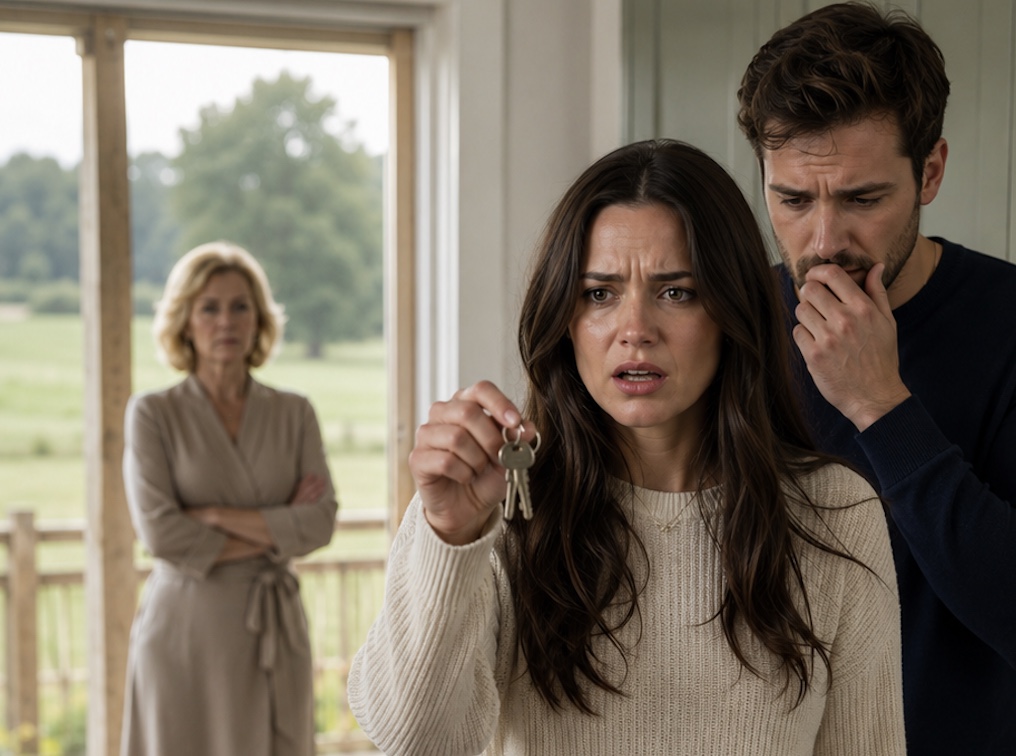
“Have you completely lost your mind?” Mila stood in the middle of the kitchen, her hands still wet, staring at Fyodor as if she were seeing the real him for the very first time. “You gave your mother the alarm code?”
Fyodor had not even taken off his jacket. He stood in the hallway, tired, smelling of the subway, cheap vending-machine coffee, and other people’s problems — the kind he always dragged home instead of an actual salary.
“What’s the big deal?” he muttered. “She’s not a stranger.”
That eternal phrase of his — “she’s not a stranger” — always came out with the tone of a priest granting absolution. As if, once those words were spoken, any absurdity automatically became acceptable.
Mila slowly dried her hands with a towel.
“She went there without warning.”
“So what?”
“She threw away my things.”
“What things?”
“My things, Fedya! Mine! From the bedroom! From the bathroom! Even my robe disappeared somewhere!”
He rolled his eyes in irritation. Not angrily. Tiredly. Like a person being distracted from something far more important than someone else’s humiliation.
“God, Mila, it’s just a robe.”
“Oh, really? Do you know what else starts as ‘just’ something? First it’s a robe. Then your mother rearranges the furniture. Then she tells the neighbors she’s the owner. Then suddenly I’m the one who doesn’t belong there at all.”
Fyodor tossed his keys onto the small cabinet.
“You’re being dramatic.”
That word hit harder than shouting.
“Dramatic.”
The favorite word of people who hurt you quietly. Without scandal. Without fists. As if they had merely brushed you with their elbow by accident — so why are you screaming?
The kitchen felt stuffy. Outside the window, an April rain drizzled down, sticky, gray, endless. Dinner bubbled on the stove, though nobody needed it anymore.
Suddenly, Mila caught herself thinking that she hated this kitchen.
The cheap cabinet fronts they had bought on sale.
The cups with cracks in them.
The constant saving.
For three years she had lived like a normal Russian woman: working, saving, carrying the mortgage, smiling at her husband’s relatives, pretending this was how things were supposed to be.
And then she bought a house.
That was when everyone around her suddenly decided the house belonged to all of them.
Especially Tamara Ivanovna.
Her mother-in-law had not appeared in their lives all at once. Or rather, physically, she had always been there, but before that she existed like a natural phenomenon somewhere in the background. Evening phone calls. Jars of pickles. Passive aggression on holidays.
But after the house was bought, something changed.
At first, it seemed innocent.
“Oh, what a lovely veranda…”
Then:
“The bedroom is too small. You should knock down that wall.”
Then:
“You two should have children. Such a house shouldn’t stand empty for nothing.”
And then Tamara Ivanovna came “for a week.”
And stayed.
Now Mila understood: none of it had happened suddenly. It had been a takeover. Slow, sticky, almost professional.
Like mold.
You only notice it when half the wall has already rotted through.
Fyodor sat down at the table and buried himself in his phone.
Mila looked at him and felt something terrible.
Not anger.
Disappointment.
The most disgusting feeling in a marriage — when a person has not betrayed you openly, but has not chosen you either.
He simply drifts aside, like water.
“Do you even understand what’s happening?” she asked quietly.
“I understand that both of you are exhausting me with your wars.”
“Wars? Your mother is hanging a ‘Private Property’ sign on my house.”
“Because people keep wandering around.”
“And who moved the furniture?”
“God, what difference does it make where the sofa stands?”
Mila gave a bitter smile.
“Of course. It makes no difference to you. You’ve never built anything yourself.”
His head snapped up.
Now she had hit the mark.
Fyodor hated conversations about money. Especially because everything she said was true.
Mila had bought the house.
Mila had paid the down payment.
Mila had paid for the renovation.
Even the damned fence had been installed by Mila while Fedya kept talking about how a “good project” was just about to start.
That project had been coming for four years. Apparently, on foot from Vladivostok.
“Here we go,” he hissed. “Money again.”
“No, Fedya. Respect.”
He stood up.
“That’s it. I’m not listening to this.”
“Of course. You never listen when the conversation is unpleasant.”
He went into the room and slammed the door.
Mila was left alone.
Only now the loneliness was not ordinary.
It was real.
Heavy.
She slowly sat down on a stool and suddenly remembered something her mother had once said:
“The most dangerous people are not the evil ones. They are the soft ones. Through them, everyone else gets into your life.”
Back then, Mila had not understood.
Now she understood perfectly.
Her phone vibrated.
A message from Tamara Ivanovna:
“Mila dear, don’t forget: tomorrow they’re delivering the wardrobe for the guest room. I chose a light one, to match the overall style.”
Mila read the message three times.
Then slowly typed:
“What wardrobe?”
The reply came immediately:
“What do you mean, what wardrobe? For the house. The old one is awful.”
Old.
Awful.
It was her grandfather’s wardrobe.
Mila closed her eyes.
Something inside her clicked like a switch.
When a person endures for too long, at some point a strange calm arrives. No emotion. No panic.
Only clarity.
She stood up, put on her jacket, and left.
Outside, the air smelled of wet asphalt and gasoline.
The taxi driver turned out to be talkative.
“Where are we going?”
“Out of town.”
“To your dacha?”
Mila smirked.
“For now, yes.”
The road stretched for almost two hours. On the radio, they played some cheerful nonsense about spring and new opportunities. She wanted to throw the stereo out the window.
When she pulled up to the house, the first thing she saw was light.
In every window.
And music.
Loud music.
Mila stopped at the gate and simply stood there for several seconds.
People were sitting on her veranda.
Strangers.
Women with dyed hair. Men with barbecue. Laughter. Bottles. Plastic plates.
Someone was smoking right next to the young thuja trees she had planted the previous autumn.
Inside Mila, everything went quiet.
Even her heart seemed to stop making noise.
She entered the yard.
Lyuba noticed her first — Tamara Ivanovna’s friend. The very same woman with the face of a permanent dacha committee activist.
“Oh! And here comes the little hostess!” she sang in a tone that made it sound as if Mila had arrived to entertain children at a party.
Tamara Ivanovna stepped out onto the veranda.
In a new tracksuit.
With a glass of wine.
Like the queen of a retirement resort.
“Mila? Why didn’t you call first?”
Mila slowly looked around the yard.
The grill.
Strangers’ slippers by the door.
A new tablecloth.
Her blanket — on a dog.
On a dog.
Some fat pug was lying on her blanket and snoring.
“What is going on here?” Mila asked.
Tamara Ivanovna blinked in surprise.
“We’re relaxing.”
“In my house?”
“There you go again,” her mother-in-law sighed. “Mila, you can’t be so greedy. A house should have life in it.”
One of the women at the table coughed awkwardly.
People began exchanging glances.
Even the dumbest guest can sense the moment when the smell of barbecue turns into the smell of catastrophe.
“I asked you not to change anything.”
“We haven’t done anything bad. On the contrary, we’re making it cozy.”
“Who are these people?”
“Neighbors. Friends. Normal, living people, not your designers with faces like starving ferrets.”
Someone giggled nervously.
Mila looked at Fyodor.
He was there too.
Sitting with a bottle of beer, pretending he might dissolve into thin air.
That was the worst part.
Not betrayal.
Cowardice.
“You’re here too?” she asked quietly.
Fyodor stood up.
“Mila, don’t start.”
“Don’t start what?”
“A scene.”
She slowly nodded.
Then she walked over to the table.
Picked up a bottle of wine.
And hurled it against the veranda wall with all her strength.
Glass exploded everywhere.
Someone screamed.
The music kept playing.
Some idiotic song about love.
“Get out,” Mila said.
Quietly.
Very quietly.
And that made it more frightening.
Tamara Ivanovna narrowed her eyes.
“Are you talking to me?”
“To everyone.”
“You’ve lost your mind.”
“No. I’ve finally understood what’s happening.”
Fyodor came closer.
“Stop it.”
“Or what?”
He fell silent.
Exactly.
Nothing.
All his life, he had done nothing but avoid choosing.
Between his mother and his wife.
Between truth and convenience.
Between being a man and being furniture.
Tamara Ivanovna folded her arms.
“Listen to me carefully, girl. Family means sharing.”
“No, Tamara Ivanovna. Family means not taking what isn’t yours.”
For several seconds, there was dead silence.
Then Lyuba suddenly said:
“Tamara, let’s go. This is already uncomfortable.”
And that was when Tamara Ivanovna changed.
Her face became hard.
Almost evil.
Old.
Real.
“No, Lyuba. It is very comfortable. Let her finally hear the truth.”
She turned to Mila.
“You think this house is yours? You’re wrong. Houses like this never belong to women like you.”
“What kind of women?”
“Cold ones. Calculating ones. Always measuring everything. You don’t even know how to love your husband properly — everything with you is about control.”
Mila laughed.
Out of sheer surprise.
Because sometimes absurdity is so enormous that laughter is the only thing left.
“And you know how to love?” she asked. “Is that why you drove into someone else’s life like a tank?”
“I am saving my son.”
“From what?”
Tamara Ivanovna looked straight into her eyes.
And said calmly:
“From you.”
Fyodor turned pale.
“Mom…”
“No, Fedya. Enough silence. She is destroying you. She counts everything. Measures everything. The house, the money, the achievements. Next to her, you are like a tenant.”
Mila slowly turned to her husband.
“And you think that too?”
He said nothing.
That was enough.
Sometimes a marriage does not end with cheating.
Or a fight.
Or someone leaving.
Sometimes it ends with a pause that lasts three seconds.
Mila nodded to herself.
Very calmly.
Then she said:
“Fine.”
And went into the house.
Upstairs.
Into the bedroom.
She opened the wardrobe.
Pulled out the folder with the documents.
And then she saw that someone had touched the drawer.
The papers were not lying the way she had left them.
Too straight.
Too neat.
Her heart slowly dropped.
Mila opened the folder.
And realized the originals were gone.
She stood in the middle of the bedroom, holding the empty folder in her hands, and felt no fear.
Only rage.
A quiet, heavy, adult rage — the kind felt by someone who has not simply been deceived, but carefully, methodically erased from her own life.
Downstairs, the music was still playing.
Someone was laughing.
Outside, meat hissed on the grill.
And inside her, her marriage was collapsing.
No, not collapsing.
It had already been taken apart brick by brick. She was only seeing it now.
Mila slowly closed the folder.
Then opened the wardrobe.
A suitcase.
A few things.
But then she stopped.
No.
Leaving now would mean losing.
She went downstairs.
On the veranda, all conversations died at once. Even Lyuba stopped chewing her salad with the expression of someone who had accidentally wandered onto a national talk show.
Fyodor stepped toward her.
“Mila…”
“Where are the documents?”
He blinked.
Too quickly.
That is exactly how people look when they already know the answer.
“What documents?”
“Don’t. Not now. Where are the originals?”
Tamara Ivanovna took a theatrical sip of wine.
“God, here comes the bookkeeping again.”
Mila turned to her.
“Did you take them?”
“And what if I did? What then?”
Now it became truly silent.
Even the wind seemed to stop.
Fyodor nervously ran a hand over his face.
“Mom…”
“What, ‘Mom’?” she snapped. “Stop making me look like a criminal. I’m just putting things in order since both of you behave like children.”
“Where are the documents?” Mila repeated.
Tamara Ivanovna smirked.
“In a safe place.”
“Give them back.”
“No.”
She said it calmly. Without shouting. The way people speak when they are sure they have won.
Mila suddenly looked at the guests.
At these dacha witnesses to someone else’s disgrace.
And she almost laughed.
God, how Russian people love other people’s family disasters. Just give them a chair to pull closer.
She walked over to the speaker and turned off the music.
“The party is over. Everyone go home.”
Lyuba was the first to jump up.
“We were actually just leaving…”
Five minutes later, the veranda was empty. Only the three of them remained.
As it should be in any proper tragedy.
Mila sat down across from her mother-in-law.
“Now listen carefully. Either you give me the documents right now, or tomorrow I go to the police.”
Tamara Ivanovna slowly set down her glass.
“And what will you say? That your mother-in-law took some papers?”
“That my real estate documents were stolen.”
“Prove it.”
Fyodor flinched.
“Mom, enough.”
“No, Fedya. Let her go all the way now. She’s our strong woman, after all. Independent. Self-sufficient.”
She pronounced the last word as if she were saying “leper.”
Mila looked at her and suddenly understood something terrible.
Tamara Ivanovna did not hate her.
She hated the very idea of a woman like her.
A woman who could buy a house herself.
Make decisions herself.
Leave by herself.
To Tamara, that was almost an insult to nature.
“Do you know what’s most disgusting?” Mila said quietly. “You don’t even love your son. You use him.”
“Don’t you dare.”
“I do dare. Because a normal mother doesn’t turn a grown man into a lapdog tied to her skirt.”
Fyodor suddenly slammed his palm on the table.
“Enough!”
They both turned to him.
And for the first time, Mila saw not exhaustion in her husband.
But panic.
Real panic.
The panic of a man who had spent his whole life sitting on two chairs and had suddenly realized the floor was gone.
“You’re both driving me insane!” he shouted. “I don’t even want to come home anymore! It’s always war here!”
“No, Fedya,” Mila said calmly. “The war only started because you never once stopped anyone.”
He breathed heavily.
Silent.
And once again, he did not choose.
That was all of Fyodor.
Thirty-eight years of existing in “as long as no one gets offended” mode.
Except life does not work that way.
Someone always ends up paying.
And usually, it is the wife.
Mila stood up.
“I’m asking for the last time. Where are the documents?”
Tamara Ivanovna suddenly smiled.
A strange smile.
Almost tender.
“Do you want the truth?”
“Very much.”
“I was afraid.”
Mila frowned.
“Of what?”
“That you would take him away from here. Completely. Drag him into your proper life, where everything is scheduled, mortgaged, and written down in lists.”
Fyodor lowered his head.
But Tamara went on:
“You think I don’t see it? Around you, he always feels guilty. Always not enough. Always trying to reach your level.”
“Because he is an adult man, not a piece of furniture standing beside his mother’s skirt.”
“There!” her mother-in-law jabbed a finger at Mila. “That is what is frightening about you. You cut people with words as if they can simply be glued back together afterward.”
Mila wanted to answer.
But suddenly she realized she was tired.
Not just today.
In general.
Tired of carrying conversations, decisions, money, responsibility — and, at the same time, the fragile psyche of a grown man.
She looked at Fyodor.
“Did you know about the documents?”
He was silent for three seconds.
Then he said very quietly:
“Yes.”
And that was it.
Sometimes one short word destroys more than betrayal.
Something inside Mila snapped completely.
Without pain.
Just a quiet click.
Like a light bulb burning out forever.
“I see,” she said.
Fyodor stepped toward her.
“Mila, listen…”
“No. Now you listen.”
He froze, confused.
“I listened to you for three years. About how ‘Mom worries.’ About ‘don’t start.’ About ‘be wiser.’ Do you know what being a wise woman means in a Russian marriage? It means swallowing humiliation in silence and smiling at relatives.”
“You’re exaggerating…”
“Exaggerating?!” For the first time, Mila lost control. “Your mother is playing mistress in my house! The two of you are moving my documents around! And I’m exaggerating?”
Tamara Ivanovna said coldly:
“Don’t shout.”
Mila turned to her.
And answered with unexpected calm:
“Don’t give me orders.”
Then she picked up her phone.
Opened the camera.
Pointed it at her mother-in-law.
“Say again that you have the documents.”
Tamara Ivanovna went pale.
“What are you doing?”
“Recording.”
Fyodor rushed closer.
“Put the phone away.”
“Don’t touch me.”
“Mila…”
“No, Fedya. That’s it. Your soft diplomacy is over.”
She looked at her mother-in-law again.
“Either the documents are in front of me right now, or tomorrow there will be a police report.”
For several seconds, Tamara Ivanovna said nothing.
Then she slowly stood up.
Went into the house.
Returned a minute later with an envelope.
And threw it onto the table.
“Choke on them.”
Mila opened it.
The originals.
All of them.
She exhaled for the first time that evening.
But there was no joy.
Nothing at all.
Only emptiness.
“Thank you,” she said.
Tamara Ivanovna laughed.
Dryly.
Ugly.
“Don’t celebrate too soon. You’ll lose anyway.”
“Why is that?”
Her mother-in-law looked straight into her eyes.
“Because he will choose me in the end.”
Fyodor flinched.
And Mila suddenly realized it was true.
Not because Fedya was a bad man.
Simply because some men never truly leave their mothers. Even when they get married.
Physically, yes.
Mentally, never.
She carefully placed the documents into her bag.
Then looked at her husband.
“I’m filing for divorce.”
Fyodor did not seem to understand at first.
“What?”
“You heard me.”
“Because of this?”
Mila almost smiled.
God.
Of course.
For him, it was still “because of this.”
Not because of the betrayal.
Not because of the lies.
Not because he had handed their marriage over to be torn apart by his own mother.
No.
“Because of this.”
“Fedya,” she said quietly, “we ended long before this. Today, you finally stopped pretending.”
He sat down.
Slowly.
Like a man whose legs had suddenly failed him.
“You can’t just…”
“I can.”
Tamara Ivanovna suddenly cut in:
“Well, go on then. Get out. You think he’ll disappear without you?”
Mila looked at her.
And unexpectedly felt no anger.
Only pity.
Because in front of her sat an old woman who had spent her entire life keeping people close only through fear and guilt.
And that was not love.
That was loneliness in an aggressive form.
Mila took her bag.
And walked toward the exit.
Fyodor caught up with her at the gate.
“Wait.”
She stopped.
He looked lost.
Truly lost.
Rain drizzled straight onto his face.
“I’m confused,” he said quietly.
“No, Fedya. You simply kept choosing the most convenient option.”
“I love you.”
Mila closed her eyes.
What a terrible thing love can be.
Sometimes a person loves you.
And still destroys your life.
“Maybe,” she said. “But it wasn’t enough.”
He grabbed her hand.
“Don’t leave now.”
“When, then? When your mother finally moves into our house? Or when the two of you rewrite something else behind my back?”
“I’ll fix everything.”
“No. Even now, you still don’t understand the main thing.”
“What?”
She looked at the house.
Tamara Ivanovna was standing in the window.
Watching.
Of course.
“You cannot build a family in a place where a grown man is more afraid of upsetting his mother than of losing his wife.”
Fyodor slowly let go of her hand.
And for the first time that evening, he said nothing.
Because there was nothing to say.
Mila got into the car.
Started the engine.
And suddenly understood something strange.
The house no longer felt like a dream.
It was just a house.
Wood. Walls. A roof.
Not happiness.
Not salvation.
Too many women in this country believe that a new house will magically fix an old life.
It will not.
If there is a coward beside you, he will remain a coward. Whether in a one-room apartment or in a cottage with a veranda.
She drove onto the highway.
Her phone vibrated almost immediately.
A message from Dasha:
“So?”
Mila looked at the wet road ahead.
And for the first time in a long while, she answered honestly:
“I think I finally saved myself.”
The End.