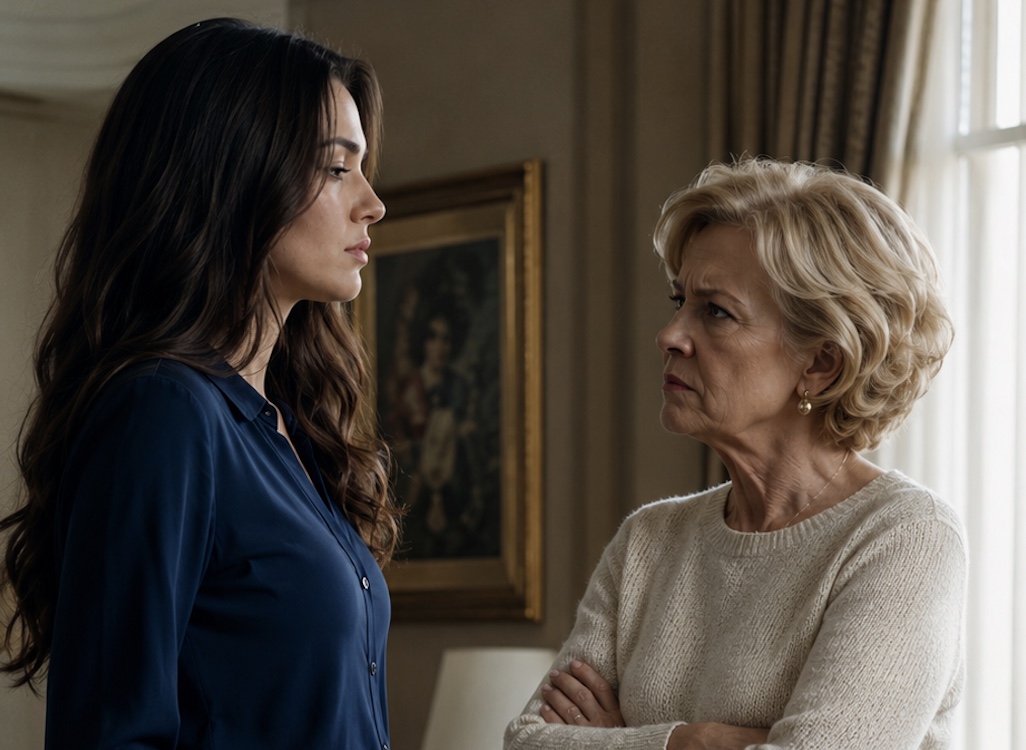
The phone rang at half past eight on a Saturday morning, just as Irina had put the kettle on. An unfamiliar number lit up the screen. Out of habit, she answered — she was waiting for a call from the veterinary clinic, where she had taken her cat for a checkup the day before.
“Irina, it’s Tamara Nikolaevna,” came a quiet, broken voice. “Please don’t hang up.”
Irina didn’t hang up. She set her cup down on the table and sat. Four years had passed since the divorce. In all those four years, Tamara Nikolaevna had not called once.
“I’m listening,” Irina said evenly.
“I’m not well, Irochka. Not well at all. My health is failing, the house is falling apart, the window frames have dried out, the roof leaks. I’m alone, do you understand? Completely alone.”
“I’m sorry to hear that,” Irina paused. “But I don’t understand why you’re calling me. You have Danil.”
“Danil?” Tamara Nikolaevna let out a short, bitter laugh. “Danil is no longer a proper man. He drinks, you know that. I mean nothing to him. He doesn’t answer his phone for weeks.”
“That’s sad. But I still don’t understand how I can help.”
“Irochka, you lived in our family for six years. Six years you ate at our table, slept under our roof. I treated you like a daughter. Doesn’t that mean anything?”
Irina closed her eyes for a second. She remembered those six years differently. She remembered paying the utility bills out of her own pocket. She remembered buying groceries for two because Danil spent his salary on who knew what.
“Tamara Nikolaevna, I respect you,” she said carefully, choosing her words. “But Danil and I are divorced. Legally and in every other sense. I don’t owe you anything.”
“You do!” Her voice immediately hardened. “You lived with my son, enjoyed everything, then left, took the apartment, and disappeared? You arranged things nicely for yourself!”
“Danil left me the apartment by mutual agreement. He took the car and the plot of land. It was a fair division.”
“Fair? That apartment is worth five times more than that land!”
“That was his choice, Tamara Nikolaevna. His own choice. He signed all the papers himself, voluntarily, without pressure.”
“You deceived him. Twisted his mind. You were always cunning.”
Irina exhaled slowly. She could have hung up. She could have snapped back. But instead, she spoke calmly, almost gently.
“I’m not going to discuss this. If you need help, contact Danil. He is your son. It is his responsibility.”
“You’ll regret this,” Tamara Nikolaevna said, and hung up.
Kirill came into the kitchen, saw her face, and sat down across from her.
“Who was that?”
“Tamara Nikolaevna. My former mother-in-law,” Irina took a sip from her cup. “She decided I owe her something.”
“And what exactly do you owe her?”
“Six years of life with her son, apparently. According to her calculations, that costs quite a lot.”
Kirill snorted softly. He knew the story. He knew how Irina had carried the household on her shoulders while Danil spent his evenings with a bottle. He knew that the divorce had been liberation, not tragedy.
“Do you think she’ll leave you alone?”
“I don’t know,” Irina looked straight at him. “But I know one thing: I’m not going to pay for it.”
Two quiet weeks passed. Irina almost forgot about the call. Life went on as usual — measured, peaceful, rebuilt brick by brick over the past four years. The apartment felt like home. Kirill was beside her. Everything was right.
But on Wednesday evening, the doorbell rang. Irina opened the door without looking through the peephole — she was expecting a courier with books she had ordered.
Tamara Nikolaevna stood on the threshold.
She looked older than Irina remembered. Her hair was gathered into a messy bun, her coat was buttoned crookedly. In her hands, she held a bag filled with some kind of documents.
“Hello, Irina. I won’t take long.”
“Tamara Nikolaevna, I didn’t invite you.”
“I don’t need an invitation. I came to talk. Five minutes.”
Irina stood in the doorway without moving. She had no intention of letting her inside. Tamara Nikolaevna understood this and began speaking right there on the landing.
“I sold my apartment two years ago. Bought a house outside the city. I thought I’d live in the fresh air and rest. But the house turned out to be rotten. The foundation is cracked, the heating barely works, the wiring is falling apart.”
“I’m sorry,” Irina said.
“I am a sick woman! My blood pressure jumps, my knees barely bend, my back won’t straighten. I’m sixty-eight years old. Who is supposed to help me?”
“Danil.”
“Danil sold the plot. Then he sold the car. Now he lives in a rented room and drinks. He’s no help to me.”
“That does not make me your helper.”
Tamara Nikolaevna pulled papers from the bag. Her hands were dry and sinewy, the veins swollen. She held the sheets out to Irina.
“Here. I wrote everything down. How much I spent on you during those six years. Gifts, food, holidays. The amounts are all here. I calculated everything.”
Irina didn’t even look at the papers. She took half a step back and spoke clearly, without irritation.
“These papers have no value. Not legally, not morally. You didn’t spend a single kopeck on me. I supported myself. And half of your son’s expenses too.”
“You’re lying!”
“No. I can pull up every bank statement from those six years. Every transfer, every receipt. If you want, I can show you who owes whom and how much. But you won’t like it.”
Tamara Nikolaevna flushed red. The papers trembled in her hands. She clearly had not expected Irina to be prepared for this conversation. She had not expected proof.
“You shameless woman,” she hissed. “God will not forgive you for this.”
“Let God deal with those who deceive others. And I am asking you to leave. And not to come again without an invitation.”
“I’ll come again. I’ll get what’s mine.”
“There is nothing for you to get here,” Irina replied, and closed the door.
Kirill was standing in the hallway. He had heard the entire conversation.
“She came with papers?”
“With a homemade calculation. She counted how much I supposedly owe her for six years of marriage to her son. As if I had been a tenant.”
“Seriously?”
“Completely seriously. She believes that if a woman lived with a man, then his relatives are entitled to lifelong support. Convenient arithmetic.”
“What are you going to do?”
“Nothing. She has no way to pressure me. No documents, no rights, no grounds. Only nerves,” Irina cleared the cups from the table and added more quietly, “But if she comes a third time, I’ll act differently.”
A month passed in silence. Irina even began to think that her former mother-in-law had accepted the situation. That she had found another way. That she had turned to her son or to social services, the way normal people do in a normal situation.
But Tamara Nikolaevna had not accepted anything. She had been waiting. Collecting resentment like water in an old bucket — drop by drop, until it overflowed.
On Friday, around six in the evening, Irina came home. Kirill was running late. She climbed to her floor and stopped.
Two suitcases stood by her door. Beside them was Tamara Nikolaevna. She wore a winter jacket, a hat, and a shoulder bag. At her feet was a checkered shopping bag stuffed to the top.
“What is this?” Irina asked.
“I’m moving in with you,” her former mother-in-law said simply, as if she were announcing the weather. “I locked up the house. I have nowhere else to live. You are obliged to take me in.”
“I am not obliged to do anything for you. We’ve already discussed this. Twice.”
“And I’m telling you — you are obliged! You must support me! We are old and sick!” Her voice was loud, clearly meant for the neighbors. “You live in the apartment you got from my son! It is ours! Ours, do you hear me?”
Irina did not raise her voice. She set her bag down on the floor, took out her phone, and dialed one number. Tamara Nikolaevna stopped short and watched her warily.
“Who are you calling?”
Irina did not answer. She put the phone to her ear, and a few seconds later said calmly:
“Danil. It’s Irina. Your mother is standing at my door with suitcases. You have exactly one hour to come and take her away. If she is still here in an hour, I will call an ambulance and social services. Whatever happens after that will no longer be my concern. One hour. I’m timing it.”
She ended the call. Tamara Nikolaevna stared at her in open outrage.
“You called Danil? He won’t come! He doesn’t care about me!”
“Then an ambulance will come. And social services. They’ll sort it out.”
“You wouldn’t dare!”
“I already did. The hour has started.”
“I’m not leaving this place! This is my son’s apartment! I have the right to live here!”
“This apartment is mine. It is registered in my name. Danil signed away his rights. You are not registered here, you are not an owner, and you are not even my relative. You are a stranger standing at someone else’s door with suitcases. Nothing more.”
Tamara Nikolaevna turned pale. She had expected tears. Confusion. She had expected Irina to panic, to justify herself, to call friends for advice, to stall for time. She had not expected Irina to call directly, immediately, without hesitation, and set a precise deadline.
“You are cruel,” Tamara Nikolaevna whispered. “Heartless.”
“I am not cruel. I am fair. And I have boundaries that you have been trying to break for two months. It will not work.”
Irina opened the door to her apartment, stepped inside, and closed it behind her. Tamara Nikolaevna remained on the landing. With her suitcases. With her bags. Alone.
Danil arrived forty-three minutes later. Irina heard heavy footsteps on the stairs and a familiar voice — hoarse, rough, nothing like it had been four years ago. She approached the door and looked through the peephole.
Danil stood in front of his mother. He had lost weight and looked worn down. His jacket hung loosely from his thin shoulders. He looked at the suitcases, the bags, his mother — and his face showed not sympathy, but irritation.
“Mother, what have you done here?” His voice was low and sharp.
“I came to Irina! She must help me! You won’t help, so she will!”
“She doesn’t owe you anything. We divorced four years ago. She’s a stranger to me now. And even more so to you.”
“And you? Do you help me? Have you given me even one ruble this past year?”
“I have no money, Mother.”
“Because you drank it all away! You sold the land — drank it away! Sold the car — drank it away! Just like your father!”
Irina opened the door. Both of them turned toward her. She stood there, leaning her shoulder against the doorframe.
“Danil, take your mother. Right now. Drive her home and help her deal with the situation.”
“Irin, I came by taxi, I myself—”
“I don’t care. She is your mother. Your responsibility. Not mine.”
Danil rubbed the back of his neck. He was confused, angry, overwhelmed. He had avoided his mother for years precisely because he knew she would pressure him, demand things, accuse him. And now he stood on someone else’s landing between two women who had no intention of yielding to him.
“Mother, let’s go,” he said dully.
“I’m not going anywhere with you! You’re broke! You don’t even have a corner of your own!”
“But Irina does. And it’s her corner. Not yours.”
“Danil,” Irina said his name in a tone that made him fall silent. “I will say this once. If this landing is not empty in ten minutes, I will call social services. And that won’t be a threat. It will be a fact. Ten minutes.”
She took out her phone. Deliberately, openly, without haste. Danil looked at his mother. Tamara Nikolaevna still wore the expression of offended dignity, but something else had already flickered in her eyes. Uncertainty. Fear.
“Mother, let’s go,” Danil repeated. “There’s nothing for you here. You started this yourself. I warned you.”
“You warned me?!” Tamara Nikolaevna spun toward him. “You?! You haven’t called me once in six months! You threw me away like an old rag!”
“And you sold the apartment,” Danil suddenly said quietly but clearly. “A good two-room apartment in the center. Sold it for four and a half million. Then bought a collapsing house for one million two hundred. Where is the rest of the money, Mother?”
Tamara Nikolaevna went silent. Irina noticed how her lips twitched. How she looked away. How she shifted from one foot to the other.
“What money? There was no money. Everything went into the house, repairs, medicine.”
“Three million three hundred thousand went into repairs?” Danil did not back down. “Mother, I’ve seen that house. There’s maybe two hundred thousand worth of repairs there, no more. Where is the money?”
“That is none of your business!”
“It is my business, because you’re standing here with suitcases at my ex-wife’s door and asking her to support you. Meanwhile, you have your own house and, judging by everything, money hidden somewhere.”
Irina listened in silence. She did not interfere. Danil was saying what she had suspected but could not verify. Tamara Nikolaevna had always been tight-fisted. Always counted other people’s pennies. And always complained of poverty while keeping something tucked away for a rainy day.
“Are you finished?” Irina asked. “I have dinner on the stove.”
“Irina, wait,” Tamara Nikolaevna suddenly changed her tone. Her voice became pleading, sweet. “Irochka, I didn’t mean any harm. I was just scared. I’m lonely. I’m afraid to be alone in that house. I thought maybe I could stay with you for a little while, until I figure things out…”
“No,” Irina said.
“Just for a month. Two weeks. One week.”
“No.”
“I’ll be quiet. I won’t bother you. I can even—”
“Tamara Nikolaevna,” Irina interrupted her in an even, quiet voice. “Four years ago, I left your son because I was tired of carrying other people’s problems. I carried his debts. His household. His empty promises. I don’t carry anyone anymore. Not him. Not you. You are an adult. You have a son. You have a house. And judging by what Danil said, you have money. Solve your own problems.”
Tamara Nikolaevna looked at her for a long time. There was no remorse in that gaze. Only anger. Envy. And the helplessness of a person accustomed to taking from others who had finally been refused.
“I am a sick old woman,” she said.
“You are a woman who came to extort housing from a stranger. Those are different things.”
Danil led his mother away. The suitcases thudded heavily down the steps. Tamara Nikolaevna walked slowly, demonstratively gripping the railing and breathing hard. But Irina had already closed the door and did not see the performance.
Two days later, Danil called. Irina answered because she wanted to make sure the story was over.
“Irin, I wanted to say thank you for calling me that day.”
“I didn’t call out of politeness.”
“I know. Listen, I found Mother’s savings book. An old one, from Soviet times, reissued into a new account. There are two million seven hundred thousand on it. It’s been sitting there for a year and a half. She hasn’t even touched it.”
“And she stood at my door with suitcases, complaining about poverty?”
“Yes. She didn’t want to spend her own money. She wanted to live at someone else’s expense. Yours.”
“I understood that from the first phone call, Danil.”
“I took her home. The house, by the way, isn’t nearly as rotten as she claimed. The roof is intact, the heating works. One pipe needs replacing — ten thousand at most. She exaggerated everything. Everything.”
“She always exaggerated. It’s just that before, there were people around who fell for it. I stopped.”
“Irin…”
“Danil, let’s end this here. I’m glad you sorted it out. But I don’t need the details. This is your family, your relationship. I am an outsider here. I have been for a long time.”
“All right. I’m sorry it happened like this.”
“Don’t apologize for her. Apologize for yourself, if you think you should.”
“For myself — I do.”
“Accepted. Goodbye.”
She hung up. Kirill was sitting nearby, sorting through postcards — he collected vintage ones, finding them at flea markets and auctions.
“Well?” he asked without looking up.
“She has two million seven hundred thousand in her account. The house is fine. The pipe costs ten thousand. And she came to me with suitcases and tears.”
“Talent.”
“Not talent. Habit. She has been like that all her life. Her husband supported her — that suited her. Her husband died — she shifted onto her son. Her son drank himself into ruin — she found me. She doesn’t need help. She needs someone to sit on.”
“And you are not a chair.”
“No. I am not a chair.”
Kirill lifted his head and looked at her. In his eyes there was calm respect. Not admiration, not pity — just warm, steady understanding. The kind of look one gives a person who has done what had to be done.
“Dinner?” he asked.
“Let’s order something. I don’t want to cook. I just want to sit next to you and do nothing.”
“Works for me.”
A week later, Irina learned from a mutual acquaintance that Tamara Nikolaevna had returned to her house. That Danil had come and fixed the pipe. That they had argued, and he had left. That Tamara Nikolaevna had tried calling two former neighbors and asking to stay with them — telling both that her daughter, as she called Irina, had thrown her out onto the street. Both had refused.
No one called again. Not Tamara Nikolaevna, not Danil. Irina blocked her former mother-in-law’s number just in case — not out of fear, but on principle. The old life remained behind a locked door, and Irina had thrown away the key long ago. Now she had thrown away the door as well.
On the last day of the month, Kirill brought home a postcard from the market — old, yellowed, dated 1957. It showed a small house with a red roof and the words: “Happiness is when no one comes looking for you.”
He placed it on the refrigerator door, holding it there with a magnet. Irina saw it, read it, and said nothing. She only smiled — briefly, with the corners of her lips.
That was enough.
THE END