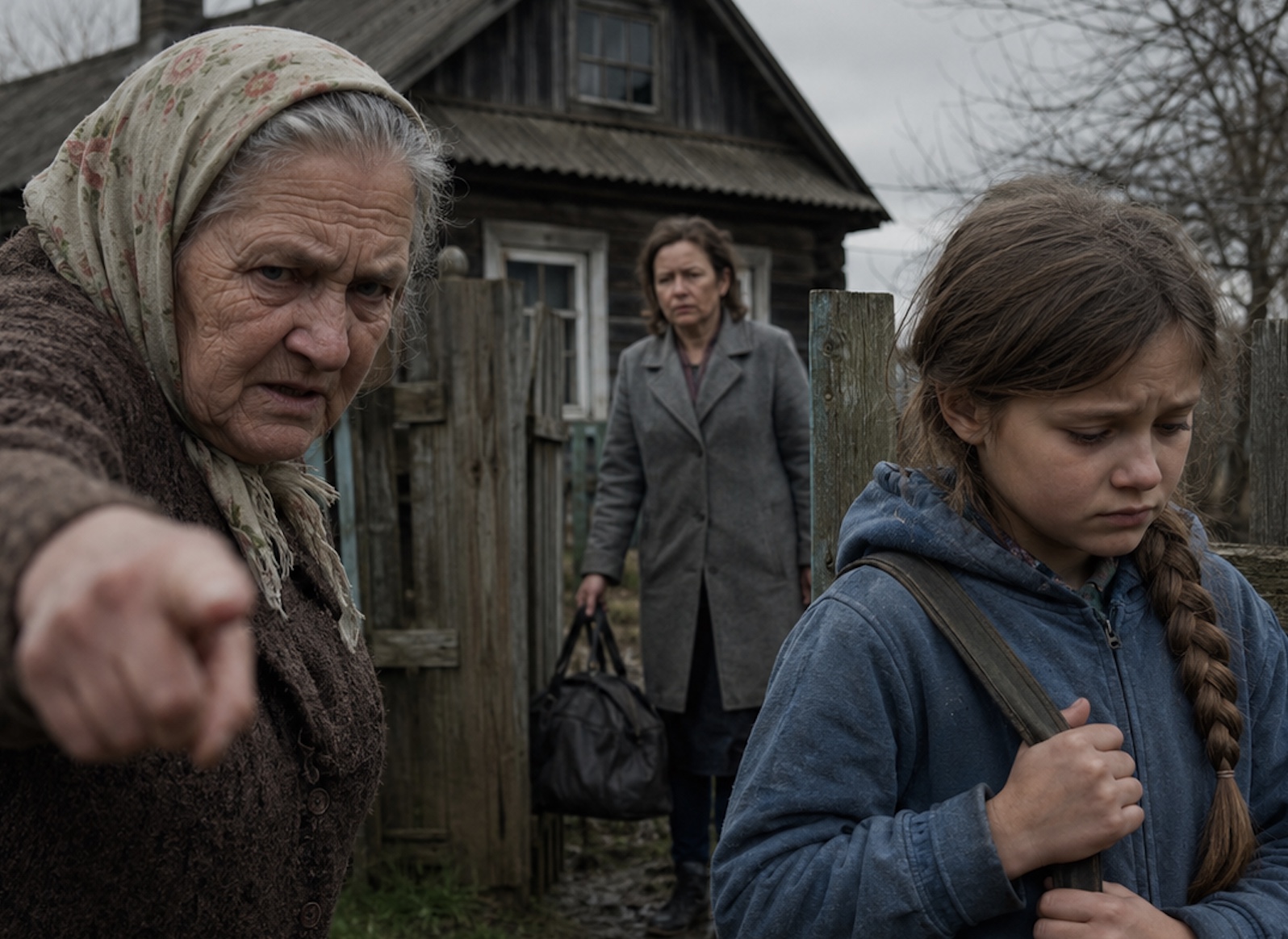
— Take your spoiled city princess back! — My mother’s voice rang through the phone, cutting through the hum of morning traffic outside the open window. — She sleeps until nine, and I’ve got potatoes to plant! The clock is ticking, the soil is drying out, and I’m supposed to tiptoe around her?
I never made it to the stove with the cezve in my hand. A cold wave passed through me. Coffee spilled across the countertop, but I didn’t even reach for a cloth.
“Mom, what do you mean, take her back?” I tensed. “We brought Dasha to you only yesterday. We agreed on two weeks. Her school holidays just started. She’s only ten. Let the child sleep a little after the school year. She was so excited about this trip.”
“Then let her sleep at home!” Valentina Petrovna snapped. I heard the creak of an old door on her end. “I’ve got potatoes to plant and seedlings to move, and she’s wandering around under my feet. No help at all, came here like some little lady. And I’m supposed to feed her too! That’s enough. Get yourselves ready and come here. I don’t want her here by lunchtime.”
The short beeps hit my ear like blows. I slowly lowered the phone. My husband, Pasha, who had just entered the kitchen in a neatly ironed shirt, stopped in the doorway.
“Anya, what happened? You’ve gone pale…”
“Mom called. She told us to come and get Dasha immediately because she’s getting in the way of her potato planting.”
Pavel let out a heavy sigh.
We both knew exactly what that trip would cost us. We didn’t have a car. We were saving for a down payment on a mortgage and cutting back on almost everything.
The day before, we had spent half a day taking our daughter there: first the stuffy metro, then an hour in an overcrowded commuter train, and after that forty minutes on foot along a dusty dirt road from the station to the village.
And now we had to make the same exhausting journey again. Only this time, not with the happy anticipation of a summer holiday, but with the dull weight of resentment pressing down on us.
“I’ll call my boss and ask to leave before lunch,” my husband said quietly. “Get dressed. We can’t leave her there listening to those reproaches.”
The journey to the village blurred into one endless nightmare.
It was hot in the train. The smell of cheap tobacco mixed with the scent of other people’s homemade pies. I stared out the window at the birch trunks flashing past, while a bitter lump rose in my throat.
How could she do that? This was her own granddaughter. I remembered my own childhood, spent on those very same garden beds. To my mother, perfect rows of carrots had always mattered more than my scraped knees.
“Stop whining and grab a hoe” had been her answer to every sorrow. I had hoped she would be softer with her granddaughter. How wrong I had been.
From the station, we walked in silence.
The June sun beat down mercilessly, and dust crunched between our teeth. Forty minutes along the broken track felt like torture. By the time we reached the green fence, my legs were aching.
The gate stood wide open. Dasha was sitting on the porch in the yard. Her packed little backpack stood beside her. My daughter sat hunched over, arms wrapped around her knees, staring at one fixed point. The sight made me want to howl.
I gently stroked her hair and walked deeper into the property. I found my mother at the far end of the vegetable garden. She was working with a heavy hoe.
“You’re here?” she shouted without stopping her work. “Take her! I fed her, but I didn’t sign up to babysit. The soil won’t wait. One spring day feeds the whole year!”
I came right up to her. The sharp smell of freshly turned earth hit my nose.
“Mom, why are you doing this?” I asked, trying to keep my voice from breaking. “She’s a child. She’s only ten. She dreamed of coming to visit you.”
Valentina Petrovna straightened, leaning on the handle of the hoe, and measured me with a hard look.
“That’s exactly why! You’ve raised a useless little delicate thing! At her age, I milked the cow and watched the younger ones, and this one sleeps! I’ve been on my feet since five in the morning, but I’m not allowed to make noise. I have a schedule, Anya. I have seedlings. Enough of this sentimentality. Take her and go.”
She turned away again and drove the blade of the hoe into the soil. I stood there, looking at her hunched back. Words were pointless here. For this woman, potatoes had always mattered more than people. This was her kingdom, where everything obeyed strict rules, unlike the unpredictable real world.
I turned around and went back to the house. I crouched down by the porch and hugged my daughter tightly. Dasha buried her face in my shoulder, and I felt her little shoulders trembling.
“Come on, sweetheart,” I whispered. “Daddy is waiting for us by the gate.”
The way back was even harder. Dasha quickly grew tired, and her new sandals began rubbing her heels raw. We stopped every ten minutes. Pasha carried her backpack, encouraged her, and tried to distract her.
On the train, we rode in silence.
Dasha fell asleep on my lap. Meanwhile, I feverishly tried to figure out what we were going to do next. We both worked from nine to six. Our vacation wasn’t until August, and the school summer camp had been full for ages. I couldn’t leave a ten-year-old girl alone in the apartment all day.
“Anya,” Pavel suddenly said. “Do you remember Aunt Nina, our former neighbor from the first floor?”
I frowned, trying to recall. Nina Vasilyevna — a lonely pensioner, a former teacher. Years ago, when we were newly married and rented a small one-room apartment there, she often treated us to jam and helped us by watering our plants. We had moved away a couple of years earlier, but my husband still called her on holidays from time to time.
“Do you think she would agree to look after Dasha?” I asked doubtfully. “We’re practically strangers to her now.”
“It’s worth a try. I’ll call her. It can’t make things worse.”
He dialed the number, shielding the phone from the noise of the carriage with his hand. The conversation was brief. Pasha explained the situation honestly, without hiding anything, saying that the grandmother had thrown the child out because of the vegetable garden.
“We’re going to her,” my husband exhaled with relief. “She said to bring the girl immediately because she was just about to make syrniki.”
Nina Vasilyevna lived in a cozy Khrushchev-era apartment building, half-hidden by lilac bushes.
She met us at the door — small, thin, with bright little wrinkles around her kind eyes. She wore a neat house robe, and the apartment smelled of vanilla.
“Oh, you poor things!” the old woman exclaimed, taking the little backpack from Pasha. “Come in quickly, wash your hands after the road. Dasha, my sunshine, what beautiful eyes you have. Come here, let me hug you.”
She held our tense daughter so sincerely and warmly that tears filled my eyes again. We went into the bright kitchen. Three plates with delicate golden rims stood on the round table. Nina Vasilyevna skillfully placed a large dish of hot, golden-brown syrniki right in the center.
“Eat, all of you. You’re so thin and worn out,” she grumbled affectionately, pouring Dasha a glass of cool cherry compote.
“Nina Vasilyevna,” I began, embarrassed. “How should we pay you? Please tell us how much you’ll take per day.”
The old woman looked at me so sternly over her glasses that I immediately fell silent.
“Anna, have you lost your mind? What money?” she said indignantly. “I sit here alone all day. The television drones from morning till night until I feel sick of it. My son has been living in Canada for five years. I only see my grandchildren through video calls. And now there’s a living soul in the house! This is a gift from fate for me. Dasha and I will go to the park, read books. I have the complete works of Jules Verne over there, so she won’t be bored. And you can sleep until noon if you want!” She winked playfully at Dasha, whose face had finally brightened.
The heavy stone that had been pressing on my chest since early morning suddenly dissolved. I looked at this woman, who was not related to us at all, and clearly understood that she was giving my child what her own grandmother had failed to give her — complete acceptance.
The first ten days flew by like one happy moment.
Every evening we found some idyllic scene waiting for us: sometimes they were making homemade dumplings together and laughing uncontrollably, other times they were planting bright geraniums on the balcony.
Dasha blossomed before our eyes. Her usual shyness disappeared, and her shoulders straightened. She chattered endlessly, telling us how Grandma Nina had taught her to crochet beautiful little doilies.
Three weeks after that disastrous visit to the village, my phone rang at the office.
I was sitting at my work computer, finishing the quarterly report, when I saw the word “Mom” on the screen. A small prick of irritation went through me. Valentina Petrovna had not called once during all that time.
“Yes, Mom,” I answered dryly, stepping into the corridor.
“Anka, disaster!” my mother’s voice sounded unusually pitiful, and real tears trembled in it. “I’ve hurt my back! Yesterday I was tying up cucumbers in the greenhouse, turned the wrong way, and now I can’t straighten up. I crawl to the toilet, sparks flying before my eyes. Take a day off and come with Pasha immediately! I need injections, the doctor wrote a prescription, and there’s no one to go to the pharmacy. And the garden is standing there — the Colorado beetles are going wild!”
I stood by the window in the office corridor, looking at the gray high-rises outside, and breathed deeply.
“Mom, I’m at work,” I said calmly. “And Pasha is at work too. We can’t just drop everything and run to you.”
“What is that supposed to mean?” my mother flared up at once, momentarily forgetting about her aching back. “I’m your mother! I need help. I can’t move, and my whole garden is dying!”
“I’ll come tomorrow morning. It’s Saturday,” I said firmly. “I’ll bring medicine and call a paramedic to give you the injections. But I’m not saving your potatoes, Mom. And neither is Pasha. No one is going to stay and care for you full-time either.”
“So that’s how it is?” Valentina Petrovna choked with genuine fury. “Ungrateful! You’re abandoning your own mother in trouble! Who do you think I plant all this for? I do it for you!”
“We’ve been buying vegetables at the supermarket for years. We don’t need your sacrifices. You abandoned your granddaughter for the sake of your garden, and you made your choice. To you, the garden turned out to matter more than a living person. I’ll come tomorrow, buy groceries, and arrange the injections. That’s the end of it. Lie down and wait.”
I ended the call. My hands were trembling slightly. That evening, I told Pasha everything. He said nothing, only held me tightly by the shoulders.
On Saturday morning, I went to the village alone.
The road no longer seemed quite so frightening. In my bag I carried painkillers, ointments, and groceries. When I entered the house, I found my mother in bed. She looked older and thinner. The house was stuffy and smelled strongly of Corvalol.
“So you finally showed up,” she muttered, turning toward the wall. “Where’s Pasha? Who’s going to collect the beetles?”
“No one, Mom,” I answered, taking out the medicine. “Take this pill. The nurse from the village council will come soon. I’ve already paid her. She’ll come every day. And Aunt Valya, your neighbor, promised to cook soup for you and bring bread.”
My mother sharply turned her head and grimaced from the pain.
“You’re paying strangers when you could come here and do everything yourself? Have you all gone mad in that city of yours? And what about the garden?”
“The garden will grow over with weeds,” I replied calmly, looking straight into her eyes. “And nothing terrible will happen. The world won’t collapse. You broke yourself over those beds, Mom. Was it worth it?”
She suddenly fell silent. Her lips trembled, and she turned away, hiding her face in the pillow. I walked over to the old dresser to leave money for the neighbor, and my eyes fell on a half-open drawer. Inside were old photographs from the nineties. In one of them, there was my mother, young and exhausted, and me in patched tights.
I remembered that terrible year, 1996. How my father left, taking all our savings with him. How my mother took any job she could find, then cried at night from helplessness. And how those endless potato beds had saved us from real hunger back then.
For her, the land had become the only guarantee of safety. A symbol that we would survive. People betrayed, the country collapsed, but the soil always gave a harvest. She had simply remained trapped in that terrible time and turned what once saved us into a manic cult.
I felt unbearably sorry for her. I understood her trauma, but it did not excuse what she had done to my daughter. Understanding the cause of an illness does not erase the illness itself. You cannot sacrifice living people to your fears and your garden beds.
“I love you, Mom, and I forgive you,” I said quietly, coming closer to her bed and straightening the blanket that had slipped aside. “I forgive everything. But you won’t see Dasha again this year. You need to heal. Physically and in your soul. Get better. I’ll call you tonight.”
I left the house, drew a full breath of fresh village air, and started walking toward the station. There was no gloating inside me, no triumph. Only a quiet, transparent clarity.
Life had put everything in its proper place.
My mother had fussed over her garden beds so much, and those very beds had broken her health, leaving her alone in an empty house.
That evening, we were sitting at Nina Vasilyevna’s place. An old round-bellied kettle hummed cozily on the table, and the room smelled of fresh cinnamon pastries. Dasha, her tongue sticking out from intense concentration, was drawing in a large sketchbook with colored pencils.
“What are you drawing, kitten?” Pasha asked, walking over and gently peeking over her shoulder.
“Our home,” Dasha answered seriously, without looking up from her work. “This is you, Daddy. This is Mom. This is me. And this, next to me, is our Grandma Nina.”
Nina Vasilyevna, who at that moment was drying her favorite cup with a linen towel, suddenly froze mid-motion. She quickly turned toward the window, where blue twilight was thickening outside, and wiped away an unexpected tear.
And I looked at them and thought that real family is not always the people related to you by blood. Family means the people who would never put you out the door for the sake of perfect potato beds. The people who cover you with a blanket and say, “Sleep as long as you need. I’ll watch over your dreams.”