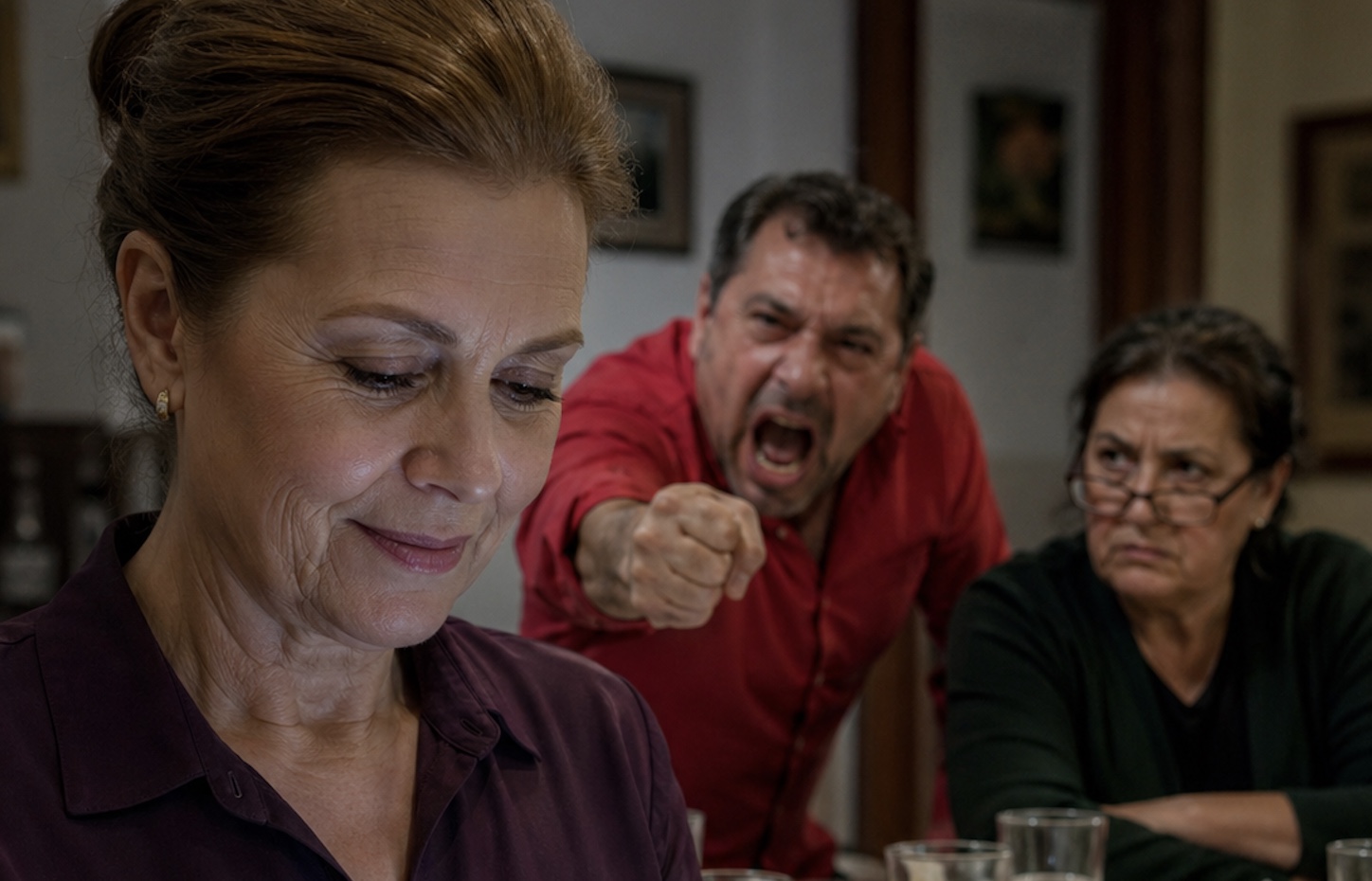
“Look at her, just standing there dripping!” Vitya laughed.
The plate of mushroom gravy hit my chest with a heavy slap. Not like crockery thrown in anger, but like he had stamped me with a greasy brown mark in front of everyone.
The sauce was homemade, thick and rich. I had simmered it for three hours to impress the guests at Vitya’s birthday dinner. Now it was sliding slowly down my pale silk dress, sinking into the folds and leaving behind an ugly, oily stain.
The room smelled of roast duck, liquor, and my marriage collapsing.
His relatives fell silent. Vitya’s aunt, Tamara Stepanovna, froze with her fork halfway to her mouth. My mother-in-law, Valentina Ivanovna, slowly adjusted her wedding ring and looked away.
Vitya stood there with his hands on his hips. He smelled of fried onions and that sharp cologne of his I had endured for twenty years.
“Know your place, hostess,” he said heavily, glancing around at the stunned family.
“And don’t get too comfortable. So what, you bought yourself a dress? First learn not to interrupt your husband when he’s making a toast.”
I didn’t move. I only watched the second hand on the clock above the fireplace count down the final moments of my old life. I gave myself exactly eleven minutes for this humiliation.
I didn’t cry. No. It was as if something inside me simply clicked off. You know how it happens—you keep smoothing over the corners, making excuses, forgiving, explaining… and then suddenly, that’s it. Silence.
I looked at Kostya. Konstantin, Vitya’s cousin, was sitting at the far end of the table. Lean, quiet, he had always seemed like an outsider in that family. He was the only one who didn’t smile. Slowly, beneath the table, he held out a napkin to me.
Just an ordinary white paper napkin.
But there was so much quiet fury in his eyes, fury meant for his cousin, that I suddenly felt hot all over.
The stain on pale silk
I stood up from the table.
“Lera, where are you going?” my mother-in-law shrieked behind me.
“Come back! Don’t shame us in front of the guests!”
I didn’t turn around. In the bedroom, I opened the closet and threw the essentials into a bag: my passport, clean underwear, my charger. I took off the dress and tossed it straight into the trash.
Just like that, stain and all.
It no longer belonged to me.
It belonged to the woman who could be hit in the face with a plate and expected to swallow it.
Calling a taxi felt endless. Outside, a miserable October drizzle was falling. My phone kept freezing on “searching for driver.” I stood by the entrance in an old coat, my teeth starting to chatter.
My phone was exploding in my pocket.
“Valentina I. — 14 missed calls.”
“Vitya — 3 missed calls.”
Then a message came from my mother-in-law:
Valeria, have some fear of God! Vitya lost his temper. You’re disgracing the family in front of the whole city. Come back right now, and we’ll tell everyone you suddenly felt ill.
I blocked her number. Then his.
The pleasure of watching those names turn into emptiness was almost intoxicating.
Ticket number forty-two
That night I stayed at my friend Svetka’s place. Her apartment always smelled of lavender air freshener and an old cat. And the very next morning, reality began.
Leaving always looks beautiful in movies. In real life, it means hunting for housing when all you have is a nurse’s salary and a tiny emergency stash. It turned out the “rainy day” was today.
I found a tiny studio apartment on the far edge of town. The landlord, a gloomy man in sagging sweatpants, demanded a two-month deposit upfront.
“The elevator doesn’t work,” he muttered, taking the money.
“So you’ll carry your own boxes.”
And there I was, standing outside the building. Next to me sat three cardboard boxes with the things I had managed to collect from Svetka’s place. My whole life packed inside: a few pots, some books, a pillow.
And that little paper ticket from the document center—A042. I had just gone there to restore some papers.
I tugged at the top box. Something stabbed in my back. Then a shadow fell across the concrete.
“Let me do that, Lera.”
I flinched and turned around. Kostya. Standing there in his denim jacket, smelling faintly of mint gum.
“How did you find me?” I breathed out.
“Through Svetka. She’s worried.”
Without another word, he picked up two of the boxes at once. Easily, as if they were empty.
“Kostya, don’t. If Vitya finds out, there’ll be another scandal. You’re family.”
He stopped by the elevator doors and looked at me. His eyes were so calm. Nothing like Vitya’s—always darting around, always looking for someone to bite.
“Vitya’s a fool, Lera. I knew that twenty years ago. I just kept quiet. It wasn’t my place back then. Now it is.”
We climbed the five flights slowly.
Tea with a different taste
A week later, the kitchen faucet in my new little place burst. Water sprayed so hard I barely managed to shove bowls underneath. Panic hit me instantly—it was a rented apartment, I was going to flood the neighbors, the landlord would throw me out…
I called Kostya. There was simply no one else.
He showed up twenty minutes later with a toolbox, everything inside neatly arranged in compartments. While he worked under the sink, I sat on a stool. He moved with focus and patience, without the usual snide comments Vitya would have made.
“There,” Kostya said, wiping his hands on a rag. “Changed the washer. It’ll hold now.”
We sat down for tea. No television blaring at full volume the way Vitya always had it.
“You know,” Kostya said suddenly, “that night at the birthday dinner, I nearly punched him in the face when he threw that plate.”
“Why didn’t you?” I asked quietly.
“Because I understood that would only make things worse for you. What you needed wasn’t a hero. You needed a way out.”
Then he reached across the table and covered my hand with his. His fingers were rough, calloused, but warm.
“I kept waiting for the day you’d finally get tired of enduring all that, Lera. I kept thinking—can a woman really disappear like this and call it living? But you didn’t disappear. You made it out. Good for you.”
Morally wrong
The storm broke a month later. Valentina Ivanovna called a family council. Vitya had decided I’d played at independence long enough and it was time to come home. They sent Aunt Tamara as a messenger.
“Lerochka,” she sang sweetly, “Vitya is suffering. He’s lost weight. Come on Saturday to his mother’s place and we’ll talk like a family. Kostya will be there too, by the way.”
I went.
I wore my new dress—nothing fancy, just a simple one from the mall for fifty-five hundred, but it looked better on me than the old one ever had. My mother-in-law’s living room smelled of valerian drops. Vitya sat in an armchair. The moment he saw me, he smirked.
“So, are you done playing around? Pack your things and come home. I’ll send a car for you tomorrow.”
He said it as if I were some suitcase in storage.
“I’m not coming back, Vitya,” I said. My voice came out steady.
“I filed for divorce. Here’s a copy of the application.”
Vitya swept a vase of cookies off the table and shoved his chair back with a crash.
“What are you even saying? Have you completely lost your mind? Mom, she’s delirious! She’ll never survive on her own!” He stepped toward me, bringing with him that familiar smell of onions, but I didn’t even blink.
“She’ll survive,” Kostya said, rising from his seat and coming to stand beside me.
Calmly. Shoulder to shoulder.
The silence in the room grew so thick you could hear the faucet dripping in the kitchen. My mother-in-law slowly stood up.
“Kostya?” she whispered. “What is this supposed to mean? With her? Your brother’s wife?”
“His ex-wife,” Kostya corrected. “And the woman I love.”
Then the circus began.
Valentina Ivanovna broke into shrill outrage.
“This is morally wrong! He’s your brother! How are you going to look people in the eye?”
I looked at Vitya’s twisted face and, for the first time, saw not a frightening husband, but a ridiculous man. I reached into my bag and pulled out the lease for the apartment Kostya and I had rented together the day before. A real one. Ours. Then I held up the keys.
“Know your place, Vitya,” I said.
“Your place is here, hiding under your mother’s skirt. Mine is wherever I’m respected.”
We walked out to the sound of my mother-in-law wailing about ruined morals. On the stairwell, Kostya exhaled sharply.
“Whew. I honestly thought she was going to throw that vase at me after all.”
Cold vanilla ice cream
The family declared a boycott on us.
We walked through the park. October had turned into November, but the sky had finally cleared. There was a line at the ice cream kiosk. We bought two plain vanilla cups. Kostya took my hand and gently licked a drop of melted ice cream from my wrist.
It was so awkward and so tender that my breath caught. At fifty-two, a kiss by an ice cream stand feels sharper than it did at eighteen.
Half a year passed.
Vitya didn’t waste time—he found himself some young girlfriend. A month later, she had talked him into taking out a loan against collateral and then disappeared. Now he’s living with his mother. People say they argue every evening over soup that isn’t salty enough.
And Kostya and I?
In our apartment, there is peace. Kostya quietly slid the butter toward me. I spread it thick on my bread, the way I did as a child. This is my breakfast now, my home, my rules. Happiness doesn’t smell like perfume. It smells like a calm, steady “we.”
Sometimes it takes a plate of gravy flying at your chest for you to finally notice the one person who offers you a napkin.
Let’s keep supporting one another, because the right to happiness has no expiration date. Come back again, and we’ll keep untangling the twists of life together.