In the wedding photo that had stood for ten years in a heavy silver frame on the dresser, I looked frightened. Kirill was a rock in that picture: broad shoulders, a confident gaze, one possessive hand on my waist. Back then, I believed I could hide behind that rock. It was unbearably hot in Lipetsk that day, and I remember my makeup melting while all I could think was how lucky I was.
Now I look at that same silver frame and see, in its reflection, a woman who has become the rock herself. And Kirill… Kirill had weathered away over ten years, like an old fence.
I am a tax consultant. My job is to find holes in budgets and uncover assets where people try to hide them. By thirty-six, I had learned to read people like balance sheets. And the balance of our marriage had long ago gone into a steep decline.
“Inna, are you almost done? Mom’s already downstairs,” Kirill said, peeking into the kitchen and rubbing his hands together. “The guests will be here in half an hour. You didn’t dry out the duck, did you?”
Without a word, I took the baking tray out of the oven. The duck in orange glaze was perfect. Appetizers were already waiting on the table, along with homemade pâté and that roasted pepper salad Kirill loved so much. I had made everything myself. After a ten-hour workday, after picking Artem up from sambo practice, after dropping medicine off for my mother.
Meanwhile, Kirill had been “recovering” from a hard week in procurement. His recovery consisted of watching fishing videos and complaining about his boss.
“Help me extend the table,” I said, wiping my hands on a towel.
“In a second. Let me finish this video,” he muttered, not looking up from his phone.
It wasn’t his laziness that hurt. I had grown used to it the way people get used to the hum of an old refrigerator. What hurt was realizing that I had built this myself. I was an efficient manager who had organized our household so well that my husband had turned into a decorative piece of furniture.
Zinaida Stepanovna entered the apartment like she owned it. She had worked in retail back in Soviet times and still believed the world was one big warehouse where she was the manager.
“The windows are dirty again, Inna,” she said instead of hello, running her finger along the windowsill. “And what is that smell? Vinegar?”
“It’s the glaze, Zinaida Stepanovna. Please go into the living room.”
The guests arrived quickly: my colleagues from the consulting firm, a couple of Kirill’s friends with their wives. Ten years was a beautiful number. I wore an emerald silk dress I had bought myself with a bonus from auditing a large factory.
Kirill stood up with a glass in his hand.
“I want to raise a toast to my wife. She is my engine. Everything rests on her. The house, the work, and me too… I’m in reliable hands.”
The guests smiled. I looked at him and thought: he doesn’t even understand that this isn’t a compliment. It is a confession of his own helplessness.
Zinaida Stepanovna had been silently picking at my duck with her fork. Her face grew more and more sour. She was waiting for the right moment. She always waited for it.
“Kirill,” she suddenly said loudly, so the whole room could hear. “I don’t understand how you can eat this. This isn’t food. This is abuse of good ingredients. Oranges with meat? You’re a man. You need proper man’s food. Something filling.”
Silence fell over the room. My colleague Marina froze with her fork in her hand. Artem stopped chewing at the other end of the table.
A chill ran down my back. Not from fear. From disgust.
At that moment, I still didn’t know that twenty minutes later this dinner would end on the stairwell landing.
Zinaida Stepanovna stood up. Slowly, solemnly, as if she were about to read out a death sentence. Her hand, covered in heavy gold rings — gifts from my late father-in-law — suddenly moved sharply. The dish with the duck I had spent three hours fussing over flew to the floor.
A dull thud. The sound of shattered ceramic. The smell of orange sauce mixed with the scent of the carpet.
“This is slop, Kirill,” she pronounced, looking her son straight in the eyes. “Your mother will not allow you to eat this. We’re going to my place. I fried cutlets. Real food.”
Silence filled the room. Artem sniffled. Marina slowly pushed back her chair. Her husband, usually cheerful and loud, stood up beside her without a word.
I looked at the stain on the carpet. Beautiful, bright, the color of sunset. One thought pulsed in my head: how much will the dry cleaner cost? A tax professional’s deformation — converting pain into losses.
“Mom, why did you do that…” Kirill sat pressed into his armchair. He didn’t even look at me. “Inna, clean it up, please. Let’s just order pizza. Mom, sit down. This is ugly.”
Marina looked at Kirill. Then at me.
“Inna, we’re leaving,” she said firmly. “And I think you should come with us. Let’s take a walk. It’s become… stuffy in here.”
I stood up. Calmly, without unnecessary gestures. I took my bag from the dresser. The same bag that held my work laptop and a folder with the apartment inheritance documents.
“Inna, where are you going?” Kirill jumped up, panic breaking through in his voice. “What about the guests? It’s our anniversary! Mom, say something to her!”
We all left together. Marina, her husband, two more couples who were my friends. Artem followed me, clutching the belt of my dress. Zinaida Stepanovna remained standing in the middle of the living room with the look of someone who had just won a decisive battle over a warehouse.
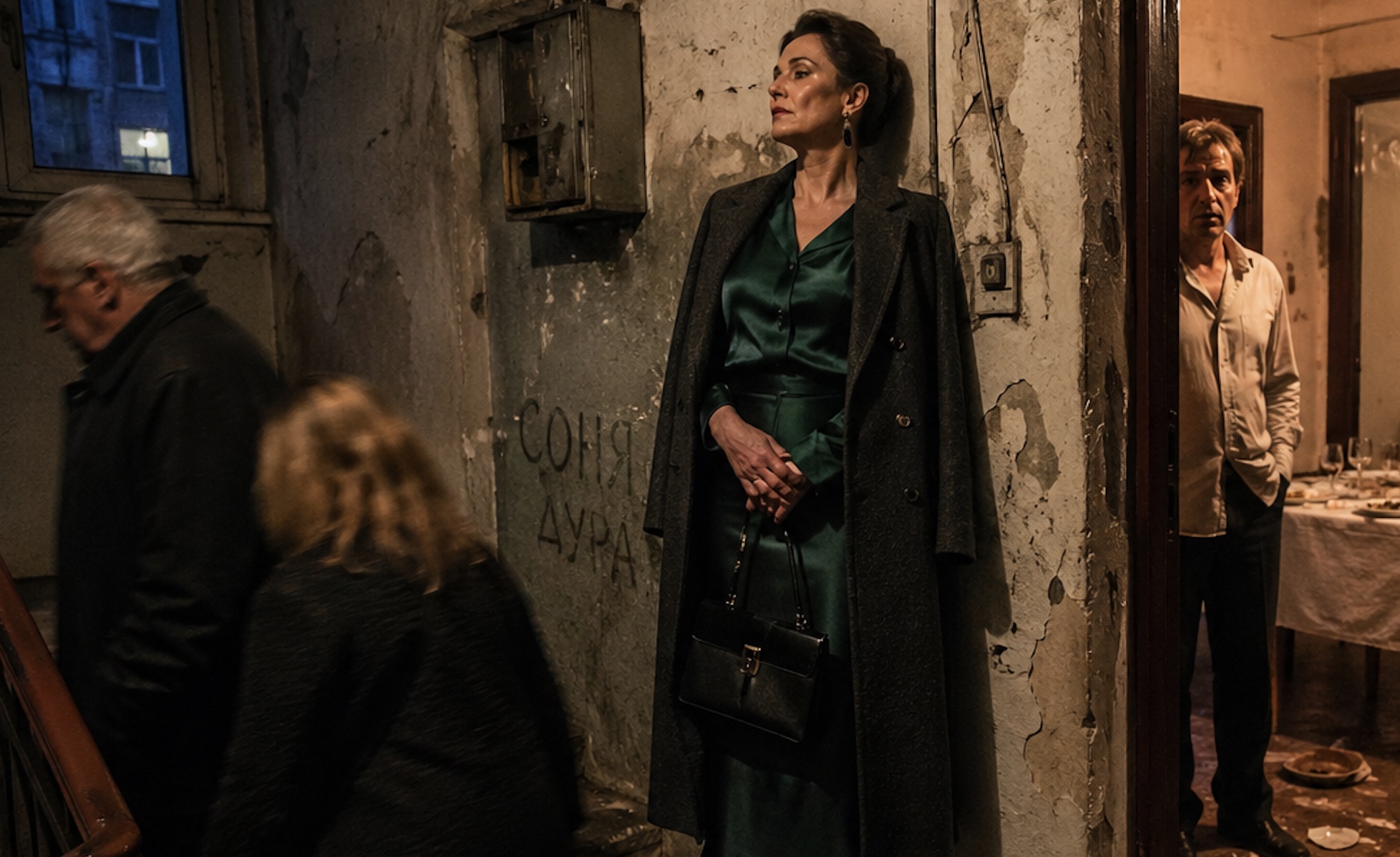
We stopped on the stairwell landing. It smelled of old concrete and faint cigarette smoke from the eighth floor. Someone had crookedly scratched the word “Peace” onto the wall. I looked at the peeling paint and felt something inside me straighten. As if the balance had finally matched.
“Inna,” Marina said, taking me by the shoulders. “Do you have somewhere to go? Come to our place.”
“No, Marina. The apartment is mine. It was my father’s inheritance. I just… I needed to step outside.”
The door to our apartment opened. Kirill came out. He had no jacket on, just his festive shirt, already wrinkled under the arms.
“Inna, come back! You’re embarrassing me in front of people!” He stepped toward us, but Marina’s husband silently blocked his way.
“Don’t shout,” he said calmly. “Better tell us why you let your wife be humiliated like that. Someone should have stopped your mother.”
“What was I supposed to do?!” Kirill suddenly broke into a shrill voice. “She’s an old woman! She’s my mother! She always acts like this, you all know that! Inna, this is your fault too! You and your perfection, your reports, you’ve exhausted everyone! You turned me into a house pet! ‘Kirill, bring this.’ ‘Kirill, don’t get in the way.’ ‘I’ll pay for everything myself.’ You never let me say a word for ten years! You want to be the boss? Fine. Be the boss in an empty house!”
I looked at him and understood: he was right. On that one point, he was absolutely right.
His shouting didn’t hurt me. What hurt was that I had grown this fungus in my own greenhouse. I had feared chaos so much, had wanted everything to be “by the ruler” so badly, that I had deprived him of even the smallest chance to be a man. I dominated, I controlled, I paid. And he simply adapted. Like mold in a damp corner.
“You’re right, Kirill,” I said quietly. “I really did turn you into a house pet. But do you know what the problem is?”
He fell silent, breathing heavily.
“I love house pets more than I love you. And tomorrow I’ll clear the apartment of parasites.”
We went downstairs. The guests dispersed, promising to call. Artem and I got into my car.
I didn’t cry. I calculated.
Loss: ten years of life.
Assets: apartment, job, son.
Liquidation balance: positive.
That night, I didn’t sleep. I sat in the kitchen, counting the tiles on the backsplash — exactly thirty-two of them. The silence in the apartment was not empty, but dense, like an unpaid bill. At three in the morning, a message came from Kirill: “Mom says you owe her an apology for ruining the anniversary. I’m at her place. Waiting for your call.”
I didn’t reply. I simply deleted the chat.
In the morning, life went on. Artem had lost his second pair of school shoes, we searched for them under the bed, and I caught myself thinking that I no longer had to listen to Kirill grumbling that “nothing can ever be found in this house.”
“Mom, is Dad going to stay at Grandma’s for a long time?” Artem asked while tying his shoelaces, not looking up.
“I don’t know, Tyoma. Probably for a long time.”
I drove him to school and went to the office. The Tax Code is an honest thing. Everything is written there: taxes, fees, penalties. It’s a pity the Family Code has no article for “voluntarily turning your husband into a decoration.”
That evening, Kirill came for his things. He was alone, without Zinaida Stepanovna. He looked rumpled, with shadows under his eyes.
“Inna, let’s not go to court,” he said, standing in the hallway without taking off his shoes. “I lost my temper on the landing. Mom too… well, you know how she is. She wants me to live with her while we ‘think things over.’ Says it’ll be calmer for me there.”
That was his boomerang. For ten years, he had complained that I controlled him, that I was the “engine” who didn’t let him breathe. And now he had returned to the main controller of his life. To the woman who would check his socks and decide what soup he should eat for lunch. Now his “freedom” smelled of his mother’s cutlets and total submission.
“There’s nothing to think over, Kirill. What you said about being a house pet was the most honest thing you’ve said in ten years. I admit my guilt. I really did build that greenhouse. And I’m tired of being its gardener.”
I brought out two suitcases. They had been standing in the hallway since eight in the morning.
“The apartment is mine. I inherited it. There’s a copy of the property registry extract in your bag. I’m giving you one month to remove yourself from the registration voluntarily. If you don’t, we’ll go to court. I explained everything to Artem. You can take him on Saturdays. But only to your own place, not to Zinaida Stepanovna’s.”
Kirill took the suitcases. The handle of one of them creaked miserably. He looked at me, and there was no despair in his eyes — only a kind of childish confusion. He was waiting for me to say, “Fine, you fool, bring your things back in.” He was waiting for me to solve everything again.
I said nothing.
The lock clicked. I turned it twice.
A month and a half passed. The first snow fell in Lipetsk — dirty, sticky snow that immediately turned into puddles under bus wheels. At work, I closed a difficult audit. Marina came into my office and placed a bar of dark chocolate on my desk.
“Well then, Inna Alexandrovna? Is today the day?”
I nodded.
It was noisy outside the registry office. A wedding procession had arrived, a limousine decorated with ribbons, a bride in a fluffy dress trying not to step into a puddle. I looked at them and remembered that silver frame on the dresser. Yesterday I had thrown it away. Along with the photo.
Kirill was waiting by the entrance. He looked even worse. Zinaida Stepanovna had apparently taken his “upbringing” seriously.
“Inna, maybe…” he began.
“Let’s go, Kirill. They’re waiting for us.”
Inside, it smelled of official parquet flooring and paper. We stood by the window. I watched a janitor outside gloomily rake wet leaves. Five minutes. Ten.
“Number forty-seven,” a voice announced over the speaker.
We went in. A woman in glasses stamped my passport. A blue mark on page thirteen.
“Terminated.”
I left the office. Kirill stayed behind to sign some papers.
I stepped down onto the front steps. The wind struck my face, making me squint. My phone rang in my bag — a client asking about a tax deduction.
I looked at the doors of the registry office. I stood there for a minute, feeling the cold air slip under my coat.
Then I turned around and walked to my car.
Not because I was in pain. And not because I was happy. Simply because, for the first time, I didn’t have to make an evening plan for someone else.
I got into the car. Turned on the radio.
I wasn’t in a hurry to go home.
For the first time in ten years, I truly didn’t care what was for dinner.