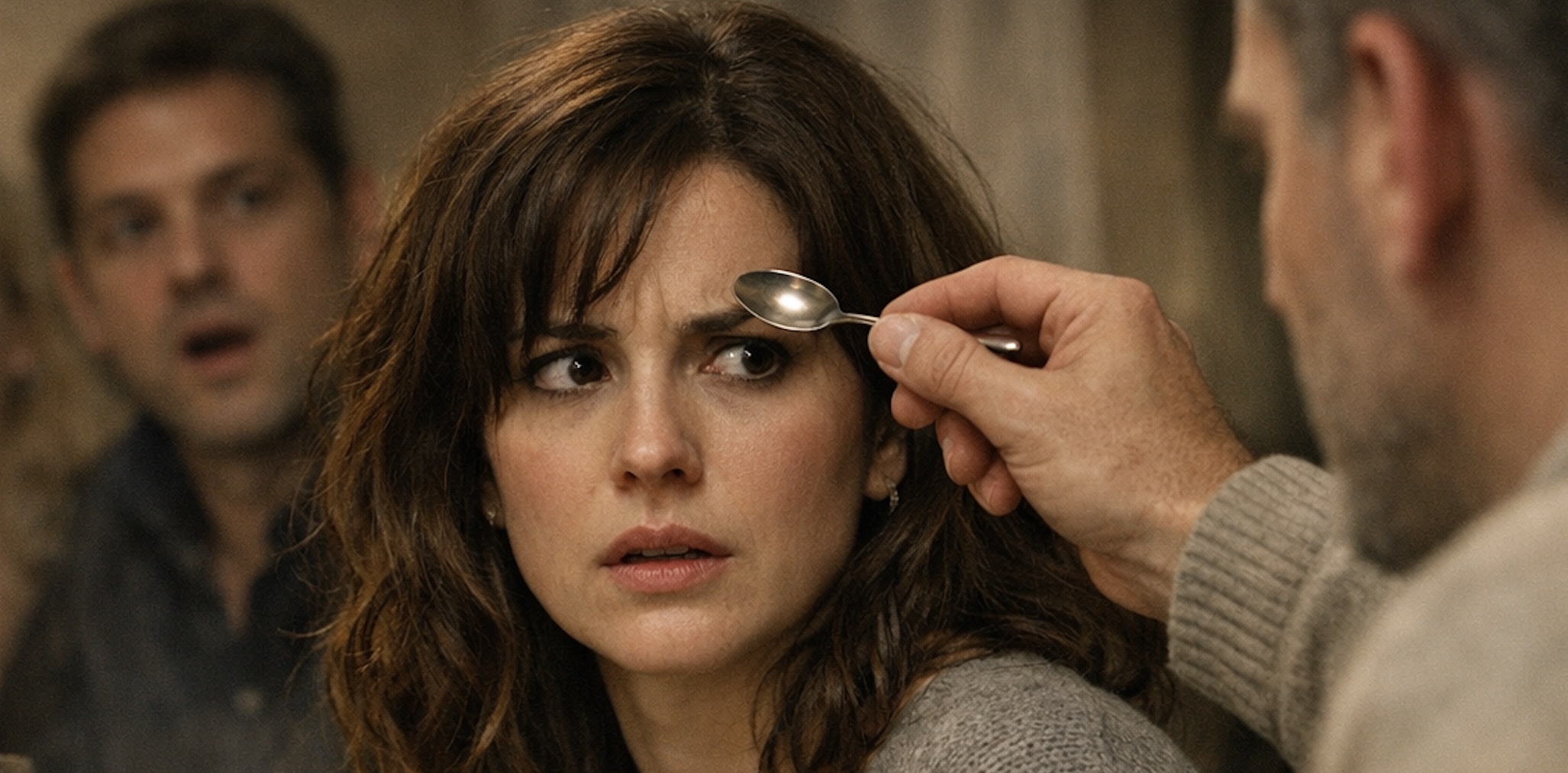
“Don’t slurp!” my husband cracked me on the forehead with a heavy silver spoon, and the sound rang louder than a cannon blast.
The spoon was an old family heirloom, darkened with age and engraved with ornate initials Igor was absurdly proud of, as if he had forged it himself between selling sheets of laminate flooring. I froze. A hot, throbbing lump swelled on my forehead almost instantly.
His guests—his boss, Pyotr Ilyich, and the man’s stout wife—went still with their forks halfway to their mouths, like wax figures in a museum of bad taste. A slice of pickled cucumber slipped off the wife’s fork and splashed back into the brine, spotting the tablecloth, but Igor did not even notice.
“Igor,” I said quietly, gripping the napkin beneath the table so hard my fingers turned white. “What are you doing? We have company.”
He did not even look at me. He calmly dabbed his lips with a starched napkin, wearing the expression of a British lord tragically misplaced in a drab apartment block in Saratov. His face remained perfectly composed, as though striking his wife at the dinner table were part of proper social etiquette.
“I’m teaching you manners, Lena, and I’m doing it entirely for your own good,” he said in that smooth, velvety voice his clients adored. “You made a sound when you swallowed. That is unacceptable in decent society. We are not in a barn, darling.”
Pyotr Ilyich, red as a boiled lobster, coughed into his fist and pretended nothing unusual had happened, staring hard at his plate.
“Come on, Igor, don’t get worked up,” he muttered, tugging nervously at his tie. “It happens to anyone. The soup’s hot, it just slipped out.”
“Manners are the face of a family, Pyotr Ilyich. The foundation of social standing,” Igor cut in, picking up the spoon again and elegantly lifting his little finger. “Lena knows the rules. I’ve told her a hundred times: discipline matters more than appetite.”
I knew those rules by heart. They had been burned into me over two years of marriage. For two years I had known that I sat the wrong way, held a wineglass the wrong way, breathed too loudly, laughed too crudely.
“You’re from a simple family, Lena. You need to rise to my level,” he liked to tell me when we were alone, usually while checking my supermarket receipts. And I had tried. I bent myself into shapes for him, read books on etiquette, learned to distinguish a fish fork from an oyster fork, though the only oysters we had ever seen were on travel shows.
But that night he crossed the line—the one separating my patience from his tyranny. To hit me with a spoon, like a misbehaving cat, in front of guests, after I had spent five hours over the stove making dinner down to the last detail?
“Bring in the main course,” he said without turning his head, as if addressing invisible staff. “And try not to bang the dishes. Pyotr Ilyich gets migraines from sharp noises.”
I rose slowly. My legs felt weak, but I kept my back perfectly straight, just as he had taught me. Your back must be like a string, Lena, even when you want to curl into a ball and howl.
In the kitchen, my masterpiece sat waiting in a massive cast-iron pot. Five liters of thick, rich kharcho soup, fragrant with cilantro and made with carefully chosen beef I had picked at the market with a jeweler’s precision.
I stood staring at the pot, remembering not the recipe but other things.
The way Igor had checked the tops of the wardrobes for dust last Saturday with a white handkerchief, wrinkling his nose in disgust. The way he had secretly thrown out my favorite worn sneakers because they “ruined the look of the hallway” and offended his sense of aesthetics.
The way he had forbidden me to see my friend Sveta, calling her “a vulgar divorcée” who would drag me down the social ladder.
I put on the oven mitts. The heavy cast iron pulled at my arms, and even through the thick fabric the heat bit into my skin.
I inhaled deeply. Garlic. Khmeli-suneli. Hot pepper. The smell was warm and spicy and real. It smelled like a home where people are loved, fed, and allowed to laugh—not trained like circus poodles.
When I walked back into the dining room, Igor was in the middle of a speech to his boss about high-end real estate and the importance of investing. Damn him, he was handsome: flawless hair, perfectly ironed shirt, cuff links gleaming. A glossy magazine cover pretending to be a man.
“…because self-control matters in everything, Pyotr Ilyich,” he was saying, lifting one finger for emphasis. “In business, in daily life, in managing staff. If you lose control of the little things, the whole structure collapses. Chaos begins.”
He noticed me from the corner of his eye and gave an impatient wave.
“Oh, finally. Put it here, in the middle,” he said, pointing at an empty spot between the salads. “And I hope you didn’t oversalt it like last time. I will not tolerate failure.”
I came up behind him, close enough for the steam from the pot to rise into my face. His boss’s wife suddenly widened her eyes. Her mouth fell open, but no sound came out. She had seen my face. For the first time, I was no longer trying to “keep myself composed.”
“Lenochka?” she squeaked, shrinking into the back of her chair.
“The salt is just right, Igor,” I said calmly, and my voice sounded unexpectedly firm. “I want you to fully appreciate the richness and depth of the flavor.”
“What?” He began turning around, frowning. “Why are you standing behind me? That’s rude. Sit down at once.”
“I don’t want to sit down, darling,” I replied, adjusting my grip on the pot handles. “I want to serve you the first course personally.”
And I did.
With one smooth, wide, deliberate movement, I poured into that motion every ounce of pain from two years of endless criticism. I did not place the pot on the table. I tipped it straight over his head.
Splosh.
The sound was wet, heavy, dull—and unbelievably satisfying. Five liters of thick, greasy, boiling kharcho crashed over his perfect hairstyle, running down over his ears, into his collar, and across his pristine white shirt.
Chunks of tender beef slapped against his shoulders like military epaulettes of some ridiculous soup general. Rice and herbs clung instantly to his eyebrows and eyelashes. Crushed walnuts pattered across the parquet floor, composing a surreal soundtrack to disaster.
A thick, tangible silence filled the room, broken only by the guests’ breathing and the soft drip of grease.
Drip. Drip. Drip.
Broth ran from his nose onto his Hugo Boss trousers.
Then Igor screamed—and it was not the cry of a man. It was the shriek of a panicked fire siren.
“Ahhh! It’s hot! Are you insane? My eyes!”
He shot to his feet, flailing wildly like a windmill in a storm. The pot sat on his head like the helmet of some miserable knight, jammed over his ears so tightly he could barely see. He clawed at it, trying to pull it off, but his greasy hands slid uselessly over the hot metal.
“Help me! Get this off me!” he bellowed from inside the pot. “She’s killed me! She’s insane!”
Pyotr Ilyich shrank back in his chair, pulling up his legs to avoid splashes of grease on his suit, looking utterly lost. His wife clapped a hand over her mouth, but I could see her broad shoulders shaking. She was not crying. She was laughing soundlessly so hard it nearly broke her.
At last Igor managed to wrench the pot off his head, and what we saw was almost biblical in its grandeur. His face was red. His shirt was red. A leaf of cilantro clung to his nose. His expression was pure, childish horror.
He gulped air like a fish thrown ashore in tomato sauce, his eyes bulging.
“You… you…” He jabbed a finger at me, orange grease dripping from it. “You’re crazy! I’m filing for divorce! You ruined my shirt! That was last season’s collection!”
“It’s kharcho, Igor,” I corrected him, feeling an astonishing lightness in my body. “And it suits you beautifully. That shade really brings out your complexion.”
I took off my apron, folded it neatly into quarters, and placed it over the back of the chair.
“Where do you think you’re going?” he shrieked, trying to wipe his eyes with a napkin and only smearing grease across his cheeks. “Clean this up right now! Immediately! The floor is parquet!”
“Blot it with a napkin,” I advised in the patient tone of an elementary school teacher. “And don’t slurp while you wash up. It’s improper in front of guests.”
I picked up my handbag from the side table and checked for my phone and keys.
“Lena! Stop right there!” He lurched toward me, trying to grab my arm, but stepped on a large piece of greasy beef.
He crashed back into his chair so hard the dishes rattled inside the china cabinet, and droplets of soup sprayed everywhere. Pyotr Ilyich finally found his voice and croaked:
“Well… Igor… now that’s what I call a hot reception. In the most literal sense.”
I walked into the hallway without looking back at the absurd theater behind me. Calmly, I slipped on my old sneakers—the pair he had not managed to throw away only because I had hidden them on the top shelf inside a blender box.
I threw on my coat and glanced at myself in the mirror. The swelling on my forehead was turning blue, but my eyes were shining.
The dining-room door stood open, and I could hear Igor whining:
“This is attempted murder! You’re witnesses! We need a report! Where’s my phone?”
I opened the front door, and cool autumn air struck my face, washing out the artificial “Ocean Breeze” freshener smell from my lungs. Outside, it smelled of wet asphalt, damp leaves, and gasoline. It smelled like real life.
I hurried down the stairs, skipping steps because I could not bear to wait for the elevator. I needed motion. Speed. Flight. A miserable fine drizzle was falling outside, but I did not care enough to open my umbrella.
I walked along the avenue smiling like an idiot, catching puzzled looks from passersby wrapped in scarves. I had no plan. No place to stay. And the bank card linked to Igor’s account would become useless plastic in five minutes.
But I had something better—a sense that a concrete slab weighing a ton had finally been lifted off my chest.
I stopped at an all-night food kiosk that smelled of grilled meat and spices.
“One shawarma, please,” I told the young man behind the fogged-up glass. “Extra garlic sauce. And the hottest adjika you’ve got.”
“You got it, beautiful. It’ll be fire,” he said with a wink, chopping deftly with his knife.
I took the hot wrap, burning my fingers through the paper, and sat down on a damp bench in the little square nearby. I unwrapped the lavash without caring whether the sauce dripped onto my coat.
Then I took a huge, indecent bite and felt the heat blaze over my tongue. Sauce ran down my chin. I chewed with my mouth wide open, smacked my lips, and I’m pretty sure I deliberately slurped once or twice.
It was the best thing I had ever eaten—better than every oyster and every scrap of foie gras in the world.
My phone vibrated in my pocket with Igor’s calls, but I had no intention of answering.
An elderly woman passed by with a tiny dog in a little jumpsuit. The dog barked at me, tugging on its leash.
“Quiet, Zhuzha, don’t bark. It’s not proper,” the woman scolded, giving the leash a tug.
I burst out laughing—loudly, openly, without covering my mouth—and my laughter sent a flock of pigeons scattering. A piece of lavash nearly slipped from my hand, but I caught it with the other one.
My manners had not disappeared. They were still mine. The difference now was simple: from this moment on, I would decide who deserved them—and who deserved a pot of soup over the head.
I finished eating, wiped my mouth with the sleeve of my coat, and felt like an absolutely happy savage.
In my pocket, the keys to my parents’ old two-room apartment clinked softly. I had kept them all this time, just in case, without admitting to myself that I had been waiting for this very moment.
The moment had come.
I got up, tossed the crumpled napkin into a trash bin, and headed toward the metro with a steady stride. The swelling on my forehead still burned, a reminder of the silver spoon, but it was the right kind of pain. The kind that tells you you’ve finally woken up—and that no one will ever again dare tell you how to eat your own soup.