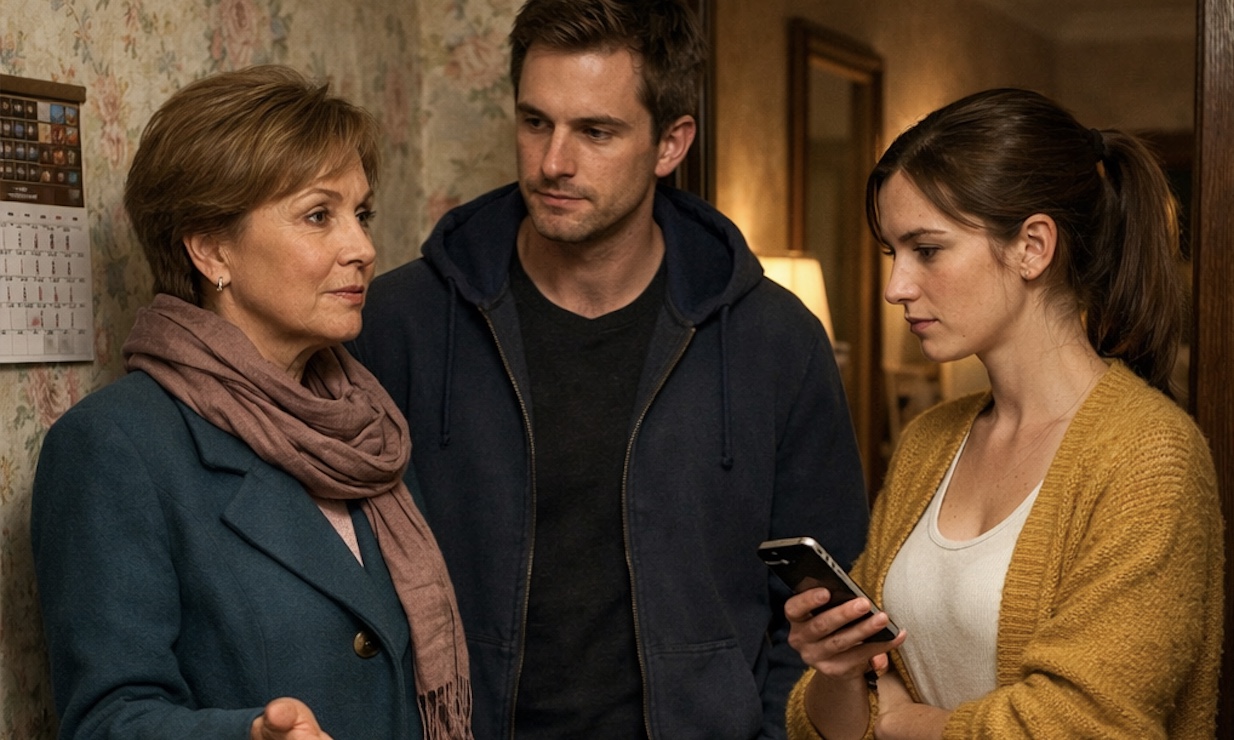
“Hello, police? My daughter-in-law has lost her mind and blocked all my accounts!” my mother-in-law screamed. The officer smirked and opened the Criminal Code.
Olesya slipped on a cardigan, walked to the door, and pressed her eye to the peephole. On the landing, directly under a dim flickering bulb, stood two patrol officers in heavy jackets. Between them, nervously twisting the strap of an expensive leather handbag, shifted her mother-in-law, Antonina Sergeyevna.
Olesya unlocked the door. Damp hallway air rushed into the apartment, carrying the smell of wet wool from the officers’ uniforms and the suffocating trail of sweet perfume.
“I told them exactly this on the phone: ‘Hello, police? My daughter-in-law has gone crazy and blocked all my accounts!’” her mother-in-law shrieked, jabbing a finger tipped with a flawless fresh manicure toward Olesya. “Arrest her immediately! She robbed me! I was sitting in a respectable place with respectable people, and she left me without a penny!”
The older officer, a man with deep shadows under his eyes, let out a tired breath. The radio on his shoulder crackled hoarsely.
“Ma’am, can you lower your voice? You’ll wake the whole building,” he said in a flat tone as he stepped over the threshold in his heavy boots. “Who robbed whom? Are you claiming this young woman took your personal funds?”
Olesya leaned against the doorframe. Inside her, there was nothing at all. No fear. No trembling knees. Only dull exhaustion. She looked at the flushed woman in the cashmere coat and tried to understand how they had ended up in this absurd scene.
Because just four months earlier, Olesya herself had brought Antonina Sergeyevna into this apartment, carefully holding her arm.
In the fall, Roman’s father had died suddenly. He had simply gone to the garage to get potatoes, sat down on an old tire, and never got back up. It was a brutal blow to the family. Roman had collapsed inward, spending hours at the kitchen table staring at one point, absentmindedly crumbling bread across the tablecloth.
“Les, how is she supposed to stay there alone now?” he had asked one evening, twisting a kitchen towel in his hands. “Every stool in that old three-room flat reminds her of Dad. She cries all the time. Let’s bring her here. We have a spare room. Let her stay until she gets herself together.”
Olesya had agreed immediately. Leaving an elderly woman alone in an empty apartment after such a loss felt heartless.
The next day Roman brought his mother over along with five huge bags of her belongings.
For the first few weeks, Antonina Sergeyevna barely left the room. She sat on the couch wrapped in an old пух shawl, staring out the window. Olesya tiptoed around the apartment, brewed her herbal tea in a thermos, bought her favorite sweet cheese snacks. In the evenings Roman hugged his wife and whispered how grateful he was.
But by mid-December, grief had somehow transformed into restless, destructive energy.
Antonina Sergeyevna decided that her son’s apartment was now her new territory, one in urgent need of reorganization.
Olesya worked remotely as a landscape designer. She needed silence and concentration. Before her mother-in-law moved in, the apartment had been the perfect workspace. Now, at exactly ten every morning, just when Olesya’s video calls with clients began, the old vacuum cleaner would roar to life in the hallway.
Olesya would lean out of her room, covering the microphone with her hand.
“Antonina Sergeyevna, please, I’m in a meeting!”
“Oh, Lesya, you’re just staring at a screen!” her mother-in-law would wave off, not even thinking of turning the monster off. “It’s impossible to breathe in here. Dust is bad for Romochka. He had skin problems as a child!”
Then came the siege of the kitchen.
Olesya liked roasting vegetables and making light salads. Her mother-in-law believed only in heavy artillery: fried meat, rivers of oil, thick soups. The smell of greasy frying permanently settled into the curtains. Olesya’s favorite mugs vanished into the depths of the cupboards because “I arranged everything properly.”
Olesya tried talking to her husband.
“Roma, your mother went through my work folders on the windowsill today. She said she was dusting. I spent half an hour looking for my sketches. I can’t work like this.”
Roman would avert his eyes and sigh.
“Les, just bear with it a little longer. She needs to feel useful, okay? She was the mistress of her own home her whole life, and now she’s lost her footing. Let her move mugs around and fry cutlets. They’re small things.”
So Olesya endured it.
Then one morning, the conversation happened.
Antonina Sergeyevna came into the kitchen in a rustling silk robe. She sat opposite her daughter-in-law, folded her hands like a praying saint, and looked at her with unbelievable gentleness.
“Lesya, my dear girl. I feel awkward always asking Romochka for money. He already works himself to the bone. My pension is delayed, and I need to go to the farm shop. They’ve brought in fresh cottage cheese, greens, nuts. Could you give me one of your spare cards? I’d only use it for essentials. Cash is such a nuisance; I get confused by coins.”
The request caught Olesya off guard, but her mother-in-law looked so pitiful.
Olesya pulled a yellow plastic bank card from her wallet. It held her personal savings, money she had been setting aside for a powerful new work computer. It was a serious sum. She had saved it over almost a year by taking on extra projects.
“Here. The PIN is Roman’s birth year. But please, let me know if you decide to buy anything major.”
“Oh, come on! What major purchases? Kefir and apples!” Antonina Sergeyevna chirped happily, slipping the card into her robe pocket with practiced speed.
Inside, Olesya felt the sharp sting of warning, but her desire to avoid yet another kitchen lecture about stinginess won out.
For the first few days, the banking app showed modest amounts: bakery, produce stall, pharmacy. Olesya relaxed.
On the fifth day, the dam broke.
She was sitting over blueprints when her phone screen flashed with a bank notification. She absentmindedly swiped it away, but the number caught her eye. She opened the app and felt a cold wave slide down her spine.
She scrolled through the past twenty-four hours of transactions.
Luxury spa club. Italian shoe boutique. Cosmetic rejuvenation clinic.
Nearly half of her savings for the computer had vanished in less than a day on “kefir and apples.”
Olesya got up slowly, walked into the living room.
Antonina Sergeyevna was lounging on the sofa. Her hair was styled into an elaborate salon blowout. On her feet were shiny new shoes. The room was saturated with the rich sweetness of expensive perfume. She was flipping through a glossy magazine.
“Antonina Sergeyevna,” Olesya said, her voice unnaturally calm, “is there anything you’d like to explain?”
Her mother-in-law glanced up innocently, eyelashes thick with mascara.
“About what, sweetheart?”
“About the money you blew from my card over the last twenty-four hours on massages, boots, and cosmetic treatments.”
Antonina Sergeyevna’s face changed instantly. The meekness disappeared, revealing hard, stubborn lines.
“So what?” she snorted, inspecting her fresh manicure. “I spent my whole life on my husband and son! I denied myself everything! I’m going through a difficult time. I need distractions. I need to enjoy myself. Romochka wouldn’t have refused me! You’re young, you can earn more. I’d like to live decently for once!”
“You are living decently in my apartment, eating food that we buy, and now you’ve decided your entertainment should come out of my pocket?” Olesya replied, sharply pronouncing every word. “I gave you that card for groceries.”
“Oh please, how miserly you are!” her mother-in-law said, turning toward the television. “I’ll tell Roman what a mercenary wife he has.”
That evening, the conversation with her husband was brutal.
When Roman learned the scale of the spending, he rubbed his face with both hands for a long time.
“Les, yeah, she went too far. I’ll talk to her. But you have to understand, she’s had some kind of breakdown from all the grief. She didn’t do it out of malice, she just tasted freedom. I’ll pay you back little by little from my bonus.”
“Roma, this isn’t about the money!” Olesya looked at him and barely recognized him. He wasn’t protecting his mother. He was protecting his illusion that the situation was under control. “It’s about lying. She took the card for milk and used it to get injections in her face.”
They argued for almost an hour.
In the end, Roman begged her to give his mother one last chance.
“Fine,” Olesya said wearily. “But this is the last warning. If one more ruble leaves my account anywhere other than a grocery store, I’m blocking the card. No discussion.”
When Antonina Sergeyevna heard the ultimatum, she staged a tearful performance in the kitchen, complained to her son about the humiliation of being distrusted, but swore solemnly that she would never again buy anything unnecessary.
Two weeks passed.
On Friday, Roman left on a short business trip.
By lunchtime, Antonina Sergeyevna had already started getting ready. She put on her best dress, curled her hair, drenched herself in perfume, and announced that she was going “to a cultural gathering with some new acquaintances.”
At about eight in the evening, Olesya’s phone vibrated.
Transaction declined. Insufficient funds. Seafood restaurant.
The amount they had tried to charge was enormous. It was enough to replace every appliance in the kitchen. Her mother-in-law had decided to throw a lavish dinner for her new friends on her daughter-in-law’s dime.
The balance on the card simply couldn’t cover her celebration of generosity.
A minute later, another attempt came through.
She was clearly asking the waiter to run the card again.
Olesya smirked. The anger was gone, replaced by icy calm.
She opened the card settings.
One tap on the red button.
Confirm.
The plastic card in Antonina Sergeyevna’s hand instantly became a worthless piece of trash.
Olesya poured herself some tea and sat down with a book.
Call after call from her mother-in-law flooded in, but Olesya just set her phone to silent.
Two hours later, someone started pounding aggressively on the door.
And now here they were, in the hallway.
“She humiliated me!” her mother-in-law wailed to the officers. “I was sitting there with cultured people! The bill came, I handed over the card, and the waiter said declined! Everyone looked at me like I was some beggar! She did it on purpose to shame me! Arrest her!”
The lieutenant shifted his heavy gaze to Olesya.
“Your mother-in-law claims that you unlawfully withheld her bank card and blocked her accounts. Is that true?”
Without a word, Olesya pulled her phone from the pocket of her cardigan, unlocked it, and opened the banking app.
“Officer, please take a look.”
She held the phone out to him. He took it, squinting against the bright screen.
“This is my profile,” Olesya said, pointing. “My name, surname, passport details. These are my accounts. And this is the very card this whole performance is about. It’s issued in my name.”
The lieutenant took out a notebook from his breast pocket, compared the details with Olesya’s passport, which she had already placed on the hallway cabinet, and then opened the transaction history.
“Spa salon. Italian shoes. Cosmetic clinic. And today’s attempted charge at a restaurant for a very substantial amount,” he read aloud.
Then he slowly turned toward Antonina Sergeyevna.
The blush fled her face, replaced by an earthy pallor.
“Citizen,” the officer said, his voice now edged with steel, “so the card belongs to your daughter-in-law?”
“But… but she gave it to me herself!” her mother-in-law squeaked, taking a step back and shrinking into herself. “She allowed it!”
“I gave her the card to buy groceries,” Olesya said clearly. “When I saw large unauthorized purchases, I revoked my permission and blocked my own card. That is my legal right.”
The younger officer, who had been silent by the door until then, smirked and pulled a blank form from a folder.
“And using someone else’s electronic payment method without the owner’s consent,” the older patrolman said, staring directly at the mother-in-law, “is a serious matter. Article 159 of the Criminal Code. Fraud involving electronic means of payment.”
Antonina Sergeyevna opened her mouth, gasping for air. Her expensive leather handbag slipped from her weak fingers and hit the rug by the door with a dull thud.
“What article? I’m his mother! You have no right to scare me!” she babbled, genuinely horrified at the blue form in the officer’s hand.
“The law is the same for everyone,” the lieutenant cut in. Then he looked at Olesya. “Do you want to file a theft complaint? The amount is significant. It would be enough to open a criminal case.”
A heavy silence settled over the hallway.
The only sound was the ragged wheeze of Antonina Sergeyevna’s breathing.
All her arrogance, all her certainty that she stood above consequences, had vanished. Now she was simply a frightened woman realizing that, this time, she could actually be held responsible.
“No,” Olesya answered calmly. “I’m not filing anything. Let this be the price of a life lesson.”
The lieutenant nodded and handed back the phone.
“And you,” he said sternly to Antonina Sergeyevna, “I strongly advise you not to call the police on false pretenses again. Next time I’ll write you up for a false report. And you should thank your daughter-in-law for not sending you to an investigator. Good night.”
When the officers left and the door closed behind them, her mother-in-law silently picked up her bag from the floor. She did not look at Olesya.
“By tomorrow morning, I’ll be gone,” she spat through clenched teeth, heading toward her room. “I’ll tell Romochka everything. He’ll never forgive you for this.”
The guest-room door slammed.
The next day, close to noon, Roman returned from his trip.
In the hallway he was met by five huge bags piled by the entrance. Antonina Sergeyevna sat on a small bench in her coat, lips pressed tightly together. The moment she saw her son, she rushed into his arms, dissolving into tears.
“Romochka! My son! Your wife is a monster! She’s throwing me out on the street! She set the police on me! She wanted me jailed for a crust of bread!”
Roman stared helplessly from his sobbing mother to Olesya, who was calmly wiping down the kitchen counter.
“Lesya, what is going on? What police?”
Olesya put down the cloth and came into the hallway.
“Your mother tried to pay for a massive dinner for her friends with my card yesterday. I blocked it. In response, she called the police herself and claimed I had stolen her personal money. The officers checked the documents, explained to Antonina Sergeyevna that she was the one breaking the law by spending someone else’s money, and offered me the chance to file a fraud complaint. I refused. Now she’s going back to her own apartment.”
Roman froze.
He looked at his mother. She dropped her gaze, nervously twisting a button on her coat, then began speaking quickly:
“I just wanted to spend time with people! I need company! And she humiliated me in front of everyone!”
“Mom… is that true?” Roman’s voice shook. “You called the police on my wife because she wouldn’t let you pay for a restaurant with her money?”
“She humiliated me!” his mother repeated stubbornly.
Roman closed his eyes.
At that moment, Olesya saw his face change.
The excuses were over.
At last, he understood that his sense of duty, his guilt, his desire to be noble, had all been used against him. His mother had been ready to send his wife through hell with the police just to avoid looking foolish in front of her new friends.
Without a word, he lifted the bags and carried them to the door.
By evening, calls from relatives began pouring in.
The first to get through was Aunt Galya, the mother-in-law’s sister.
“Olesya, how could you do this?” she began forcefully. “Tonya is calling me in tears, saying you threw her into the cold with the police!”
Olesya did not justify herself. She simply recited the facts in a calm voice: the boutique purchases, the restaurant bill, the false police call made by her mother-in-law herself.
There was a long pause on the other end.
“Oh… I see,” Aunt Galya said at last, her tone changing instantly. “So she wanted to live large on your money? Well, Tonya always did love draining other people dry. She did the same thing to my brother and left him without a penny. You did the right thing, girl. Don’t give in.”
Late that night, Roman sat in the kitchen.
He looked exhausted, but the heavy tension that had hung over him for months was gone. He took Olesya’s hands in his.
“Forgive me,” he said quietly, looking straight into her eyes. “I was completely blind. I wanted to be the perfect son, and instead I let her treat you disgracefully in your own home.”
Now Antonina Sergeyevna lives in her own apartment again. Roman visits once a week, brings groceries, helps with utility bills, but any conversation about money or about his wife is shut down immediately and firmly.
And Olesya learned the main lesson:
compassion and respect for someone else’s suffering must never become permission to violate your boundaries.
And if protecting those boundaries means letting two patrol officers deliver a lecture from the Criminal Code right in your hallway, then so be it.