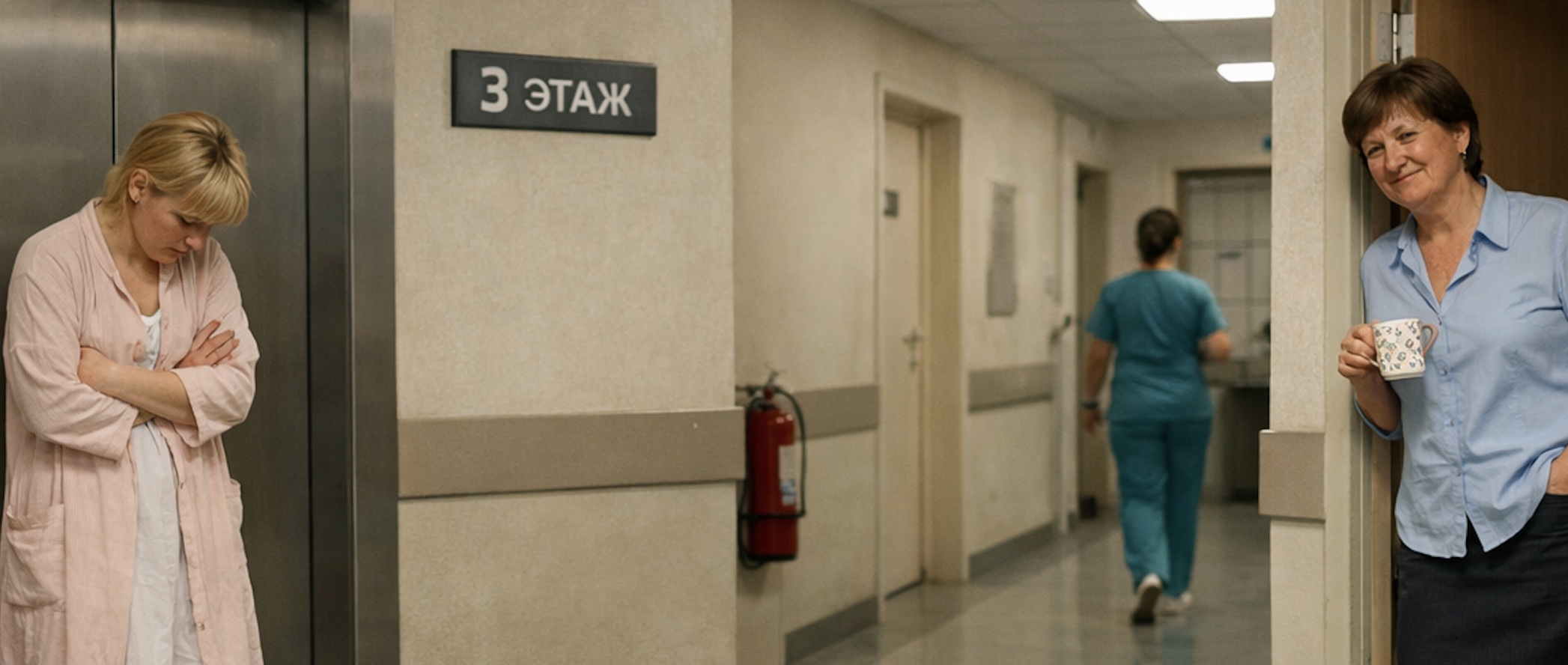
“Leave the keys on the dresser, Polina. And stop looking at me like that. I wasn’t hired to nurse you after your ‘women’s procedures.’ Roma has a new life now, and you’re standing here like a weed in a flower bed.”
Antonina Stepanovna stood in the middle of the entryway with her arms folded across her chest. She smelled of lavender soap and something cloyingly sweet, a scent Polina had learned over five years of marriage to recognize as the warning sign of an approaching storm. Behind her, farther down the hallway, Roman hovered in the background. He would not look at his wife. Instead, he stared intently at the toes of his house slippers, as though all the wisdom in the world had somehow been woven into their fabric.
Polina leaned against the doorframe. Her abdomen still ached from surgery, and her head was filled with a hollow rushing sound, like the sea trapped inside an empty shell. Being discharged from gynecology at three in the afternoon was hardly the ideal moment for a forced migration. She tightened her grip on the strap of the small bag in her hand. Inside were only slippers, a robe, and a pack of painkillers.
“Roman, are you serious?” Polina’s voice came out soft, almost colorless. “Right now?”
“Polya, what’s the point of dragging it out?” Roman finally lifted his eyes, only to shift them at once toward the mirror. “We talked about this. There isn’t enough space. It’s cramped for everyone. Mom needs peace, and I… I need to move on. Yulia already brought her things. It’s awkward, having someone standing in the doorway with suitcases.”
“Someone?” Polina almost laughed. “So Yulia waiting in the doorway is awkward, but me standing on the landing after anesthesia is perfectly fine?”
Antonina Stepanovna stepped forward, closing the distance. Her small bead-like eyes flashed with triumph. She had waited for this moment for a very long time. Ever since the day Roman had brought “that gray little mouse from the design office” into their family nest. In her eyes, Polina had always been nothing more than a temporary inconvenience, a youthful mistake made by her perfect son.
“I already packed up your bundles,” Antonina said sharply. “They’re out by the elevator. Everything’s there. Your rags, your ridiculous books. I kept the roasting pan, though. That’s a family piece. It belonged to my mother. No need dragging it around from one dump to another.”
Polina turned her gaze toward the pile of black trash bags dumped beside the elevator. The sleeve of her favorite cashmere sweater, a gift from her father, was sticking out of one of them. The bags had been ripped open, as though her mother-in-law had searched through them to make sure the “freeloader” had not stolen an extra silver spoon.
At that moment Yulia walked out of the kitchen. She was about ten years younger than Polina, sugary in every way, dressed in a pink plush lounge set that looked absurd in this apartment with its high ceilings and decorative molding, like a plastic cup set down on an antique table. In her hands she held the very same double-walled glass mug Polina had bought for herself with her first bonus.
“Oh… hi,” Yulia chirped, taking a sip of tea. “I’m just… settling in. Antonina Stepanovna said the place is free now.”
Something inside Polina clicked. Not snapped into hysteria, not broken into tears. Clicked. Settled into place like a part in a complicated mechanism. In an instant she remembered everything: the three years she had spent paying off the loan taken out for “a renovation for Mom,” the nights she had stayed awake drawing shopping center plans while Roman was “finding himself” in online casinos, the polite smiles she had forced while Antonina lectured her about how a real woman should be her husband’s quiet shadow.
“Free now, is it?” Polina straightened up. The pain in her stomach was still there, but it had faded into the background beneath the sharp ice in her chest. “Roman, are you absolutely sure this is what you want?”
“Polina, don’t make a scene,” her husband grimaced. “You always complicate everything. You’ve got somewhere to go, don’t you? You can go stay with your mother in the village, get some fresh air. It’ll do you good after the hospital.”
“My mother doesn’t have a village, Roma. My mother has a single room in a communal apartment, which she rents out so she can help us pay for ‘our’ apartment.”
Antonina gave a dismissive snort.
“Help! She counted every penny she gave. Enough. This conversation is over. Roma, close the door. There’s a draft. Yulia has a weak throat.”
The door slammed shut.
Polina was left standing in the cold stairwell. The silence of the old Stalin-era building hung heavy in the air, scented with dust and old wood. She looked at her bags. Then she walked over and picked up the sweater. One seam had been torn apart. Her mother-in-law must have been in such a rush that she had simply yanked things from the closet without care.
Polina sat down on her suitcase. Her hand moved almost on its own toward her bag. In the inner pocket, beside her passport, was a document she had never told her husband about. It had been there for two years. She had put it in place on the day she accidentally saw Roman’s messages with “Yulia Bunny.” She had not left then. She had wanted to see how far they would go. She had waited for the peak. And here it was: a filthy trash bag by the elevator and a girl in pink with her feet under the table.
She took out her phone. Her fingers were perfectly steady.
“Mom? Hi. No, everything’s fine. Yes, they discharged me. Listen, please send me the scan of Grandpa’s deed of gift. Yes, that one. And one more thing… call our district officer, Stepanych. The same one who helped you with the garage. Tell him I’ve got an unlawful takeover here and an attempt to steal personal property.”
She ended the call and looked at the massive oak door. From behind it came Roman’s laughter and the clatter of dishes. Yulia was probably already making herself at home in the kitchen. Antonina was likely recounting, with pride, how neatly she had gotten rid of the dead weight.
There was one tiny detail they did not know.
This apartment had never belonged to Antonina Stepanovna. Or to Roman.
Back in 1998, Polina’s grandfather, an old architect, had bought the place from the city through some complicated arrangement. Later, when Polina got married, he signed it over to her mother as a gift. With one condition: “As long as Polina stays married, let them live there. But if anything happens, throw them out.” Polina herself had begged her mother not to tell Roman. She had wanted to believe he loved her, not her registration in a prestigious apartment on Prospekt Mira.
She rose to her feet. The pain was still throbbing, but her mind was crystal clear. She would not go down in the elevator. She would not gather up the ripped clothes. She would wait.
Two hours passed.
Polina was still sitting on her suitcase when heavy footsteps echoed through the stairwell. Stepanych, the district officer, came up to the landing. His face looked like that of a tired bulldog. Two uniformed men followed behind him.
“Polina Arkadyevna?” Stepanych nodded toward the bags. “This your handiwork?”
“No, Major. These are my things. Or rather, the result of my former relatives’ handiwork. Here’s my discharge paper from the hospital. The apartment documents should hit my email any second now.”
Stepanych studied the gynecology discharge note, cast a dark look at Polina’s pale face, and rang the bell. Long. Firmly.
Antonina Stepanovna opened the door. She was wearing an apron and holding a ladle. At the sight of the police she froze for one fraction of a second, but quickly regained herself. Soviet hardening was excellent armor.
“Oh? What’s going on? We didn’t call the police. That woman,” she said, nodding toward Polina, “doesn’t live here anymore. She received all her personal belongings.”
“That woman lives here precisely,” Stepanych said in a deep voice as he stepped inside. “The question is on what grounds you, Antonina Stepanovna, and your son are staying here.”
“What do you mean on what grounds?” Roman burst out of the room, buttoning his shirt on the move. “This is my mother’s apartment! We’ve lived here for forty years! Well, I mean, Mom has, and I—”
“Forty years?” Stepanych smirked as Polina handed him the phone showing the scanned deed. “Funny. Because this says the owner is Vera Pavlovna Krivtsova. Ownership registered on the basis of a deed of gift dated 2010. And before that…” He glanced at Polina. “Remind me?”
“Before that my grandfather leased it from the housing fund and later bought it in my mother’s name,” Polina answered calmly. “Antonina Stepanovna lived here as a family member. By my goodwill. But goodwill, as it turns out, ended along with the anesthesia.”
A silence fell over the entryway so complete they could hear the kettle beginning to whistle in the kitchen. Antonina Stepanovna’s face changed from flushed triumph to a gray, earthy pallor. She stared at her son, and the terror in her expression was so raw and primitive that Polina almost felt sorry for her. Almost. Then she remembered the torn cashmere sweater.
“Roma… what does this mean?” Antonina whispered. “Is she… the owner?”
“Looks that way,” Roman had gone completely white. “Mom, but you said Dad had sorted everything out… that we were protected…”
“Your father knew how to arrange debts, nothing else!” Antonina shrieked, suddenly lunging toward Polina. “You snake! You scheming little viper! You wormed your way in, sniffing around! Took care of the old man just to get the flat? It won’t work! I’ll sue! I’m registered here!”
“Your temporary registration expired six months ago,” Polina replied. “I just chose not to renew it. I thought, why wave papers around, we’re family. Turns out we’re not family. And if you’re nobody to me, then you have no right to be here.”
Yulia, peeking out from behind Roman’s shoulder, abruptly spun around and disappeared into the apartment. A minute later she returned dragging her pink suitcase.
“Roma, I think I’m leaving. This is all… weird. You said it was your place, but this is more like some communal drama. Police, bells, all of it.”
“Yulia, wait!” Roman tried to stop her, but Stepanych moved lightly, firmly, and blocked his way.
“All right, everyone. It’s late. The owner wants the premises vacated. Pack your things fast and quietly. And if I find one more damaged item belonging to Polina Arkadyevna besides what’s already in the hallway, we’ll add property damage to the report.”
Chaos broke loose.
Antonina Stepanovna sobbed while clutching the roasting pan to her chest. Roman rushed back and forth between the wardrobe and his mother, stuffing shirts into a bag. Yulia was already by the elevator, nervously stabbing at the call button.
Polina stepped into her bedroom. Someone else’s things lay on her bed: lace underwear, cheap perfume. The smell was unbearable. She went to the window. Down below, on Prospekt Mira, the streetlights were flickering on. Kostroma was preparing for the night.
Then a chill ran down her spine.
In the corner of the wardrobe she spotted an old box. Her box. Her mother-in-law had not looked inside it. Polina opened it. Her drawings were there, the first projects Roman used to dismiss as “girly nonsense.” And at the bottom lay a voice recorder.
She pressed play.
“…we’ll throw her out, Roma darling, just wait. Once the operation’s done, we’ll take her by the arms and send her off to the countryside. The apartment is ours, I checked with a notary, the trail is buried. And that girl… she’s an idiot. She actually thinks we love her. The main thing is to get her signature on the waiver while she’s drugged up on pills…”
Antonina Stepanovna’s voice came through clearly, metallic and cruel.
Polina switched the recorder off. She had made that recording a month earlier by accident, leaving it running in the kitchen. At the time she had not wanted to believe what she heard. She had thought it must be some vicious joke.
Now the jokes were over.
Three hours later the apartment was empty.
The hallway stood silent, broken only by the faint drip of water from the bathroom. Stepanych was the last to leave, promising to “keep an eye on the building.”
Polina remained in the middle of the living room. Bits of torn packaging were scattered across the floor, along with a cheap barrette Yulia had forgotten and dust. A great deal of dust. It was strange how quickly a home could turn into ruins once pretense had left it.
A soft scratching came at the door.
Polina flinched. She looked through the peephole.
Roman.
She opened the door without removing the chain. He stood alone on the landing. No mother, no Yulia, no swagger. His hair was disheveled, his jacket half open.
“Polya… let me in. I took Mom to my aunt’s place. She’s hysterical. Yulia… Yulia went to a friend.”
“What do you want, Roman?” She looked at him as if he were a stranger. It was astonishing how fast attachment disappeared once you saw what was underneath.
“Polya, come on, we’re human beings. Five years together. I love you. I just got confused. Mom kept pressuring me, saying you were barren, that we needed an heir, while you were always running around your construction sites… I’m an idiot, Polya. Forgive me. Let’s start over. The apartment is yours, I get it. Fine, yours. I’ll help. We’ll finish the renovation…”
Polina listened, and inside her spread a strange calm. Not triumph. Not malice. Calm. Justice is not when your enemy is crushed. Justice is when you no longer need to explain yourself to them.
“Roman, look at the bags by the elevator,” she said quietly. “Do you see my sweater? Your mother tore it. For no reason except spite. She wasn’t tearing a sweater. She was tearing me apart. And you stood there. Staring at your slippers.”
“Polya, I was afraid of upsetting her! Her blood pressure—”
“And you weren’t afraid of upsetting me? My stitches from surgery haven’t even been removed yet. You threw me onto a concrete landing, Roma. You didn’t betray me. You betrayed us.”
She reached for the chain, but he shoved his foot into the gap.
“Polina, wait! Where am I supposed to go? I don’t have a penny, all the money is tied up in the business, in the shipment—”
“What shipment, Roma?” she said with a bitter smile. “The one I calculated for you three months ago? Today I withdrew all my engineering approvals. Without them, your license is nothing but toilet paper. Your boss already knows the PromSnab project has been revoked by its lead author.”
Roman froze. His eyes widened.
“You… you did that? You ruined me?”
“No, Roma. You ruined yourself the moment you decided I was a weed in your flower bed. The weed has been pulled out. Now let’s see how your flower bed grows without water or soil.”
She pushed the door. He moved his foot automatically.
“I’m staying,” she said in parting. “In my apartment. In my life. And you… try learning how to tie your own laces without your mother. It might help you grow up.”
The lock clicked shut.
Polina leaned back against the door. Her heart was pounding somewhere up in her throat. But the heavy silence of the old apartment building felt warm now, almost comforting. She went into the kitchen, took the roasting pan Antonina had been too frightened to carry off in front of the police, and set it on the stove. Tomorrow she would buy new curtains. Green ones, the color of a forest.
She picked up her phone and deleted Roman’s number.
For good.
Ahead of her lay a long evening, the first peaceful night in a very long time, and an entire life in which no one would ever dare rip open her bags again.