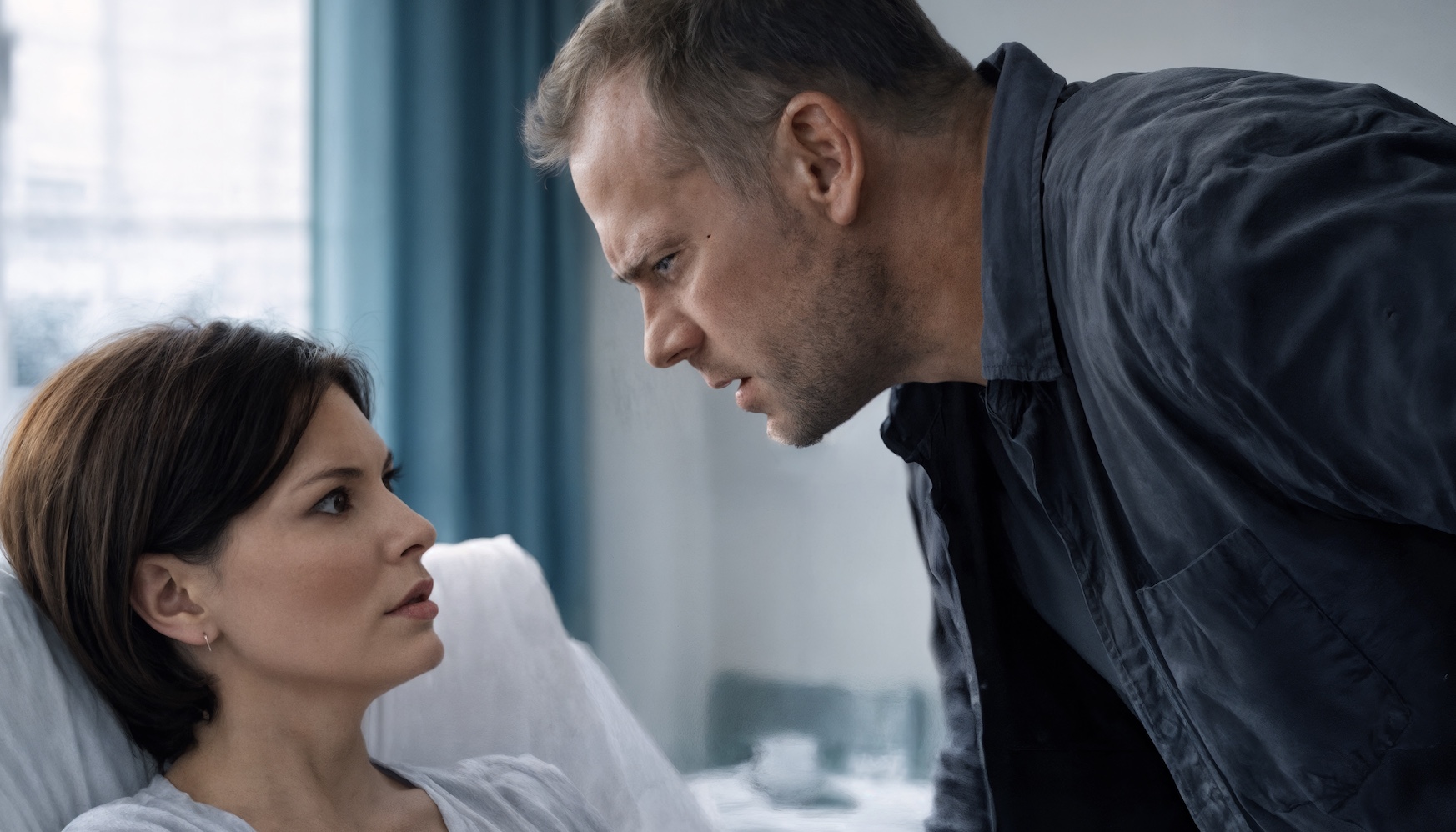
Sveta opened her eyes as dusk deepened beyond the hospital window. Her head felt heavy, and the weakness in her body had not eased since the day before. The second day in the hospital was proving difficult—her strength was coming back slowly, and even the smallest movement took effort. She lay still, staring at the white ceiling, trying not to think about how long this would last.
The attack had come out of nowhere. Late in the evening, after finishing dinner preparations, Sveta felt a sharp pain in her abdomen. At first, she assumed she had simply eaten too much, but within an hour the pain became unbearable. Pyotr called an ambulance, and the doctors quickly identified the problem and took her to the hospital. The diagnosis was serious—acute pancreatitis with complications. She needed close monitoring, IV treatment, and strict rest.
She had not expected Pyotr to visit. When the ambulance took her away, he stayed behind, saying he would stop by in the morning. But morning came and went, then the entire day passed, and only now, late on the second evening, did the ward door open. Sveta turned her head and saw her husband. There was no worry on his face, no concern—only the familiar expression of a man who had come because there was something to handle.
“You came,” Sveta said softly, trying to lift herself on one elbow. The movement cost her dearly, and she sank back onto the pillow.
Pyotr nodded and glanced around the room—three beds, bedside tables, a window overlooking the next building. His eyes moved over the IV stand and the medical equipment, but his face remained unreadable. He came over to the bed, yet instead of sitting close beside her, he stopped at the foot of it, one hand resting on the metal rail.
“How are you?” he asked, without much interest, as if going through a required formality.
“Better than yesterday,” Sveta answered. “The doctor said the worst is over, but I still need to stay here. At least five more days, maybe a week.”
Pyotr frowned. Sveta saw his shoulders tense and his eyes narrow. She knew that look well—it appeared every time something failed to fit into his plans.
“A week?” he repeated. “Why so long?”
Sveta sighed. She had no desire to explain medical details, no desire to justify herself. But old habits were hard to break.
“My pancreas was inflamed. It’s serious, Petya. I need time to recover.”
Pyotr sat down on the chair, though he still did not move any closer. He pulled out his phone, looked at the screen, then slipped it back into his pocket. Sveta could tell he was weighing something in his mind, choosing his words. She waited for him to ask about the treatment, what the doctors had said, whether she needed him to bring anything. Instead, he began talking about something entirely different.
“The house is a disaster,” he started, looking not at his wife but somewhere past her, toward the window. “I tried cooking dinner yesterday, and it was a mess. Burned the frying pan, ruined the pot too. I don’t even know where you keep anything.”
Sveta stayed silent. She understood where this was heading, but she did not want to believe he would actually say it out loud.
“The laundry hasn’t been done,” Pyotr continued. “I’m out of clean shirts, had to wear an old one. And the fridge is empty. I bought some frozen meals, but that’s not real food.”
Sveta closed her eyes. She wanted to shout that she had not landed here by choice, that an ambulance had brought her in while she was doubled over in agony, that she had barely managed to stay conscious. But instead, she only asked quietly,
“And what exactly are you suggesting?”
Pyotr looked at her, and there was not a trace of understanding in his expression. He spoke as though they were discussing some small domestic inconvenience that could be solved in minutes.
“You’ve rested enough,” he said with certainty, as though stating something obvious. “There’s plenty to do at home, and you’re lying here taking it easy.”
Sveta went still. His words were so clear, so casual, that for a second she wondered if she had misheard him. Slowly, she opened her eyes and looked at him, trying to figure out whether he was joking or serious. But his face remained perfectly calm, without even a flicker of irony or doubt.
“What did you just say?” Sveta asked quietly, unable to believe her ears.
“I said it’s time to come home,” Pyotr repeated, a note of irritation in his voice. “You’ve already been here two days. That’s enough. Doctors always overdo it—they keep people longer than necessary. And I have a mountain of things waiting for me at home. I don’t have time to deal with cooking and cleaning.”
Sveta slowly pushed herself up on one elbow, fighting through the weakness. The IV line tugged at her arm, and she carefully adjusted it. Her gaze turned sharp and focused—as if for the first time in years she was truly seeing the man she had lived beside for so long.
“Do you honestly think I’m resting here?” she asked, and for the first time during the conversation, steel entered her voice.
Pyotr shrugged, as though the question itself were ridiculous.
“Well, what else would you call it? You’re in bed, they feed you, they take care of you. No rush, no responsibilities. I wouldn’t mind that kind of break myself.”
Sveta felt her face flush hot. Blood rushed to her cheeks, betraying the anger she was struggling to contain. She clenched her fists, trying not to snap, not to raise her voice. But inside, everything was boiling—hurt, outrage, and the bitter realization that the man before her was not even trying to understand what she was going through.
“Pyotr,” she began slowly, pronouncing every word with deliberate clarity, “I am not resting here. I am being treated. I had a serious attack. The pain was so bad I could hardly breathe. I was brought here by ambulance. I’m on IV medication. This is not a vacation.”
Pyotr waved his hand, brushing her words aside as if swatting an irritating fly.
“You’re exaggerating. You always do. Every little thing turns into a catastrophe. So your stomach hurt—so what? You could’ve taken a pill at home and it would’ve passed.”
Sveta fell silent. In that moment, she understood there was no point arguing. Pyotr was not listening. He did not want to listen. To him, his wife’s illness was an inconvenience, a disruption of the routine he was used to. He did not care how she felt, how much pain she was in, or how serious the diagnosis was. There was only one thing on his mind—who would cook, wash, and clean.
“I’m not leaving before the doctors say I can,” Sveta said firmly. “The doctor decides when I’m discharged. Not you.”
Pyotr pressed his lips together in irritation. He stood up, paced across the room, and stopped by the window. Sveta saw how rigid his back was, how tightly his fists were clenched. He had clearly expected something else—obedience, agreement, excuses. But Sveta no longer felt any need to explain herself.
“You know what I think?” Pyotr said, turning toward her. “I think you just don’t want to come back. It suits you here, hiding behind the doctors and shifting responsibility onto them. And I’m supposed to tear myself apart between work and the house?”
“You can hire help,” Sveta replied calmly. “There are cleaning services. There’s food delivery. Or ask your mother to help. She lives nearby.”
Pyotr’s face changed immediately.
“My mother? So she can go around telling everyone my wife is lying in the hospital while her husband does everything himself? No thanks.”
Sveta closed her eyes tiredly. The conversation was going in circles. She knew Pyotr would not let it go easily, that he would keep pressing, trying to force her into agreement. But she no longer had the strength to play that game.
“Listen,” Pyotr said, changing tactics. His voice softened, almost becoming tender. “I’m not trying to hurt you. I’m just exhausted. Work, the house—everything’s on me alone. You understand how hard this is for me without you, don’t you?”
Sveta opened her eyes and looked at him. Once, those words would have worked on her. She would have felt guilty, offered a compromise, maybe even agreed to leave early. But now something had shifted. Maybe the pain she had gone through had burned away the last of her willingness to sacrifice herself for someone else’s comfort. Or maybe she was simply exhausted from always being the one who gave in.
“It’s hard for me too,” she said quietly. “But I’m not here because I want to be. I’m here because I’m sick. And if you can’t understand that, then I have nothing left to say to you.”
Pyotr frowned. The softness vanished from his face, replaced by annoyance.
“See what you’ve become?” he snapped. “Selfish. You only think about yourself.”
Sveta did not answer. She simply looked at him, and there was no anger in her gaze, no hurt—only exhaustion. Exhaustion from endless complaints, from always being taken for granted, from always coming last.
“Go, Pyotr,” she said evenly. “I need to rest.”
He did not move right away. He stood by the window with his arms folded across his chest, staring at her in disbelief. Sveta could see he had not expected this. Usually she yielded, tried to smooth things over, tried to please him. But not now.
“You’re seriously throwing me out?” he asked, astonishment creeping into his voice.
“I’m not throwing you out. I’m asking you to leave because this conversation is going nowhere. You don’t understand what’s happening to me, and it seems you don’t want to. So why are you standing here?”
Pyotr jerked one shoulder, turned, and headed for the door. At the threshold he stopped and tossed over his shoulder,
“Fine. Stay as long as you want. But when you come back, don’t expect things to be the same.”
The door shut behind him with a dull thud. Sveta was alone again. She lay back and stared at the ceiling, feeling the tension slowly drain from her body. There were no tears—only emptiness and an odd sense of relief. As if a heavy burden she had carried for years had finally slipped from her shoulders.
The next morning, her friend Vera came to visit. She brought fruit, juice, and fresh pastries from a bakery near the hospital. Vera was one of the few people Sveta could speak to honestly, without fear of judgment.
“How are you?” Vera asked, sitting down beside the bed.
“Better,” Sveta replied. “The pain has almost gone, the IVs are helping. The doctor says that if everything continues like this, I’ll be discharged in four days.”
“And Pyotr? Did he come?”
Sveta nodded and told her about his visit the night before. Vera listened without interrupting, but her expression darkened with every word. When Sveta finished, Vera slowly shook her head.
“He really said you were relaxing in here?”
“Yes. And it’s not the first time he’s said things like that. Before, I ignored it. I kept telling myself maybe he just didn’t know how to show concern.”
“Sveta, that isn’t concern. That’s selfishness. He’s only thinking about himself.”
Sveta sighed. She knew Vera was right, but saying it out loud made it real. It meant admitting that the man she had lived with for years did not truly see her as a person, only as someone convenient to keep the household running.
“You know what’s strangest?” Sveta said after a pause. “I always thought we were a team. That we were building a life together, supporting each other. But it turns out I was just performing functions. Cooking, cleaning, washing. And as long as everything ran smoothly, it was fine. The second I got sick, he showed me exactly what he really thinks of me.”
Vera took Sveta’s hand and squeezed it tightly.
“You don’t have to put up with this. You do not have to be convenient for him.”
“I know,” Sveta said softly. “But I’m scared. Scared to change my life, scared to be alone. I’m over forty, Vera. Starting over… it’s frightening.”
“Starting over is always frightening. But staying in a relationship where you’re not valued is worse. You deserve better.”
Sveta nodded. She had no idea what would happen next, but one thing had become absolutely clear—something inside her had changed. The illness, the pain, her husband’s indifference—all of it had come together in one moment when she finally saw the truth. And once seen, it could not be unseen.
Over the next few days, Sveta had plenty of time to think. The IVs continued, her condition improved, yet her thoughts would not let her rest. She remembered how her relationship with Pyotr had begun. He had been charming, attentive, always joking. She had believed she had found someone with whom she could build a happy life.
But slowly, year after year, something changed. Pyotr sank deeper and deeper into work, and cared less and less about what was going on in her life. Sveta took on the entire household, telling herself that it was normal, that this was simply how things were supposed to be. But over time she realized that what was expected of her was not partnership, but service. No one asked for her opinion anymore. No one noticed when she was tired. She had become a backdrop for Pyotr’s life.
She remembered once suggesting they go to the sea together. Pyotr had refused, saying he was too busy. A month later, she found out he had gone fishing with his friends. She had not made a scene, had not asked for explanations. She swallowed the hurt and kept living as though nothing had happened.
How many moments like that had there been? How many times had she stayed silent, yielded, bent herself out of shape? And where had it led? To a place where her illness was treated as an inconvenience and her treatment as a holiday.
On the fourth day, Sveta called Vera and asked her to bring a few things from home. Vera arrived an hour later with a bag of clothes, documents, and Sveta’s phone, which had been left at the apartment.
“Was Pyotr there?” Vera asked.
“No, he was at work. I used the spare key you gave me.”
Sveta nodded, turned on her phone, and saw several messages from her husband. All of them were short and dry: “When are you getting discharged?”, “Buy milk when you come back,” “Don’t forget the dry cleaning.” Not a single word asking how she felt. Not one question about her treatment.
She placed the phone on the bedside table and decided not to respond. Not yet. She needed time to figure out what to do next. The doctor had said she would likely be discharged tomorrow if her tests came back normal. Which meant she would soon have to go home. And there, Pyotr would be waiting with his complaints and resentment.
But Sveta no longer wanted to live the way she had before. She did not want to be invisible, did not want to be taken for granted. If Pyotr could not change the way he treated her, then something else would have to change.
That same evening, Pyotr came after all. He entered the room looking irritated and dropped a bag of groceries onto the bedside table.
“Brought you some apples,” he muttered. “Though judging by the way you’re ignoring me, you probably don’t need them.”
Sveta looked at the bag, then at her husband.
“Thank you,” she said evenly, without emotion.
“When are you getting out?” Pyotr asked, remaining on his feet.
“Tomorrow. If the tests are good.”
“Finally,” he exhaled with relief. “I’m tired of this mess already. Everything at home is falling apart without you.”
Sveta said nothing. She looked at Pyotr and saw a man who, even now, after several days of her illness, still did not understand what she was going through. The only thing that mattered to him was restoring the usual order—having her become convenient again, quiet again, always ready to meet his needs.
“Pyotr,” she began slowly. “We need to talk.”
He frowned.
“About what?”
“About us. About the way we live. About what’s happening between us.”
Pyotr waved his hand dismissively.
“Not now, Sveta. I’m tired, I want to go home. We’ll talk when you’re back.”
“No,” she said firmly. “We’re talking now.”
Pyotr sat down reluctantly, crossing his arms over his chest. Sveta could see he had no interest in a serious conversation, but it no longer mattered. She was done postponing what had been waiting to be said for years.
“When you came here the first time, you said I was relaxing,” Sveta began. “You didn’t ask how I felt. You didn’t ask what the doctors were saying. The only thing you cared about was who would do the housework.”
“I already explained—” Pyotr started, but Sveta cut him off.
“No, you didn’t explain anything. You showed me exactly what I mean to you. I’m not your wife, not your partner. I’m just a housekeeper who is supposed to always be available and do her job.”
Pyotr’s face changed.
“That’s nonsense. I love you, you know that.”
“No, I don’t,” Sveta replied calmly. “Love isn’t just words. It’s actions, attention, care. And you showed me none of that. You came to my hospital room with complaints instead of support.”
Pyotr fell silent. He looked down at the floor, and the anger on his face was impossible to miss. But Sveta no longer cared what he felt. She was not speaking for him anymore. She was speaking for herself—to finally say out loud everything that had been building inside her for years.
“I don’t want to live like this anymore,” she continued. “I don’t want to be invisible. I don’t want to be taken for granted. I’m tired of my opinion never mattering, of my needs always coming last.”
“And what exactly are you suggesting?” Pyotr asked coldly.
“I’m suggesting that either this relationship changes, or it ends.”
Pyotr shot up from the chair.
“You’re joking? Divorce because I asked you to come home? Have you lost your mind?”
“Not because of that,” Sveta answered calmly. “Because you don’t even understand what the real problem is. In your eyes, I’m at fault for getting sick. I’m at fault because your life became less convenient. And not once have you stopped to think about what I’m feeling, what I’m going through.”
Pyotr stood there with his fists clenched, staring at his wife in fury. Sveta could see he was searching for words that would force her back into silence, put everything back where it had been. But she was done yielding.
“Health is not optional, Pyotr,” she said firmly. “It’s not something to negotiate over. I’m not here because I want to be. I’m here because I am unwell. And decisions about my condition are made by doctors, not by your list of household chores.”
Pyotr had no answer. He stood there another minute, then turned and headed for the door. At the threshold he stopped and looked back.
“You’ll regret this,” he said.
“Maybe,” Sveta replied. “But right now, the only thing I regret is staying silent for so long.”
The door closed, and Sveta was alone again. She lay back, shut her eyes, and felt an unfamiliar calm settle over her. It was as if something inside her had finally fallen into place. She did not know what would happen next, whether Pyotr would come back, whether he would change. But one thing was certain—she would not sacrifice herself for someone else’s comfort anymore.
The conversation had ended quickly because one thing had become obvious: pressuring her would no longer work. Pyotr left angry, without getting the agreement he had expected. He had counted on obedience, on her readiness to submit. Instead, he met a firm refusal. And that broke whatever power he thought he had.
The next day, Sveta was discharged. Her tests were normal, the doctor gave her instructions, and she was allowed to go home. Vera came to pick her up and drive her back. During the ride, they said little. Sveta stared out the window, thinking about what was waiting for her there.
When they reached the building, Sveta asked Vera to wait downstairs. She went up to her floor, unlocked the door, and stepped inside. The apartment was quiet. Pyotr was at work. She looked around—the sink was full of dirty dishes, clothes were scattered across the floor, and the table was buried under grocery bags.
She walked into the bedroom, pulled a suitcase from the closet, and began packing. She did not take much—only the essentials. Documents, clothes, toiletries. She realized she could not stay there. Not now. She needed time to think, to decide what came next.
Twenty minutes later, Sveta came downstairs carrying her bag. Vera looked at her questioningly.
“I’m going to stay with you for a couple of weeks, if that’s okay,” Sveta said.
“Of course it is,” Vera replied, hugging her friend. “Stay as long as you need.”
In that moment, Sveta understood one thing with absolute clarity: if someone sees your treatment as a vacation, then they need to get used to the fact that you are choosing yourself now—with no explanations and no apologies. She did not know what her life would look like from here. Maybe she would return to Pyotr if he truly changed. Maybe she would file for divorce and begin again from scratch. But one thing was beyond doubt—she would never again allow anyone to diminish her pain, her health, or her life.
Sveta settled into Vera’s car, leaned back against the seat, and closed her eyes. Ahead of her lay uncertainty, unanswered questions, and difficult choices. But the heaviness inside her was gone. For the first time in a long while, she felt she was living for herself rather than for someone else’s convenience. And that was what mattered most.
The car pulled away, and Sveta opened her eyes. In the rearview mirror, she could see the life she was leaving behind—a life built on silence, compromise, and self-sacrifice. Ahead of her was a new road. It was unknown, and it was frightening, but Sveta knew she would make it through. Because now, she was choosing herself. And that was the most important choice she had ever made.