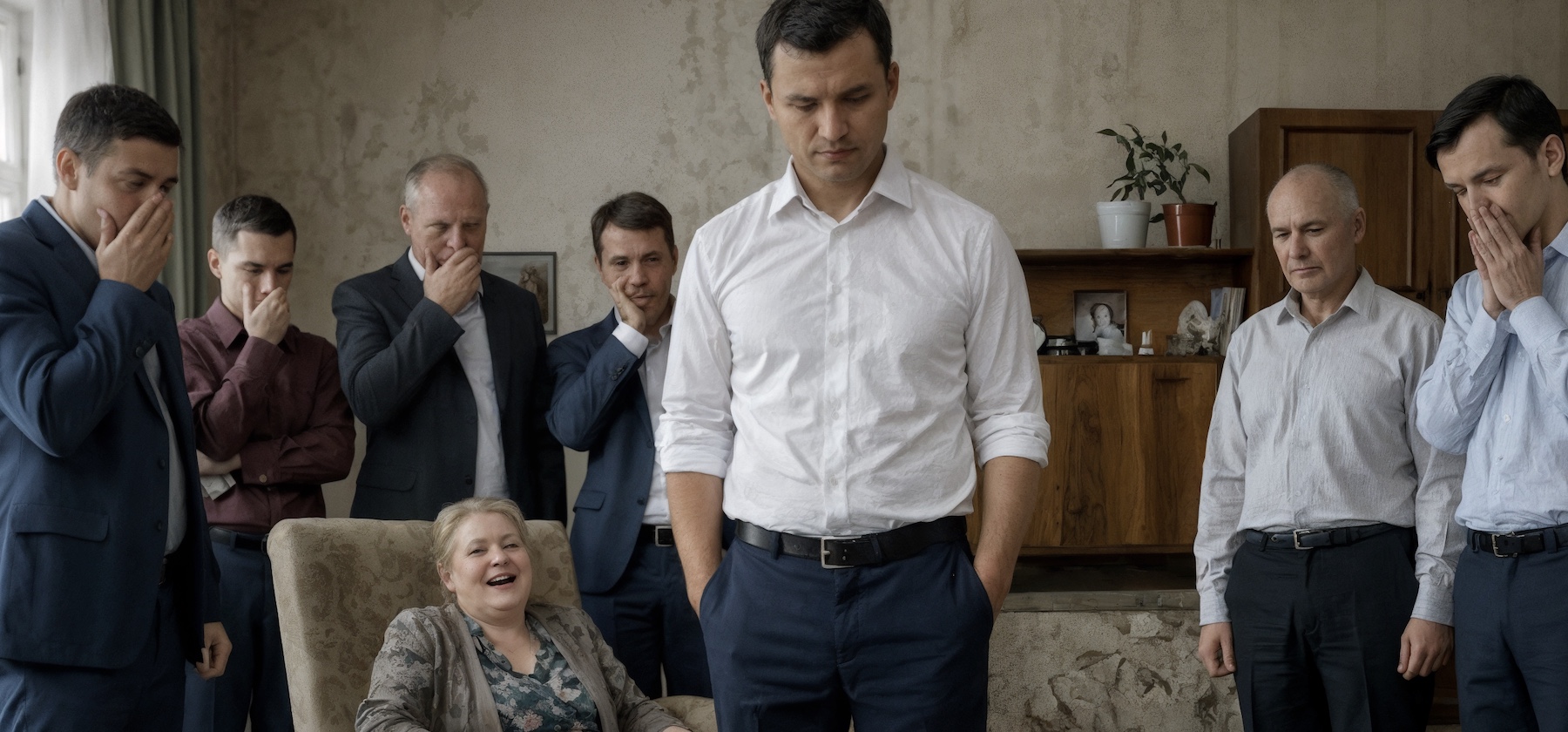
The pile of the rug—cheap, synthetic, carrying the stale scent of dust and recent cleaning—ground into Alla’s right cheek. At first, she did not even realize she was lying on the floor. There had only been a sudden wrench at her shoulder, the tearing sound of silk at the seam of her blouse, and then the world had flipped and smashed her face against the ground.
Ilya stood above her. His face, usually polished and self-satisfied, was now warped into a grotesque mask of superiority. Nine people—his “team,” sales managers he had invited over to celebrate yet another bonus—had frozen in place. One man held a whiskey glass suspended in midair. Another had stopped chewing a caviar tartlet.
“Know your place, cook!” Ilya’s voice boomed through the room, bouncing off the stretch ceiling. “In this house, you speak only when I say you can. Understood?”
From the kitchen, Alla heard the kettle screaming on the stove. Its thin, piercing whistle cut straight through the silence in the living room. Then came laughter. Raisa Stepanovna, her mother-in-law, leaned back in a deep armchair with a glass of wine in hand. Her laugh was dry and brittle, like branches snapping underfoot.
“Oh, Ilyusha, just like his father!” she forced out between bursts of laughter, dabbing at a tear in the corner of her painted eye. “She used to try acting smart too whenever the men were discussing important matters. Stay there, Allochka, stay there. You may as well wipe the floor with that blouse of yours—it looks dusty in here anyway.”
Ilya’s coworkers kept silent. One looked away toward the window, where the evening darkness of Biysk was thickening behind the glass. Another became suddenly fascinated by his shoes. No one moved. At work, Ilya was a king, and his temper could cost them their bonuses.
Slowly, Alla rolled onto her back. Her head was buzzing, and a metallic taste had filled her mouth—she must have bitten her lip. She looked up at Ilya. He wore the expression of a man who believed he had just accomplished something grand. He was inflated with his own importance. He was not seeing her as a person. He was seeing a “place” he believed he had just put back where it belonged.
“7:12 p.m.,” Alla said quietly.
“What are you mumbling?” Ilya snapped, kicking the edge of the rug just inches from her hand. “Get up and go to the kitchen. Turn off that kettle, it’s driving me crazy. And bring more ice. Now.”
Alla got to her feet slowly, steadying herself against the edge of the TV stand. The blouse she had bought with her last paycheck from the treatment room really had split hopelessly along the seam. She did not bother brushing herself off. She walked into the kitchen, took the kettle off the stove, and the whistle died. In the sudden silence, voices from the living room drifted in—his coworkers had begun cautiously talking again, trying to pass the whole thing off as a joke.
“Well, Ilya, that was something… You were pretty harsh on her.”
“And what else am I supposed to do?” Ilya laughed, slapping someone on the shoulder. “A woman has to know who runs the house. Otherwise she climbs onto your neck. Mom, tell them.”
“True, son, absolutely true,” came Raisa Stepanovna’s satisfied voice.
Alla stood at the kitchen window, looking down at her hands. Her fingers were dusted with flour—she had been about to finish shaping the second batch of dumplings for these “guests” when Ilya exploded over some trivial thing. She thought it had started because she asked when he planned to return the money for the heating bill, which he had once again “put into the business.”
She picked up her phone. There was an incoming call from her lawyer. Eleven minutes earlier, she had sent him her last message.
“Hello,” she whispered. “Yes. They’re all here. Everything is happening exactly like this. Yes, I’m ready.”
She ended the call and looked at the kitchen clock. 7:18 p.m.
In six minutes, her life was supposed to change forever.
Ilya leaned into the kitchen doorway.
“Where’s the ice? Did you fall asleep in here?”
“Ilya,” Alla said, turning toward him. Her voice was unnaturally calm. “You do remember that this apartment belonged to my grandmother, don’t you?”
“Oh, here we go again…” He grimaced. “We’ve gone over this a hundred times. Yours, mine—what difference does it make? We’re family. I paid for the renovations here! That tile in the bathroom alone cost thirty thousand.”
“You bought that tile with my bonus from the COVID shifts,” Alla reminded him. “And my grandmother left the apartment only to me in her will. Half a year ago, after the first time you hit me, I did something. Something I ‘forgot’ to tell you about.”
“I don’t give a damn what you did!” Ilya snapped, stepping toward her and raising his hand. “You’re going to take out that ice and smile at my guys, or else—”
At that exact moment, the doorbell rang. Three short, insistent rings.
“Oh.” Ilya froze, lowering his arm. “That’s probably Pashka running late. Or the pizza delivery—I ordered more. Go answer it. What are you standing there for?”
Alla walked past him into the hallway. Her legs felt weak, but she kept her back straight. In the living room, her mother-in-law was already entertaining the guests with stories about how little Ilyusha had been “the man of the house” even back in kindergarten.
Alla opened the door.
Three men were standing there. One wore a strict gray suit and carried a leather folder under his arm. Another was a short police officer in uniform. The third was taller, dressed in work gear bearing the logo of a private security company.
“Alla Sergeyevna Volkova?” asked the man in the suit.
“Yes,” she breathed.
“We are here regarding your complaint. The court order for forced eviction and the interim enforcement measures took effect today at 5:00 p.m. We are ready to begin.”
Ilya, who had stepped into the hallway holding a glass in his hand, choked on his whiskey.
“What eviction? Who the hell are you? You’ve got the wrong address, guys! We’re having a private party here—get out!”
The police officer stepped forward, his expression cold and bored. He had seen scenes like this every week.
“Captain Sazonov. Show identification, please. Are you Ilya Viktorovich Volkov?”
“Well, yes,” Ilya said, turning pale. “So what? This is my house. My apartment.”
“According to the state property registry,” the man in the suit said—this was Alla’s lawyer, Mark Borisovich—“the sole owner of this residence is Alla Sergeyevna. You are not registered here and hold no ownership share. The gratuitous use agreement Alla Sergeyevna signed with you last year was terminated unilaterally a month ago. Notice was sent to you by registered mail at your mother’s address. You received it and signed for it.”
Raisa Stepanovna drifted out of the living room, her laughter finally gone.
“What notice? Ilyushenka, what are they talking about? Allochka, tell them this is some kind of joke! The boys are watching, this is embarrassing!”
By then, Ilya’s nine coworkers had crowded into the doorway to the living room. The silence was so thick that the elevator on the landing could be heard moving.
“This is not a joke, Raisa Stepanovna,” Alla said at last, looking directly at her mother-in-law. “A month ago, I filed the suit. And this morning I received the writ of enforcement. Ilya Viktorovich must leave the premises. Right now.”
“Are you out of your mind?” Ilya suddenly shouted, lunging toward her. “You’re humiliating me in front of my people? I’ll—”
The security guard moved between them instantly. He did nothing more than place a hand on Ilya’s shoulder—not roughly, but firmly enough that Ilya stopped at once.
“Easy there, citizen. Don’t make it worse. Article 19.3—failure to comply with a lawful order. Do you really need that?”
Mark Borisovich opened his folder.
“Ilya Viktorovich, you have fifteen minutes to collect your personal belongings. The furniture, appliances, and all other property will remain here until a full inventory is completed, since you cannot provide receipts proving they were bought with your personal funds rather than your wife’s. According to Alla Sergeyevna’s bank statements, she paid for all major purchases over the last two years.”
“This is robbery!” shrieked Raisa Stepanovna. “My son bought everything! He’s a director!”
“A director of a company with a zero balance and tax debts up to its neck?” Mark Borisovich lifted one eyebrow with dry irony. “We reviewed your son’s records before going to court.”
Ilya turned toward his coworkers. Nine pairs of eyes were fixed on him. But now there was no fear in them. Only curiosity, disgust, and that deadly expression of “well, would you look at that,” the kind that destroys a reputation faster than any formal complaint.
“Ilya Viktorovich,” Alla said softly. “It’s 7:24 p.m. Your time has started. Your ‘place’ is out there now—on the other side of the door.”
The packing was quick and ugly. Ilya shoved his suits into a sports bag with frantic hands—the same suits Alla carefully steamed every Sunday. He cursed under his breath, tossed things around, missed half of what he grabbed. Raisa Stepanovna tried to sneak an expensive skincare set of Alla’s out of the bathroom, but one sharp look from the guard stopped her cold.
Ilya’s coworkers began to leave. They slipped out quietly, doing their best not to look at the man they had admired only the day before. One muttered, “Sorry.” Another simply let the door shut behind him. The last to leave was Pashka—the one who had laughed hardest at the joke about the “cook.” He paused for a second near the door, looked at Alla, and gave her a brief nod. That nod said everything: recognition of her strength, and understanding that Ilya would not be keeping his place in the department much longer.
When only Ilya remained in the hallway with his overstuffed bag and Raisa Stepanovna standing hunched beside him, Alla walked to the chest of drawers and took out a small envelope.
“There are five thousand rubles in here, Ilya,” she said, placing it on top of his bag. “Enough for a taxi to your mother’s place and to get by for a little while. Your salary for the last month—the part you transferred to your hidden account—has already been frozen by court order against future spousal support and compensation for the damage to my belongings.”
Ilya stared at her. There was no fire left in his eyes now. Only the emptiness of a man who had spent his life leaning on other people’s walls and had suddenly discovered those walls were made of cardboard.
“You’ll regret this, Alla,” he rasped. “You’ll die alone. Who needs you? You’re just a low-paid nurse.”
“I need myself,” Alla said. “Turns out that matters far more.”
When the door closed behind them, Mark Borisovich and the security guard said their polite goodbyes. The police officer stayed a little longer to finish the enforcement report.
“How are you holding up, Alla Sergeyevna?” he asked, slipping his pen back into his pocket. “Would you like some water?”
“No, thank you,” she said with a faint smile. “I’ve had a kettle boiling in there for a while already.”
Then she was alone.
The apartment was astonishingly quiet. The rug still lay on the floor in the living room, marked by the place where her cheek had pressed into it. Alla went back into the kitchen and poured herself some tea. She sat at the table, where the half-finished dumplings were still waiting.
She thought of how, just twelve minutes earlier, she had been lying on that floor listening to her mother-in-law laugh. At the time, it had felt like her whole world was collapsing. But now she understood: her world had not fallen apart. It had been cleared out.
Alla picked up a piece of dough and rolled it flat. The steady, mechanical motion soothed her. She would not eat anything left from that “party” tonight. She would throw all of it away. Tomorrow she would buy new curtains. And a new blouse. And on Monday she would go back to her shift at the treatment room, where people truly valued her hands and her calm presence.
She looked at the clock with the whistle-shaped hands. 8:05 p.m.
Her first night in her own home. No shouting. No fear. No cruel laughter over her head.
She tore off a piece of bread and took a bite. It tasted good. Just bread. Just silence.
And that was how it began.