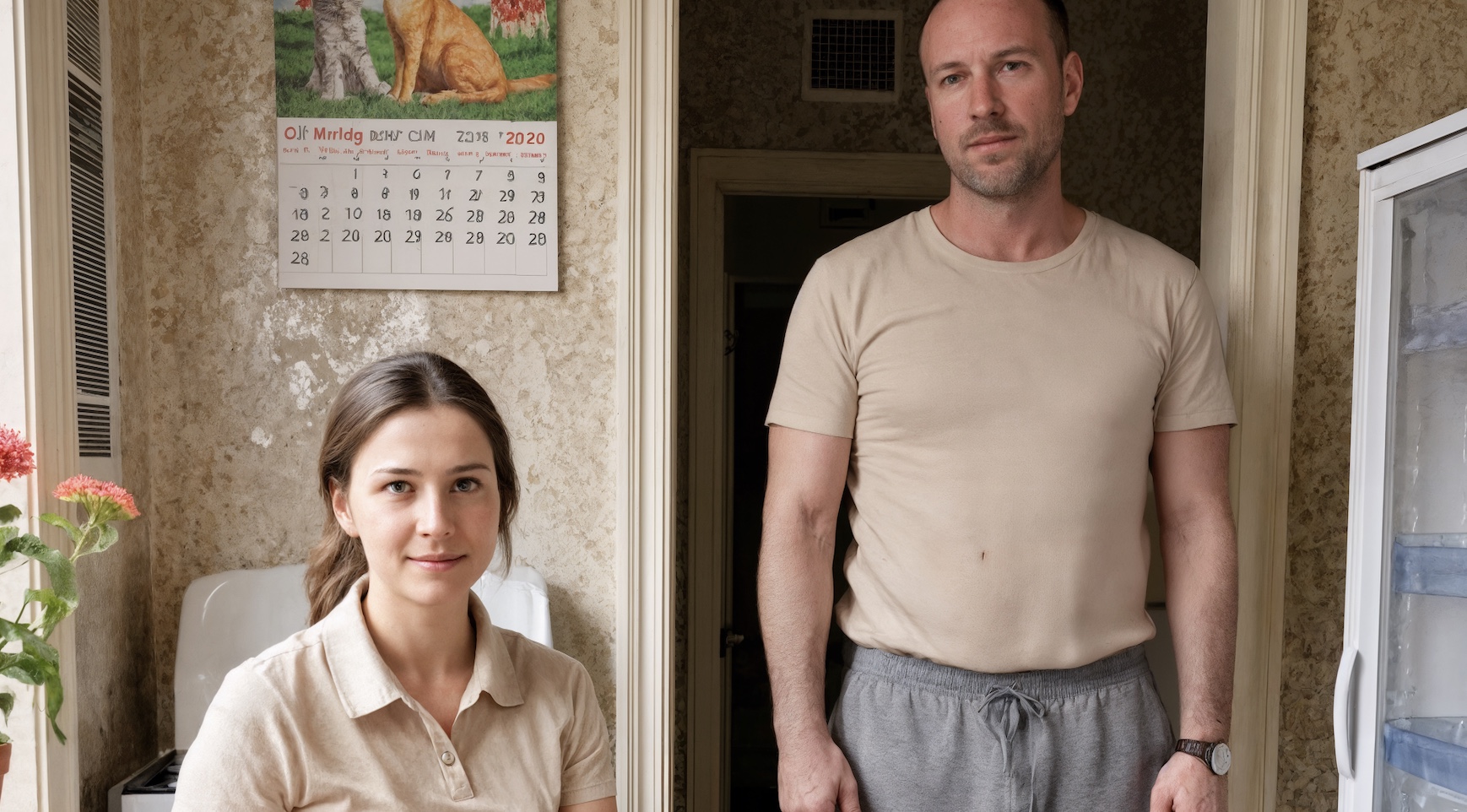
“Olezha, we’re out of sunflower oil, and there’s only enough laundry detergent left for one more wash,” Nina said from the doorway, drying her wet hands on her apron. “We really need to go to the store. The shopping list has gotten pretty long.”
Without taking his eyes off the television, where some tense football match was playing, Oleg gave an irritated shrug.
“Nina, you know how things are,” he drawled without even turning his head. “They’re delaying pay again at the factory. The foreman said we can forget about bonuses this month. I gave you my last two thousand the day before yesterday. Make it last somehow.”
Nina let out a heavy sigh. She had been hearing that phrase — make it last somehow — nonstop for the past six months. As if the family budget were made of rubber and could be stretched forever. Quietly, she went back into the kitchen, opened the fridge, and looked miserably at a lone jar of pickles and a pot with the remains of yesterday’s soup. It was a thin meatless soup made with chicken backs, because they hadn’t bought proper meat in nearly three weeks.
Nina worked as the head nurse at the city clinic. Her salary was steady, but small. Back when Oleg used to bring home good money, they lived decently enough: they went to the seaside once a year, bought new clothes, and their refrigerator was always full. But then, according to him, the factory had fallen on hard times. Wages had been cut, bonuses canceled, and now he was bringing home next to nothing — barely enough, supposedly, to cover utilities and his own gas.
All the responsibility for groceries and household basics had landed on Nina’s shoulders. She picked up extra shifts, worked weekends, and did everything she could to keep them afloat. And Oleg… Oleg came home tired, dropped onto the couch, lamented the unfairness of life, and still expected a full dinner with multiple dishes.
“Make it last,” Nina whispered, staring at the empty oil dish. “There’s nothing left to stretch. It’s going to snap.”
The next day after work, Nina stopped by the supermarket as usual. She stood for a long time at the meat counter, looking at juicy cuts of pork neck, but in the end she chose a tray of chicken gizzards. Cheap and practical. If you stewed them long enough with sour cream, they turned out edible.
At the checkout, she scraped together every last coin in her wallet. There were still three days left until her advance payment, and her purse was completely empty.
That evening, while the gizzards simmered on the stove, Nina decided to dust the entryway. Oleg was already asleep, worn out by a hearty dinner and a couple cans of beer that, according to him, he had bought “with some spare change he’d saved.”
Nina picked up her husband’s jacket to hang it more neatly and felt something in the inner pocket. She knew it wasn’t right to go through his things, but the habit of checking pockets before washing clothes kicked in automatically. Her fingers found a folded slip of paper.
It was a receipt. But not from a grocery store.
It was an ATM receipt, printed just that evening at 6:45 p.m.
Nina unfolded it and felt the floor drop out from under her.
Account balance: 345,000 rubles.
She blinked, thinking she must have read it wrong. Maybe she had misplaced the comma. No. The numbers were perfectly clear. And above that was another line:
Salary deposited: 78,000 rubles.
Seventy-eight thousand.
And he had brought home two.
He had told her that was all he got.
Nina slowly lowered herself onto the small bench in the hallway. Her head was ringing. She remembered how, just a month earlier, she had walked around in old boots that leaked because Oleg had said, “Just hang on a little longer, Nina, we have no money at all.” She remembered putting off a visit to the dentist and dulling the pain with pills. She remembered the chicken backs. The gizzards.
The hurt spread through her chest, hot and corrosive like acid. It wasn’t even hurt anymore. It was betrayal. While she was saving on sanitary pads and tea, he had been quietly piling up hundreds of thousands. For what? A new car? Another woman? Or simply out of greed, because he believed his wife should feed the family on her own?
Nina carefully slipped the receipt back into the pocket.
She wanted to storm into the bedroom, shake him awake, shove the paper in his face, scream, smash dishes, throw him out on the spot.
But she stopped herself.
A scandal would solve nothing. He would start making excuses, lying, saying he had been saving for a surprise or that the bank had made a mistake.
No. This needed a different approach.
She went back into the kitchen and turned off the stove. The gizzards smelled good, but she had completely lost her appetite. She packed the food into a container, but instead of putting it in the shared refrigerator, she slipped it into the work bag she took with her every day.
If there’s no money, then there’s no money, she thought with grim satisfaction.
The next morning, Nina left for work earlier than usual without making Oleg any breakfast. She left an empty plate on the table and a note:
Sorry. We’re out of food. No money. Drink some water.
All day at the clinic she worked on autopilot, but her mind kept circling back to her plan for the evening. At lunch, she went to the cafeteria and, for the first time in a long while, got herself more than just a salad. She ordered goulash with mashed potatoes, compote, and a sweet bun. She ate well, slowly, with real pleasure.
That evening she came home light and unburdened. No heavy shopping bags. No grocery sacks. Her hands were free, her back straight.
Oleg met her in the hallway, looking irritated.
“Nina, why are you so late? I’m starving. The fridge is completely empty — there aren’t even any eggs. Did you stop at the store?”
Nina calmly took off her coat, removed her shoes, and walked into the room.
“No, Olezha. I didn’t.”
“What do you mean, you didn’t?” He followed after her. “So what are we supposed to have for dinner?”
“There is no dinner,” Nina said, sitting on the couch and picking up a book. “I told you the day before yesterday — there’s no money. My advance doesn’t come until the day after tomorrow. Today at work I drank plain tea and went hungry. You can do the same. We’re in a crisis, remember?”
Oleg stared at her.
“You’ve got to be kidding. Where’s the soup? The main dish? You always came up with something!”
“My imagination ran out, darling. You can’t shape cutlets out of thin air. You said it yourself — there’s no money. I spent my tiny salary on utilities and transportation. That’s it. The budget is empty.”
Oleg stood in the middle of the room opening and closing his mouth. Apparently, he had expected Nina to work her usual miracle: borrow from a friend, pull cash from some secret stash he assumed every woman had, or simply conjure food from the depths of the cupboards.
“Well, this is something…” he muttered. “So what am I supposed to do?”
“Drink some water. Or go to bed early. Hunger doesn’t feel as bad when you’re asleep.”
Oleg snapped, slammed the door, and marched into the kitchen. Nina could hear him rattling cabinets, opening and slamming the refrigerator, rustling through bags of dry goods. Apparently he found some leftover pasta, because before long the smell of boiled dough filled the apartment. Nina smirked. Plain pasta with no butter and no sausages — an excellent meal for a man with three hundred thousand sitting in his account.
The next day, the same thing happened again.
Nina ate a solid lunch at work, then on her way home bought herself a cup of coffee and a pastry, which she enjoyed on a quiet park bench. By the time she got home, she was full and calm.
This time Oleg met her not with confusion, but with anger.
“This isn’t funny anymore, Nina! I’ve been eating plain pasta for two days! Are you doing this on purpose? Are you the mistress of this house or what?”
“I’m your wife, Oleg, not a magician,” she shot back. “I can’t buy groceries without money. Give me money, and I’ll go to the store, make borscht, fry cutlets — whatever you want. So what exactly is the problem?”
“I told you, I don’t have any!” he barked, but his eyes darted nervously. “They delayed it!”
“Well, I don’t have any either. So we’re on a diet. Good for the health.”
That evening Oleg dressed pointedly and stormed out. He came back an hour later smelling of shawarma. Nina said nothing, but she noted to herself that he had managed to find money for takeout almost instantly. He hadn’t brought anything home with him.
That week dragged by in a strange, icy silence.
Nina stopped cooking. She stopped washing Oleg’s dishes after him — he left dirty plates on the table, and she refused to touch them. She stopped doing his laundry.
“There’s no detergent,” she said whenever he complained about his dirty shirts. “Ran out. No money to buy more.”
Oleg grew angrier by the day. He huffed, glared, tried guilt, then outrage.
“You’ve gotten completely heartless!” he shouted on Friday evening. “I work, I come home exhausted, and what do I get? A pigsty! No food, wrinkled shirts! What kind of wife are you?”
“And what kind of husband are you?” Nina asked calmly, looking him straight in the eye. “One who can’t provide bread and detergent for his family? I work too, Oleg. And I’m no less tired than you are. But somehow the burden of food and housework is only ever my problem.”
“Because you’re the woman! That’s your job!”
“My job is to love and care when I’m loved and cared for in return. The one-sided arrangement is over.”
On Saturday morning, Nina woke to a delicious smell. Fried sausage and eggs.
She walked into the kitchen. Oleg was sitting at the table happily eating scrambled eggs with tomatoes and bologna. In front of him stood a mug of steaming coffee and a plate of cheese sandwiches.
When he saw Nina, he almost choked, but quickly recovered.
“Oh, you’re up. Sit down if you want. I… found some spare change in my winter jacket and ran to the store.”
Nina sat across from him. On the table lay a package of expensive sausage, good cheese, and a carton of selected eggs.
Spare change in the jacket, she thought with bitter amusement.
“Thanks, I’m not hungry,” Nina lied. She wanted to see how far he would take this. “Go ahead, eat. You need your strength.”
Oleg chewed while avoiding her gaze. He was clearly uncomfortable eating under his wife’s steady stare, but hunger mattered more.
“Listen, Nina,” he began after swallowing a sandwich. “Let’s stop this circus. I borrowed five thousand from Seryoga. Here. Take it. Go buy some groceries, make soup. We can’t live like this.”
He placed a five-thousand-ruble note on the table. Nina looked at the money, then at him.
“You borrowed it from Seryoga?” she repeated. “How generous of him. And how exactly are you planning to pay him back if you have no salary?”
“I’ll manage somehow!” Oleg snapped. “Why do you care? Just go to the store.”
Nina picked up the bill and turned it over in her fingers.
“All right. I’ll go to the store. But I’ll only buy what I need. You can eat with Seryoga, since he’s so generous.”
“What nonsense are you talking?” Oleg shot to his feet so fast he knocked over the chair. “I gave you money! For the family!”
“For the family?” Nina stood up too. Her voice rang sharp and tight like a pulled wire. “And when your seventy-eight thousand was deposited three days ago, whose money was that? Personal funds? And the three hundred forty-five thousand in your account — what is that? A relief fund for starving husbands?”
Oleg froze.
His face first went pale, then blotchy red. He opened his mouth, closed it, opened it again.
“So… you were going through my pockets?” he hissed at last. “Spying on me?”
“Don’t change the subject, Oleg. I found the receipt by accident while I was hanging up your jacket. And do you know what’s most disgusting? Not even that you’re hiding money. It’s that you watched me scrape together pennies, watched me deny myself everything, watched me walk around in ripped boots, and still calmly ate the soup I bought with my own money! Aren’t you ashamed?”
“I was saving!” Oleg yelled, slamming his fist on the table. “I was saving for a car for us! My wreck is falling apart! I wanted it to be a surprise! And you — all you care about is money!”
“A surprise?” Nina gave a bitter laugh. “A surprise is buying a car without forcing your wife to go hungry first. A surprise is when two people decide together to save for something important. What you were doing was hoarding behind my back. You were living off me while keeping your own salary untouched. You were feeding off me, Oleg.”
“You don’t understand anything! I’m a man — I need a decent car so I won’t be embarrassed in front of the guys! And you with your chicken guts… big deal, we saved for a month. You didn’t die, did you?”
“No,” Nina said with a nod. “I didn’t die. But something inside me did. My respect for you died. My trust died.”
She put the five-thousand-ruble note back on the table.
“Take your money. And buy yourself a ticket.”
“To where?” Oleg asked, stunned.
“To a bright new future. Or to your mother’s. Or to a rented apartment. I don’t care. I don’t want to live with a man who sees me as a servant and a fool.”
“You’re throwing me out? Over money?” Oleg stared at her in genuine confusion. In his mind, the situation looked completely different: yes, he had been sly, yes, he had hidden money away, but it had been for a reason.
“Not because of money, Oleg. Because of what it says about you. Pack your things.”
He didn’t leave right away.
There was a long, exhausting fight. He yelled, accused her of overreacting, then tried to make peace, promised to buy her a fur coat with the money he had saved, then started yelling again. Nina did not bend. It was as if she were seeing him clearly for the first time — greedy, petty, hysterical, and utterly чужой to her now, a stranger in her own home.
By evening he had packed a bag.
“You’ll regret this!” he spat from the doorway. “Who’s going to want you at forty-five? You’ll be alone with your cats! And I’ll find a normal woman who knows how to appreciate her husband!”
“Good luck,” Nina said, and closed the door behind him.
When the lock clicked, she slid down the door and sat on the floor. She had no strength left. She wanted to cry, but there were no tears. Only a huge, ringing emptiness.
She went into the kitchen. The package of sausage Oleg had bought was still lying on the table. Nina picked it up and threw it into the trash. Then she opened the refrigerator, now almost spotless except for her forgotten container of chicken gizzards.
“It’s fine,” she said aloud. “At least now I know exactly where my money goes.”
A month passed.
Nina was walking home from work without hurrying. The weather was beautiful — early May, lilacs just beginning to bloom, the air fresh and soft. She stopped at her favorite supermarket and wandered slowly through the aisles.
Into her basket went a small jar of red caviar, a wedge of good blue cheese, a bottle of dry white wine, fresh vegetables, and a trout steak.
At the checkout, she paid with a card that now always had money on it. It turned out living alone was much cheaper. The utilities were lower — far less water and electricity were being used. She needed very little food. There were no more expenses for beer, cigarettes, endless give me money for gas, or I need cash for spare parts.
Nina came home, turned on her favorite music, cooked the fish, poured herself some wine, and sat by the window watching the sunset.
Her phone chimed.
A message from Oleg.
Nina, hi. How are you? Maybe we could meet and talk? I understand everything now. I was wrong. I never bought that stupid car. I still have the money. Let’s start over? I miss you.
Nina looked at the screen and took a sip of cold wine. She remembered his face when he had shouted about her “chicken guts.” She remembered the humiliation of begging for money to buy detergent.
She deleted the message and blocked his number.
“I missed someone too,” she said to her reflection in the dark window. “Myself. A normal life. And I’m never giving that up again.”
The next day, Nina bought herself new boots. Expensive ones — soft leather, Italian. And she bought a two-week stay at a health resort. The money she had managed to save from the part of her salary that was no longer being drained had covered it perfectly.
As it turned out, life doesn’t end after divorce.
It becomes richer.
And more honest.