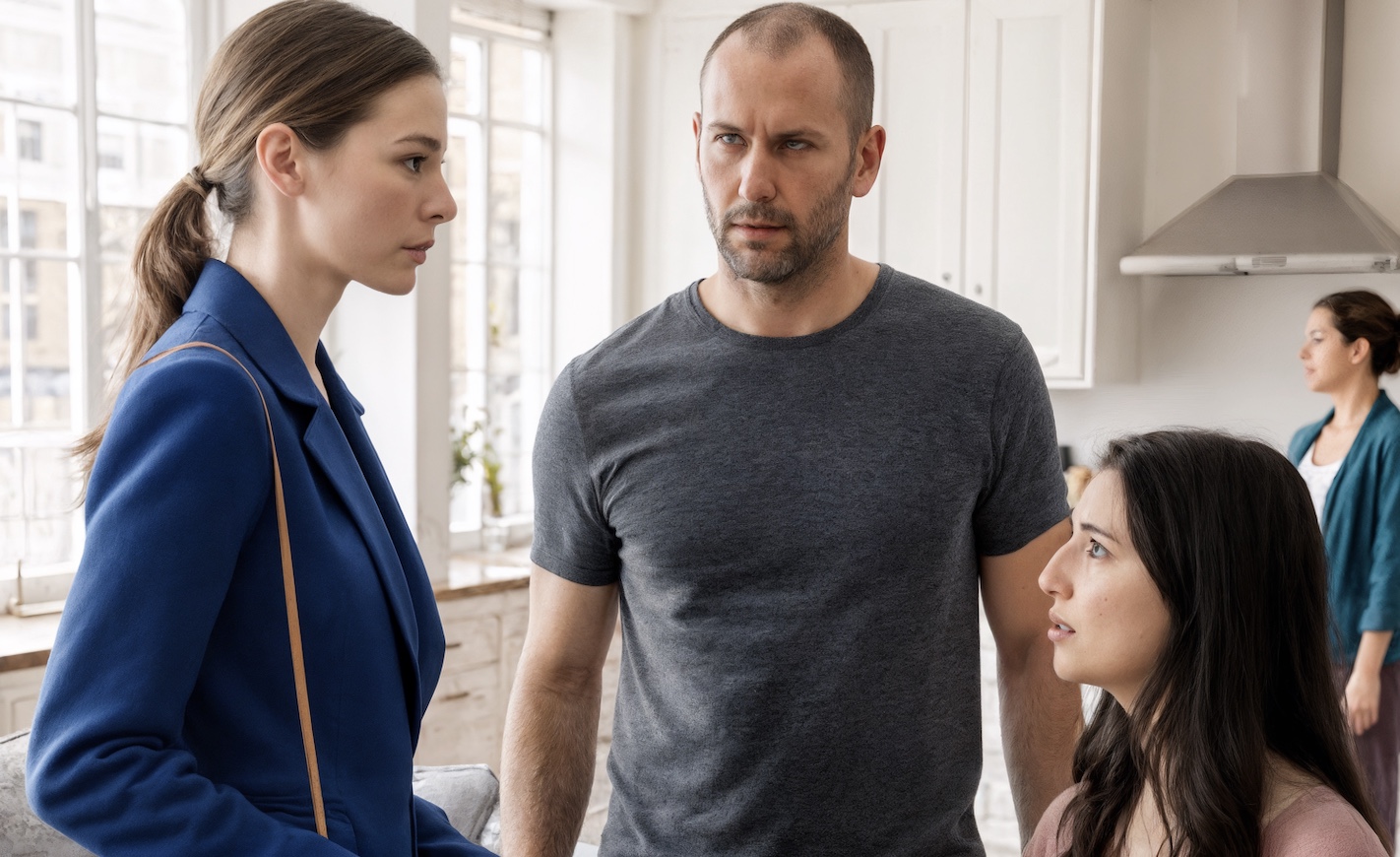
“Are you really that naive?”
Marina froze in the check-in line. It was Svetlana — her sister-in-law, married to Anton’s brother. She never called without a reason.
“Svetlana, my flight boards in twenty minutes…”
“Return the ticket. Right now. Go home. Fate has a surprise waiting for you there.”
The call ended.
At the counter, a young woman in uniform was already reaching out for Marina’s passport. Marina stared at her without moving. She had been looking forward to this trip for two weeks. In twelve years of marriage, she had never once gone away without Anton. He had bought the ticket himself and said, “Go take a break from everything, sunshine.”
“I’m sorry,” Marina said. “I changed my mind.”
In the taxi, she kept turning her wedding ring around her finger. The gold had grown dull with time, but she had never taken it off. Naive. What was that supposed to mean?
The apartment welcomed her with silence.
On the kitchen table sat two mugs. One had a coffee stain around the rim. The other was still damp inside. There was also a plate with a few croissant crumbs. Anton never ate croissants — they gave him heartburn.
Marina called Svetlana back. She didn’t answer right away.
“Are you home?” Svetlana asked at last.
“Yes.”
“Then listen. And don’t interrupt.”
Svetlana spoke for five minutes straight. Marina stood by the window, staring at the swings in the courtyard below. They swayed on their own in the wind. When her sister-in-law finally fell silent, Marina asked only one question.
“How long have you known?”
“A month. I was afraid you wouldn’t believe me. But today he let it slip in front of Maksim. Said that while you were away in Crimea, he’d move his things out. To his secretary Diana’s apartment. The same Diana from the office party.”
Marina remembered her. Young. Bright lipstick. Long hair. Anton had kept refilling her glass with sparkling wine, and Diana had laughed at all his jokes. Back then, Marina had felt nothing.
“A whole year, Marina. He’s been lying to you for an entire year. He bought you that ticket so he could move out conveniently and avoid seeing your face.”
Marina sank onto the couch. She looked at her hands. She’d gotten her nails done the day before — pale pink, for the sea. How foolish it seemed now.
Her mother used to say, “The worst part isn’t finding out the truth. It’s realizing you felt it all along and chose to ignore it.”
For the last few months, Anton had been staying late.
“Project deadlines.”
She believed him.
He had started shaving more often, wearing his best shirts.
“Client meetings.”
She had ironed those shirts for him.
Anton came home around seven-thirty. He stopped in the doorway when he saw her on the couch.
“You… why are you home?”
“My blood pressure shot up. I decided to stay.”
He let out a breath of relief. He even smiled.
“That was the right choice. Health comes first.”
He went into the bedroom and came back with a duffel bag. The zipper wouldn’t close — he had stuffed it in a hurry. The edge of his favorite plaid shirt stuck out, the very one she had ironed two days earlier.
“I’m heading to Sergey’s dacha,” he said. “He heated up the bathhouse. I’m staying the night.”
“All right. Go.”
He paused at the door.
“Are you sure you’re okay? Maybe I should make you some tea?”
Marina looked up at him. Twelve years. A marriage proposal in the rain, the ring trembling in his hands. Renovating their apartment together. Arguing about curtain colors. His tears at his grandmother’s funeral. All of it had been real.
“Go to Sergey’s,” she said. “Give him my regards.”
As soon as the door closed, she called Svetlana.
“I need your help.”
“Anything.”
“A wreath. A funeral one. By tomorrow morning.”
There was a pause.
“What should the ribbon say?”
“‘Happy Freedom from Lies Day.’”
“Marina, are you sure?”
“Absolutely. And I need the address of that apartment.”
The next morning was gray and overcast. Svetlana came out of the flower shop carrying the arrangement — lush, dramatic, dark purple and white, with a red ribbon lettered in gold.
“I worked on it all night,” she said. “Maksim says I’ve lost my mind. But I’m on your side, Marina.”
The address led them to a new development on the edge of the city — those soulless high-rises that all look the same. Svetlana pointed to a third-floor window.
“There. That one. He rented it six months ago.”
They went upstairs. Marina carried the wreath herself. It was heavy, imposing, but she felt none of the weight. Only an icy calm — the kind that settles in just before a storm.
She rang the bell.
Behind the door came footsteps. Voices. A man’s and a woman’s.
Anton opened the door wearing lounge pants and a wrinkled T-shirt. The color drained from his face instantly.
“Marina…”
“Hi,” she said. “May I come in? Or would you prefer the neighbors hear everything?”
He stepped aside.
In the living room, Diana was sitting on the couch. No makeup. A loose robe. Her stomach was rounded now, unmistakably pregnant.
Marina slowly set the wreath down on the coffee table.
The ribbon hung over the edge, the letters catching the light.
“What is that?” Diana asked, rising to her feet, her voice thin.
“A monument,” Marina said, “to our shared foolishness.”
Anton sank into a chair. Diana kept looking from him to Marina, tears already forming in her eyes.
“He told me he was getting divorced!” she cried. “That you’d been living separately for a year and were only waiting for the paperwork. I didn’t know…”
“The day before yesterday we were picking out a swimsuit for me together,” Marina interrupted calmly. “He told me red looked good on me. Then we had ice cream at a café. Just an ordinary evening for an ordinary married couple.”
Diana let out a broken sob and collapsed back onto the couch. Anton raised his head, something pitiful flickering in his eyes.
“I’m sorry,” he muttered. “I didn’t want it to happen like this… it just happened, I didn’t plan—”
“Quiet.”
He fell silent immediately.
“I didn’t come here to argue,” Marina said. “I came to tell both of you something.”
She pulled out her phone and opened her notes.
“First. The apartment we lived in for twelve years is in my name. My grandmother gave it to me before we married. You will get nothing from it.”
Anton went even paler.
“Second. Our savings are in my account. All of them. And the money you gave for household expenses is legally considered gifts from a husband to his wife. Hire a lawyer if you want. He’ll tell you the same thing.”
“You couldn’t possibly—”
“Third,” Marina continued, ignoring him, “do you remember Larisa? My old classmate — she came to our place for New Year’s. She’s now the director of your branch office. I told her about your office affair. A manager and his subordinate secretary. Larisa was very surprised. She said it was a serious violation of corporate ethics.”
Diana gasped. Anton shot to his feet.
“Marina, that’s—”
“By Monday, both of you will receive official notices. Larisa promised to handle it personally. So now you’ll have more time to spend together. Looking for jobs, for example. Side by side.”
Diana burst into tears. Anton just stood there, mouth open.
“But she’s pregnant!” he blurted at last. “She needs money, doctors—”
“Funny that you’re only thinking of that now,” Marina said, looking at him with cold contempt. “You didn’t think about it when you planned to run off while I was at the seaside. You didn’t think about it while lying to both of us for a year.”
“I love him,” Diana sobbed. “We wanted to be together…”
“Then here’s my gift to you,” Marina said, nodding toward the wreath. “Freedom from lies. Now you’ve got what you wanted. Each other. No jobs, no money — but at least now it’s honest.”
She turned and walked away. Svetlana followed her.
“Marina, wait!” Anton shouted. “We can talk about this like adults—”
Marina turned back at the doorway. She looked one last time at the man she had spent twelve years with. And she felt nothing. No hatred. No heartbreak. Just emptiness where something important used to be.
“There’s nothing left to discuss. You’ll receive the papers by mail.”
She walked out without looking back.
They were silent in the elevator. Outside, Svetlana wrapped an arm around her shoulders.
“You were incredible,” she said. “I’ve never seen you like that.”
“Neither have I,” Marina admitted. “All night I thought I’d cry, scream, throw dishes. But in the morning I realized I was just tired. Tired of him, of the lies, of pretending to be a happy wife when really I was just convenient.”
They walked to the bus stop and sat down on a bench. Around them the city carried on as usual — people rushing somewhere, cars honking, music drifting from a café.
“So what now?” Svetlana asked.
Marina took out her phone and opened the airline app. She found a flight for the day after tomorrow. Simferopol. Same time.
“Now I’m going to Crimea after all,” she said. “Only this time I’m not running away from exhaustion. I’m heading toward something new.”
Svetlana nodded and wiped her eyes.
That evening Marina sat on her balcony. Her phone vibrated — an unknown number.
This is Diana. I truly didn’t know he was lying. I’m sorry. You did the right thing. Thank you for opening my eyes. I’m leaving him. I’ll raise the baby on my own. I don’t want my child growing up with a father like that.
Marina read it twice, then blocked the number. Not out of anger. Simply because that story no longer had anything to do with her.
She looked at the ring on her finger. Took it off and placed it in her palm. The gold was dull. Her wedding date was engraved inside. Twelve years ago. Another life.
Two days later, Marina stood in the same airport at the same counter. The woman in uniform smiled and checked her in.
“Have a nice flight!”
“Thank you.”
No one called. No one stopped her. She went to the gate in peace, took her seat by the window, and as the plane lifted off, she looked down at the shrinking city — at her old life, still somewhere down there.
Once they reached cruising altitude, she took out her phone. She opened her photos — vacations, holidays, evenings with Anton. She looked at them without pain. Then she tapped Select All and Delete.
Are you sure?
Yes.
The screen went blank.
An elderly woman sat beside her, knitting something from pale blue yarn.
“First time in Crimea?” the woman asked.
“No. But it’s my first time going alone.”
“Alone is good,” the woman nodded. “No one gets in the way of hearing yourself. I’ve been flying alone for ten years now, ever since my husband passed away. At first I was scared. Then I understood — it isn’t loneliness. It’s freedom.”
Marina looked out the window. Beneath the wing stretched endless white clouds.
“Yes,” she said. “Freedom.”
Crimea greeted her with wind and the scent of the sea. Marina checked into a small hotel right on the shore, with a balcony overlooking the waves. For the first two days, she simply sat on the beach, watching the water, thinking of nothing.
On the third day, her phone buzzed. A message from Svetlana:
Anton tried calling Larisa. He begged her to reverse the decision. She refused. Officially. Diana left for her parents’ house in another city.
Marina typed back: Thank you. But it no longer matters to me.
She sent it and turned off her phone.
That evening she sat by the sea. The waves rolled in with a steady hiss, and the setting sun painted the sky orange. Somewhere gulls cried. Children were playing on the beach. A couple walked along the shore holding hands.
Marina reached into her pocket and took out the wedding ring she still carried with her. She held it in her palm for a moment, looking at it. Then she stood, walked to the water, and let a wave wash over her feet — cold, sharp, alive.
She drew her arm back and threw the ring into the sea.
It flashed once in the air and disappeared into the waves.
Marina stood there a little longer, breathing in the salt air, listening to the surf. Then she turned around and walked back. She still had eleven days of vacation ahead of her. Eleven days that belonged to no one but her.
When she returned home two weeks later, the apartment greeted her with silence again. But this was a different kind of silence — calm, peaceful. Marina unpacked her suitcase, made herself dinner, and sat on the couch with a book.
Then she opened her laptop and looked up rental listings. That apartment was too big, too full of memories. A month later, she moved into a studio in the city center — bright, with a panoramic window overlooking a park. New. Empty. She furnished it slowly, choosing every single thing for herself.
She sold the old apartment and put the money away.
One day, about six months later, Marina was coming home from work. A light rain was falling, and yellow leaves were scattered across the sidewalk. She stopped at a crosswalk and suddenly saw Anton on the other side of the street.
He stood outside a café, smoking, hunched over. He looked older. Thinner. Alone.
Their eyes met for a second. He recognized her and jerked forward as if he might approach. But Marina turned away and kept walking — toward her own life, her own future.
She never looked back.
Because the people who choose to leave on their own don’t deserve to be looked back at.
And the ones who find the strength to let go and keep walking deserve everything.