At three in the morning, the world feels unreal. Flat, colorless, almost monochrome, carrying the dusty scent of heavy velvet curtains. I woke up thirsty, but it was not just an ordinary need for water. It was a sticky, unsettling dread, as though an invisible hand of ice had pressed itself against my chest.
My throat was unbearably dry. The idea of climbing out of the warm bed felt almost impossible. Beside me, Sergey was breathing softly, turned toward the wall. At least that was what I assumed from the shape beneath the blanket. I had spent twenty-five years sleeping next to this man. I knew the rhythm of his breathing, the way his leg twitched in his sleep, the smell of his skin — expensive tobacco mixed with sandalwood.
I slipped on my silk robe — a birthday gift from my husband last year, though naturally he had not chosen it himself but delegated it to his secretary — and moved silently into the hallway. Our home in Peredelkino, that enormous mansion that resembled a castle, had always felt alive to me. In daylight it was welcoming, full of light pouring through panoramic windows onto the oak parquet floors. But at night it turned into a maze of shadows.
The parquet floor had a habit of creaking, but I knew the map of its “minefields” by heart. The third board from the bedroom, the corner by the library where Sergey kept his cherished first editions — those were places not to step. I moved like a ghost through my own house, barefoot, feeling the chill of the polished wood against my feet.
The kitchen light was on. A narrow yellow strip spilled out from beneath the door, slicing through the darkness of the hall. It felt wrong. Sergey had been asleep beside me… hadn’t he? Or had that shape been nothing more than a pillow bundled under the blanket? My heart skipped. For a second, ridiculous thoughts of burglars flashed through my mind, but the alarm system was silent.
My hand had just closed around the cold brass handle when I heard a voice. My husband’s voice. Low, velvet-soft. He had not spoken like that to me in at least ten years. With me, his voice was usually tired, sometimes irritated, most often merely functional, like a news anchor reporting exchange rates. “Buy some bread.” “The car is in the shop.” “We have dinner with partners tonight, wear the blue dress.” But this voice was alive, charged with passion and… anticipation.
“…there should be lots of flowers, but nothing vulgar. No carnations. She hated them. Couldn’t stand that ‘Soviet chic.’”
I froze, my hand still hovering near the handle. Who was he talking about? His mother? But Antonina Petrovna had died three years ago, and Sergey had not even cried at her funeral.
A woman’s voice, unfamiliar, slightly husky, answered with a trace of boredom and cynicism.
“Sergey, are you seriously discussing floral arrangements at three in the morning? We’re talking about the finale. The endpoint. The strategy, for heaven’s sake.”
I pressed my ear against the door. My cheek touched the cool wood. It felt like a scene from one of those cheap melodramas I sometimes watched while ironing his shirts. We had a housekeeper, but I liked ironing his things myself — it gave me the illusion of caring, of still mattering. The wife eavesdropping at the door. Trite. Cheap. Yet I could not move.
“Liza, it matters,” Sergey insisted. I heard the clink of ice against glass. Whiskey. “Everything has to look dignified. Elena deserves a dignified… ending. Twenty-five years is no joke. A silver anniversary. All our friends, business partners, the press, even the governor promised to come. It’s going to be a grand event. And right after that — curtain.”
Cold washed over me. Elena was me. “Curtain?”
“You’re awfully sentimental for a man who’s planning… let’s call it a radical life reset,” Liza said with a laugh. Who was she? A lawyer? A new assistant?
“I’m not sentimental. I’m practical.” My husband’s voice hardened, ringing with the metallic edge I used to fear whenever he berated employees over the phone. “The assets have been moved. The trust fund in the Caymans is set up as bearer-controlled. The house… the house will remain as a monument. No one will dare go digging through the private life of a widower who appears so sincerely grief-stricken in front of the entire elite.”
Widower. The word struck me like a blow to the solar plexus, knocking the air out of me harder than any physical hit. My vision dimmed. I remembered how we had met. A student cafeteria. Spilled fruit compote. His ridiculous glasses back then. We had built everything together. I sold my grandmother’s apartment so he could open his first kiosk in the nineties. I waited for him during business trips when the news was full of shootouts and gang wars. I was his rear guard. His foundation.
“And what about the medical report?” Liza asked. “Her heart is perfectly healthy. You used to complain that she’d outlive you and spend your entire fortune on cat shelters.”
“Stress, Liza. Terrible stress from preparing for the anniversary. And there are drugs that can imitate acute heart failure. Doctor Levenshtein owes me very badly after that little incident with his license and an underage patient. He’ll sign whatever I tell him to sign, as long as I keep quiet. I already paid him an advance.”
I remembered Doctor Levenshtein. A pleasant, cultivated older man with a trimmed beard, who treated our flu, wished us Happy New Year, and always kissed my hand. “An underage patient”? Dear God — what filth had I been living in without ever seeing it?
“So the plan is this,” Liza summed up. Her heels tapped against my kitchen tiles. She was walking through my kitchen. “On the twentieth, the banquet. Speeches, tears, kisses, all of it. Night in the Ritz suite. In the morning, the devastated husband finds the body. The ambulance confirms a massive heart attack. Three days later, the funeral. Six months after that, you and I make it official somewhere in Nice.”
“Exactly,” Sergey said. “And I will finally be free. You know, she’s become unbearable. All that caring. Those wounded-dog eyes. She’s like an old suitcase without a handle — too awkward to carry, too pitiful to throw away. At least until now. But a silver anniversary is the perfect milestone. ‘They died on the same day’ is poetic, but ‘She died of happiness on the day of her anniversary’ — now that is brilliant PR for my holding company. The stock will soar on a wave of sympathy for the grieving owner.”
I sank onto the floor in the hallway, curled into myself. “Old suitcase.” “Wounded-dog eyes.” Twenty-five years of loyalty, and this was what it had become to him: worn luggage. Tears rushed up, ready to spill, but then they dried before they could fall. In their place came something else — a cold, ringing clarity.
A chair scraped in the kitchen.
“I’m going to the bathroom,” Liza said. “And pour me another one. Blue Label. Don’t be stingy.”
Footsteps. The click of high heels. She was coming toward the door.
I realized I had seconds. If she stepped into the hall and saw me, it would be over. Their “heart attack” plan would simply be moved up to tonight, right here on the parquet floor.
I jumped to my feet. The rush of adrenaline hit so hard I nearly lost my balance. Running back to the bedroom was too risky — the floorboards would betray me. The closest door was the storage closet under the stairs. I slipped inside the darkness, thick with the smell of the vacuum cleaner and old coats, clamped a hand over my mouth, and pulled the door almost shut, leaving only the tiniest gap.
A tall brunette passed by in a business suit that fit her like a second skin. I knew her. Elizaveta Arkadyevna, the new chief financial officer of the holding company. “Very sharp, Lena, really has a grip,” Sergey had said six months earlier when he invited her to our New Year’s dinner. I had noticed then how cold her eyes were, like a fish’s. Sharp was not the word.
I watched her disappear down the hallway. My life, as I had known it, had ended five minutes ago. The woman who had gotten out of bed for a glass of water and still loved her husband had died in that closet. Someone else was born in her place.
I went back to the bedroom after Liza returned to the kitchen. I rolled up a pillow to imitate Sergey’s body beneath his side of the blanket, while I slipped into bed myself and pulled the covers over my head. I was shaking violently. My teeth chattered so loudly it seemed the neighbors would hear.
Half an hour later Sergey came back. He smelled of expensive whiskey and a woman’s perfume — sharp, musky, aggressive. He lay down, let out a satisfied sigh, and within a minute he was snoring.
I stared into the darkness until dawn. One thought circled in my head over and over: The silver anniversary is in two weeks. I have fourteen days. I must do more than survive. I must destroy them.
In the morning he kissed my cheek as usual.
“Good morning, Lena. Did you sleep well?”
I looked at him — at his freshly shaven cheek, at the smile I had once loved. Now I saw the snarl hiding behind it.
“Beautifully, darling,” I said, holding his gaze. “I had the most extraordinary dreams. As if old skin were peeling away and a new life were beginning.”
He smiled, not hearing the ice in my voice. He had already pictured me in a coffin.
The following days turned into a surreal performance. Sergey was more attentive than usual: bringing flowers (roses, thank God, not carnations), discussing the banquet menu.
“Lena, I think we should invite the governor,” he said one morning over breakfast, spreading jam on his toast. “It would underline our family’s status.”
“Of course, darling. Status is very important. Especially when one is taking stock.”
I smiled and stirred my coffee, a coffee I was sorely tempted to poison with cyanide. But I held back. Death would have been too easy for him.
I needed a plan. And I needed allies. I knew I could not handle the technical side on my own. “Bearer-controlled trust fund,” access keys, transfers — it was all a foreign language to me.
Then I thought of Denis. The son of an old school friend of mine. A brilliant autistic boy who, at sixteen, hacked the city administration’s website just to see how it worked. He was twenty-five now, employed somewhere in cybersecurity, and occasionally repaired my laptop.
We met in a noisy café downtown, far from the places where Sergey’s acquaintances might appear. Denis listened without interrupting, stirring his milkshake with a straw while I told him everything. The conversation. The plan. Levenshtein.
“That’s brutal, Aunt Lena,” he said at last, pushing up his glasses. “We need a full mirror of his digital life. Phone, laptop, cloud accounts.”
“Can you do it?”
“Yes. But I need physical access to his phone for at least five minutes. And to his laptop.”
“I know the laptop password. ‘Elena1998.’”
Denis snorted. “Sentimental bastard. Fine. I’ll give you a flash drive. Plug it into the laptop, run the file, wait two minutes. The phone is trickier. We need to install spyware.”
That evening I staged a little performance. I came out of the shower wearing nothing but a towel while Sergey was reading the news on his phone in the bedroom.
“Seryozha, can you help me unclasp my necklace? It’s tangled,” I asked helplessly.
He set the phone on the bedside table and came over. While he fiddled with the clasp, I “accidentally” knocked his phone under the bed.
“Oh, sorry! I’m so clumsy.”
“It’s fine, I’ll get it.”
“No, no, you’re in your suit, I’ll do it. You go shower before the water gets cold. I’ll put it on the charger.”
The moment the bathroom door shut, I pulled out the phone. My hands trembling, I unlocked it — passcode 1234, because he had never bothered with real security — and downloaded the file from the link Denis had sent me. The app icon vanished from the screen a second after installation. Done.
A day later, we had full access to Sergey and Liza’s messages. Reading them felt like a form of self-torture.
“She asked again today about our Italy vacation. Naive fool. Tell her you booked the villa,” Liza wrote.
“I did. She was thrilled. Pathetic sight. By the way, Levenshtein wants more. Send it to him in crypto,” my husband replied.
Levenshtein was the next link in the chain. I booked an appointment with him. His office smelled of expensive cologne and fear. The doctor looked exhausted.
“Elena Vladimirovna,” he said with a fake smile. “What seems to be the problem?”
“You know, doctor — a premonition,” I said, placing my handbag on my lap. Inside it, a recorder was running, and the feed was streaming directly to Denis. “I have a feeling I’m going to die soon. At the anniversary, in fact.”
Levenshtein went pale.
“Now, now, my dear…”
“And Sergey says my heart is weak. That there are drugs…”
I pulled a printout from my bag. It showed a Bitcoin transaction — date, amount, everything.
“Denis traced the wallet, Arkady Semyonovich. We know it was you. And we know about that girl. Three years ago.”
The doctor collapsed back into his chair like a deflating balloon.
“He’ll ruin me…”
“I’ll ruin you faster,” I cut in. “From now on, you work for me. Whatever drug you intend to hand Sergey for me — you will replace it.”
“With what?”
“With a powerful tranquilizer. Something that puts a person out cold for twelve hours. And one more thing. You are going to write a medical conclusion. Not about my death. About his mental incompetence, if necessary.”
The hardest part still remained: the assets. The trust fund. Liza, as CFO, held the access keys.
I called her and invited her to lunch under the pretense of planning a surprise for Sergey. We met at a fashionable restaurant near Patriarch’s Ponds. She looked magnificent and dangerous, like a viper. I played the part of the starry-eyed fool.
“Liza, I’m preparing a short film about Sergey’s genius. I need some figures, growth charts, success metrics.”
She relaxed the moment she decided I was harmless.
“Of course, Elena Vladimirovna. Sergey Petrovich is a great man.”
That was when Denis launched Plan B. He called her from a spoofed number, pretending to be the bank’s security department.
“Elizaveta Arkadyevna, suspicious activity has been detected on your main account. We need you to verify your identity in the app immediately.”
She apologized and began nervously tapping on her phone. I watched carefully. Denis was intercepting the data packets through a Wi-Fi trap that I — yes, I — had discreetly stuck beneath the table with chewing gum before she arrived.
“It’s fine,” she exhaled a minute later.
“Thank God,” I smiled. “Let’s drink to success.”
That evening Denis texted: We’re in. We have the Cayman keys. Waiting for your signal to drain it.
Wait until the banquet, I wrote back. I want him to become penniless at the exact moment he raises a toast to his own fortune.
Three days before the anniversary, I prepared a farewell dinner for Sergey at home. I cooked his favorite roast duck with apples. I watched him eat, watched him dab his lips with a napkin, and thought: Eat, Seryozha. Enjoy it. Prison food does not include duck.
“You seem mysterious lately, Lena,” he remarked.
“I’m just nervous about the anniversary. Twenty-five years… a quarter of a century.”
“Yes,” he said, looking away. “An entire lifetime. But ahead of us — new horizons.”
“Oh yes. You have no idea.”
The day finally came.
The mansion buzzed like a hive. Florists decorated the halls with thousands of white roses — I personally made sure not a single carnation slipped in. It was my private little mockery.
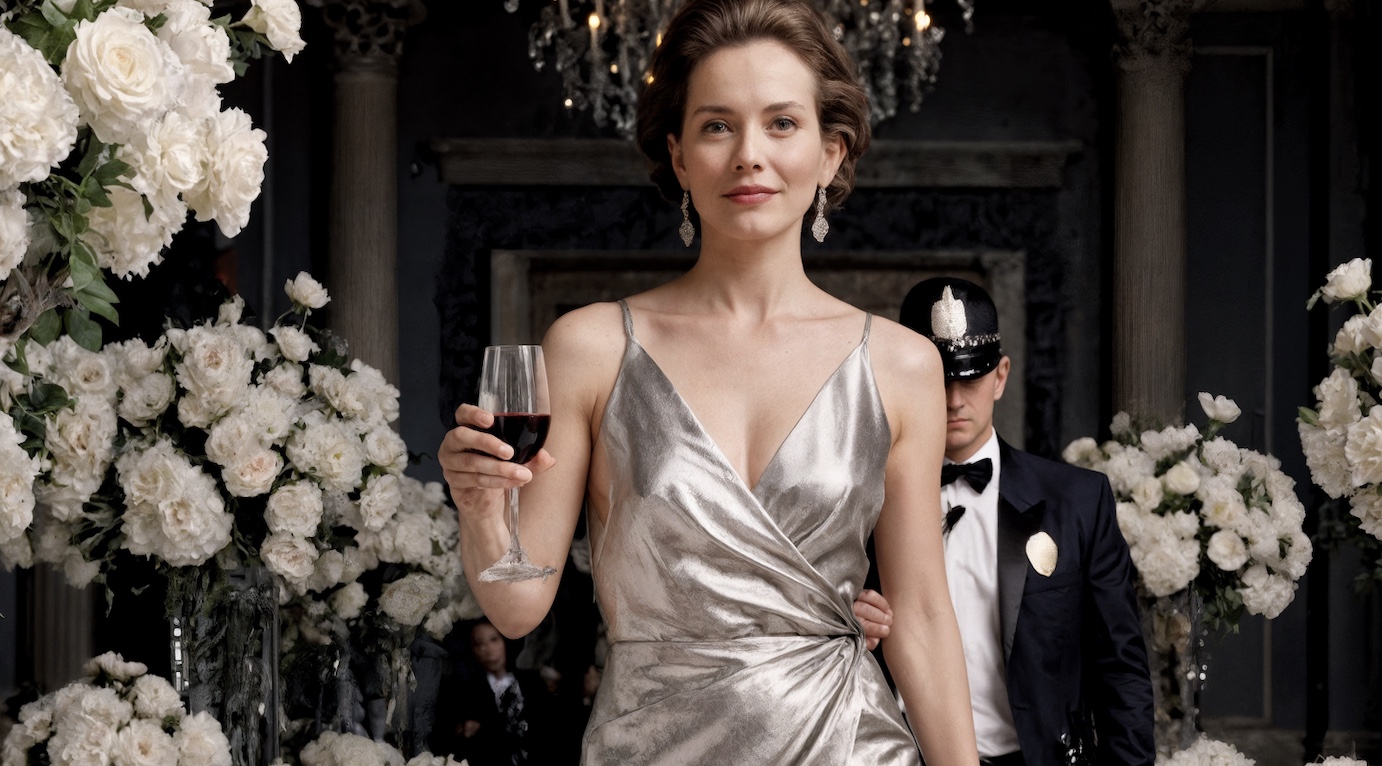
I wore a custom-made silver gown. Clinging like a second skin, it made me look less like a wife and more like something carved from ice, or sharpened steel. I stared at myself in the mirror and hardly recognized the woman staring back. There was no wounded dog there anymore. There was a she-wolf.
Sergey looked dazzling in his tuxedo. Liza was there too, in a provocative burgundy dress, keeping to the shadows, though their exchanged glances flashed for me like neon signs.
Soon, their eyes said.
Already, I thought.
Denis was in a van nearby, overseeing the asset transfer and the multimedia system.
“Five minutes,” he messaged. “The accounts are emptying. They’re about to be nothing.”
The banquet was in full swing. The governor gave a speech about family values. Sergey was radiant. Then he took the microphone.
“My friends! Today is a special day. For twenty-five years I have walked hand in hand with this saintly woman. Lena, you are my angel. Without you, I would be nothing. And today I want to say…”
“Wait, darling,” I interrupted softly, taking the microphone from him. My hand did not tremble. “I have a surprise too. A little film about our journey. About what remains behind the curtain.”
The lights dimmed. Wedding footage appeared on the giant screen. The guests applauded. Sergey relaxed and took a sip of champagne. He knew this script. Or thought he did.
Then the image jolted. The screen went black, but the sound came through louder, sharper, clearer than glass.
“…there should be lots of flowers, but nothing vulgar. No carnations. She hated them.”
Sergey’s voice thundered through the hall.
The hum of conversation died at once.
“Sergey, are you seriously discussing floristry? We’re talking about the finale. The endpoint.”
Liza’s voice.
I watched Sergey’s face turn gray. The glass slipped from his hand and shattered into hundreds of pieces. In the corner, Liza pressed herself against the wall.
“The ambulance confirms a massive heart attack… I’ll finally be free. She’s like an old suitcase without a handle — too awkward to carry, too pitiful to throw away.”
The room froze. No one understood whether this was a joke, a prank, or a nightmare. Sergey lunged toward the sound technician.
“Turn it off! It’s a deepfake! A provocation from competitors! Shut it down!”
But Denis had locked the controls. The recording went on.
“Doctor Levenshtein owes me… He’ll sign anything… The plan is this: banquet on the twentieth, body in the morning.”
At that moment the doors burst open.
Not with waiters carrying a cake, but with uniformed officers and plainclothes investigators. Investigator Volkov, an old acquaintance of my father whom I had contacted two days earlier, stepped forward.
“Sergey Petrovich. Elizaveta Arkadyevna. You will need to come with us. Attempted murder, large-scale fraud, falsification of medical records.”
Sergey spun around like a trapped animal. He looked at Liza — she was already sobbing, screaming that he had forced her into everything. He looked at the guests — they were backing away from him as if from a leper. At last, he looked at me.
Disbelief filled his eyes.
“Lena… you? But you… you don’t understand technology… You’re just… domestic…”
I stepped close enough to see the terror in his face. My silver dress blazed beneath the lights.
“I understand everything, Seryozha. I’m the ‘old suitcase.’ But you forgot something, my dear. Sometimes old suitcases contain forgotten weapons. Or bombs.”
He was led away in handcuffs. Liza was dragged out behind him, one shoe missing. Doctor Levenshtein, I was later told, had been arrested at the airport while trying to flee to Israel.
The evening ended. The guests drifted away in whispers, glancing over their shoulders. I remained alone in the enormous empty hall, littered with confetti and white roses.
A month later
I sat in the visiting room of the detention center. Sergey had lost weight, grown haggard, and all his signature polish had fallen away, leaving only a bitter, aging man in prison clothes.
“Are you satisfied?” he hissed through the glass. “You destroyed everything. The company, the reputation. The accounts are empty. You stole my money!”
“Your money?” I smiled faintly. “The trust fund was bearer-controlled, Seryozha. And the bearer is me now. By the way, I transferred half of it into a fund for victims of domestic violence. The rest is more than enough for me to live very comfortably.”
“I’ll get out. Lawyers…”
“You do not have money for top lawyers anymore. And your public defender is already advising you to plead guilty for a reduced sentence. Liza told them everything. Levenshtein handed you over with all the details. You’re alone, Sergey. Completely alone.”
He slammed his fist against the glass. The guard stirred, but I raised a hand to stop him.
“Why did you come?”
“To say goodbye. And to thank you.”
“To thank me? For what?”
“For killing the old Elena. The naive fool with wounded-dog eyes. Thank you for that. I like the woman I am now much better.”
I rose, smoothing the lapel of my perfectly tailored jacket.
“Goodbye, Seryozha. For a silver anniversary, people usually give silver. I gave you bracelets. I hope they fit.”
I stepped outside. A fine drizzle was falling, but I felt warm. A car was waiting by the gate. Denis sat behind the wheel.
“Where to now, Elena Vladimirovna?”
“To the airport, Denis. I have always dreamed of seeing Nice. They say it’s beautiful this time of year. And you know… no return ticket.”
I got into the car and, for the first time in many years, looked into the rearview mirror not to check my makeup, but to watch the gray prison wall grow smaller and vanish around the bend, left behind in a life that no longer belonged to me.