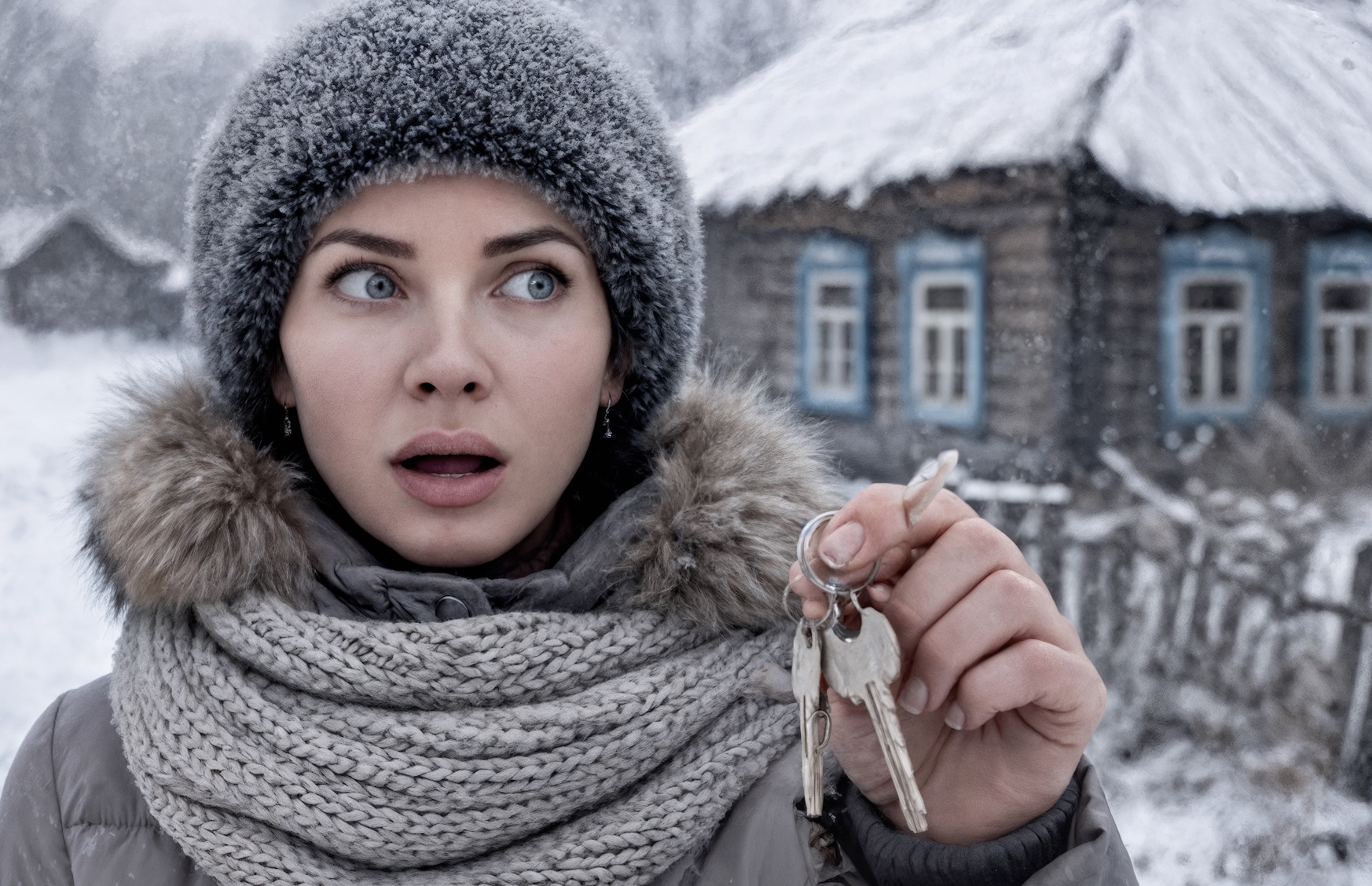
— Take this dump out in the sticks! I don’t need it anyway! — Yuri slammed a set of keys onto the table so hard they bounced with a sharp jingle and skittered across the linoleum. — Consider it my divorce present to you!
Sofia picked the keys up and studied them as if they belonged to another planet.
A heavy, time-smoothed metal ring chilled her fingers.
They were the keys to a house in the village of Sosnovka, where Yuri’s eighty-year-old grandmother lived… Nadezhda Aleksandrovna.
— A present? — Sofia could hardly process the words. — You’re seriously calling this a present?
— Why wouldn’t I? — he shrugged, indifferent, pulling on his sweater. — You’ve got nowhere else to go. Or are you planning to rent another bug-filled room in a communal apartment?
He hit the sore spot perfectly.
Sofia had grown up in an orphanage. Before marriage, she’d drifted between rentals, getting by on translation gigs.
The apartment they’d lived in all those years had been bought by Yuri long before she existed in his life. So Sofia had always felt like a temporary guest—one who’d overstayed her welcome.
— There’s just one catch, — he went on, stuffing the last of his things into a bag. — My grandma’s in bad shape. Dementia, senility—something like that. Doctors say she hasn’t got long. So keep an eye on her, alright? Do your Christian duty. Maybe the universe will reward you.
Sofia clenched the keys until they dug into her palm.
Three years earlier, when they’d just gotten married, Yuri spoke about his grandmother with genuine warmth—about the little house with carved window frames, the garden, the summers he spent there as a kid.
Now it was nothing but dead weight to him.
— The house is a wreck, though, — he added with a look of disgust. — The fence is leaning, the stove smokes, there’s no plumbing. But at least you’ll have a roof. And Grandma… — he flicked his hand carelessly. — How much time does she have left? Six months tops. Then you can sell the place or do whatever you want. I don’t care.
He said “six months” as casually as if he were discussing a broken appliance—something you toss out instead of fixing.
— I see, — Sofia said quietly. — So you keep the apartment, and I get “rewarded” with a miserable shack in a village.
— Stop with the melodrama. I bought that apartment with my money. And the house… it is a gift. I actually took pity on you, if you want the truth. Call it payment for the years we spent together.
After he left, Sofia sat on the edge of the couch for a long time, turning the keys over in her hands.
Outside, cold October drizzle smeared the windows. The apartment—half emptied of furniture—felt hollow and lifeless. Yuri had gone to his new woman.
And Sofia truly had nowhere to go.
Nowhere.
She opened her laptop and searched for Sosnovka.
The village wasn’t tiny: around a thousand residents, a school, a small clinic, a post office, even a little store. Reviews said mobile service was decent. The district center was forty kilometers away, and a bus ran daily.
— Could be worse, — she whispered.
But she remembered her one visit there: a sagging fence, peeling walls, tiny windows that barely let light in. And Nadezhda Aleksandrovna—thin, dried-up in a washed-out dress, forever forgetting things and asking the same questions twice.
That evening Sofia called the old woman. No one answered right away.
— Hello? — a confused voice finally came through.
— Nadezhda Aleksandrovna, hello. It’s Sofia. Yuri’s wife.
— Yuri… which Yuri? — the grandmother stammered, suddenly anxious.
— Your grandson. We met last year, remember?
— Ah… yes. Sofiyushka. How are you, dear? Why doesn’t my Yurochka call me?
Sofia shut her eyes. Announcing a divorce over the phone felt cruel.
— I’ll tell you everything—later. I wanted to come see you. Is that okay? For a few days.
— Of course! — the old woman’s voice brightened. — But it’s not very nice here. The house is old… not cozy. Will Yurochka come with you?
— No. He’s very busy with work.
Three days later Sofia sat on a bus rumbling along a paved but battered road between yellowing fields and dark lines of forest. In her backpack were her laptop, chargers, and the bare essentials. In her jacket pocket, the keys chimed softly—keys to a different life.
Nadezhda Aleksandrovna’s house stood on the edge of the village, with the forest beginning right behind it.
Sofia paused at the gate to take it in properly: gray logs blackened with age, a crooked porch, an attic window boarded over with plywood. The garden was swallowed by weeds and nettles.
Against the modern cottages nearby, neat fences and fresh paint, the old house looked like it belonged to another century.
The gate screeched so loudly a woman leaned out from the neighboring yard.
— Are you here for Nadezhda Aleksandrovna? — she called. — Thank goodness! She’s been preparing for guests for two days. Says her grandson is coming.
— I’m her… relative, — Sofia answered, not sure how to explain the situation.
— Ah, alright then. We were getting worried. She’s… you know… — the woman twirled a finger by her temple. — Feeding chickens that haven’t existed in years, talking to her late husband like he’s still alive.
Sofia nodded and hurried toward the house.
Nadezhda Aleksandrovna met her on the porch—tiny, hunched, wearing a faded floral robe and felt slippers. Her eyes were clear, but scattered, as if she was constantly reaching for something she couldn’t quite remember.
— Sonyechka! — she clapped her hands with joy. — I’ve been waiting! The kettle’s on, I baked pies. Where’s Yurochka? Still in the car?
— Yuri… couldn’t come, — Sofia said, hugging her fragile shoulders. — His work is complicated right now.
— Oh, that boy of mine, — the grandmother sighed. — Working, working… and life just slips away.
Inside, the house was even rougher than it looked outside. The stove ate up half the kitchen. Old linoleum covered the floor, torn and patched with tape. There was only a table with a frayed oilcloth, two chairs with sunken seats, and an ancient refrigerator that roared so loudly you could hear it anywhere.
— Come in, come in, — the old woman fussed. — I’ll make you up a bed in the front room. It’s clean—just a bit damp. Yurochka slept there as a boy when he came for holidays.
The “front room” was a cramped space with one window and an iron bed under a flowered flannel blanket. Faded photographs hung on the walls, and an icon sat in the corner.
— Thank you, Nadezhda Aleksandrovna, — Sofia said, setting her backpack down. — It’s very cozy.
— You must be hungry, — the grandmother took her hand. — Come have tea. I made cabbage pies. Yurochka loved them.
Over tea, Nadezhda Aleksandrovna chatted about neighbors, the rainy autumn, and a good potato harvest. Her speech went in waves: clear and steady one moment, then breaking off as she lost her thread.
— How long will you stay with us? — she asked, pouring tea from an old aluminum kettle.
— I’m not sure yet, — Sofia admitted. — Maybe for a long time.
— Oh, wonderful! I’ve been so lonely. The neighbors come by, but they’re all young, always busy. No one to talk to. Yurochka hasn’t been in ages—always promising…
Sofia struggled for words.
How do you tell an eighty-year-old woman her beloved grandson won’t come back? That he gave away the house—with her included—as if she were a piece of worn-out furniture?
— Nadezhda Aleksandrovna… have you ever thought about moving to the city? To Yuri?
The grandmother looked at her, genuinely surprised.
— Why would I? I’ve lived here my whole life. My father built this house, my husband died here, my children grew up here… No, dear. You don’t transplant old trees.
That evening, once the old woman had gone to bed, Sofia inspected the house more carefully. The roof really did leak—there was a bucket in the kitchen catching drips. The stove smoked because it hadn’t been cleaned in years. The outdoor toilet door was broken. There was no running water; water had to be carried from the well in the yard.
She took out her laptop and tried to connect. No Wi-Fi, of course—but mobile data flickered in and out.
Her inbox held a few new translation orders.
Not bad—enough to survive for now.
Around midnight she woke to a strange noise: footsteps in the kitchen and dishes clinking. She threw on her jacket and stepped out.
Nadezhda Aleksandrovna, in a nightgown, stood at the stove, cooking something in a pot.
— Nadezhda Aleksandrovna, what are you doing?
The old woman turned, deadly serious.
— Mikhail Petrovich will be home from work soon. I’m making him borscht.
Sofia understood: she meant the grandmother’s late husband.
— Nadezhda Aleksandrovna, — Sofia said gently, — it’s late. Let’s go back to bed.
The old woman went obediently to her room. Sofia turned off the stove and moved the pot aside. The neighbor had been right: the grandmother didn’t always understand where she was or what was happening.
Sofia lay awake a long time, staring at the ceiling.
What was she doing here? Throwing away her time, her youth. She needed to leave—fast.
But in the morning, when Nadezhda Aleksandrovna brought her tea in bed and timidly asked if she’d slept well, Sofia realized she simply couldn’t abandon this small, defenseless woman.
The first month in Sosnovka became a chain of small discoveries and huge frustrations. Sofia quickly understood the grandmother needed constant supervision. The old woman might forget to turn off the stove—or step outside in a thin nightshirt in freezing weather.
Yet between episodes, she had startlingly lucid moments—telling stories from the past, sharing hard-won wisdom, even joking about her own forgetfulness.
— Oh, Sonyechka, — she confessed one morning, — my head’s full of holes now. Like a sieve. I forget everything… but how to cook borscht? That I remember. Strange, isn’t it?
Sofia slowly adjusted to the rhythm of village life: up at seven, fire up the stove, make breakfast, then sit down to translate. The orders weren’t many, but they covered the basics. Working in silence, with rain tapping the roof, even felt better than city noise.
But the house needed urgent repairs.
The bucket in the kitchen corner filled with rainwater every night. The stove smoked so badly she had to air out the rooms again and again.
Sofia tried to find local craftsmen, but the prices were steep—and her savings were shrinking by the day.
The neighbor, Tatyana Vladimirovna, the same woman she’d met on arrival, turned out to be extremely sociable. She worked in the district administration and seemed to know everyone and everything.
— So, are you here for long? — she asked once, dropping in to borrow salt. — People keep asking about you.
— I don’t know yet, — Sofia dodged. — Depends on how things go.
— And what do you do for work?
— I’m a translator. Freelance.
— Oh! — Tatyana brightened. — Do you know English?
— Yes.
— Then you need to go see Petrovich! Viktor Petrovich is our local businessman—runs a farm. He’s been looking for someone to help with documents. Some European deals, but he doesn’t speak English. I’ve heard him complain about it a hundred times.
The next day Sofia went to see Petrovich.
The farm was on the far side of the village—modern metal hangars and administrative buildings.
— A translator? — the man looked her over with interest. — What kind of experience do you have?
Sofia told him about her education and years of work. He nodded, asked precise questions.
— Here’s the situation, — he said at last. — I’m setting up supplies to Europe. Hungarians and Slovaks want to buy our product: organic meat and vegetables. But the paperwork is complicated and the requirements are strict. I need someone to handle correspondence, translate contracts, certificates. It’s a lot of work—but I’m ready to pay well.
They agreed on a trial period.
Sofia returned home feeling lightheaded. For the first time, she had a real chance to earn decent money.
Working with Petrovich was both interesting and profitable. Sofia studied international standards, translated technical regulations, and handled negotiations by email.
In her first month she earned more than she ever had before.
— You’re a lifesaver, — Petrovich told her. — The Hungarians are already ready to place their first order. They say it’s easy to work when the translator is competent.
With stable income, Sofia decided to transform the house for real. She found a roofer to fix the leaks, hired a stove specialist to clean the chimney, replaced the wiring—still Soviet-era and sparking—then brought hot water into the house.
Nadezhda Aleksandrovna watched the changes with wonder and joy.
— Oh, Sonyechka, it’s so beautiful now! — she said, staring at the new bathroom fixtures. — Like a palace. When Yurochka comes, he’ll be so happy!
Every time the grandmother mentioned Yuri, Sofia tensed. He hadn’t called once in all those months, as if he’d erased his grandmother from his life.
Sofia didn’t dare tell the old woman the truth—but lying over and over was becoming unbearable.
In winter, Nadezhda Aleksandrovna got seriously ill. It started like an ordinary cold, then the fever rose and she developed shortness of breath.
Sofia called a doctor from the district hospital. The doctor examined her and shook her head.
— Pneumonia. At her age it’s dangerous. Better to hospitalize her.
— No, no! — Nadezhda Aleksandrovna clutched Sofia’s hand. — I don’t want a hospital. If I’m going to die, I’ll die at home.
So Sofia took on everything: three weeks she barely left the bedside—feeding her by spoon, giving injections, monitoring the temperature. She worked in scraps of time, at night, when the grandmother finally fell asleep.
But Nadezhda Aleksandrovna recovered. And, astonishingly, she entered a long stretch of complete clarity.
— Sonyechka, — she asked one evening, — where is Yurochka? Why hasn’t he come? Did something happen?
Sofia knew she couldn’t lie anymore.
— Nadezhda Aleksandrovna, — she began carefully, — Yuri and I… divorced. It’s been six months.
The grandmother stayed silent for a long time, looking out the window.
— I see, — she said at last. — So you stayed with me out of pity?
— No, — Sofia answered firmly. — I stayed because… I feel good here. And I feel good with you.
The old woman took her hand.
— Thank you, dear. For everything.
As Sofia spent months working with Petrovich’s documentation, she unexpectedly became fascinated by the farming itself. At first she only translated material about organic products, but gradually she learned the nuances: varieties, methods of growing without chemicals, certification requirements.
— See how picky the Hungarians are about greens? — Petrovich said, showing her a new specification sheet. — Everything has to be perfect!
Sofia studied the requirements closely. She was genuinely curious—why one lettuce variety cost twice as much as another, what conditions organic spinach needed, how to obtain quality certificates.
— What if I try growing greens myself? — she suggested one day. — We’ve got a big plot, plenty of sun…
Petrovich thought for a moment.
— You know… that’s not a bad idea. Greens are a good place to start—small investment, quick turnover. Try it, and we’ll see.
Sofia caught fire with the idea. She read dozens of articles, ordered elite seeds, and set up drip irrigation in the old greenhouse.
Nadezhda Aleksandrovna watched with fascination.
— Oh, Sonyechka, you’re so clever! — she marveled. — And the dill is so lush! And the basil smells heavenly!
The first harvest turned out excellent. Petrovich showed samples to the European partners, and they were immediately interested. Orders began coming regularly.
— Sofia, — Petrovich предложил after six months, — let’s become partners. I’ll grow vegetables, you grow greens. Together we’ll offer Europeans a broader organic lineup.
That’s how her farm business began.
First she expanded the greenhouses, then moved part of the production into open ground. Demand was enormous: basil, spinach, assorted lettuces—European restaurants were ready to buy year-round at strong prices.
— I can’t believe it, — Nadezhda Aleksandrovna said, looking at the greenhouses now covering half the property. — My Sonyechka has become a real entrepreneur! If Mikhail Petrovich were alive, he’d be so proud!
The grandmother seemed younger. She helped pack the greens, greeted workers, told every neighbor about “her granddaughter’s” success. Memory lapses happened less often—and when they did, Sofia no longer panicked. Still, for safety, she hired a caregiver who came whenever Sofia had to leave on business.
In the third year Sofia made a bold decision: a major rebuild. Despite all the repairs, the old house remained cramped and inconvenient. And the growing business needed an office, storage, and a modern kitchen for processing.
— Let’s tear down this old place and build a new one, — she suggested to Nadezhda Aleksandrovna. — Not huge, but comfortable. Heated floors, big windows…
— Are you sure, Sonyechka? That’s a lot of money…
— I’m sure, — Sofia smiled. — Now we can afford it.
Construction took six months. Sofia didn’t cut corners: she hired a strong crew and used quality materials. The result was a cozy two-story cottage with panoramic windows, a modern kitchen, comfortable bedrooms, and a home office. Part of the ground floor became a mini facility for packing greens.
— Like a fairy tale! — the grandmother kept saying, admiring her new room with a view of the greenhouses. — I never thought I’d live in a palace at my age!
At first the neighbors were shocked, then envy crept in. Sofia’s home became a local landmark.
Petrovich often brought potential investors there, showing what could be built from nothing.
— Three years ago this was a half-collapsed hut, — he’d say, — and now look… a modern farm operation at European level!
One bright May day, as Sofia checked the new harvest in greenhouse number three, a security worker spoke into the radio:
— Sofia Vladimirovna, you’ve got visitors. A man and a woman in a black SUV. They say they’re family.
Sofia stepped out—and saw a familiar car. Yuri got out, along with a young blonde in a flashy dress. Both froze, staring at the property.
Instead of the crooked old fence, a solid brick wall with wrought-iron elements stood at the entrance. Beyond the gates: a handsome cottage, rows of large greenhouses, neat paved paths. Several service vehicles were parked by the house.
— Is this the place? — the blonde asked skeptically. — Are you sure the address is right?
Yuri nodded without speaking, his face stunned. He’d clearly expected to see the same “shack” he’d dumped on his ex-wife three years earlier.
Sofia didn’t rush to the gate. She watched from behind the greenhouse as Yuri walked slowly across the grounds, turning his head left and right. The blonde kept pace, visibly uncomfortable.
— Yuri! — Sofia finally called, stepping out to meet him. — What brings you here?
He turned and went still. In his eyes she saw a mix of disbelief and envy.
— Sofia? Is that… really you?
— Who else would it be? — she smiled. — Come inside, since you’ve shown up.
— What is all this? — Yuri waved toward the greenhouses. — Where’s the old house? What’s with the construction?
— What construction? — Sofia said, almost amused. — It’s a farm. We grow organic greens for export.
— Export? — he echoed.
— Yes. Hungary, Slovakia. Big demand—Europeans love our salad greens.
The blonde shot him a nervous glance.
— Yura, maybe we should go… We have a restaurant reservation…
— Wait, Alina. Sofia, can I see the house?
— Sure. Come in.
Inside the cottage, Yuri looked like he’d been hit by a wave: a spacious living room with panoramic windows overlooking the greenhouses, a sleek kitchen, quality furniture. On the walls hung certificates and diplomas, photos from agricultural expos.
— This is all… yours? — he rasped.
— Ours—mine and Nadezhda Aleksandrovna’s, — Sofia corrected. — Speaking of her, she’ll be back soon. She was checking the basil.
— Grandma’s alive? — Yuri went pale. — I mean… how is she?
— Great. These last years she’s practically blossomed. Helps with the business, greets clients, checks packaging quality.
— And you didn’t tell me that she…
— That she’s alive? Healthy? — Sofia shrugged. — Why would I? You said she was a burden.
At that moment Nadezhda Aleksandrovna walked in. In three years she truly had changed: straighter posture, brighter face, lively eyes.
— Sonyechka, the basil is ready for cutting. Tomorrow we can ship, — she said, not yet noticing the visitors. Then she looked up and froze.
— Yuri? — she whispered.
— Granny! — he lunged toward her with open arms. — I’ve missed you so much! How are you?
But Nadezhda Aleksandrovna stepped back.
— Stop, — she said coldly. — Stay where you are.
Yuri lowered his hands, confused.
— Granny, what’s wrong? I came to visit…
— After four years, — her voice rang with anger. — Four years you didn’t remember me! You thought I’d be dead by now?
— No, no… I’ve just been busy…
— Busy! — she sneered. — Busy enough to leave your own grandmother to die? You said I didn’t have long left—remember?
Sofia listened, stunned. She’d never seen the grandmother like this.
— Granny, you don’t understand— — Yuri started.
— I understand perfectly! — she cut him off. — You sent Sofia here like a stray dog. “Let her look after the dying old woman.” And when I died, you’d come back, sell the house, pocket the money. That was the plan, wasn’t it?
Alina backed toward the door.
— Yura, let’s go…
— Yes, yes—take your… girlfriend and go, — Nadezhda Aleksandrovna said with contempt. — And don’t come back. I don’t want to see you.
— You can’t talk to me like that, — Yuri tried to reach for her hand. — I’m your grandson!
— You were my grandson. Now you’re nobody to me. I have Sofia. She’s my daughter, my granddaughter, my whole family. And you—get out of my house.
— Your house? — Yuri suddenly gave a short laugh. — The house, by the way, is legally mine. Remember the deed of gift?
Nadezhda Aleksandrovna looked at him with disgust.
— What deed? I didn’t sign any deed.
— What do you mean you didn’t? The last time I visited—
— Oh, those papers, — she waved her hand. — I canceled them a long time ago. I signed a new deed. To Sofia. This house is hers now.
Yuri swayed.
— That’s impossible…
— Very possible! — the old woman nodded, satisfied. — Sofia explained that we needed that document so you wouldn’t show up one day and throw her out. So I did it properly.
Sofia stood there with her mouth slightly open. A year earlier she’d mentioned the deed, but she’d assumed the grandmother hadn’t really understood—or would forget.
— So leave, — Nadezhda Aleksandrovna repeated. — And don’t you dare come back.
Yuri’s face burned with humiliation. Alina had already fled outside and was smoking nervously by the SUV.
— This isn’t fair, — Yuri muttered. — I’m your only relative…
— It’s fair. More than fair. The one who abandoned loses. The one who stayed finds. Now get out.
After the SUV disappeared around the bend, Sofia and Nadezhda Aleksandrovna stood by the window laughing for a long time.
— Did you see his face when he heard about the deed? — the grandmother cackled. — And his little girlfriend—clicking around in her heels like a frightened bird!
— Nadezhda Aleksandrovna, — Sofia asked when they finally calmed down, — did you really transfer the house to me?
— Of course, dear. You’ve become like a real daughter to me. Who else would I leave everything to?
Sofia hugged her fragile shoulders.
— Thank you. For everything.
— No—thank you, — the grandmother said, stroking her hair. — You gave me my life back. You saved the house, you put me back on my feet. And that one… — she gestured toward the road, — let him bite his elbows now.
Justice really had won.
The man who thought only of profit was left with nothing. And the woman who chose kindness and patience gained not just a house and a business, but something far more valuable—family, a home, and faith in tomorrow.