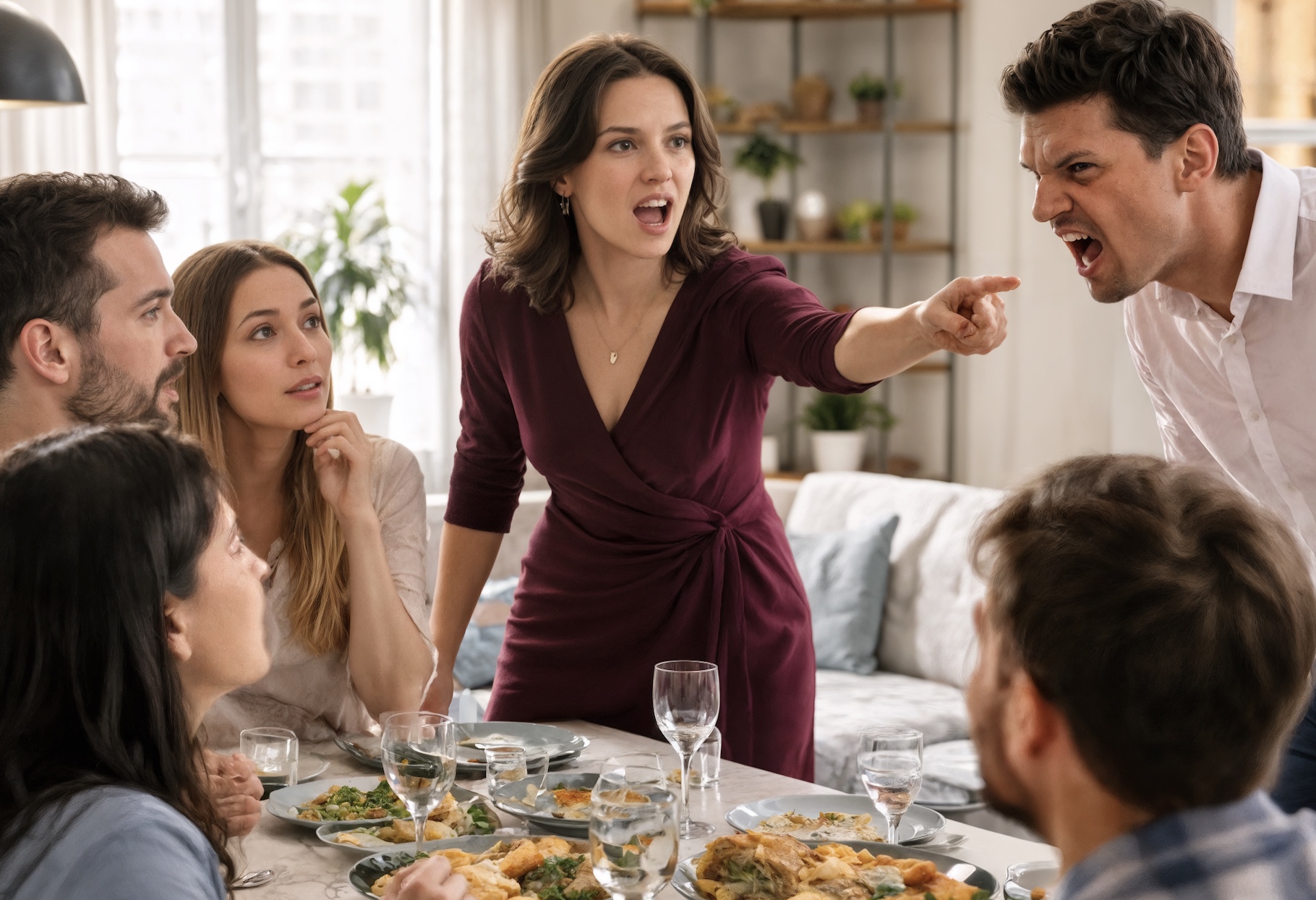
Olga had sensed it from the moment she woke up — that heavy, uneasy feeling, like the air right before a thunderstorm breaks. Today, Igor’s relatives would gather again. His mother’s birthday. A table set to bursting, endless toasts, loud laughter, hugs… and his jokes. Always his jokes.
She stood at the stove, staring through the window at the bleak gray of a November sky. Eight years of marriage. Eight years of being the dutiful audience to his one-man comedy show. In the beginning, she’d even enjoyed it — Igor could make any crowd laugh, the kind of man who became the center of a room without trying. His charm had won her over back in her first year at university: tall, witty, always surrounded by attention. She truly believed she’d been lucky.
“Olyushka, what are you thinking about?” Igor wandered into the kitchen in lounge pants and a stretched-out T-shirt, yawning as he came out of his afternoon nap. “Guests will be here soon, and you’re standing here like a philosopher.”
“I’m cooking,” she said, flatly.
“Oh, borscht!” He leaned over the pot. “Just don’t drown it in sour cream. Remember last time Mom hinted it came out too watery?” He peeked inside, then smirked. “Though who am I even talking to? My wife and cooking are like a ballerina and a powerlifter. Both are ‘sports,’ but somehow the pairing just doesn’t work.”
Olga clenched her jaw. Here we go. And the guests weren’t even here yet.
“Igor, maybe today—”
“Today what?” He was already digging through the fridge. “Today is a celebration! Mom turns sixty-five. Everyone’s coming. It’ll be fun.”
Fun. Yes — for him, it was always fun.
By six o’clock, the apartment was filled with voices. Igor’s mother, Valentina Petrovna, arrived first, hair perfectly set as always, eyes sharp and assessing. Then came his sister Sveta with her husband Yuri and their two children. After them, his brother Pavel showed up with his wife Marina. And of course Uncle Slava and Aunt Nina — lifelong veterans of family feasts.
Olga rushed between the kitchen and the living room, carrying plates, topping up glasses, clearing dishes. Igor, meanwhile, sat at the head of the table like a host on a stage, pouring everyone their first shot and already working the crowd.
“Alright, everyone — a toast to the birthday woman!” He lifted his glass. “Mom, you’re like a fine wine: you only get better with age. The only difference is, unlike wine, you get more sour.” He winked, and the whole table erupted.
Even Valentina Petrovna smiled, shaking her head. “You’re unbelievable.”
“What? I’m just telling the truth!” Igor knocked back his shot. “Now eat!”
Olga brought in the salads. Igor immediately took her hand.
“Look at my hardworking wife,” he announced. “Spent the whole day in the kitchen. The outcome is… questionable, but hey — at least she put her heart into it!” He laughed loudly, and everyone laughed with him.
“Igor, come on, it’s all really tasty,” Marina said softly.
“Marina, you’re just kind,” Igor waved her off. “Olya and I know the reality. She’s the queen of simple meals: borscht, dumplings, pasta with hot dogs. Fine dining? Not in this house.”
Olga set down the last plate and moved to the window, pretending to fix the curtain. Inside, everything tightened into a hard knot. Breathe. Just breathe.
The gathering picked up speed. Toasts rolled one after another. Igor was on fire — joking, telling stories, doing impressions. His relatives doubled over. He knew exactly how to catch each person, how to trigger laughter. He was an expert.
“Remember how last year Sveta and Yuri went to Cyprus and spent a whole month telling us how beautiful it was?” he began again. “Well, Olya and I went to Sochi. We arrive, I go, ‘Olyush, look — the sea!’ And she says, ‘I’ve seen seas before. They’re all the same.’ Romance, right?”
“Igor, stop,” Sveta said quietly, though she kept smiling.
“Oh, please, what’s wrong with that?” he shrugged. “I love my wife exactly as she is. Cool and practical. Like a Swiss watch — runs perfectly, just don’t expect surprises.”
Laughter. More laughter.
Olga sat on the very edge of the couch, holding her wineglass tightly. She almost never drank, but today she’d taken a few sips. She needed something to drown the anger rising in her chest.
“And our Pasha is a hero,” Igor went on, turning to his brother. “Quiet, modest. So modest, in fact, that his wife is the boss. Marina, admit it — did you give him permission to come today?”
Pavel smiled, embarrassed. “Oh, enough.”
“Not ‘enough’! I can see who wears the pants in your family. And it’s definitely not you, brother.”
Everyone laughed again. Marina blushed, but smiled too. No one seemed offended. No one, except Olga.
She watched her husband and felt as if she didn’t know him. That mocking mouth. Those eyes glittering with the thrill of performance. The certainty that he could say whatever he wanted and it would be forgiven. When had it started? Or had he always been like this, and she just refused to see it?
No — she had seen it. She’d always seen it. She’d simply stayed quiet. She’d bitten down and stayed quiet. Because “he doesn’t mean it,” because “he’s only joking,” because “don’t be so sensitive.” How many times had his relatives said that? How many times had Igor told her, “Olyushka, you have no sense of humor. Relax.”
And then there were the evenings when everyone left and they were alone. That’s when Igor’s jokes changed — and turned toward his own family.
“Did you see Mom’s new hairstyle?” he’d cackle, stripping off his clothes before bed. “She looks like a poodle after grooming. Of course I told her it suits her — but did you see her face? She knows it’s a disaster.”
Or: “Sveta got fat again. By forty she’ll weigh a hundred kilos.”
Or: “Pasha is a complete doormat. Marina spins him any way she wants. I wonder if he’s ever made a decision on his own.”
Or: “Uncle Slava is such a bore. Same stories every single time about his work. I know them by heart. We could do a full reenactment, parts and all.”
Olga listened and said nothing. What could she say? It was his family. His right to think what he wanted. Let him vent at home — as long as he acted sweet and charming around them.
But now, sitting there and looking at their laughing faces — faces that didn’t know what he said behind their backs — Olga suddenly understood: she was part of it. Her silence made her complicit. She stayed quiet, and by doing so she allowed him to humiliate her in public and ridicule them in private. She had become his hidden trash bin, where he dumped his bitterness and cruelty so he could go back out smiling, clean and lovable.
“And, Olya, remember last week when you couldn’t open that pickle jar?” Igor turned to her again. “You fought it for half an hour. I come in, open it in three seconds. Hard to open it when you’re twisting the wrong way.”
“Mhm,” Olga answered.
“What do you mean ‘mhm’?” He shook her shoulder playfully. “Tell everyone how it was. You even got offended that I didn’t help you right away! My wife is a world champion at being offended over nothing. That’s her special talent.”
Valentina Petrovna cut in, almost gently. “Igor, enough. Let the girl sit.”
“I’m not being mean, Mom! It’s harmless.” He grinned. “Olya knows I love her. Right, Olyush?”
Olga looked up and met his eyes. There was smug satisfaction there, confidence that he was right. He didn’t even understand what he was doing. For him, it was a game — entertainment. And if the crowd laughed at his wife, so what? She wasn’t offended. He loved her, didn’t he?
Loved her.
She put her glass down and stood slowly. Everyone turned toward her.
“Igor,” she said, and her voice was strangely calm, “now, dear… let me tell your family what you call them.”
Silence hit the room. Igor blinked, not immediately grasping it.
“What?”
“I said: let me tell your relatives what you call them. You have nicknames for everyone — such sweet little home nicknames. Why not share them?”
Igor’s expression shifted. His smile slid off his face and something wary replaced it.
“Olya, what are you talking about?”
“The truth.” She turned to the table. “Valentina Petrovna, do you know what Igor calls you?”
His mother frowned. “Olechka, what is happening?”
“He calls you a harpy. Or Cerberus, depending on his mood. He says you’re never satisfied and you’ve been nagging him since he was a child. And he laughs at your hairstyle — says you look like a poodle after a bad haircut.”
Valentina Petrovna went pale. Her mouth opened, but no sound came.
“Sveta,” Olga continued, turning to her sister-in-law. “He calls you ‘Balloon.’ Because, in his words, you’ve ‘inflated like a ball’ and soon you’ll ‘burst.’ After every visit he tells me he can’t understand how Yuri lives with you.”
Sveta shot up, her face burning red. “That’s not true!”
“It is,” Olga said evenly, without emotion, like she was reading from a page. “Pasha, to him you’re a rag. Or a doormat. He thinks you’re weak and that Marina controls you. He says you’re not a man.”
Pavel lowered his fork slowly.
“Yuri,” Olga went on, looking at Sveta’s husband, “you’re ‘the punching bag.’ Because you put up with a ‘fat wife’ and ‘constantly whining kids.’”
“Enough!” Igor roared, jumping to his feet. “Olya, shut up! Right now!”
“No.” She looked at him. “I won’t.” Then she turned again. “Uncle Slava, you’re ‘the Bore.’ Every time you leave, Igor copies your voice and retells your stories while yawning dramatically. He says you’re stuck in the last century.”
Uncle Slava — an older man with gray mustache — went dark red and started breathing heavily.
“Aunt Nina, he calls you ‘the Cuckoo.’ Because of your voice and the way you laugh. He says you ‘cackle like you’re out of your mind.’”
Aunt Nina let out a sob and covered her face with her hands.
“Stop! Stop, I said!” Igor rushed around the table and grabbed Olga by the shoulders. “What are you doing?! Have you lost your mind?!”
“No,” she said, calmly pulling away. “I’m just tired. Tired of being your target. Tired of you humiliating me in front of people — and then humiliating them at home. Tired of staying silent.”
“That’s all lies!” His voice cracked as he shouted. “She’s lying! She made it up!”
“Lies?” Olga gave a thin smile. “Then look them in the eye and tell them you’ve never called your mother a harpy. Tell them you’ve never mocked Sveta’s weight. Tell them you’ve never said Pasha is a doormat. Go on.”
Igor’s eyes darted from face to face. Everyone was staring at him. Waiting. But he couldn’t speak.
Valentina Petrovna rose slowly, her face hardening into stone.
“Is it true?” she asked quietly. “Do you really talk about us like that?”
“Mom, I—”
“Answer me.”
“I didn’t… it’s just… Olya misunderstood, I didn’t mean it—”
“Didn’t mean it,” Olga repeated, turning his excuse back at him. “Just like your jokes about me? You didn’t mean those either?”
Sveta grabbed her bag and took her children by the hands. “Yura, we’re leaving. Now.”
“Sveta, wait—”
“Don’t you dare speak to me.”
Pavel stood too, helping Marina up. His face stayed blank, but his hands trembled.
“Let’s go,” he said shortly.
One by one, the relatives began to collect their things. Uncle Slava and Aunt Nina left first without saying goodbye. Sveta, Yuri, and the children followed. Pavel and Marina paused at the door.
“You’ve always been like this,” Pavel said, staring at his brother. “Always needing to put someone down so you could feel higher. I thought you’d grow up. But you didn’t.”
The door closed.
Valentina Petrovna was in the entryway pulling on her coat. Igor stepped toward her.
“Mom, I’m sorry. I didn’t want—”
“I don’t care what you wanted,” she said, looking at him with cold eyes. “You betrayed all of us. You laughed behind our backs. You used our love.”
“It’s Olga’s fault! She turned you against me!”
“Olga?” His mother scoffed. “Olga told the truth. That’s your problem — you can’t stand the truth about yourself.”
She walked out without looking back.
Igor stood frozen, staring into nothing. Then slowly he turned toward Olga. His face held a messy mix of anger, confusion, and fear.
“Why did you do this?”
“And why have you been doing it for years?”
“I was joking! I was just joking!”
“Jokes are supposed to be funny for everyone,” Olga said, starting to gather dirty plates from the table. “Not only for the one telling them.”
“They all loved my jokes!”
“No,” she stopped, holding a stack of plates. “They tolerated you. The way I tolerated you. Because you’re built like this: if someone doesn’t laugh, then they ‘have no sense of humor.’ You never once considered the problem might be you.”
“You ruined my family!”
“You ruined it yourself,” Olga carried the plates into the kitchen. “A long time ago. Today it just finally showed.”
He followed her.
“So what now? You think everything will just… settle? They’ll hate me!”
“Maybe.”
“And you don’t care?”
Olga set the plates into the sink and turned to him.
“Igor, I spent eight years not being cared about — while you mocked me in front of your family. Maybe it’s time you feel what that’s like.”
He went pale.
“You’re getting revenge.”
“No,” she shook her head. “I’m done being your toy. Your clown. And your storage box for dirty secrets.”
“I loved you.”
“No,” sadness slipped into her voice. “You loved yourself. I was just the audience in your one-man theater. Like everyone else.”
Igor sank into a chair. For the first time all evening, he looked lost and defenseless — as if the script he’d lived by had ripped apart and he had no idea what came next.
“What happens now?”
Olga poured herself a glass of water and took a sip. Her chest still burned — but not with rage anymore. With relief.
“Now I’m filing for divorce.”
“Because of one night?”
“Because of eight years,” she corrected. “Tonight was only the last drop.”
“But we can fix it! I’ll talk to them, I’ll explain—”
“Explain what?” she asked, meeting his eyes. “That you don’t really think they’re fools? That the nicknames were a joke? They won’t believe you. Because every joke has truth in it — and yours were one hundred percent truth.”
“And what about us?”
“There is no ‘us’ anymore,” Olga said simply. “If there ever really was.”
That night they didn’t speak again. Igor locked himself in the bedroom; Olga stayed in the living room. She sat by the window, watching the city at night, and for the first time in years she felt something close to peace.
In the morning Igor tried to talk, but she stopped him.
“Don’t. Everything has already been said.”
A week later she filed the paperwork. Two weeks after that she moved in with a friend. The divorce was quick — they hadn’t built much together, and there were no children. Igor didn’t fight it. It was as if that evening had cracked something in him and drained away his shine and swagger.
His relatives didn’t return. Sveta and Pavel stopped answering his calls. Valentina Petrovna agreed to speak only after six months — and even then, coldly, formally. The family fell apart like a house of cards.
Olga didn’t feel triumphant. Just exhausted, and strangely lighter. She was free — from constant humiliation, from forcing smiles through pain, from being the silent accomplice.
A year later she ran into Igor by chance at a shopping mall. He looked older, and somehow untidy. When he saw her, he tried to smile, but it came out weak and pitiful.
“Hi,” he said.
“Hi,” Olga replied.
“How are you?”
“Good. And you?”
“Yeah… I’m living.”
They stood in silence for a moment. Then Igor asked:
“So… you never forgave me?”
Olga thought about it. Had she forgiven him? Probably. The anger had faded long ago. What remained was the understanding that they had been wrong for each other. He needed an audience that would admire him. She needed a partner who would respect her.
“I’m not angry at you,” she said at last. “But I don’t want to come back. I never will.”
He nodded as if he’d expected it.
“I changed,” he said quietly. “Really. I don’t joke like that anymore.”
“That’s good,” Olga answered honestly. “Then that night wasn’t pointless.”
They said goodbye. Olga walked on without looking back. In her new life there was no space for the past. Ahead of her was freedom — and she walked toward it with a steady step.
And Igor remained standing in the middle of the mall, watching her go. He understood: it was the end. That night destroyed more than his family. It shattered the illusion that you can laugh at people without consequence, that you can hide contempt and anger inside “jokes,” and that everyone will forgive you because “he didn’t mean it.”
He was wrong. And now he had to live with that knowledge.
Olga stepped out into the sunlight and smiled. Life was waiting — new, without mockery, without humiliation, without the need to pretend. A life where she could simply be herself. And it was the best thing that had happened to her in the last eight years.