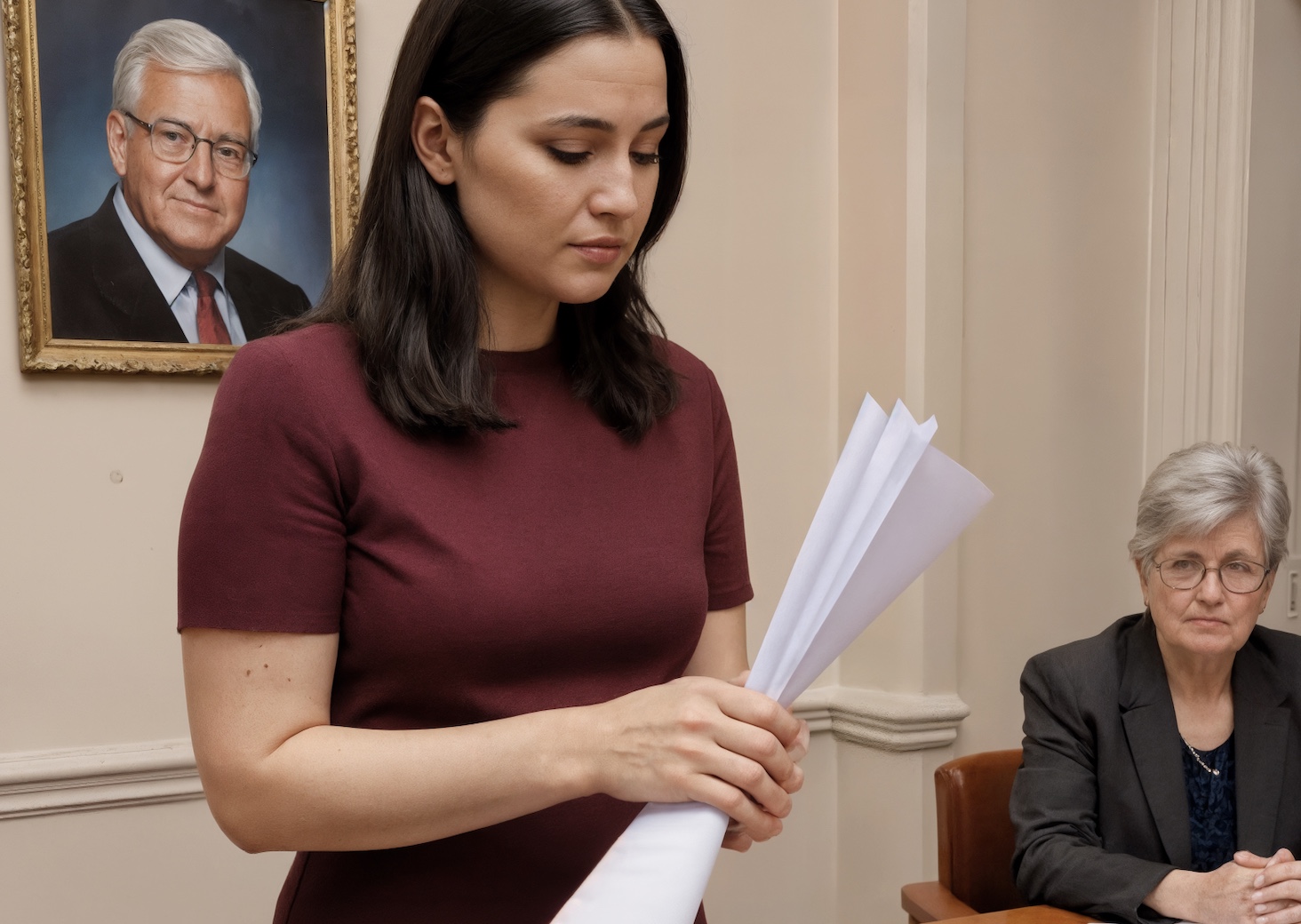
The key in the notary office door clinked so loudly it sounded like a gunshot.
I stopped short on the threshold. Was it closed? No—the door opened a crack, and a woman in her fifties in a строгий, tailored suit leaned out.
“Zinaida Sergeyevna?” she asked. “Come in. I’ve been waiting for you.”
Inside, the air carried the smell of old paper and something else—unease, maybe. Or perhaps it was just my nerves, so tense that even the room felt heavy.
“Please, sit,” the notary said, nodding toward a leather chair. “So—you’d like to formalize a gift transfer for an apartment?”
“Yes. I mean… no. I want…” My voice wavered. “My husband wants to sign his share over to me. Before we sell the place.”
The notary raised an eyebrow but said nothing. She pulled out the forms and began writing. And I sat there thinking how on earth my life had gotten to this point.
It had started a month earlier.
I came home from work worn out—another brutal shift, nonstop crises in accounting. I kicked off my heels in the hallway and walked into the kitchen. Boris was sitting at the table with a strange expression. Not angry. Not sad. Just blank.
“Sit down,” he said. “We need to talk.”
My heart sank. When a man says “we need to talk,” it’s never good.
“I spoke to Mom,” he began, not looking at me. “She has health problems. Serious ones. She needs surgery.”
I sat across from him in silence. His mother, Klavdiya Ivanovna—the woman who’d looked at me from day one like something stuck to the bottom of her shoe. The woman who, every time she visited, found a reason to correct me: the soup was too salty, the floors weren’t clean, her son was getting thin under my care.
“What kind of surgery?” I asked softly.
“Heart surgery. Something with valves—they need replacing. At the public hospital the wait is six months, but she can’t wait. The doctors said it has to be urgent.”
I understood immediately where this was heading, and my stomach tightened.
“A private clinic is expensive,” Boris went on. “Very expensive. One and a half million.”
One and a half million. We didn’t have that kind of money. Not at all.
“There’s only one way,” he finally said, meeting my eyes. “We sell the apartment.”
I went still.
Our apartment. The three-bedroom place on the outskirts we’d been paying off for six years. The one I’d renovated with my own hands—hanging wallpaper, painting radiators, scrubbing floors. The one where I gave birth to our daughter. The one where every corner held our life.
“Sell it?” I repeated. “And where are we supposed to live?”
“At Mom’s,” he said. “Temporarily. Until we save up for a new place.”
Temporarily. Under his mother’s roof. Under Klavdiya Ivanovna’s roof—the woman who criticized everything about me, even my socks, my makeup, the way I played with my own child.
“Borya, wait,” I said, trying to stay calm. “What if we take a loan? Or ask for an installment plan?”
“A loan? For one and a half million? We’d be paying it off until retirement! No. We sell. There isn’t another option.”
I didn’t argue, because I knew what would happen if I refused. I’d become the heartless daughter-in-law who “let her mother-in-law die.” The one people whisper about. The one her husband resents forever.
“Fine,” I breathed. “But on one condition.”
He tensed.
“Before we sell, you transfer your share to me. So the apartment is entirely in my name.”
“Why?”
“Because,” I said, looking him straight in the eye, “I want to know the money is really going to the surgery. And not to something else.”
His face darkened. But he couldn’t protest—not after what had happened two years earlier, when his mother “borrowed” two hundred thousand for an “emergency roof repair at the dacha.” We never saw any repairs. But her nephew suddenly showed up in a brand-new car.
And so there I was in the notary’s office. Boris signed the papers without a word. His mother—who had “just happened to drop by with us”—sat in the corner, drilling holes in me with her stare.
“Well, that’s it,” the notary said, stamping the documents. “Now the apartment is fully yours, Zinaida Sergeyevna. Congratulations.”
Congratulations. On what? On selling it a week later and ending up trapped under my mother-in-law’s roof?
When we left the office, Klavdiya Ivanovna walked beside me, muttering under her breath. I didn’t listen. My mind was elsewhere.
At home I started packing. Clothes into boxes. Dishes wrapped in newspaper. My daughter hovered nearby, confused.
“Mom, where are we going?”
“To Grandma Klava’s for a little while,” I lied brightly. “Just for a short time.”
“And our room?”
“It’ll stay here. It’s just… other people will live in it for now.”
She frowned but didn’t ask more. Kids always know when adults are lying.
We posted the listing everywhere. Calls came immediately. People toured the apartment, negotiated, haggled. One offered 1.2 million. Another tried to shave off three hundred. One man even suggested trading for a one-bedroom plus a top-up.
Finally, we found someone willing to pay exactly one and a half million—a middle-aged man in an expensive coat. He walked through quickly, businesslike.
“I’ll take it. When can we sign?”
“In three days,” I said. “Thursday.”
He nodded and left.
Wednesday night I couldn’t sleep. I lay staring into the dark. Boris snored beside me—lately he’d been distant, almost absent, as if it weren’t his life collapsing but someone else’s.
Thursday morning I got up early. I dressed, gathered the documents, and slipped out quietly so I wouldn’t wake anyone.
And I didn’t go to the notary.
I went to my childhood friend, Lena—the one who worked as a nurse at the very private clinic where Klavdiya Ivanovna was supposedly scheduled for heart surgery.
“Zin, hi,” Lena opened the door half-asleep in her robe. “Why are you here so early?”
“Lena, I need help. Please check your system. Klavdiya Ivanovna Morozova. She’s supposed to be scheduled for heart surgery.”
Lena yawned but went to the computer. She tapped at the keyboard, then frowned.
“Zin… are you sure about the last name?”
“Yes. Morozova. Klavdiya Ivanovna. Sixty-one.”
“We don’t have her. Not in appointments, not in the archive for the past year. Nothing.”
I felt my chest go cold.
“So she never even contacted you?”
“No. Should she have?”
I turned and left without another word. Outside, my knees nearly buckled—I had to brace myself against the wall.
So there was no surgery. No heart condition. All of it was a lie.
But then… why?
The answer surfaced on its own when I remembered a conversation from a month earlier. Klavdiya Ivanovna had casually mentioned some Viktor Stepanovich she was “just friends” with. Boris had brushed it off—Mom, you’re an adult, be friends with whoever you want.
Viktor Stepanovich. A widower. A man with a pension and an apartment in the city center. A man she spoke about with a breathy little softness in her voice.
I pulled out my phone and called a mutual acquaintance who lived in the same building as my mother-in-law.
“Galya, hi. Tell me—does Klavdiya Ivanovna go to that… what’s his name… Viktor Stepanovich often?”
“They practically live together now!” Galya said eagerly. “They’re talking about buying a dacha. Somewhere out on New Riga. He found a plot, but he doesn’t have enough money. And Klavdiya, well…”
She cut herself off.
“Wait. Didn’t you know?”
I hung up. My hands shook so badly I almost dropped the phone.
So that was it. No surgery. No dying. Just a country house. On New Riga. For one and a half million. The same one and a half million she’d planned to squeeze out of me.
Out of us. Out of our apartment. Out of our daughter’s life.
I got in the car and drove straight to the notary.
The buyer was already waiting in the hallway. Boris too—pale, jittery. When he saw me, he exhaled in relief.
“Thank God!” he said. “I thought you weren’t coming. Come on, everything’s ready.”
“Wait,” I stopped him.
He turned.
“Borya… have you ever been to this clinic? The one where your mother is supposedly having surgery?”
“No. Why would I? She handled everything.”
“And did you see any doctors? Any test results? Referrals?”
He frowned.
“Zina, what are you talking about? The buyer’s here, we’re signing now, why are you—”
“There is no surgery,” I said loudly. “Your mother doesn’t need anything done. She’s healthy. I checked through a friend at the clinic. She isn’t even in their system.”
Silence.
In the hallway, the buyer turned his head, suddenly interested.
“What are you talking about?” Boris went white. “How would you even—”
“And one more thing,” I continued evenly. “Your mother is planning to get married. To Viktor Stepanovich. And they want to buy a dacha—big, pretty, out on New Riga. For one and a half million. Our one and a half million.”
His face went gray.
“That can’t be true.”
“It is. Call her neighbors if you don’t believe me. Or call your mother. Ask her about the dacha.”
He didn’t speak. Then he abruptly turned and walked outside. Through the window, I watched him pull out his phone, dial, and press it to his ear.
A minute later, he came back. His face was stone. His eyes were empty.
“We’re canceling,” I told the notary. “We’re not selling the apartment.”
The buyer exploded—shouting about wasted time, lost opportunities, threats. I didn’t care.
Boris sank onto a chair in the hallway and covered his face with his hands.
We drove home in silence. He drove; I stared out the window. In the back seat, our daughter drew something in her notebook, oblivious.
That evening, Klavdiya Ivanovna showed up herself. She burst into the apartment without knocking, red-faced and wild.
“What did you say to my son?!” she screamed from the doorway.
“The truth,” I replied calmly. “That there’s no surgery. And about the dacha.”
She froze. Opened her mouth. Closed it. Then, suddenly, her shoulders sagged.
“I… I just wanted to arrange my life,” she mumbled. “I’m sixty-one. When will I get another chance? Vitya is a good man, but he doesn’t have money. And the dacha… we could’ve been there together…”
“On our backs?” I cut in. “By taking the roof from over my daughter’s head?”
She snapped upright again.
“Your daughter! And what about my son? I raised him alone! His father left when he was three! I gave him my whole life!”
“No one asked you to give it away,” I said quietly, but firmly. “And it doesn’t give you the right to run our lives. Boris is an adult. He has his own family. If you want money for a dacha, earn it. Or ask Viktor Stepanovich. But not at our expense.”
Klavdiya Ivanovna stared at me like I’d betrayed her.
“You… you’re destroying our family!”
“No,” I said. “You tried to destroy it. I’m protecting it.”
She spun around and left, slamming the door.
Boris stood by the window, looking out into the dark.
“I’m sorry,” he said softly. “I should’ve checked. Asked questions. Not believed blindly.”
“Yes,” I said.
“I thought… she’s my mother. Why would she lie?”
“Because she’s used to manipulating people. And she thought it would work on you.”
He turned toward me.
“So what now?”
“Now we keep living,” I said. “In our home. With our daughter. And no one decides for us anymore what we do with our life.”
Three months passed.
Klavdiya Ivanovna called Boris a couple of times—cold, brief, strictly business. He visited her alone; I didn’t go. And he didn’t take our daughter with him.
One evening, while I was washing dishes, he came into the kitchen and wrapped his arms around me from behind.
“Thank you,” he said.
“For what?”
“For not letting me do something stupid. I would’ve hated myself for the rest of my life.”
I turned and kissed him.
“Family isn’t the people who gave you life,” I said. “Family is the people you build a future with.”
Not long ago, I ran into Klavdiya Ivanovna at the store. We stopped by the milk case—she froze, and so did I.
“Hello,” I said first.
“Hello.”
A pause.
“How are you?”
“Fine. And you?”
“Fine.”
Then she looked me straight in the eyes.
“I… I did the wrong thing.”
I nodded.
“Yes.”
“But I was scared,” she said quietly. “That he’d forget about me. That I wouldn’t matter to anyone anymore.”
“You matter,” I answered. “Just not as the center of his universe. As his mother. That’s different.”
She was silent for a moment. Then she gave a stiff, awkward nod and started to walk away. But before she left, she looked back.
“Tell my granddaughter… that Grandma loves her.”
“I will,” I said.
And we went our separate ways. No hugs. No tears. Just… separate ways.
I don’t know if we’ll ever have a warm relationship. Probably not. But it doesn’t matter anymore.
What matters is that I protected what was mine.
My home. My family. My daughter.
Every daughter-in-law, sooner or later, faces a choice—give in or stand her ground. I chose the second. And I don’t regret it.
Because a mother-in-law can only manipulate the daughter-in-law who lets her.
And I didn’t.
Now we live in our apartment—by our rules.
And it’s the best thing I could’ve done for my family.