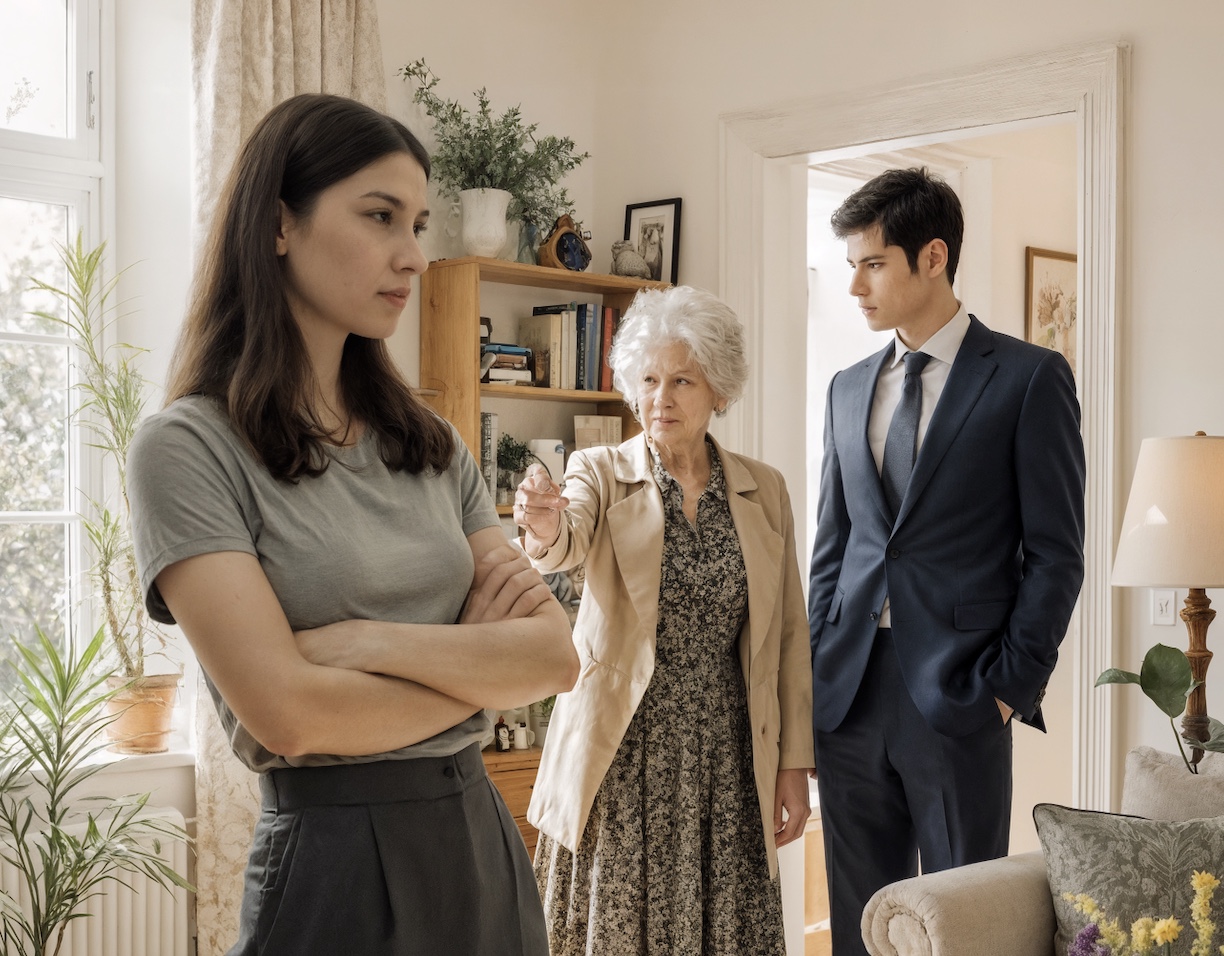
It all began with a geranium—an ordinary, awkward-looking geranium in a flimsy plastic pot from a big-box store. Olga Petrovna brought it over on Saturday morning, without warning, as usual.
“Mother-in-law, this is MY apartment!” I clenched my fists in fury. “Stop trying to run my life!”
“Here,” she said cheerfully as she stepped over the threshold, “so your place can finally feel like a home. Because, forgive me, it’s like a disinfected hospital ward in here.”
Elena was in the kitchen washing a mug. She turned around—no smile.
A promo banner for a Telegram channel with ‘popular and exclusive stories’ appears here in the original text.
“My comfort is in my mind,” Elena replied coolly. “This geranium won’t take root here, but… thanks.”
“Oh yes, of course,” Olga Petrovna sighed and, without taking off her boots, headed straight into the room. “In our home, a geranium always sat on the windowsill. Respectable people keep flowers, not… these cacti you have.”
A cactus, Elena thought as she dried the mug, because it doesn’t ask for anything. And it stings when someone tries to get too close.
Alexey—Elena’s husband—was sitting quietly in the bedroom behind his laptop, acting like he was working. Or maybe he really was; he could play both roles flawlessly.
“Lyosha!” Elena called from the kitchen. “Can you come here for a minute?”
He appeared, slightly hunched, like a schoolboy called to the chalkboard.
“Mom, why do you keep dragging things into our place? We agreed…”
“That was your agreement with her, not with me,” Olga Petrovna snapped. “I’m your mother. I have the right to make a contribution, so to speak.” She sat down in the armchair she had once “gifted” them too—duckling-yellow, faded and sad.
“Mom,” Alexey tried to joke, “a ‘contribution’ is money, not furniture. And not a geranium.”
“Don’t be clever,” she cut him off. “Your wife is the currency—useful everywhere. And I want you to live like normal people, not like you’re renting a room in some cheap hotel.”
Elena swallowed it. Again. For the third year in a row. For some reason, everyone kept calling her endurance “respect,” as if it wasn’t just pure exhaustion.
They lived in Elena’s apartment. A small one-bedroom she’d inherited from her parents. It wasn’t luxurious, but it was warm—until a woman moved in with the face of a tax inspector.
Olga Petrovna had come “temporarily,” she said.
“Until they finish renovating my place.”
“Until the upstairs neighbor replaces the pipes.”
“Until grandchildren appear.”
No children appeared. The mother-in-law stayed.
Her “in-between slippers,” the smell of her old-school face cream, her constant confusion over why Elena didn’t simmer broth—everything became part of their new reality.
“If I were you, I’d change the wallpaper. And rearrange the furniture. That sofa’s been in the same corner forever—no comfort, no energy,” Olga Petrovna would say, scanning the room like a dorm supervisor.
And if I were you, Elena would mutter to herself, I’d wear my slippers in my own apartment.
But not out loud. Not yet.
That evening, when Olga Petrovna went for a walk with a neighbor (to gossip—who else?—about who was being kicked out of their flats), Elena slid the bolt shut and went to Alexey. He was behind the laptop again, hiding in “work.”
“We need to talk,” she said, sitting beside him.
“Yeah?”
“She can’t live here anymore.”
“Len, you know she doesn’t have another option right now…”
“That’s not my problem, Lyosh. That’s yours. She moved in ‘temporarily.’ It’s been almost six months.”
“Well, you understand… Mom… she’s older, it’s hard for her…”
“You know what’s hard?” Elena’s voice tightened. “Coming home and finding someone else’s blanket on your bed. Seeing your things shoved aside in the closet. Being told coffee is harmful and that laundry has to be washed separately from ‘men’s things.’ That is hard.”
“She just wants us to be okay,” he mumbled.
“She wants us to live exactly the way she did. And she wants me gone.”
Alexey sighed and sat closer. He still wouldn’t look her in the eyes.
“Lena… you know she’s just… difficult.”
“She’s not difficult. She’s controlling. That’s not the same thing. And she doesn’t respect me, Lyosh. Not as the owner of this place, not as your wife, not as a person.”
The next day Elena gave him an ultimatum.
“It’s her or me. You choose.”
“Lena, you can’t put it that way…”
“I can. This is my apartment. My space. My life. I’m suffocating. I can’t keep pretending this is normal.”
He stayed silent for a long time, staring toward the spot where their vacation photos used to stand—now replaced by an icon Olga Petrovna had brought “so the home would be protected.”
“Fine,” he said quietly. “I’ll talk to her. But not today.”
“Of course not today,” Elena said with a bitter laugh. “First you’ll eat her borscht, say ‘thanks, Mommy,’ and then go smoke on the balcony because it’s become impossible to breathe inside.”
“Len, I’m asking you…”
“You’re always asking me to hold on. And who’s going to thank me for all the time I did hold on?”
Later, Elena sat in the kitchen in her robe, hair twisted into a bun, staring out the window. The geranium stood on the sill. Silent. Submissive.
Just like Alexey.
“So I’m the stranger in my own apartment,” she murmured.
Or maybe he is. Or she is. Or maybe we’re all strangers to one another— I just realized it first.
The door slammed. Olga Petrovna returned, groceries in hand, as always.
“I bought trout—on sale. Shall we do it for dinner?”
Elena stood up, walked over, and said with a smile:
“Go ahead. Just at your place.”
“What do you mean by that?”
“Tomorrow we’re going to look at an apartment for you. It’s either you—or me. But the two of us are not staying here together.”
“Alexey!” she shouted into the flat. “Did you hear that?!”
Alexey came out of the bedroom, rubbing the back of his neck. He nodded slowly.
“Yes, Mom. I heard.”
And silence rang out—sharp as glass struck by a stone.
The kitchen smelled like fried buckwheat and burnt nerves.
Olga Petrovna sat on the same old chair with a broken backrest—one Elena had planned to throw out last year. She didn’t. Out of politeness. And politeness is just cowardice wrapped in pretty paper. Now her mother-in-law sat on that throne like a general at a war council.
“I knew it,” she said, cracking her knuckles. “A woman without children is trouble. They invent drama for themselves and carry it around like a holy icon.”
“At least they don’t invent it out of other people,” Elena shot back, setting her mug on the table. “You’re especially sharp this morning.”
“How else should I be? They’re kicking me out of my home!” Olga Petrovna flared, tapping her fingers on the tabletop. “As if I’m not the mother! As if I didn’t do everything for Lyoshka!”
“Right—and now, for his sake, you’re shopping for a tiny one-bedroom near the train station?”
Olga Petrovna looked her over with a gaze that mixed pity, contempt, and appraisal—like she was picking a dress for her in a thrift store. Alexey stood by the window, nervously poking at his phone. He was a referee in a match between a snake and a tigress—only the tigress was tired, and the snake never ran out of energy.
“I didn’t give birth just to end up in a shoebox,” Olga Petrovna said, standing and adjusting her robe. “I wanted a family. Not… your modern performances.”
“A performance is a grown man staying quiet while two women fight for his voice,” Elena stepped closer. “Lyosh, maybe you’ll finally say something? Or are you going to run to the bathroom like always?”
“Lena…” he began, but the words failed him.
“What, ‘Lena’?” her voice rose. “What are you trying to say—that Mom just picked the wrong moment? That she’ll leave, but not now? That I need to endure a little longer? Or that we’ll finally handle this like adults?”
“We’re adults,” he muttered.
“No. An adult is someone with a spine. You’re still just a boy trapped between your mother’s skirt and your wife’s slippers.”
Silence.
Olga Petrovna sat down again. She understood she’d lost this round—though the match wasn’t over.
“I get it,” she said in a syrupy voice with poison underneath. “You’re tired. Nerves. Hormones. But why destroy the marriage?”
“The marriage is the one in menopause, Olga Petrovna. Not me.”
The next day Alexey went to a friend’s place “to think.” The friend lived alone, played video games, and asked no questions.
Elena was left alone with Olga Petrovna. Their standoff turned cold: fewer words, more cabinet doors slammed.
And in that kind of silence, the last illusions usually fall.
Elena woke at night to a soft rustling. Someone was moving around in the kitchen. She got up barefoot, like a soldier on a night mission.
Olga Petrovna stood by the fridge in her robe, biting into a cabbage pie.
“I can’t sleep when they’re throwing me out,” she grumbled.
“No one is throwing you out,” Elena said. “You don’t pay rent, you don’t share expenses—but you command everything here like it’s your house.”
“And you’ve forgotten who helped you with money for that vacation,” Olga Petrovna snapped.
“No, I haven’t. And I haven’t forgotten how you told the whole neighborhood about it—your friends, the mail carrier, and even your dentist.”
“I’m the mother. I have the right.”
“To what?” Elena’s voice went low. “To turn my life into a trap?”
Olga Petrovna suddenly went quiet. Elena expected an argument, but instead her mother-in-law sat at the table.
“Do you really think I hate you?”
Elena blinked. She hadn’t expected that.
“I think you don’t respect me,” she said slowly. “And that’s almost the same.”
“I don’t understand you,” Olga Petrovna whispered. “Nothing pleases you. Everything is ‘my rules,’ ‘my apartment,’ ‘my life.’ Where is ‘ours’? Where is family?”
“Did it ever occur to you that when someone keeps making ‘ours’ according to their pattern, it stops being ‘ours’ at all?”
“You’re hurting Lyosha. He isn’t a bad man.”
“I love him,” Elena said. “But I can’t be his comfort blanket and your pillow at the same time.”
Olga Petrovna stared at one point on the table. The pie cooled in her hand.
“I don’t want him to be alone.”
“He won’t be alone,” Elena answered. “If he learns to speak. And to choose.”
Two days later, Elena and Alexey drove out to view apartments. More accurately, he drove her in silence, hands locked tight on the steering wheel.
They argued three times on the way: about the neighborhood, the price, and who would pay for the gas bill. The third time, Elena simply pulled out her phone and texted the agent to reschedule.
“I can’t do this alone,” she said. “If you want your mother to move out, you handle it. Because I’m done.”
“I’m tired too, Lena.”
“You’re tired quietly,” she said. “I’m tired out loud.”
They returned in silence. Olga Petrovna was home, sitting in her robe with her hands folded on her stomach.
“Well?” she asked.
“We’ll look at one more place tomorrow,” Alexey said.
“And registration?” she shot back immediately.
Elena spun around.
“Registration? What are you talking about?”
“I’m saying that until you divorce, Lyosha has a right to a share. Which means he has a right to be registered here. Otherwise I’ll take it to court.”
Silence. Even the refrigerator seemed to stop humming.
Alexey sat down, his face grey.
“Mom… have you lost your mind?”
“No. I’m just sick of her arrogance. ‘My apartment, my conditions.’ He’s my son! He’s not a homeless man who should live without registration!”
Elena walked to the door.
“I’m calling a taxi. Go see a lawyer. And then go to hell.”
“Len, wait…”
“No. I won’t. Either you tell her right now you’re not taking part in this circus—or tomorrow I file for divorce. And believe me, she won’t get registration. She’ll get served.”
She slammed the door and disappeared into the night. She slid into the taxi. Her heart pounded as if she’d run up ten flights of stairs.
And one question hammered inside her: How could you, Lyosha?
How could you even think I’d let a stranger get registered in the home my parents left me?
That day the apartment didn’t smell like buckwheat—it smelled like a storm. Heavy clouds pressed against the windows like the sky itself was preparing to sit in judgment over this story.
Elena stood in the hallway, arms crossed. Alexey and Olga Petrovna sat on the sofa like defendants accused of betraying… comfort and peace.
“So,” Elena began, her voice cold and sharp as a blade, “today is the final round. I’m done surviving in my own home. And you’re done living in limbo.”
“You’re too harsh,” Alexey sighed, eyes lowered. “Maybe we can solve this without breaking up?”
“Without breaking up?” Elena repeated with a bitter smile. “And what do you call this cycle of hypocrisy and silent betrayal we’ve been living in? Because to me, this is already the crack before the break.”
“Len, Mom is just scared,” Alexey tried. “She’s afraid of being alone.”
“Fear of being alone isn’t permission to trample someone else’s life,” Elena snapped, stepping toward her mother-in-law. “You’ve been a shadow that clings and doesn’t let me breathe.”
“I was trying to save the family!” Olga Petrovna suddenly exploded, standing and balling her fists. “You don’t understand what it means to be a mother!”
“And I seem to understand what it means to be a wife who endures,” Elena shot back, eyes blazing. “I’m tired of being a hostage to your demands and your jealousy.”
“So it’s my fault you have no children?” Olga Petrovna asked, pain flashing through her voice. “You never gave Lyosha an heir!”
“I wasn’t going to ‘produce an heir.’ I wanted a child. But for that you need a family. And with you, what we have is a performance where the roles were assigned long ago.”
“You’re twisting things,” Olga Petrovna muttered, looking away.
“A twist is you discussing the sale of my apartment without me,” Elena said, her voice breaking with hurt. “And now it’s simple: either you leave, or I leave.”
Alexey finally stood between them—finally choosing truth.
“Mom, enough. You’ve broken too much already. Lena is right. We haven’t been living together—we’ve just been trapped in the same space, and it stopped being a home a long time ago.”
“I can’t leave you alone,” Olga Petrovna whispered, her voice trembling. “I’m afraid.”
“You’re afraid,” Alexey exhaled, “but that still doesn’t give you the right to ruin someone else’s life.”
In that moment Elena saw tears in her mother-in-law’s eyes—not pride, not rage. Just fear. Fear of losing the only thing she had.
“So this is the end?” Elena asked, looking at her husband.
“I think it is,” Alexey answered—and for the first time, his voice was firm.
“Then I’m making the decision,” Elena said, taking a deep breath. “You both leave my apartment by the end of the week. Otherwise I’ll do it through the courts.”
Olga Petrovna nodded silently, and Alexey looked at his wife in despair.
“You were my first love,” he said quietly. “We started together… maybe this is our last chance.”
“A last chance is respect,” Elena replied, “not obedience to someone else’s rules.”
She turned and stepped into the corridor. At that moment the lawyer she had arranged called at the door.
“Well?” he asked, glancing at the three of them.
Elena smiled—truly smiled—for the first time in a long while, with relief and certainty.
“I’m going to protect my home. And myself. Because no family is worth feeling like a stranger inside it.”
Outside, the first thunder rolled. The storm had begun. But for Elena it wasn’t disaster—it was cleansing. A purge of the life she’d been trapped in, so that something real and untouchable could finally begin.
May everyone have their own home, their own truth, and their own chance at happiness—without чужие диктаты and questionable “inheritances.”