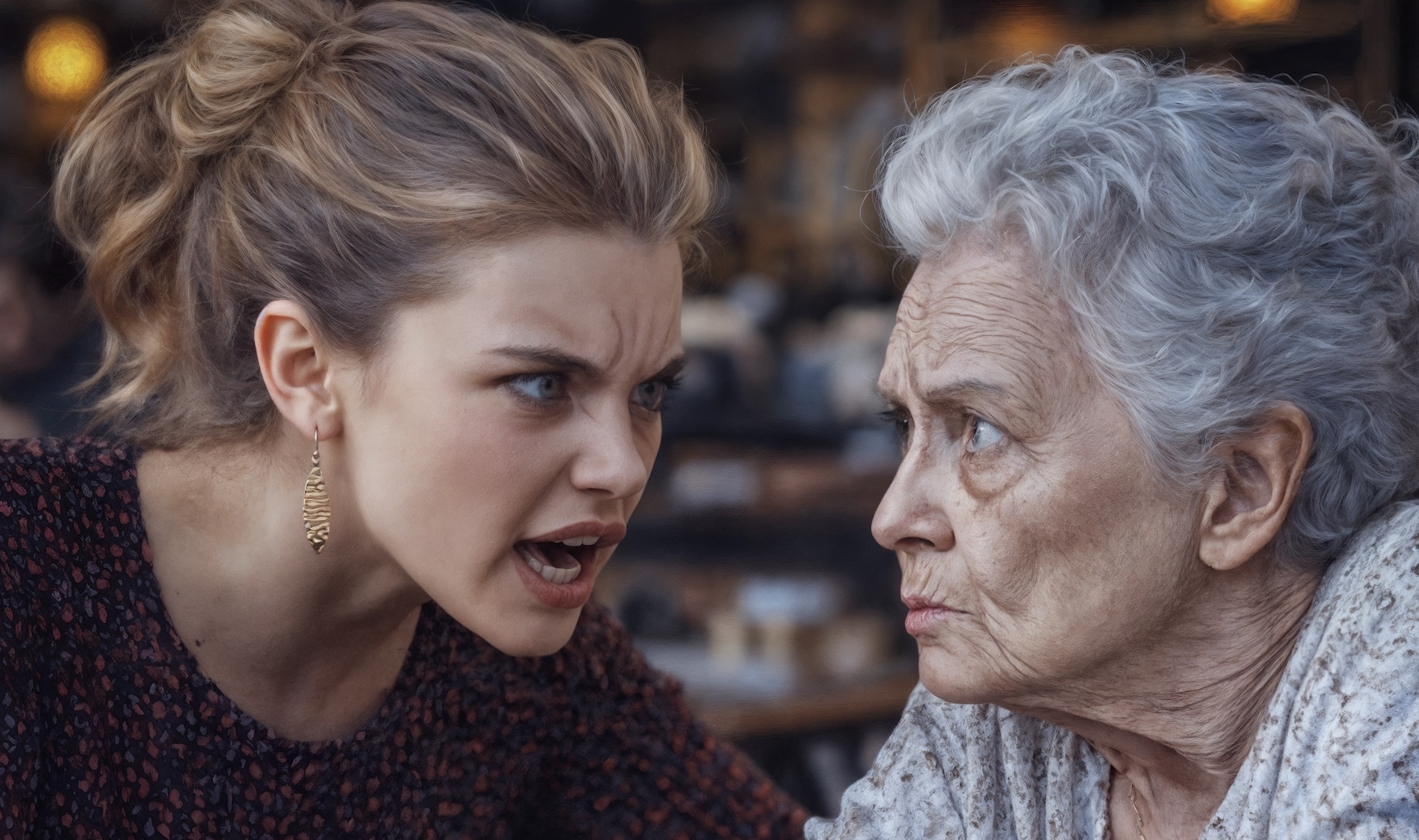
“And this hunk of meat,” the voice remarked, “I see isn’t cooked properly at all. Blood on the plate is a one-way ticket to parasites, Zhanna. Or did you decide that since you don’t cook at home, you can poison yourself here with whatever you feel like?”
Zhanna froze with her fork lifted to her lips. She would have recognized that voice even through the scream of a fighter jet—let alone the constant hum of a business-center dining hall. Slowly, she raised her eyes.
In front of her—blocking the aisle and looming over her small window table like a thundercloud—stood Veronika Yevgenyevna.
Her mother-in-law looked exactly as she always did: immaculate, intimidating. A gray cashmere coat. Hair styled to perfection. And on her face—an expression of contemptuous pity, the kind people reserve for something they’ve crushed underfoot.
“Good afternoon, Veronika Yevgenyevna,” Zhanna said, carefully setting her fork down on the rim of the plate. Her appetite vanished instantly, as if a cold draft had blown it away. “I didn’t know you came to this area. I’m on my lunch break. I only have thirty minutes.”
“I know perfectly well where you work and when your break is,” her mother-in-law replied. “Unlike you, I have a flexible schedule, and I actually know how to plan my time.”
Without waiting to be invited, Veronika Yevgenyevna pulled out the chair opposite and sat.
She did it with the easy ownership of someone who behaved as if the café belonged to her. One finger at a time, she slipped off her leather gloves and laid them beside Zhanna’s plate, nearly brushing the edge of the half-finished steak. Her perfume—expensive, heavy—swallowed the smell of coffee and food in an instant. It carried notes of cold metal and old powder.
“Did you want something?” Zhanna asked, feeling a dull, simmering anger begin to rise. This was her time—her earned half hour of silence between reports and client calls. And now this refuge had been invaded—boldly, shamelessly.
“I wanted to see what the woman who feeds my son processed trash eats herself,” Veronika Yevgenyevna said, sweeping her eyes over the table and lingering on the coffee cup and plate. “You know, Zhanna, I stopped by your place yesterday while you were at work. I have my own keys, in case you’ve forgotten. I opened the refrigerator… and I nearly got sick.”
She paused, waiting for Zhanna to react. Zhanna said nothing—just stared straight at her. Veronika Yevgenyevna clicked her tongue and continued, raising her voice slightly so the men in suits at the next table could hear.
“Empty. A dead mouse would hang itself in there. Two dried-up bits of cheese and a jar of some pickles. Oh—and dumplings in the freezer. Store-bought. Do you even understand what you’re doing to Denis’s stomach? He’s had gastritis since he was a child. He needs diet food—steamed, homemade, proper. And you keep stuffing him full of chemicals.”
“Denis is an adult man, Veronika Yevgenyevna,” Zhanna answered evenly, though her fingers curled into a fist under the table. “If he wants steamed cutlets, he can buy ground meat and ask me to make them. Or make them himself. We both work until eight.”
“‘We both work,’” her mother-in-law mocked, twisting her burgundy-painted lips. “And that is exactly the problem. You’re far too absorbed in your… ‘career.’ If moving papers around an office even counts as one. You’re a woman, Zhanna. Your real work is your home and your husband. And you look…”
Veronika Yevgenyevna leaned forward, inspecting her daughter-in-law’s face with the blunt entitlement of a dermatologist at an exam.
“…You look awful. Bags under your eyes. Gray skin. Makeup thrown on in a hurry. No wonder Denis has been staying late recently. Who wants to come home to a tired, perpetually dissatisfied wife whose head is filled with debits and credits—and dinner is defrosted dough with meat of questionable origin?”
Heat rushed into Zhanna’s cheeks—not from embarrassment, but from fury. Cutlery clinked around them, people laughed, talked business, servers passed with trays—but for Zhanna the world narrowed to this table and the woman opposite her, radiating poison like a radioactive substance.
“Veronika Yevgenyevna, let’s not make a scene,” Zhanna said, keeping her voice controlled. “I didn’t ask you to inspect my refrigerator. And I certainly didn’t ask you to evaluate my appearance. If something bothers Denis, he can tell me himself.”
“He won’t!” her mother-in-law snapped, a sharp, shrill edge tearing through her tone. “He’s too well brought up. I raised him to be a gentleman. He’ll endure it, he’ll keep silent, he’ll choke down your dumplings and smile because he’s noble. But I’m his mother. I can see him suffering. I can see him wasting away. His shirts aren’t even ironed! I saw him last week—his collar was wrinkled! Wrinkled. It’s a disgrace, Zhanna. A disgrace for a wife.”
Her voice climbed higher and higher. People at neighboring tables began to turn. Someone stopped chewing, listening to the budding scandal. Veronika Yevgenyevna seemed to draw energy from the attention. She squared her shoulders like an actress onstage delivering a righteous monologue.
“You came all the way here to discuss collars?” Zhanna leaned back. The food had gone completely cold and looked as unappetizing as this entire conversation. “You could have called.”
“On the phone you hang up and claim you’re busy. Here you can’t run,” her mother-in-law said with a nasty little smile. “I came to open your eyes, sweetheart. You’re living under the illusion that everything is fine. It isn’t. You think bringing home a salary is enough? A man doesn’t need your pennies. He needs comfort. He needs care. He needs admiration. And you? You come home and collapse on the couch.”
With a look of disgust, she shoved the napkin holder aside as if it were obstructing her truth. Her gaze turned needle-sharp.
“And do you know what my neighbor told me yesterday? She saw you taking out the trash. In sweatpants. In some stretched-out tank top. In public! You’re not just embarrassing yourself—you’re embarrassing my son’s family name. How is he supposed to feel knowing his wife looks like a beggar?”
“I was at home. I stepped out to the trash chute,” Zhanna replied, trying to keep a thread of reason in the absurdity. “Veronika Yevgenyevna, this is beyond ridiculous. What I wear is my business.”
“Your business ended when you put a ring on your finger!” her mother-in-law cut her off, slamming her palm onto the table. The sound cracked through the room—sharp, ugly. “Now you’re the face of the family. And that face—excuse me—looks anything but presentable. I will not let you drag Denis down. I invested too much—effort, money, my soul—for some… office mouse to turn his life into a domestic swamp.”
Zhanna glanced at the clock. Only five minutes had passed, yet it felt like an hour. She understood she would not be allowed to finish her lunch in peace. Veronika Yevgenyevna hadn’t come to talk—she’d come to demolish. This was a planned intimidation: a public execution where the victim, in the executioner’s mind, would be too ashamed to fight back.
“Listen,” Zhanna leaned forward, and her voice hardened. “I respect you as my husband’s mother. But you’re crossing a line. I’m not your subordinate, and this isn’t a staff meeting.”
“Don’t you dare tell me about lines,” Veronika Yevgenyevna hissed, eyes narrowing. “You don’t even know where the line is. You think you’re the one in charge? You think a stamp in your passport gives you guarantees? Silly, naïve girl. Let me tell you what happens to arrogant little empties like you. I came prepared, Zhanna. I have a long account to settle.”
She reached into her expensive handbag—yet pulled out no papers.
She pulled out months of stored hatred, and she was ready to pour it directly onto the café’s bright white tablecloth.
Veronika Yevgenyevna began curling her fingers, counting. Her neat French manicure looked like tiny blades poised to cut open, in her mind, the “infected wounds” of Zhanna’s supposedly wrong life.
“Point one: the bathroom,” she announced. “I went to wash my hands and was horrified. Toothpaste splatter on the mirror. Limescale on the faucet. Do you even know what cleaning products are, or are you waiting for the dirt to fall off on its own? My son comes home from work and should step into a sterile space to wash away stress—not into a pigsty where it’s disgusting to touch the doorknob.”
Zhanna clenched her jaw and stayed silent. She’d cleaned the bathroom on Saturday. But for Veronika Yevgenyevna, cleanliness was apparently measured by laboratory standards—standards no living person could meet.
“Point two,” her mother-in-law continued, bending another finger; steel rang in her voice. “Clothes. I went through Denis’s closet. Why are winter sweaters mixed with T-shirts? Where are the moth sachets? Where are the perfect stacks sorted by color? You just shoved everything in and shut the door with your foot. That’s disrespect. Things have energy, Zhanna. When you treat your husband’s clothes like rags, you treat him the same way. You devalue his status.”
“I don’t reorganize Denis’s things because it’s his personal space,” Zhanna shot back coldly, feeling something inside her pull tight like a string. “He asked me not to touch his shelves so he can find what he needs.”
“Don’t lie to me!” Veronika Yevgenyevna roared so loudly the barista flinched behind the counter and spilled coffee beside the cup. “Denis is a neat freak! He grew up in a house where everything was perfect. If he’s living in chaos now, it’s only because you broke him. You trained him into your laziness. You’re like mold—spreading through his life, infecting everything with your carelessness.”
She leaned in; her eyes glittered with a fanatic light. Now she wasn’t speaking like an annoyed relative—she sounded like a prosecutor reading a death sentence.
“And don’t think I don’t see how he looks at normal women,” she said. “Well-groomed women. Obedient women. Competent women. Yesterday we ran into my friend’s daughter, little Lena. Smart, beautiful, bakes pies, hangs on a man’s every word. Denis looked at her… with longing, Zhanna. With the longing of a trapped animal caught in a snare with an incompetent wife.”
“Are you finished?” Zhanna asked, her pulse hammering at her temples. She wanted to stand and leave, yet something held her in place—perhaps the need to see how far this could go.
“Oh no, sweetheart,” Veronika Yevgenyevna smiled like a predator. “I’m just getting started. The most important part is your attitude. Your arrogance. You think you’re far too important. ‘I work,’ ‘I’m tired,’ ‘I have a career.’ Please. Who needs your career if you can’t give a man basic comfort? You should greet him at the door with a smile, slippers, and a hot dinner. You should ask how his day went and listen—silently—rather than dumping your office chatter onto him. You should be a shadow: convenient, invisible, creating the backdrop for his success. And you? You’re trying to be his equal.”
She paused to draw breath and swept a triumphant glance across the room, making sure the audience was still watching. They were. Someone shook their head at Zhanna in judgment; someone filmed from behind a phone.
“Do you know how this ends?” her mother-in-law went on, quieter now—yet the softness made it worse, turning her voice ominous, prophetic. “Denis tolerates a lot. He’s gold, he’s gentle. But patience has limits. One day he’ll come home, see those store-bought dumplings again, see your dissatisfied face, see dust along the baseboards… and he won’t hold back.”
She leaned across the table until she was nearly in Zhanna’s face. The cloying perfume flooded the air.
“He’ll start ‘teaching’ you, Zhanna. Like a man. With his fist. And I won’t condemn him. I’ll even tell him, ‘Son, you’re right.’ Women like you need to be raised with force when words don’t work. A good slap can do wonders for a defective wife. It puts her brain back in place and teaches humility. And if even that doesn’t get through to you…”
She sat back, pleased with the reaction she’d managed to provoke.
“…then he’ll throw you out on the street. Like a kitten that messes in the shoes. The divorce will be fast and brutal. You’ll have nothing—stuck in your rented little hole, old and unwanted, a lonely divorcée. And Denis will find a proper woman—maybe that same Lena—who will appreciate him and worship the ground he walks on. That’s my promise. I’ll make him wake up. I’ll drip poison into his ears every day until he finally sees what kind of worthless thing lives under the same roof with him.”
Zhanna stared at the woman across from her and saw not her husband’s mother, but a monster stitched together from insecurity and hunger for control. The talk of beatings was the final drop. This wasn’t criticism about cleaning—it was a direct incitement to violence, a justification of cruelty wrapped in the packaging of “motherly concern.”
“Do you honestly think Denis could hit me?” Zhanna asked softly. Her voice was deceptively calm, like the surface of water before a storm.
“I think you’d deserve it,” Veronika Yevgenyevna said flatly, without blinking. “A man has the right to demand respect. If a woman won’t understand the nice way, a man uses force. That’s nature’s law. And if you think I’d protect you—you’re deeply mistaken. I’d hand him the belt myself.”
A tight silence settled over the café. The hiss of the espresso machine sounded absurdly loud. Veronika Yevgenyevna sat with the air of a victor, convinced she had finally crushed her daughter-in-law. She expected tears. Excuses. A trembling voice. She expected Zhanna to begin babbling apologies and promising to “improve.”
But Zhanna didn’t cry.
She slowly pushed the cold steak away, smoothed a napkin over her knees, and straightened her back. In her eyes—where confusion had flickered a moment ago—something else burned now: a cold, measured flame. Fear was gone. Only disgust remained, and a clear understanding of what came next.
This was no longer a family spat.
This was war.
And Zhanna was ready to fire the first shot.
“Are you finished fantasizing about your son beating me,” Zhanna said quietly, “or do you have more ideas straight out of the criminal code?”
The words were soft, but the ice in her tone stopped Veronika Yevgenyevna mid-breath. She blinked. She’d expected hysteria—screaming, sobbing, messy emotions that would confirm her theory that Zhanna was unstable. She had not expected to be looked at like a pathologist studying an interesting—but already dead—specimen.
“What did you say?” her mother-in-law demanded, sitting straighter. “You dare call what I’m saying ‘fantasies’? I’m talking about real life—how normal families work!”
“You’re talking about violence, Veronika Yevgenyevna,” Zhanna replied, carefully shifting her coffee cup aside and clearing space on the table as if preparing for surgery. “You’re describing your son as a sadist—and yourself as his accomplice. But I’ll disappoint you. Denis will never lay a hand on me. Not because I’m ‘good’ or ‘bad,’ but because—unlike you—he’s mentally healthy. And if you keep dripping your venom into his head, trying to turn him into a household tyrant, you’ll achieve only one thing.”
Zhanna paused just long enough to watch red blotches rise on her mother-in-law’s face.
“And what, exactly, will I ‘achieve’?” Veronika Yevgenyevna hissed. “That he finally sees who you really are?”
“No,” Zhanna said. “You’ll achieve losing your son. For good.”
Veronika Yevgenyevna snorted and tugged at her coat collar with a twitchy, uncertain gesture.
“Don’t make me laugh. A mother is sacred. Wives come and go, but a mother is forever. He’ll never abandon me for some—”
“Listen closely, Veronika Yevgenyevna,” Zhanna cut in, her voice suddenly ringing through the space. “If you say one more thing to my husband against me, then believe me—we will move so far away you won’t even know where we are. I promise you that.”
The café fell silent. Even the men at the next table stopped discussing stock numbers and turned toward them. Zhanna didn’t break eye contact. She stared straight at the bridge of her mother-in-law’s nose, and that look landed harder than any slap.
“We’ll sell the apartment,” Zhanna continued evenly, not allowing her mother-in-law to interrupt. “Yes—the very one you love barging into with your keys and your little inspections. We’ll leave the region. Maybe we’ll go all the way to the Far East. Or Kaliningrad. Somewhere your long arms and your toxic tongue can’t reach. And you will never see Denis again. Not on holidays. Not on birthdays. You’ll become nothing but a voice on the phone he hears once a year—if I allow it.”
“You… you’re blackmailing me?” Veronika Yevgenyevna went pale; her lips trembled, not from hurt, but from powerless rage. “You won’t dare! Denis won’t agree! This is his hometown!”
“Denis will agree,” Zhanna said with quiet certainty. “Because he’s tired. Tired of your endless calls, your criticism, your attempts to run his life like he’s a puppet. He loves me, Veronika Yevgenyevna. And he will choose a calm life with me over a lifetime of neurosis with you. You think he doesn’t see what you do? He sees everything. He’s simply too polite to tell you where to go. I’m not that polite.”
Zhanna leaned forward. Her voice dropped low, meant only for her mother-in-law’s ears—making it even more terrifying.
“And forget grandchildren. If we decide to have children, you won’t see them. Ever. No ‘grandma’s pies,’ no park strolls. They’ll know only this: that somewhere there’s a cruel woman who hated their mother. Is that the old age you want? An empty apartment with a spotless bathroom—and total isolation?”
Veronika Yevgenyevna’s eyes widened. Zhanna had struck the one place that truly hurt. The power Veronika Yevgenyevna had cultivated for years crumbled to dust in a few sentences from this “office mouse.” She was used to being feared, obeyed, treated as law. And now she wasn’t merely being challenged—she was being erased from the equation.
“You’re vile,” her mother-in-law breathed, her face twisting with hatred. “Cold, calculating, vile. I knew it from day one. You want to steal my son from me!”
“I want you out of our bedroom, out of our kitchen, and out of our life,” Zhanna snapped back. “The keys. Now.”
“What?” Veronika Yevgenyevna instinctively clutched her handbag to her chest.
“The keys to our apartment. Put them on the table. Right now. Otherwise, tonight I’ll call a locksmith and change the locks. And the next time you show up to inspect my pots, you’ll be kissing a metal door. Choose: you give me the keys willingly and we keep the pretense of a barely civil relationship—or we go to war, and you lose everything.”
Zhanna extended her open palm—an ultimatum. She wasn’t asking. She was demanding surrender.
Veronika Yevgenyevna stared at that hand as if it were the barrel of a gun. Her mind couldn’t accept how quickly the situation had flipped. She’d arrived like a queen, ready to judge and execute, and now she’d been driven into a corner.
She felt the stares of the café patrons. Felt her authority collapsing. Panic surged in her chest—then melted into something wild and hysterical. She couldn’t lose. Not to this upstart. Not here.
“You think you’ve won?” her voice shook, tipping into a shriek that turned heads across the room. “You think you can dictate terms to me? To me—the woman who gave her whole life to making a man out of her son?!”
“The keys,” Zhanna repeated, flat and steady, her hand still out.
That calm was the last straw. Something snapped inside Veronika Yevgenyevna. The mask of an elegant lady slid off, revealing a furious, unhinged face—like a market vendor being robbed of her last coin.
“Keys?!” she screeched. “You’re demanding the keys to my son’s apartment? Who do you think you are, you barren little tramp, to kick me out?!”
In one violent motion she shot up from her chair so fast it flew backward with a crash into a nearby table. An elderly couple flinched away. But Veronika Yevgenyevna no longer saw anyone. In her eyes churned the madness of someone whose entire meaning in life—total control—was being ripped away.
“You think I’ll let you take him?” she loomed over Zhanna, spit flying. “You think I’ll hand you my boy? Never! Do you hear me? Never! I’ll die before I let it happen, but I’ll split you up! I’ll make him unable to even look at you without disgust! I’ll hire people, I’ll invent an affair, I’ll destroy you!”
Zhanna didn’t even flinch. She remained seated, back straight, her hand still extended—like she was waiting for alms from someone poor in spirit. That composure enraged Veronika Yevgenyevna even more. It humiliated her far more than any shouting could.
“Put that stump away!” her mother-in-law screamed, and slammed her hand down hard on Zhanna’s palm.
The blow was clumsy and glancing, but it was enough to clip a tall cup of half-finished latte perched near the edge of the table. The heavy ceramic tipped over. Hot brown liquid poured like a small river across the white tablecloth, dripping onto Zhanna’s pants and splattering Veronika Yevgenyevna’s expensive cashmere coat.
The crash of the cup hitting the floor was the starting gun for chaos.
“You snake!” Veronika Yevgenyevna howled, staring at the stains on her coat as if they were acid. “You did that on purpose! You set this up! You ruined my coat! This coat costs more than your pathetic life!”
Whatever dignity she’d pretended to have dissolved completely. She lunged across the table, reaching for Zhanna’s hair. Those manicured hands became claws.
“I’ll scratch your eyes out! I’ll destroy you!” she shrieked, grabbing Zhanna by the lapels and shaking her with unnatural force.
Zhanna caught her wrists and squeezed—hard. There was no fear in her movements, only cold disgust, as if she were restraining a violent patient in a hospital ward.
“Take your hands off me,” Zhanna said in a voice like ice, staring straight into the blown pupils of the unhinged woman.
“Security!” the manager’s shout cut through the hysteria.
Two broad-shouldered men in black uniforms hurried toward the table. A young administrator, pale with shock, trotted after them, gesturing frantically to calm the patrons who had jumped up and were filming everything on their phones.
“Ma’am, calm down!” one guard barked, seizing Veronika Yevgenyevna by the elbows and pulling her away from Zhanna.
“Don’t touch me!” she thrashed in the grip of the strong man, trying to kick him with the sharp heel of her boot. “You have no right! I’ll file complaints! Do you know who I am?! Let me go! She attacked me! Look—she spilled coffee on me! That girl is a psychopath!”
She wriggled like an eel. Her hairstyle had collapsed, strands stuck to her sweaty forehead, lipstick smeared onto her chin. The aristocratic image was gone. In front of the entire café was simply a shrieking woman causing a scene.
“Take her out,” one guard said curtly to the other.
They grabbed her under the arms and hauled her toward the exit. Her feet scraped along the floor, but she kept twisting around to scream back at the table where her daughter-in-law still sat.
“Curse you!” her voice rang through the café. “May you die! Denis will hear about this! I’ll tell him how you humiliated me! You’ll regret it! You’ll pay in blood, you wretch!”
People parted, grimacing. Some laughed. Some openly made the “crazy” gesture by their temples. Veronika Yevgenyevna—the woman who had spent her whole life obsessed with “what people will say”—was being thrown out like a drunk troublemaker, while those same people looked at her like dirt.
The doors swung open. A blast of cold street air hit everyone nearby. The guards practically dumped her onto the sidewalk. She continued yelling, pounding on the glass, wagging a finger—but her voice was swallowed by the noise of the street. A minute later, realizing how pointless it was and catching passersby staring, she spun around and hurried off on her high heels, frantically rubbing at the coffee stain on her coat.
Inside, the café fell into a ringing, fragile silence, broken only by cheerful background music that now sounded wildly inappropriate.
The administrator approached Zhanna, nervously adjusting his tie.
“I’m so sorry about the incident,” he murmured, glancing at the spilled coffee pooling on the tablecloth. “We’ll clean this up right away. Can I bring you anything? Water, maybe? We’ll comp the bill, of course.”
Zhanna slowly shifted her gaze from the door—behind which her old life of endless criticism and lectures had just vanished—to the administrator. Her face held no tears. No trembling lips. Only the calm of someone who had just closed a difficult deal.
“No water,” she said evenly. “Bring me another espresso, please. And a couple of napkins.”
She pulled a paper napkin from the remaining stack and methodically wiped the latte from her sleeve. She hadn’t gotten the keys—but it no longer mattered. Tonight the locks would be changed. Denis would be shocked when he saw security footage or heard his mother’s version of events, but facts were facts: his mother had caused a public meltdown.
Zhanna finished blotting the stain, crumpled the napkin, and dropped it into the brown puddle on the table—right where, a moment earlier, the distorted, furious face of her mother-in-law had reflected.
A waiter set down a small cup of steaming black coffee. Zhanna nodded in thanks and took a careful sip. The coffee was bitter, strong, and hot—exactly the way she liked it.
For the first time in three years of marriage, she felt completely free.
War had been declared. The first battle had been won. And Zhanna knew with absolute certainty—she would not be taking prisoners.
She looked out the window at the busy street, and a faint, hard smile—an unmistakable victor’s smile—played at the corners of her mouth.