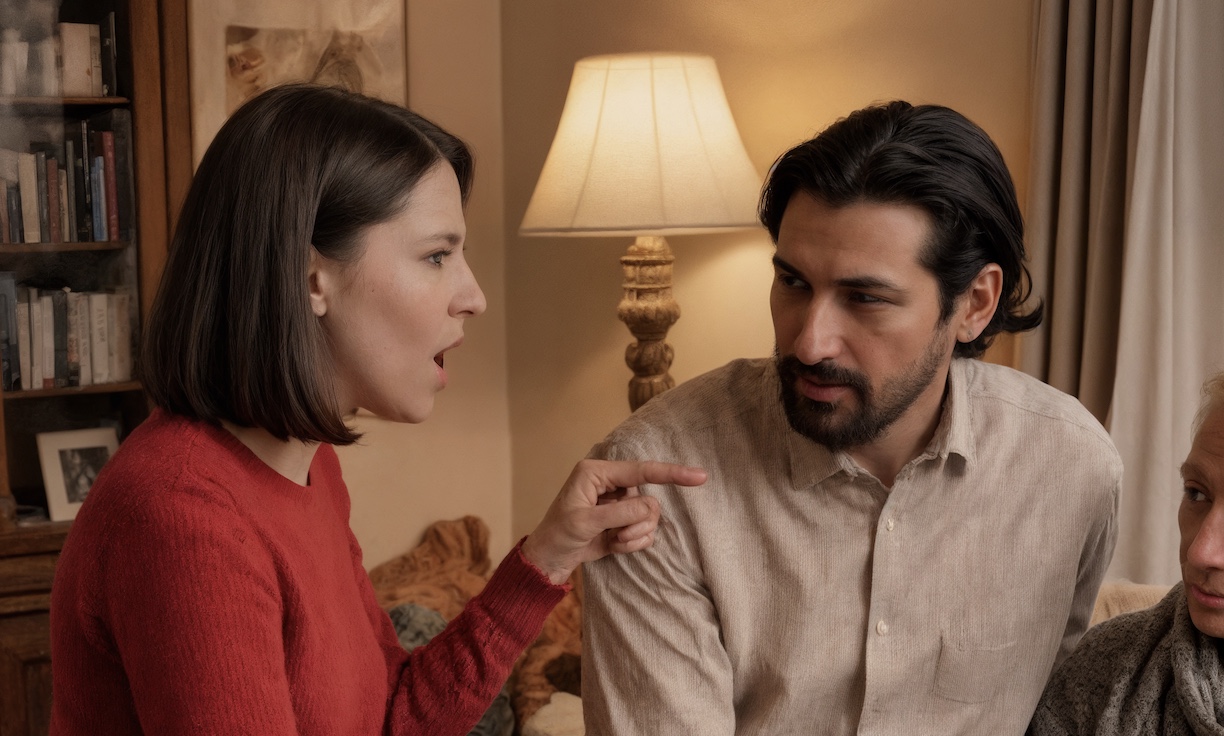
Oleg ceremoniously tugged at his shirt collar and swept his gaze over the relatives gathered around the table. September rain tapped steadily at the windowpanes, while every lamp in the living room burned bright, wrapping the scene in a warm, “family evening” glow. Lena poured tea into cups, waiting for her husband to finally explain why he’d called everyone together on a Saturday night.
Across from him sat his mother, Tamara Ivanovna; his sister Natasha with her husband; and his brother Sergey with his wife. All eyes were on Oleg, expectant—like they were about to hear news that would change something.
“My dear family,” Oleg began, grinning wide, “I brought you here today to share something wonderful.”
Lena lifted her eyes from the teapot, wary. Something in his voice didn’t sit right. Oleg wasn’t usually this theatrical. She ran through possibilities: a promotion, maybe… or perhaps he’d decided to buy the small country place they’d dreamed about for years.
“Lena and I have been thinking for a long time about how to make life better,” he went on, and Lena frowned. There had been no “we,” no long talks. What was he even talking about?
“And now, at last, the decision has been made!” Oleg stood up and raised a hand as though he were making a toast. “I gave my mother a house! From today on, Mom is the rightful owner!”
The room fell into a heavy, stunned silence. Lena froze with a cup in her hand, blinking, as if her brain refused to accept the words. A house? A gift? What house?
Tamara Ivanovna lit up with pride, as if she’d just hit the jackpot. She straightened in her chair and gave a regal nod.
“Thank you, son,” she said, her voice trembling with emotion. “I always knew I had the best son in the world.”
Natasha started clapping.
“Oleg, you’re incredible! Mom deserves this!”
Inside Lena, something flared hot and sharp. Blood rushed to her cheeks as she struggled to keep her outrage under control. The house in Podolsk—the very one they’d planned to buy for themselves. The one they’d saved for, month after month, for five years.
“How… are the documents already done?” Lena’s voice sounded distant, like it was coming from someone else.
“I went yesterday and handled everything,” Oleg said with a carefree wave. “Mom’s the owner now. She can live peacefully and stop worrying about the future.”
“And what about our plans?” Lena forced the words out. “We were going to buy a house for our family. For the children we’re planning.”
Oleg brushed it off as if she were complaining about something minor.
“My own mother matters more than any plans,” he declared. “She sacrificed her whole life for me. Now it’s my turn.”
His relatives nodded in agreement, as though this choice was obviously the only “right” one.
“Of course,” Natasha chimed in. “Tamara Ivanovna deserves a calm, comfortable old age.”
“And you two are young,” Sergey’s wife added. “You’ll save up again.”
Lena slowly set her cup down. Her hands were trembling. Five years of cutting corners—no vacations, no new clothes, no restaurant meals. All of it for the home they imagined living in together, raising their kids there.
“Oleg,” Lena said carefully, “did you ask me before spending what we saved together?”
“What do you mean, ‘together’?” Oleg looked genuinely surprised. “I earn the money. So I decide where it goes.”
“I work too,” Lena reminded him. “And my money went into that fund as well.”
“So what?” Oleg shrugged. “I still contributed more.”
Tamara Ivanovna leaned in, as if to settle the matter.
“Lenočka, don’t upset yourself. This is for the family! Now we’ll have a true family nest. The grandchildren will come visit Grandma at the dacha.”
“What grandchildren?” Lena asked, bewildered. “We don’t even have children yet.”
“You will,” her mother-in-law said with total confidence. “And until then the house won’t sit empty. I’ll take care of it, keep an eye on everything. I’ll plant a garden, grow vegetables.”
“Mom’s right,” Oleg nodded. “Why should the place stand unused? This way she’ll live comfortably.”
Lena stared at her husband and didn’t recognize the man she’d been married to for seven years. When had he become so indifferent to her opinion? When had he stopped treating her like an equal partner?
“And where are we supposed to live?” Lena asked. “When we decide to have children—still in a one-room rental?”
“We’ll rent something bigger,” Oleg answered lightly. “Or we’ll move in with Mom. The house is big—there’s room for everyone.”
“With your mother?” Lena repeated.
“What’s the problem?” Oleg looked surprised. “That’s how people used to live—several generations under one roof. And somehow they managed.”
Natasha quickly backed him up.
“Lena, it’s perfect! Tamara Ivanovna will help with the kids when they come—cook, wash, everything. You’ll just work and relax.”
“Exactly,” Sergey agreed. “My wife would love that kind of help from a mother.”
Lena glanced at Sergey’s wife, but she kept quiet, eyes lowered into her cup—apparently “living together” wasn’t as dreamy as Sergey made it sound.
“Oleg,” Lena said slowly, “I don’t want to live with your mother.”
A tense silence snapped into place. Tamara Ivanovna’s eyebrows shot up in offended disbelief.
“Oh, is that so?” she burst out. “So I’m not good enough for the young lady! Madam doesn’t approve!”
“Mom, calm down,” Oleg tried. “Lena didn’t think before she spoke.”
“I did think,” Lena replied firmly. “We’re adults. We have a right to our own life.”
“What ‘own life’?” Natasha scoffed. “That’s pure selfishness! Your mother-in-law is willing to help, and you turn your nose up?”
“I’m not turning my nose up,” Lena said evenly. “I want to live in my own home with my husband. In the home we saved for five years.”
“Well then you will,” her mother-in-law sneered. “In my home—the one my son gifted me.”
“That was our home,” Lena countered. “Bought with our shared money.”
“Our?” Oleg echoed. “It’s in Mom’s name. That means it’s hers.”
“Without my consent!” Lena’s voice cracked into a shout.
“And why do I need your consent?” Oleg asked, genuinely puzzled. “I’m the head of the family. I make the decisions.”
Lena stood up from the table. Her legs felt unsteady under the weight of everything hitting her at once. Seven years of marriage—and he still thought he was the only one who mattered.
“Oleg, get the money back,” Lena demanded. “Cancel the deal.”
“What money?” Oleg laughed. “The house is bought. Papers are done. There’s no going back.”
“Then let your mother reimburse my share.”
“What share?” Tamara Ivanovna cut in. “It was a gift. Gifts are free. There’s no reimbursement.”
“Free?” Lena blinked. “With my money?”
“With my son’s money,” her mother-in-law corrected.
“Half of that money was mine!”
“Prove it,” Tamara Ivanovna said coldly, almost daring her.
And in that moment Lena saw how hopeless it was. The savings were in Oleg’s account. On paper, it all belonged to him. Proving that half came from her would be difficult.
“Are you serious?” Lena asked Oleg, her voice barely above a whisper.
“Completely,” he nodded. “Mom deserves peace.”
“And what do I deserve?”
“You’re young. You’re healthy. You’ll earn more.”
Lena looked at him and understood: he had betrayed her. The ugliest way possible. He’d taken what they built together and handed it away—without even warning her.
“I see,” Lena said slowly. “Now I understand everything.”
She turned and walked toward the living room doorway. Behind her she felt the family’s puzzled stares.
“Lena, where are you going?” Oleg called.
“To get ready,” she answered shortly, not turning around.
“Get ready? For what?”
Lena paused in the doorway and faced him. Hurt and fury surged through her veins.
She didn’t argue anymore. Her words had ended the instant Oleg called himself the “head of the family” and dismissed her opinion as irrelevant. Without another sound, Lena went into the bedroom, leaving his relatives staring after her in total confusion.
“Lena, come back!” Oleg shouted. “Let’s talk like adults!”
But she didn’t turn. In the bedroom she opened the closet and took out a folder of documents—birth certificate, diploma, employment record, medical papers—everything that belonged to her personal life. The marriage certificate she left on the table. Let it stay there.
She didn’t even open a suitcase. She had no intention of fleeing a place she also paid to live in—but she wanted them to understand one thing: she was done playing along.
“Lena, what are you doing?” Natasha peeked into the room. “Why all this drama? Tamara Ivanovna got a house—this is happiness!”
“Happiness for whom?” Lena asked icily, sliding the papers into her bag.
“For everyone! For the family!”
“What family?” Lena looked straight at her sister-in-law. “The one where a wife isn’t asked before the household savings are spent?”
Natasha blinked, thrown off by the bluntness.
“Lena, you’re exaggerating. Oleg did it for his mom.”
“At my expense,” Lena cut in.
“What expense? The money was shared!”
“Exactly,” Lena said. “It was shared. And one person decided alone.”
She zipped her bag and walked past Natasha into the hallway. There stood Oleg, anxious, with the rest of the relatives hovering behind him, awkward and uncertain.
“Lenka, where are you going?” Oleg blurted. “This is home!”
“This is your home,” Lena answered calmly. “Mine is now at your mother’s.”
“Don’t be ridiculous!”
“Not ridiculous at all,” Lena said, putting on her jacket without rushing. “You made your choice. A house for Mom, and our family tossed in the trash. Well done—now stay with her. Alone.”
“Lena!” Oleg reached for her arm, but she dodged him.
“Don’t touch me.”
“You can’t just leave!”
“I can,” Lena said. “And I am.”
Oleg tried to justify himself—duty to his mother, “family values,” how Lena simply didn’t understand what mattered. But his words fell flat. No one even tried to back him up. Even his relatives went quiet, sensing how wrong it had all become.
Sergey shifted uncomfortably near the door. Sergey’s wife stared at the tips of her shoes. Natasha opened her mouth as if to speak, then closed it again.
The family looked shaken. Tamara Ivanovna clutched the symbolic “house papers” to her chest, but her victory already felt hollow. Instead of a grateful daughter-in-law and a happy family—there was a scandal and her son’s wife walking away.
“Lena, wait,” her mother-in-law said plaintively. “Let’s talk. Maybe we can come up with something.”
“Come up with what?” Lena turned to her. “How you all decided to spend my money? It’s too late for ‘something.’”
“But we can still negotiate!”
“With whom?” Lena gave a bitter smile. “With people who see me as a wallet, not a member of the family?”
She pulled out her phone and ordered a taxi. The driver said he’d arrive in ten minutes.
“Lena, be reasonable,” Oleg tried again. “Mom is old, she needs care. And we’re young—we’ll make it up.”
“You’re young,” Lena corrected him. “I’m thirty-two. And I spent five years saving money you handed to your mother.”
“I’ll give it back! I’ll compensate you somehow!”
“With what?” Lena shook her head. “You don’t have a spare cent.”
“I’ll borrow it. I’ll take out a loan!”
“And pay it off until retirement?” Lena asked quietly. “No, Oleg. Too late.”
The taxi arrived even faster than promised. Lena heard the horn in the courtyard and headed for the door.
“Where are you going?” Oleg asked.
“To my parents,” Lena said. “To think in peace about what I do next.”
“What do you mean—what you do next?”
She didn’t answer. She stepped out, leaving behind a thick silence and a room full of people who suddenly didn’t know what to say.
Lena’s parents lived in a nearby district. Her mother, Galina Nikolaevna, met her with one searching look.
“What happened, sweetheart?”
Lena told them everything—about the house, the savings, the decision made without her knowledge. Her parents listened quietly, exchanging glances now and then.
“And what will you do?” her father, Vladimir Sergeevich, asked.
“I don’t know yet,” Lena admitted. “I need time.”
“Stay with us as long as you need,” her mother said softly. “You’ll figure it out without pressure.”
The next morning Lena returned to the apartment early. Oleg was already at work; the place was empty. She went through their papers again—bank statements, income documents, everything she could find.
The picture became painfully clear. The savings were indeed in Oleg’s account. Legally, they were his. But Lena remembered every transfer—every amount she sent him for their “shared future.”
Around noon she came back with a notary. An elderly man in a strict suit studied the documents carefully.
“It’s complicated,” Igor Vladimirovich admitted. “Formally your husband had the right to use money from his own account. But in reality, half of that amount is yours.”
“Can it be proven?”
“We can try. You’ll need proof of your income, card statements, witnesses confirming the transfers.”
“And if my husband refuses a settlement?”
“Then it’s court,” the notary said with a helpless gesture. “And even then there’s no guarantee you’ll recover everything.”
Lena nodded. She already understood: this wasn’t about money anymore. It was about trust—trust Oleg had destroyed with his own hands.
That evening Oleg came home looking bleak and unsettled. All day he’d been torn between guilt and confusion.
“Lena, you’re home!” he exclaimed with relief. “I thought you wouldn’t come back.”
“I’m here for my things,” she answered.
“What things? Lena, please, let’s talk properly. I get it—you’re upset…”
“Upset?” Lena looked at him. “Oleg, you spent our savings on a gift for your mother without even telling me. That isn’t ‘upset.’ That’s betrayal.”
“Betrayal? I did it for the family!”
“For which family?” Lena asked quietly. “For your mother and your relatives? And who am I in this family?”
“You’re my wife!”
“I was,” Lena said. “Until last night.”
Oleg went pale.
“What are you saying?”
“I’m saying exactly what I mean.” Lena pulled an envelope from her bag. “Tomorrow I’m filing for divorce.”
“Through the registry office?” he asked weakly.
“Through the court,” Lena replied. “There’s marital property to divide.”
“What property? We rent this place. No car…”
“The house in Podolsk,” Lena reminded him. “Bought with joint funds. Half its value belongs to me.”
Oleg stared, blinking.
“But it’s in Mom’s name!”
“The court will sort that out,” Lena said evenly. “If my share can’t be recovered from the house itself, it will be taken from your future income.”
“Lena, you’ve lost your mind! You’re going to destroy a family over money!”
“You destroyed it,” Lena said. “The moment you decided your opinion mattered and mine didn’t. The moment you spent my money without my consent.”
“But I didn’t mean it in a bad way! Mom needed help!”
“And what did I need?” Lena asked. “Respect. Partnership. Being consulted before major decisions. You couldn’t give me that.”
She gathered the remaining papers and headed for the door.
“I’ll leave my keys on the dresser. My lawyer will contact you in the next few days.”
“Lena!” Oleg called after her.
She turned.
“Is there really no chance to fix this?”
Lena thought for a few seconds.
“There would have been,” she said at last, “if you’d apologized yesterday. If you’d admitted you were wrong and tried to make it right. But you kept insisting you were the ‘head of the family.’ So you learned nothing.”
Lena walked out for good. Behind her stayed seven years of life with someone who, in the end, turned out to be a stranger. Ahead was uncertainty—but at least it would be an uncertainty where no one would betray or deceive her.
Two weeks later, the legal proceedings began. Oleg tried to argue the house was a loving gift to a parent. Lena presented proof of her income, account statements, and witness testimony. The court ruled that she must be compensated for half the house’s value.
Tamara Ivanovna wept in the courtroom. Oleg sat pale and lost. Natasha whispered about ingratitude and selfishness.
But Lena listened to the judge’s decision calmly, thinking about the future—about building a life with someone who would respect her voice. Because trust is the foundation of a family, and without it, no house—no matter how big—can save anything.