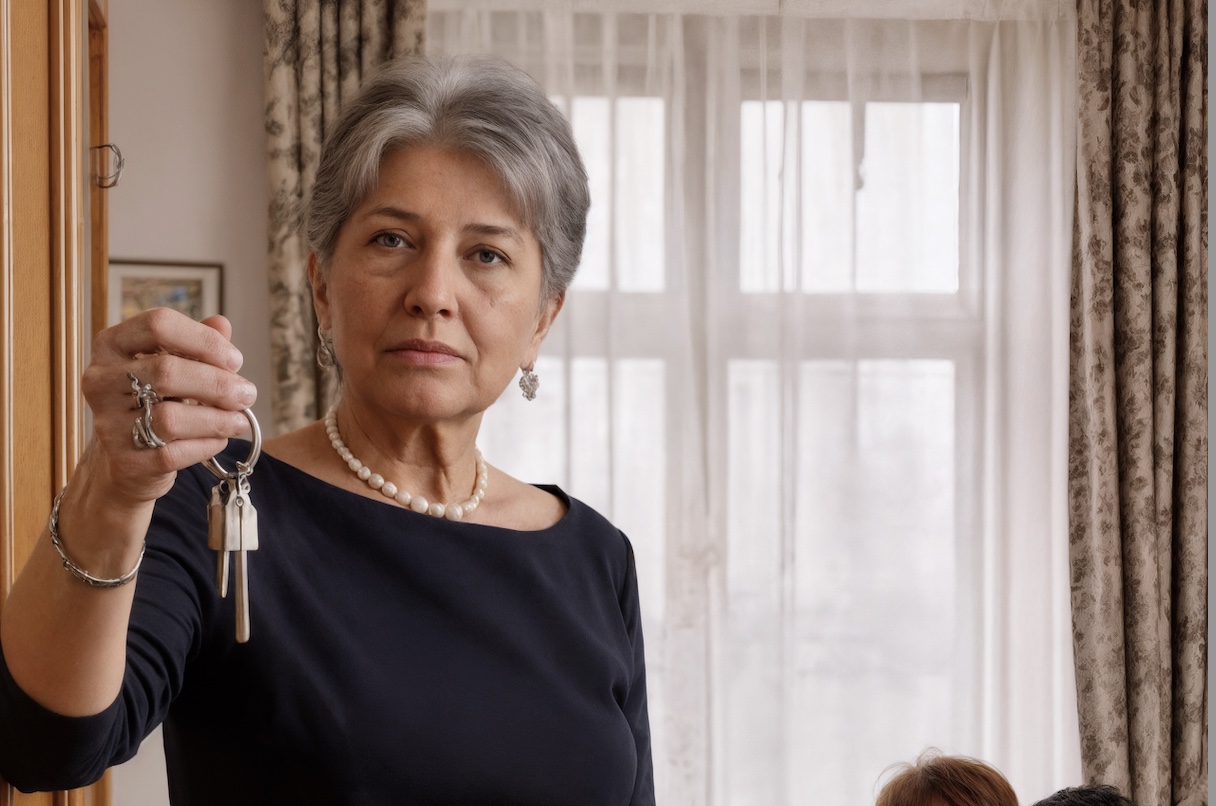
Raisa Petrovna walked into her son’s apartment without knocking, using her own key. The first thing she noticed was a couple of pillows tossed across the couch and a throw blanket crumpled on the floor.
“Another disaster!” she announced loudly, deliberately raising her voice so her daughter-in-law would hear from the bedroom. “Imagine that—she’s home all day and still can’t manage to keep the place decent!”
Lena came out of the kitchen, drying her hands on her apron. A polite smile had frozen on her face—the one she’d mastered over three years of marriage: not bright enough to look fake, but not cold enough to give Raisa Petrovna a reason to pounce.
“Hello, Raisa Petrovna. I didn’t hear the bell.”
“And why should I ring the bell at my own son’s home?” her mother-in-law snapped as she marched into the living room. With theatrical emphasis, she picked up the blanket and folded it neatly. “I have a key. Or are you trying to say I’m not allowed to come see my own child?”
Lena said nothing. She’d learned that any response would be used against her. If she agreed, she’d be admitting fault. If she protested, she’d become the “wicked daughter-in-law” who wouldn’t let a mother visit her son.
“Where’s Maksim?” Raisa Petrovna asked, settling onto the couch as if she were the owner. Then, without waiting: “I can drink tea at home. I came to talk about something serious.” She straightened, her gaze turning hard. “Sit down, Lena. We need to discuss something.”
Lena lowered herself into the armchair opposite her, instinctively sensing trouble. Over three years she’d become skilled at reading these visits—when Raisa Petrovna wasn’t here to complain about dust or criticize borscht, but came with a plan.
“I’ve been thinking about your future,” Raisa Petrovna began, and Lena tensed. Whenever her mother-in-law started “thinking about their future,” it never ended well. “You’ve been married three years, and still no children. At your age I was already raising Maksim.”
“Maksim and I decided to wait a little,” Lena said carefully. “We want to get stable first, save some money…”
“Money?” Raisa Petrovna scoffed. “What expenses do you have? You live in my apartment—you only pay utilities. Other women in your place would’ve already had three children!”
Lena bit her tongue. The apartment was indeed in Raisa Petrovna’s name, even though for the past two years Lena and Maksim had paid for everything—utilities, repairs, upgrades. Reminding her would be pointless. Raisa Petrovna was convinced she was doing them a grand favor by letting them live in “her” place.
“But that’s not the point,” she went on, her voice turning even more brisk and businesslike. “I’ve made a decision. I’m selling this apartment.”
For a second, the room seemed to tilt. Lena couldn’t process what she’d just heard.
“What? But… how… Does Maksim know?”
“I’ll tell Maksim myself—when it’s time. For now I’m discussing it with you, because as I understand it, you’re the one running the show in this family.”
The sarcasm in her tone was unmistakable. Raisa Petrovna had always accused Lena of “taking over” her son, when the truth was simply that Maksim avoided stepping into arguments between his wife and his mother.
“But why?” Lena tried to pull her thoughts together. “Where are we supposed to live?”
“That’s your problem,” Raisa Petrovna replied coolly. “Rent somewhere. Or take a mortgage. That’s what people do. I need the money. I have a right to my own personal life, too.”
Raisa Petrovna’s “personal life” was a whole story in itself. Six months earlier she’d met a man named Viktor Pavlovich, a widower with a summer cottage outside Moscow, and ever since then she talked about him nonstop. Lena suspected he was behind this sudden decision to sell.
“Raisa Petrovna,” Lena tried to keep her voice even, though everything inside her was boiling. “Let’s wait for Maksim and discuss this together. This is a serious decision…”
“There’s nothing to discuss!” her mother-in-law cut her off. “It’s my apartment—I’ll do what I want. And Maksim… my Maksim is a good son. He’ll understand. You’re the one who’s always unhappy, always wanting more!”
“I’m unhappy?” Lena finally snapped. “I’ve spent three years swallowing your insults, cooking by your recipes, cleaning by your rules—and I’m the unhappy one?”
“There!” Raisa Petrovna exclaimed triumphantly. “There’s your real face! Swallowing it, are you? And here I thought we were one family!”
Just then the front door opened, and Maksim walked in. He immediately felt the tension hanging in the air like a storm cloud.
“Mom? Lena? What’s going on?”
“Your mother decided to sell the apartment,” Lena said, looking him straight in the eyes. “And throw us out onto the street.”
“I’m not throwing anyone out!” Raisa Petrovna protested. “It’s simply time for you to live on your own. How long are you going to sit on your mother’s neck?”
Maksim’s eyes moved helplessly from his mother to his wife. It was his usual look in moments like this—the confusion of someone who doesn’t want to hurt anyone, but knows he can’t avoid it.
“Mom, but… why sell it? We live here…”
“Exactly—you live here! For free!” Raisa Petrovna sprang up from the couch. “And I have a life too, you know! Viktor Pavlovich proposed to me. We want to buy a little house by the sea, down south. And for that, I need money.”
“Viktor Pavlovich?” Maksim frowned. “Mom, you’ve only known him for six months…”
“And how long have I known you?” she shot back. “Thirty-five years? So what? Have you ever once thought about me? Ever asked how it feels for me to live alone, what I want?”
It was Raisa Petrovna’s signature move—turn the conversation into a performance of her own suffering and make herself the victim. And as always, Maksim fell right into it.
“Mom, what are you saying… Of course I think about you…”
“If you really thought about me, you’d have given me grandchildren a long time ago!” she blurted, firing a vicious look at Lena. “But your wife clearly thinks she’s too good for that!”
“That’s not true!” Lena snapped. “Maksim and I decided together to wait!”
“Together!” Raisa Petrovna waved her hand with contempt. “She’s scrambled your brain, that’s all. A normal woman at her age would’ve already had two!”
“Mom, stop,” Maksim tried weakly, but his voice got lost in the flood of accusations.
“I lived my whole life for you!” Raisa Petrovna continued, tears breaking through her voice. “I raised you alone, denied myself everything! And now that I have a chance at happiness, you want to take even that away from me!”
“No one is taking anything,” Maksim said, exhausted. “It’s just… unexpected. Give us time to think.”
“Think all you want. In a month the apartment goes on the market. I’ve already spoken to a realtor.”
With that, Raisa Petrovna headed for the door—then turned back in the doorway.
“And one more thing, Lena. Leave the keys on the dresser when you move out. I don’t want to chase you down later.”
The door slammed, leaving the couple in suffocating silence. Maksim collapsed onto the couch, burying his face in his hands. Lena sat beside him but didn’t reach for him—she knew too well that in moments like this, he disappeared into himself.
“She can’t just throw us out,” Lena finally said. “We’re registered here. We have rights.”
“It’s her apartment,” Maksim answered dully. “She can do whatever she wants.”
“But we put so much money into renovating it! Remember last year—new plumbing, new windows…”
“Lena, it doesn’t matter. She’s my mother.”
That sentence—she’s my mother—was a wall Lena’s arguments always crashed into. How many times had she heard it in three years? It meant the conversation was over, that Maksim wouldn’t challenge his mother no matter what she did.
“So what do you suggest? We pack up and leave?”
“I don’t know,” Maksim looked at her with tired eyes. “Maybe she’ll change her mind. Maybe this Viktor Pavlovich isn’t who he claims to be…”
“And if she doesn’t? If she really sells the place?”
“Then… then we’ll rent. Or take a mortgage.”
Lena stood and walked to the window. Children were playing in the courtyard below; their laughter floated up even through the double-pane windows. She thought about how they might already have children if it weren’t for the constant pressure from Raisa Petrovna. Every time they mentioned a baby, his mother started lecturing—how to raise the child, what to feed them, how to dress them. She’d already decided she’d take the grandchild every weekend, that the child would spend summers at her country house, that the baby must be named after Maksim’s late father. Lena understood that if she had a child in that apartment, she wouldn’t truly be the mother—she’d be a surrogate for Raisa Petrovna’s grandchild.
“You know,” Lena said without turning around, “maybe it’s for the best.”
“For the best?” Maksim didn’t understand.
“That we leave. That we finally start living our own life. Without your mother dropping in every day, without her keys to our home, without constant criticism.”
“Lena…”
“No—listen to me,” she turned to face him. “Three years, Maks. Three years I’ve tried to build a relationship with your mother. I cook her favorite dishes—she says it’s too salty. I clean every day—she finds dust where there is none. I buy her gifts—she’s offended I didn’t guess exactly what she wanted. I’m tired, do you hear me? Tired of always being the guilty one.”
“She’s just… she’s used to being alone,” Maksim said quietly. “It’s hard for her to accept that I got married.”
“Three years, Maks! You can get used to anything in three years. But she doesn’t want to. She wants everything the way it was—either you live with her, or at the very least your wife becomes a shadow who silently obeys her orders.”
Maksim didn’t answer. He knew Lena was right, but admitting it meant admitting something terrible about his mother… and he couldn’t even allow himself to think it.
The next day, Lena made a decision. She called her friend Ira, who worked at a law office.
“Ira, I need advice. My mother-in-law wants to sell the apartment we live in. We’re registered there, and we paid for renovations ourselves. What can we do?”
“Do you have paperwork for the renovations? Receipts, contracts?”
“Some. Not all, but some.”
“Then you might be able to go to court and claim a right to part of the property—or at least compensation. Unjust enrichment, value added through improvements… there are options. Come by and bring what you have.”
Lena gathered every receipt and invoice she could find. There were more than she expected—her habit of keeping financial documents, drilled into her by her accountant father, finally paid off. Windows—seventy thousand. Plumbing—forty-five. Stretch ceilings—thirty… The total added up to a serious amount.
“Not bad,” Ira said approvingly as she flipped through the papers. “We can work with this. But I’m warning you—it’ll be ugly. Your mother-in-law will go feral.”
“She’s already feral,” Lena said with a thin smile.
That evening she showed the documents to Maksim. He studied them for a long time, then set them down.
“You want to sue my mother?”
“I want to protect our rights. We put almost half a million rubles into this place, Maks. That’s our money—money we could’ve used as a down payment on a mortgage.”
“But she’s my mother…”
“There it is again!” Lena exploded. “Maks, your mother is ready to throw us out for some man she’s known six months! She doesn’t care about your feelings, about our future—about anything! Why are you always defending her?”
“Because she raised me alone! Because she sacrificed everything for me!”
“And now you have to sacrifice your family for her? Where’s the logic?”
They argued deep into the night and still didn’t reach an agreement. Maksim couldn’t imagine facing his mother across a courtroom, and Lena couldn’t accept being calmly shoved out of a home they’d poured money, work, and years into.
The next morning Raisa Petrovna came again—this time early, without warning. Lena had barely stepped out of the shower when she heard a key turning in the lock.
“I’m here to see what needs to be done before the viewings,” her mother-in-law said briskly, walking through the rooms. “The bathroom needs freshening up, and the kitchen walls should be repainted…”
“We renovated the bathroom last year,” Lena reminded her. “With our money.”
“So what?” Raisa Petrovna shrugged. “No one forced you. You wanted it—you did it. And if you don’t like it now, you can rip it out and take it with you.”
That was the final straw. Lena pulled out her phone and started recording.
“What are you doing?” Raisa Petrovna asked sharply.
“Documenting your words. It’ll be useful in court.”
“In what court?” her mother-in-law went pale.
“The one that will recognize our right to a portion of this apartment—or at least the value of what we вложили into it. We put nearly half a million rubles into this place, and we have the documents. So you’ll only be able to sell it with our consent.”
“You… you wouldn’t dare! Maksim will never allow it!”
“Maksim is tired of being caught between two fires,” Lena said evenly. “And if you keep pushing, he’ll have to choose. Between a mother who thinks only of herself—and a wife who’s fighting for their shared future.”
Raisa Petrovna stared at her in silence, and for the first time Lena saw not contempt in her eyes, but fear—fear of losing control, fear of losing power over her son.
“I’m offering a compromise,” Lena continued. “You leave the apartment to us, and we pay you its value over five years. Monthly—like a mortgage, only to you. Everyone gets something, and no one has to hate anyone.”
“That’s blackmail!”
“It’s a business proposal. You have a week to think about it.”
That evening Maksim came home darker than a storm cloud. His mother had called him at work, thrown a hysterical fit, accused him of betrayal, of letting his wife manipulate him.
“She was crying,” he said, staring into nothing. “She said I chose you over her.”
“And what did you say?”
“Nothing. I just listened.”
“Maks,” Lena sat beside him and took his hand. “I don’t want a war with your mother. But I want us to have our own life. I want us to make decisions ourselves, without checking with her first. I want our children to grow up in love—not in constant conflict.”
“Children?” He looked at her, surprised.
“Yes. Children. I want kids, Maks. But not here—not under your mother’s control. I want to be a mother, not a babysitter serving a grandmother.”
The week crawled by. Raisa Petrovna didn’t come, didn’t call. Maksim walked around like he was carrying a stone in his chest, torn between guilt toward his mother and the growing realization that his wife was right.
On the eighth day, an unfamiliar number called. A man’s voice introduced himself as Viktor Pavlovich.
“Are you Elena? Raisa Petrovna’s daughter-in-law?”
“Yes, that’s me.”
“I’d like to meet you. To talk about what’s happening.”
They met in a café downtown. Viktor Pavlovich turned out to be a pleasant man in his early sixties, with an intelligent gaze and a calm, approachable smile.
“I’ve heard a lot about you from Raisa,” he began. “Not all of it was flattering.”
“I can imagine,” Lena said with a short laugh.
“But I’m an experienced man—I can read between the lines. And here’s what I’ve understood: Raisa is afraid of you. Afraid of losing her son, afraid of ending up alone.”
“But she has you…”
“She does. But I can’t replace her son. And I’ll tell you something else—I don’t want her to sell the apartment at all.”
Lena raised her eyebrows, genuinely surprised.
“I have my own place, my own dacha. I don’t need her money. I asked her to move in with me, but she refused. She said she first had to ‘solve the apartment issue.’ I think this is her way of testing your husband—whether he’ll choose her or choose you.”
“It’s like kindergarten,” Lena sighed.
“I agree,” Viktor Pavlovich said. “But Raisa spent her whole life living only for her son. No hobbies, no friends, no life of her own. And now that he has a family, she feels betrayed. Abandoned.”
“But we aren’t abandoning her! We just want to live our own life!”
“I understand. And I want to help. I have a proposal.”
Viktor Pavlovich took documents from his briefcase and placed them on the table.
“This is a gift deed. Raisa transfers the apartment to Maksim, but keeps the right to live there for the rest of her life. You gain stability; she gets the security of knowing she can always return. And one more thing—I take on the responsibility of providing for Raisa’s needs. She won’t have to ask you for money. That matters to her pride.”
Lena read through the papers carefully. It was more than generous.
“Why are you doing this?”
“Because I love Raisa and I want her to be happy. And she’ll only be happy when she makes peace with her son. And with you.”
“Will she agree to this?”
“She will—if you and Maksim ask her. Not demand it. Not issue ultimatums. Ask her—as a mother. She needs to feel needed. To feel her opinion matters.”
That evening Lena told Maksim everything. He sat in silence for a long time, then finally said:
“Call Mom. Invite her to dinner. Tomorrow.”
Raisa Petrovna arrived guarded, ready for a fight. But instead of accusations and criticism, she heard something she never expected.
“Mom, forgive us,” Maksim said. “We didn’t mean to hurt you. It’s just… we’re learning too. Learning how to be a family.”
“Raisa Petrovna,” Lena added, “we want you to be part of our family—a real part. Not a supervisor, not a critic, but a loved mother and a grandmother to our future children.”
“A grandmother?” Raisa Petrovna’s eyes lifted, and tears flashed in them.
“Yes. We’re planning a baby. And we want you close to us. But being close doesn’t mean instead of us. It means with us.”
Raisa Petrovna was silent for a long time. Then she stood, walked to the window, and said without turning around:
“Viktor showed you the papers, didn’t he?”
“Yes,” Lena answered honestly.
“He’s a good man,” Raisa Petrovna said, her voice tight. “A proper man. Not like…” She waved a hand as if brushing away old pain. “I’ll sign. The apartment will be yours. But I want the right to come by. Not every day—I won’t interfere. But I need to know I can come to my son.”
“Of course, Mom,” Maksim said, stepping to her and hugging her. “You’ll always be welcome.”
“Welcome,” she repeated bitterly. “Yes, I suppose that’s the right word. A guest—not the mistress of the house.”
A month later the paperwork was signed. Raisa Petrovna moved in with Viktor Pavlovich, but she kept a key—by the terms of the agreement, she had the right. The truth was, she used it less and less. Her new life carried her away: trips, theater nights, restaurants. Viktor Pavlovich turned out to be a gentle, attentive companion.
And a year later, when Lena gave birth to a daughter, Raisa Petrovna came to the maternity ward with a huge bouquet of roses and tears in her eyes.
“Forgive me, Lenochka,” she said. “I was wrong. You’re a good wife to my son—and a good mother to my granddaughter.”
That was the beginning of a new relationship. Not perfect, not cloudless, but honest. Raisa Petrovna learned to respect the young family’s boundaries, and Lena learned to value her mother-in-law’s experience and wisdom. Maksim finally stopped being torn between the two most important women in his life.
The apartment that had once been the apple of discord became a true family nest. Photos appeared on the walls—wedding pictures, their baby’s homecoming from the hospital, the little girl’s first birthday. And in the place of honor: a picture of all of them together—Maksim, Lena, little Mashenka, Raisa Petrovna, and Viktor Pavlovich. A real family that learned not to wage war against one another, but to make agreements.
Sometimes Lena remembered the day her mother-in-law had announced she would sell the apartment. Back then it felt like a catastrophe—the end of the world. But it turned out to be a beginning. The beginning of an adult, independent life where everyone had their own place and role—and, most importantly, mutual respect, without which no family can truly be happy.